Quick Verdict: The Sensible Electric Crossover
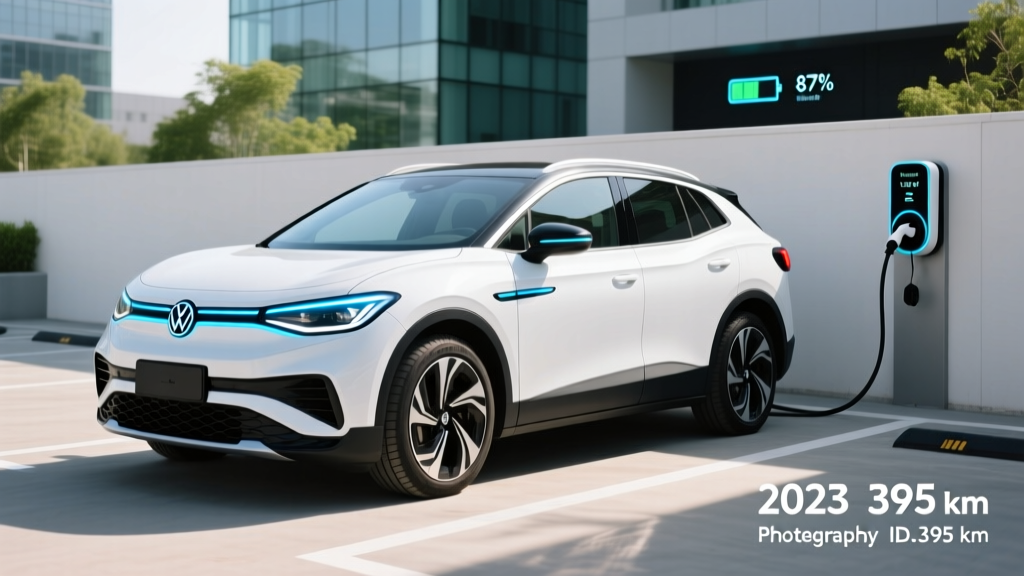
The 2023 Volkswagen ID.4 occupies a specific niche in the EV market: it's the electric crossover for buyers who want something that feels like a conventional compact SUV, happens to run on electrons, and doesn't scream "futuristic" from the outside. After VW's software struggles at launch, the 2023 model year brought meaningful improvements — faster DC charging, upgraded infotainment with a 12-inch screen, and a new entry-level Standard trim that dropped the price floor. It's not the fastest-charging or longest-range vehicle in its class, but it delivers a comfortable ride, generous cargo space, and competitive pricing that becomes even more attractive after federal incentives.
If you're cross-shopping the ID.4 against the Hyundai Ioniq 5, Tesla Model Y, or Ford Mustang Mach-E, this review gives you the exact numbers you need to make an informed decision — from real-world range expectations and charging-curve behavior to total cost of ownership and tax credit eligibility.
Range and Efficiency: What the EPA Says vs. What You'll Actually See
The 2023 ID.4 is available with two battery sizes and two drivetrain configurations, which produce different EPA range estimates:
| Trim / Config | Battery (Usable kWh) | Drivetrain | EPA Range | MPGe (Combined) | kWh/100 mi |
|---|---|---|---|---|---|
| Standard (RWD) | 62 kWh | Rear-Wheel Drive | 209 miles | 104 MPGe | 32 |
| Pro / Pro S (RWD) | 77 kWh | Rear-Wheel Drive | 275 miles | 107 MPGe | 31 |
| Pro / Pro S (AWD) | 77 kWh | Dual-Motor AWD | 255 miles | 98 MPGe | 34 |
The ID.4 uses NMC (nickel manganese cobalt) lithium-ion chemistry in both battery sizes. NMC offers higher energy density than LFP (lithium iron phosphate), which is why VW can pack 77 usable kWh into a relatively compact battery enclosure. The trade-off is that NMC batteries are generally more sensitive to sustained high states of charge and extreme temperatures compared to LFP, so VW's battery management system is conservative with buffers to protect long-term health.
Efficiency-wise, the RWD model's 107 MPGe combined is respectable for a 4,700-pound crossover, though it trails the Hyundai Ioniq 5 (114 MPGe RWD) and Tesla Model Y Long Range (122 MPGe). The dual-motor AWD version's 98 MPGe reflects the additional weight and mechanical losses of the front motor.
Charging Performance: DC Fast Charging and Home Level 2
The 2023 model year was a turning point for ID.4 charging. VW upgraded the DC fast-charge capability from the original 125 kW to 170 kW on the 77 kWh battery (Pro and Pro S trims). The Standard trim with the 62 kWh battery retains a 125 kW peak. Here's the full charging breakdown:
| Charge Level | Standard (62 kWh) | Pro / Pro S (77 kWh) | Miles Added per Hour |
|---|---|---|---|
| Level 1 (120V / 12A) | ~1.4 kW | ~1.4 kW | ~4-5 mi/hr |
| Level 2 (240V / 32A) | 7.7 kW | 7.7 kW | ~24-28 mi/hr |
| Level 2 (240V / 48A) | 11 kW | 11 kW | ~34-39 mi/hr |
| DC Fast Charge (Peak) | 125 kW | 170 kW | N/A |
| DC Fast 10-80% | ~32 minutes | ~30 minutes | N/A |
Charging-curve reality: The 170 kW peak on the 77 kWh model is not sustained across the entire 10-80% session. The ID.4 typically holds its peak rate from roughly 5% to 30% state of charge, then tapers progressively. By 60% SoC, you're seeing approximately 120-130 kW, and by 80% it drops to around 50-60 kW. This is why VW quotes a 10-80% time of roughly 30 minutes — the average rate across that window is closer to 110-120 kW, not the 170 kW peak. This is normal behavior for NMC batteries with active thermal management, but it does mean the ID.4 trails competitors like the Ioniq 5 (800V architecture, 10-80% in ~18 minutes at up to 240 kW) and the Tesla Model Y (10-80% in ~20-25 minutes at up to 250 kW on V3 Superchargers).
On Level 2 home charging, the onboard 11 kW charger is a strong point. With a 48-amp hardwired home charger (like a ChargePoint Home Flex or Wallbox Pulsar Plus), you'll add roughly 35-39 miles of range per hour, meaning a full charge from 10% to 100% takes about 7-8 hours — perfect for overnight replenishment. Note that kW (kilowatts) measures the rate of power delivery, while kWh (kilowatt-hours) measures the total energy stored in the battery — a distinction that matters when sizing your home charger.
The ID.4 uses the CCS1 connector standard for DC fast charging and the J1772 connector for Level 2 AC charging. VW includes a complimentary three-year Electrify America charging plan (unlimited 30-minute sessions) with new 2023 models, which significantly reduces public charging costs during the early ownership period.
Performance and Driving Dynamics
| Specification | Standard / Pro (RWD) | Pro S AWD |
|---|---|---|
| Motor Configuration | Single rear motor | Dual motor (front + rear) |
| Horsepower | 201 hp | 295 hp |
| Torque | 229 lb-ft | 339 lb-ft |
| 0-60 mph | ~7.7 seconds | ~5.4 seconds |
| Top Speed | 99 mph (electronically limited) | 112 mph |
| Towing Capacity | 2,200 lbs (with factory hitch) | 2,700 lbs (with factory hitch) |
The RWD ID.4 is tuned for comfort, not sportiness. The 201 hp rear motor provides adequate acceleration for merging and passing, but it won't pin you back in your seat. The 5.4-second 0-60 time on the AWD Pro S is genuinely quick for a family crossover and makes highway merging effortless. The dual-motor system can send torque to the front axle in as little as 100 milliseconds when traction is needed, though the ID.4 is not designed for serious off-road use.
Ride quality is where the ID.4 earns strong marks. The MEB platform's low center of gravity and well-tuned suspension absorb bumps with a planted, composed feel that outperforms its price point. Steering is light and predictable — ideal for city driving and parking — though it lacks the feedback that driving enthusiasts might want. The turning circle of 31.5 feet is excellent for a crossover of this size, thanks to the rear-motor layout freeing up front-wheel steering angle.
Regenerative braking deserves specific mention: the ID.4 offers adjustable regen through the gear selector (D for coasting, B for stronger regen), but it does not offer true one-pedal driving that brings the car to a complete stop. You'll still need the brake pedal at low speeds and stops. This is a deliberate VW design choice, and opinions on it are divided — some drivers appreciate the natural coasting feel, while others accustomed to one-pedal driving in a Tesla or Nissan Leaf find it frustrating.
Interior, Cargo, and Technology
The ID.4's interior prioritizes space and simplicity over luxury materials. Soft-touch surfaces appear on the dashboard and door uppers, but hard plastics are more prevalent than in a Hyundai Ioniq 5 or Kia EV6. The minimalist design philosophy means very few physical buttons — most functions are controlled through the touchscreen or capacitive touch sliders.
Passenger and Cargo Dimensions:
- Front headroom: 41.1 inches
- Front legroom: 41.1 inches
- Rear headroom: 38.4 inches
- Rear legroom: 37.6 inches
- Cargo volume (rear seats up): 30.3 cu ft
- Cargo volume (rear seats folded): 64.2 cu ft
- No frunk: The ID.4 does not have a front trunk. The space under the hood houses electronics and the cabin HVAC system.
The 30.3 cubic feet behind the second row is competitive with the segment — the Model Y offers 30.2 cu ft (plus a small frunk), and the Ioniq 5 provides 27.2 cu ft. Fold the 60/40 split rear seats and the 64.2 cu ft total is generous for weekend trips, furniture runs, or two large dogs.
Infotainment and Tech: The 2023 ID.4 upgraded to a 12-inch touchscreen (up from the 10-inch on 2021-2022 models) running VW's ID. Software 3.0. Key features include:
- Wireless Apple CarPlay and Android Auto
- Wireless phone charging pad (Pro S and above)
- Over-the-air software updates
- Voice control with "Hello ID." wake word
- Heads-up display with augmented-reality navigation (Pro S)
- IQ.DRIVE suite: adaptive cruise control, lane-keeping assist, travel assist (Level 2 driver assistance), front assist with automatic emergency braking, and Park Assist Plus with memory parking
The infotainment system was the ID.4's most-criticized feature at launch. The 2023 software update improved responsiveness and menu logic, but it still lags behind Tesla's interface in speed and intuitiveness. The capacitive touch sliders for volume and temperature remain a frustration point — they're unlit at night and lack tactile feedback. VW addressed this partially in later model years, but for the 2023, it's a notable ergonomic drawback.
Driver Assistance (SAE Level 2): The IQ.DRIVE Travel Assist system combines adaptive cruise control with lane-centering for hands-on-wheel highway driving. It's a competent Level 2 system — meaning the driver must remain attentive and keep hands on the wheel at all times. It is not a self-driving or "eyes-off" system. Performance is reliable on well-marked highways, but it can be hesitant in construction zones and on faded lane markings.
Pricing, Trim Levels, and Federal Tax Credit
| Trim | Drivetrain | Base MSRP | Key Features |
|---|---|---|---|
| Standard | RWD (62 kWh) | $38,995 | 12" screen, heated seats, IQ.DRIVE, 209-mi range |
| Pro | RWD (77 kWh) | $43,995 | 275-mi range, 170 kW DC charging, panoramic roof option |
| Pro S | RWD (77 kWh) | $48,495 | Panoramic roof, power liftgate, heated steering, 20" wheels |
| Pro S Plus | AWD (77 kWh) | $52,795 | Dual-motor AWD, 295 hp, top-tier features |
Federal Tax Credit (§30D) Eligibility: The 2023 VW ID.4 qualifies for the federal EV tax credit, but the exact amount depends on battery sourcing requirements, your income, and the vehicle's MSRP. According to IRS guidelines, the credit is split into two halves:
- $3,750 for meeting the critical minerals requirement
- $3,750 for meeting the battery component sourcing requirement
The ID.4's battery is manufactured in a VW plant, and for the 2023 model year, VW confirmed the ID.4 meets at least the battery component requirement, qualifying for a minimum $3,750 credit. Whether it also meets the critical minerals threshold (and thus the full $7,500) depends on the specific production batch and sourcing documentation. Buyers should verify eligibility with their dealer at the time of purchase.
- MSRP Cap: The ID.4 is classified as an SUV, so the MSRP cap is $80,000. All trims qualify.
- Buyer Income Cap: Modified AGI must not exceed $150,000 (single), $225,000 (head of household), or $300,000 (joint filers).
- Point-of-Sale Transfer: As of 2024, buyers can transfer the credit to the dealer at purchase, reducing the out-of-pocket cost immediately rather than waiting for a tax refund. This applies retroactively to eligible 2023 purchases made after the rule took effect.
- Battery Sourcing: Requirements tighten annually. Confirm with your dealer which half (or both) the specific vehicle qualifies for.
After a $3,750-$7,500 credit, the ID.4 Standard effectively starts around $31,495-$35,245, and the popular Pro S RWD drops to roughly $40,995-$44,745. This positions the ID.4 competitively against the base Model Y ($43,990 before credit) and the Ioniq 5 SE ($41,450 before credit).
Warranty and Long-Term Ownership
| Coverage | Term |
|---|---|
| New Vehicle Limited Warranty | 4 years / 50,000 miles |
| Battery Pack Warranty | 8 years / 100,000 miles (70% capacity retention) |
| Powertrain Warranty | 4 years / 50,000 miles |
| Roadside Assistance | 3 years / 36,000 miles |
| Corrosion Perforation | 7 years / 100,000 miles |
VW guarantees the ID.4's high-voltage battery will retain at least 70% of its original capacity over 8 years or 100,000 miles — whichever comes first. This is the industry-standard threshold shared by most automakers. Real-world NMC degradation data from early ID.4 owners suggests roughly 3-5% capacity loss over the first 40,000-50,000 miles, with degradation slowing significantly after the initial break-in period. To maximize battery longevity, VW recommends setting the daily charge limit to 80% and only charging to 100% for longer trips.
One ownership cost to budget for: EV insurance premiums. The ID.4 typically costs 15-25% more to insure than a comparable gas-powered VW Tiguan due to higher repair costs for battery and structural components. Get quotes from your insurer before committing to the purchase.
Pros, Cons, and Who Should Buy
Pros
- Comfortable, quiet ride quality
- Generous rear-seat and cargo space (30.3 cu ft)
- Tight turning circle for easy city maneuvering
- Competitive pricing after tax credit
- Free Electrify America charging for 3 years
- 11 kW onboard charger for fast home replenishment
- Strong IIHS safety ratings (Top Safety Pick+)
Cons
- DC fast charging slower than Ioniq 5 and Model Y
- Infotainment still lags behind competitors in responsiveness
- Capacitive touch sliders lack tactile feedback and night illumination
- No one-pedal driving (regen doesn't bring car to full stop)
- No front trunk (frunk)
- AWD towing limited to 2,700 lbs
- Hard plastics more prevalent than rivals
Who the 2023 VW ID.4 Suits Best
Choose the ID.4 if: You want a comfortable, spacious electric crossover for daily commuting and family duty. You have home Level 2 charging and prioritize ride comfort over sporty handling. You value a traditional SUV aesthetic over a futuristic design. You live in a moderate climate where the 275-mile EPA range is achievable year-round.
Look elsewhere if: You need the fastest DC charging for frequent road trips (consider the Ioniq 5). You want a tech-forward interior with best-in-class infotainment (consider the Model Y). You need serious towing capacity (the ID.4 tops out at 2,700 lbs — the F-150 Lightning or Rivian R1S handle far more). You regularly drive in sub-freezing temperatures and need maximum range (the RWD AWD range penalty plus cold-weather loss may push you toward a longer-range option).
Frequently Asked Questions
What is the real-world range of the 2023 VW ID.4?
The RWD Pro/Pro S with the 77 kWh battery has an EPA-estimated 275 miles. In real-world mixed driving at moderate temperatures, expect 245-265 miles. Sustained highway driving at 75 mph reduces this to roughly 235-250 miles. In cold weather below 30°F, plan for 190-220 miles on a full charge.
How fast does the 2023 ID.4 charge?
On DC fast charging, the 77 kWh model peaks at 170 kW and charges from 10-80% in approximately 30 minutes. On a 48-amp Level 2 home charger, it charges at up to 11 kW, adding roughly 35-39 miles of range per hour. A full home charge from 10% takes about 7-8 hours.
How much does the 2023 VW ID.4 cost after tax credits?
Base MSRP ranges from $38,995 (Standard RWD) to $52,795 (Pro S Plus AWD). With a $3,750-$7,500 federal tax credit (depending on battery sourcing eligibility and your income), effective prices start around $31,495-$35,245 for the Standard trim and $40,995-$44,745 for the popular Pro S RWD.
Is the 2023 ID.4 worth buying vs. the competition?
It depends on your priorities. The ID.4 wins on ride comfort, turning circle, and value after incentives. The Hyundai Ioniq 5 charges faster and has a more modern interior. The Tesla Model Y offers longer range, faster charging, and a superior software experience. The Ford Mustang Mach-E is sportier to drive. The ID.4 is the "sensible sedan" of electric crossovers — it won't wow you in any single category, but it's well-rounded and comfortable.
Does the 2023 VW ID.4 qualify for the $7,500 federal EV tax credit?
The ID.4 qualifies for at least $3,750 of the §30D federal tax credit (battery component requirement met). Full $7,500 eligibility depends on critical mineral sourcing, which varies by production batch. Eligibility also requires buyer income below $150K/$225K/$300K thresholds (single/HOH/joint). The MSRP cap for SUVs is $80,000 — all ID.4 trims fall well below this. Always verify with your dealer and consult a tax professional for your specific situation. See IRS.gov for current rules.
What is the battery warranty on the ID.4?
VW covers the high-voltage battery for 8 years or 100,000 miles, guaranteeing at least 70% capacity retention over that period. This is the industry-standard warranty threshold.
Can I tow with the 2023 ID.4?
Yes, with the factory-installed hitch: the RWD model is rated for 2,200 lbs, and the AWD model for 2,700 lbs. This is adequate for a small utility trailer, bike rack, or light camper, but it's not suitable for boat towing or large travel trailers.