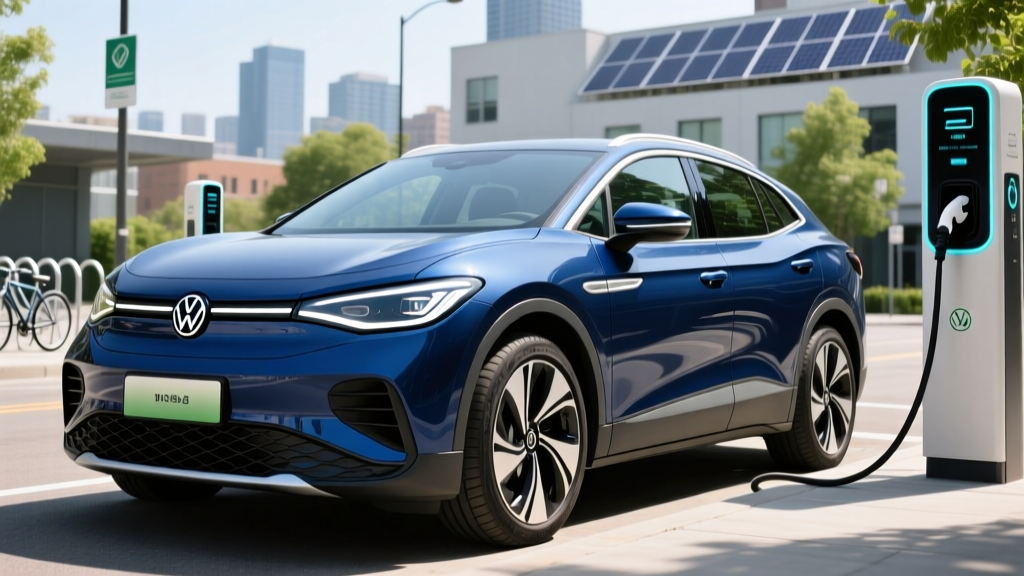
Quick Verdict: The ID.4 Pro S as a Pragmatic Electric Crossover
The 2023 VW ID.4 Pro S occupies a specific niche: a mainstream, family-oriented electric crossover that prioritizes comfort and practicality over performance theatrics. With an EPA-estimated 275 miles of range (RWD), a usable 77 kWh battery pack, and a starting MSRP that positioned it squarely against the Hyundai Ioniq 5 and Ford Mustang Mach-E, the Pro S trim adds premium touches like panoramic glass roof, heated seats, and VW's IQ.DRIVE suite. For buyers shopping the used or certified-pre-owned market in 2026, the 2023 model year represents a sweet spot — it received the larger 82 kWh battery upgrade over the 2021-2022 models and the 170 kW DC fast-charging capability that earlier US-spec ID.4s lacked.
This review breaks down every number that matters for ownership decisions, from real-world highway range to the charging curve taper that VW doesn't advertise on the window sticker.
Range, Battery & Efficiency: What the EPA Number Doesn't Tell You
| Specification | Pro S (RWD) | Pro S (AWD) |
|---|---|---|
| EPA Estimated Range | 275 miles | 255 miles |
| Battery Pack (Gross / Usable) | 82 kWh / 77 kWh | 82 kWh / 77 kWh |
| Battery Chemistry | NMC (Nickel Manganese Cobalt) | NMC (Nickel Manganese Cobalt) |
| MPGe (City / Hwy / Combined) | 104 / 93 / 99 | 100 / 87 / 94 |
| Energy Consumption | 34 kWh/100 mi | 36 kWh/100 mi |
| Drivetrain | Rear-Wheel Drive (single motor) | All-Wheel Drive (dual motor) |
The EPA 275-mile sticker on the RWD Pro S is achievable in mixed city/suburban driving at moderate temperatures. On sustained highway trips at 70-75 mph, expect 230-250 miles before needing to stop. In cold weather (below 32°F), range drops to approximately 195-220 miles due to cabin heating demands and reduced battery efficiency — even with the ID.4's standard heat pump. The AWD Pro S sacrifices about 20 miles of EPA range for the traction benefit, landing at 255 miles EPA and roughly 215-230 miles real-world highway.
The 5 kWh buffer (82 kWh gross vs. 77 kWh usable) protects long-term battery health by preventing deep discharge and overcharge at the cell level, per fueleconomy.gov battery management documentation.
The NMC chemistry in the ID.4 delivers higher energy density than LFP alternatives, which is how VW packages 82 kWh into a crossover this size. The trade-off: NMC cells are more sensitive to sustained 100% state-of-charge storage. For daily driving, VW recommends setting the charge limit to 80% and only charging to full for road trips — a practice that meaningfully extends long-term battery health.
Charging Speed: DC Fast Charge, Level 2 & the Curve Reality
| Charging Level | Power / Rate | Time or Miles Added |
|---|---|---|
| DC Fast Charge (Peak) | 170 kW (CCS) | 10-80% in ~30 minutes |
| DC Fast Charge (Sustained Avg) | ~110-120 kW avg | 10-80% realistic: ~34 min |
| Level 2 (240V, 48A) | 11.5 kW onboard charger | ~33 miles of range per hour |
| Level 2 (240V, 32A) | 7.7 kW | ~22 miles of range per hour |
| Level 1 (120V, 12A) | 1.4 kW | ~4 miles of range per hour |
The 2023 ID.4 Pro S peaks at 170 kW on DC fast chargers — a meaningful upgrade from the 125 kW cap on 2021-2022 US models. At a 350 kW Electrify America station (VW's affiliated network, which includes 3 years of complimentary charging on the 2023 model), the ID.4 can add roughly 70% of its battery in about 30 minutes under ideal thermal conditions.
Here's the charging-curve reality that spec sheets omit: the 170 kW peak only holds between roughly 10-30% state of charge. From 30-50%, the rate tapers to approximately 130-140 kW. From 50-80%, it drops further to 80-100 kW. This means the average sustained rate over a 10-80% session is closer to 110-120 kW. If you arrive at a charger with a cold battery (below 60°F), expect even slower speeds unless you've used the navigation-based battery preconditioning feature, which warms the pack en route to a planned charging stop.
For home charging, the 11.5 kW onboard charger is competitive. On a 48-amp Level 2 circuit (requiring a 60-amp breaker), a full overnight charge takes roughly 7 hours from near-empty — more than sufficient for daily replenishment. Most ID.4 owners install a 32-amp or 48-amp ChargePoint or EVgo-compatible wall unit for $500-$800 in equipment plus electrician labor.
Performance & Driving Dynamics
| Metric | Pro S (RWD) | Pro S (AWD) |
|---|---|---|
| Horsepower | 201 hp | 295 hp |
| Torque | 229 lb-ft | 339 lb-ft |
| 0-60 mph | ~7.7 seconds | ~5.4 seconds |
| Top Speed | 99 mph (electronically limited) | 112 mph |
| Towing Capacity | 2,200 lbs (with factory hitch) | 2,700 lbs (with factory hitch) |
The RWD Pro S is adequate rather than exciting. The 201 hp single rear motor provides smooth, linear acceleration that feels quicker than the 7.7-second 0-60 time suggests, thanks to instant electric torque. Highway merging and passing are confident. Where the RWD model shines is efficiency — it's the range-maximizing choice for buyers in mild climates who don't need all-wheel traction.
The AWD Pro S adds a front induction motor for 295 hp combined, dropping the 0-60 to a genuinely quick 5.4 seconds. The dual-motor setup also enables a more sophisticated traction control system for snow and rain. The trade-off is 20 miles of EPA range and a roughly $3,800 price premium over RWD at MSRP.
Ride quality is a genuine strength. The ID.4's MEB platform delivers a low center of gravity and well-damped suspension that absorbs road imperfections better than many competitors in this price segment. Cabin noise levels at highway speed are impressively low — VW invested heavily in sound insulation and acoustic glass for the US market.
Interior Space, Cargo & Practicality
The ID.4 Pro S is sized as a compact crossover, competing directly with the Toyota RAV4 and Honda CR-V in footprint but offering superior interior volume thanks to the flat-floor EV architecture.
- Cargo volume (behind rear seats): 30.3 cu ft
- Cargo volume (rear seats folded): 64.2 cu ft
- Front headroom: 41.1 inches
- Rear headroom: 38.4 inches
- Front legroom: 40.9 inches
- Rear legroom: 37.6 inches
- Frunk (front trunk): None — the ID.4 does not offer a front storage compartment, unlike the Ford Mach-E or Hyundai Ioniq 5
The absence of a frunk is a notable miss in this segment. VW used the front space for power electronics and the HVAC system. For families, the 30.3 cu ft rear cargo area comfortably fits two large suitcases plus a stroller. The 60/40 split rear seats fold nearly flat for longer items. The Pro S trim adds a power liftgate and adjustable cargo floor.
Tech, Infotainment & Driver Assistance
The Pro S trim includes VW's 12-inch touchscreen infotainment system (up from 10 inches on the base Pro), wireless Apple CarPlay and Android Auto, a 5.3-inch digital instrument cluster, and wireless phone charging. The infotainment system runs VW's ID.Software 3.x, which received multiple over-the-air updates through 2024-2025 to address early complaints about laggy response and confusing menu structures.
The touch-sensitive steering wheel controls and capacitive climate slider below the screen remain divisive — they lack haptic feedback and can be imprecise while driving. This is one of the ID.4's most-cited ergonomic frustrations.
IQ.DRIVE suite (Level 2 driver assistance):
- Travel Assist (adaptive cruise + lane centering) — functional up to 95 mph
- Front Assist (automatic emergency braking with pedestrian detection)
- Lane Assist (lane-keeping)
- Blind-spot monitor with rear cross-traffic alert
- Park Assist Plus (semi-automated parking)
VW's Travel Assist is an SAE Level 2 driver-assistance system, per SAE International. This means the driver must remain fully engaged — hands on or near the wheel, eyes on the road — at all times. It is not autonomous or "self-driving." The system provides steering, acceleration, and braking support but does not handle construction zones, complex merges, or adverse weather independently.
Pricing, Trims & Federal Tax Credit Eligibility
| Trim | MSRP (at launch) | Key Additions Over Base Pro |
|---|---|---|
| ID.4 Pro (RWD) | $43,995 | Base trim, 10" screen, cloth seats |
| ID.4 Pro S (RWD) | $47,295 | 12" screen, panoramic roof, heated seats, leatherette |
| ID.4 Pro S (AWD) | $51,095 | Dual-motor AWD, 295 hp, same Pro S features |
| ID.4 Pro S Plus (RWD) | $50,795 | Gradient package, 20" wheels, premium audio |
Destination charge added $1,220 to all trims. As-tested pricing for a well-equipped Pro S AWD with metallic paint typically landed between $52,000-$53,500 before incentives.
Federal Tax Credit (§30D) — Current Rules
For the 2023 model year when new, the ID.4 qualified for up to $7,500 in federal tax credits — $3,750 for critical minerals sourcing and $3,750 for battery component manufacturing, subject to IRS §30D requirements. As of 2026, used 2023 ID.4 models may qualify for the up-to-$4,000 used EV credit (30% of sale price, capped at $4,000) if purchased from a dealer, priced at or below $25,000, and the buyer meets income thresholds.
- Used EV credit income caps: $75,000 single / $112,500 head of household / $150,000 joint (modified AGI)
- Vehicle price cap (used credit): $25,000 maximum sale price
- Vehicle age requirement: At least 2 model years old (2023 qualifies in 2026)
- Point-of-sale transfer: Available for both new and used credits — the dealer applies the credit as a down payment reduction rather than requiring you to wait for tax filing
Verify current eligibility at IRS.gov clean vehicle credits before purchasing, as battery-sourcing and critical-mineral requirements update annually.
Warranty & Long-Term Battery Outlook
| Coverage | Term |
|---|---|
| Bumper-to-Bumper (Limited) | 4 years / 50,000 miles |
| Powertrain | 4 years / 50,000 miles |
| High-Voltage Battery | 8 years / 100,000 miles (capacity retention ≥70%) |
| Roadside Assistance | 4 years / 50,000 miles |
| Corrosion Perforation | 7 years / 100,000 miles |
VW's 8-year/100,000-mile battery warranty guarantees that the high-voltage pack will retain at least 70% of its original usable capacity. If degradation drops below that threshold within the warranty period, VW will repair or replace the battery at no cost. This is industry-standard, matching the federal minimum mandated by the EPA for emissions-related components and aligning with competitors like Hyundai (10yr/100k), Ford (8yr/100k), and Tesla (8yr/100k-120k depending on model).
Real-world NMC degradation data from early ID.4 owners (2021-2022 models now at 3-4 years of use) suggests approximately 5-8% capacity loss at 40,000-60,000 miles when following best practices (80% daily charge limit, avoiding frequent DC fast charging above 90%). The 77 kWh usable buffer means even 10% degradation still leaves roughly 248 miles of original 275-mile range — well within the 70% warranty floor.
Who the 2023 ID.4 Pro S Is For — And Who Should Look Elsewhere
- You want a comfortable, quiet daily-driver crossover with adequate (not thrilling) performance
- Your typical commute is under 80 miles round-trip with home Level 2 charging
- You value ride quality and low cabin noise over sporty handling
- You need 30+ cu ft of cargo space for family gear without stepping up to a 3-row SUV
- You're buying used/CPO in 2026 and want to capture the up-to-$4,000 used EV credit
- You want the fastest charging in the segment — the Hyundai Ioniq 5 peaks at 240 kW (800V architecture) vs. the ID.4's 170 kW
- You need a frunk for additional cargo flexibility (Ford Mach-E, Ioniq 5 both offer one)
- You want the longest EPA range — the Tesla Model Y Long Range delivers 330 miles EPA
- You prioritize cutting-edge infotainment — VW's capacitive controls and software remain a weak point vs. Tesla and Hyundai
- You tow heavy — 2,700 lbs max (AWD) trails the F-150 Lightning and Rivian R1S significantly
Pros & Cons at a Glance
Pros
- Comfortable, quiet ride quality that punches above its price class
- Spacious interior with 30.3 cu ft cargo and generous rear legroom
- Competitive 275-mile EPA range (RWD) for the segment
- 170 kW DC fast charging is a major upgrade over 2021-2022 models
- 3 years of complimentary Electrify America charging (from new)
- Heat pump standard — better cold-weather efficiency than many competitors
- Strong safety ratings: IIHS Top Safety Pick+ for 2023
Cons
- No front trunk (frunk) — a glaring omission in 2023
- Capacitive touch controls on steering wheel and climate are frustrating
- Infotainment software, while improved, still lags behind Tesla/Hyundai UX
- Charging speed (170 kW peak) trails Ioniq 5 (240 kW) and Porsche-based platforms
- AWD range penalty is steeper than some dual-motor competitors
- No one-pedal driving mode — regen doesn't bring the car to a full stop
- Rear drum brakes (regenerative-assisted) feel unusual to traditional-car buyers
Frequently Asked Questions
What is the real-world range of the 2023 VW ID.4 Pro S?
The EPA rates the RWD Pro S at 275 miles and the AWD at 255 miles. In real-world highway driving at 70-75 mph, expect 230-250 miles (RWD) or 215-230 miles (AWD). Cold weather below freezing reduces range by roughly 20-25%, bringing the RWD down to approximately 195-220 miles. City driving with regenerative braking often matches or slightly exceeds the EPA estimate.
How fast does the 2023 ID.4 Pro S charge?
On DC fast chargers, it peaks at 170 kW with a 10-80% charge time of approximately 30 minutes under ideal conditions (warm battery, low state of charge on arrival). Real-world 10-80% sessions average 32-36 minutes due to charge-curve tapering above 50% SoC. At home on a 48-amp Level 2 charger, it adds roughly 33 miles of range per hour (11.5 kW), fully replenishing the 77 kWh usable battery in about 7 hours.
Does the 2023 VW ID.4 qualify for the federal EV tax credit in 2026?
As a used vehicle in 2026, the 2023 ID.4 may qualify for the up-to-$4,000 used clean vehicle credit (30% of sale price, max $4,000) if the dealer sale price is $25,000 or below and the buyer's modified AGI falls within IRS income caps ($75K single / $150K joint). The original $7,500 new-vehicle credit is no longer applicable for a 2023 model purchased in 2026. Always verify current rules at IRS.gov before purchasing.
Is the 2023 ID.4 Pro S worth buying vs. the Hyundai Ioniq 5 or Tesla Model Y?
It depends on your priorities. The ID.4 Pro S wins on ride comfort, cabin quietness, and value on the used market. The Ioniq 5 charges faster (240 kW peak, 800V architecture) and has a frunk. The Model Y offers longer range (330 mi EPA Long Range), a more advanced software ecosystem, and Supercharger network access. If comfort and daily usability matter more than charging speed or tech, the ID.4 is a strong choice — especially at depreciated 2026 used pricing.
What are the biggest problems with the 2023 VW ID.4?
The most commonly reported issues are software-related: infotainment lag, occasional screen freezes (largely addressed by OTA updates through 2024-2025), and the frustrating capacitive touch controls. The lack of a frunk and the absence of true one-pedal driving are design choices that frustrate some EV-experienced drivers. Mechanically, the ID.4 has proven reliable with no widespread battery or drivetrain defect campaigns as of early 2026.
How much does it cost to charge the ID.4 Pro S at home?
At the US average residential electricity rate of ~$0.16/kWh (per EIA data), fully charging the 77 kWh usable battery from empty costs approximately $12.32. For a typical daily commute consuming 25 kWh, expect about $4.00 per day in electricity — roughly equivalent to $1.20-$1.50 per gallon of gasoline. Annual home charging costs for 12,000 miles of driving run approximately $650-$750 depending on local rates.