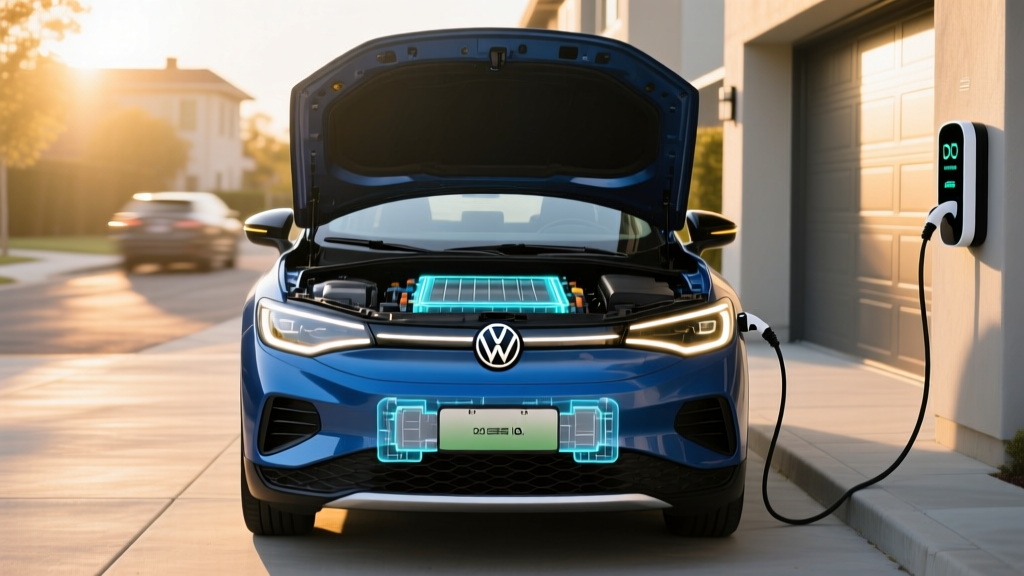
The 2023 Volkswagen ID.4 arrived at a pivotal moment for mainstream EV adoption. Positioned as a practical, family-oriented electric crossover, it undercuts many rivals on price while offering competitive range and Volkswagen's first dedicated EV platform sold at scale in the United States. Now that the 2023 model year has been on roads for a few years, we have solid data on real-world efficiency, charging behavior, and ownership quirks. Here is everything you need to know before buying one new-old-stock or on the used market in 2026.
Specs at a Glance: 2023 Volkswagen ID.4
| Specification | Pro / Pro S (RWD) | Pro S / Pro S Plus (AWD) |
|---|---|---|
| EPA Range | 275 mi | 255 mi |
| Battery (usable) | 82 kWh (NMC) | 82 kWh (NMC) |
| Horsepower | 201 hp | 295 hp |
| 0–60 mph | ~7.7 sec | ~5.4 sec |
| Drivetrain | RWD (single motor) | AWD (dual motor) |
| MPGe (combined) | 104 MPGe | 97 MPGe |
| Efficiency | 32 kWh/100 mi | 35 kWh/100 mi |
| Max DC Fast Charge | 170 kW | 170 kW |
| 10–80% DC Charge | ~30 min | ~30 min |
| Level 2 Home Charge | 11 kW (~37 mi/hr) | 11 kW (~37 mi/hr) |
| Cargo (behind rear seats) | 30.3 cu ft | 30.3 cu ft |
| Cargo (seats folded) | 64.2 cu ft | 64.2 cu ft |
| Rear Legroom | 37.6 in | 37.6 in |
| Base MSRP | $38,995 (Std) | $46,795 (Pro S Plus) |
| Battery Warranty | 8 yr / 100,000 mi | 8 yr / 100,000 mi |
Source: EPA fueleconomy.gov
Battery, Chemistry, and What 82 kWh Actually Means
The 2023 ID.4 uses an 82 kWh usable (91 kWh gross) lithium-ion battery pack with NMC (nickel manganese cobalt) chemistry. NMC offers higher energy density than LFP (lithium iron phosphate), which is why VW can package this much capacity in a compact crossover footprint. The trade-off: NMC batteries are more sensitive to sustained high states of charge and extreme heat, so VW recommends daily charging to 80% and using 100% only for long trips.
The pack sits low in the MEB platform chassis, contributing to a flat floor and generous interior volume. Thermal management is liquid-cooled and liquid-heated, which helps preserve battery health and enables preconditioning for faster DC charging in cold weather. VW's battery warranty guarantees the pack will retain at least 70% of its original capacity over 8 years or 100,000 miles, whichever comes first — a fairly standard threshold among mainstream EV makers.
Charging Speed: DC Fast, Level 2, and the Curve Reality
The ID.4's peak DC fast-charging rate is 170 kW on a CCS1 connector. That peak is achievable when the battery is preconditioned and at a low state of charge (around 5–10%). Here is what the actual charging experience looks like:
- 10–80% in approximately 30 minutes at a 170+ kW station (Electrify America, EVgo, etc.)
- Peak rate sustains from roughly 5% to 30% SoC, then tapers progressively — by 70% SoC you will see ~80–100 kW, and above 85% it drops below 50 kW
- Level 2 (240V home charging): 11 kW onboard charger adds roughly 37 miles of range per hour, meaning a full 0–100% charge takes about 8–9 hours on a 48-amp Level 2 home station
- Level 1 (120V standard outlet): ~1.2 kW, adding about 3–4 miles per hour — viable only for emergency trickle charging or very low daily mileage
The 170 kW peak is competitive but not class-leading. The Hyundai Ioniq 5 peaks at 240 kW (with its 800V architecture), and the Tesla Model Y on V3 Superchargers can hit 250 kW. In practice, the ID.4's 30-minute 10–80% time is perfectly adequate for road-trip rest stops, but if you regularly drive 300+ mile routes, the taper above 80% means topping off the last 20% takes disproportionately long — plan your stops accordingly.
Connector note: The 2023 ID.4 uses the CCS1 standard. VW has announced future models will transition to NACS (Tesla's connector), but 2023 models require a CCS-to-NACS adapter for Tesla Supercharger access. VW provides three years of complimentary Electrify America charging (typically 600 kWh) with new purchases, though availability for remaining new-old-stock 2023 units should be confirmed with your dealer.
Performance and Drivetrain: Adequate, Not Thrilling
The rear-wheel-drive ID.4 produces 201 hp and 229 lb-ft of torque from a single rear-mounted permanent-magnet motor. The 0–60 mph time of roughly 7.7 seconds is perfectly adequate for merging and passing but won't win any stoplight races. The instant torque delivery makes it feel quicker around town than the number suggests.
The dual-motor AWD variant bumps output to 295 hp and 339 lb-ft, cutting the 0–60 time to approximately 5.4 seconds. This is the version to choose if you regularly drive in snow, tackle steep grades, or simply want more confident highway merging. The AWD system adds a front AC induction motor that disengages during light-load cruising to preserve efficiency.
Ride quality is a genuine strength. The ID.4 is tuned for comfort over sportiness, with compliant suspension that absorbs road imperfections well. The turning circle is surprisingly tight at 31.5 feet (RWD), making it maneuverable in urban environments. Steering is light and numb — this is a family hauler, not a driver's car.
Interior, Tech, and Daily Livability
The cabin is minimalist in a way that divides opinion. Materials are mostly soft-touch plastics with a few harder surfaces on lower door panels. The 12-inch touchscreen (10-inch on base Standard trim) runs VW's ID. Software 3.0, which was significantly improved over the launch-year 2021 version. Wireless Apple CarPlay and Android Auto are standard.
Notable tech features include:
- IQ.DRIVE suite: adaptive cruise control with stop-and-go, lane centering, travel assist (Level 2 driver assist — not self-driving; hands must remain on the wheel)
- Augmented-reality head-up display (Pro S and above) that overlays navigation arrows onto the road view
- Heated steering wheel and front seats (standard on Pro S)
- Panoramic fixed glass roof with shade (Pro S and above)
- ID. Light — a thin LED strip along the windshield base that pulses for navigation prompts and incoming calls
The biggest daily-living complaint from owners: the capacitive touch sliders for climate and volume. They lack backlighting on 2023 models (VW added backlighting for 2024), making them difficult to see at night. The touch-sensitive steering wheel controls also draw criticism for accidental inputs.
Cargo space is generous: 30.3 cubic feet behind the rear seats and 64.2 cubic feet with the 60/40 split seats folded. There is no front trunk (frunk) — the space under the hood houses electronics. Rear legroom of 37.6 inches comfortably fits adults on longer trips.
Pricing, Trims, and Federal Tax Credit Eligibility
The 2023 ID.4 launched with aggressive pricing that undercut the Model Y and Ioniq 5. Here is the original MSRP structure (destination included):
| Trim | Drivetrain | MSRP |
|---|---|---|
| Standard | RWD | $38,995 |
| Pro | RWD | $40,295 |
| Pro S | RWD | $43,795 |
| Pro S | AWD | $45,295 |
| Pro S Plus | AWD | $46,795 |
Federal tax credit (§30D): The 2023 ID.4 qualifies for the full $7,500 federal EV tax credit for eligible buyers, subject to IRS rules. Key eligibility requirements per irs.gov:
- MSRP cap: SUVs must be under $80,000 — all ID.4 trims qualify
- Buyer income cap: Modified AGI must not exceed $150,000 (single), $225,000 (head of household), or $300,000 (joint filing)
- Battery sourcing: For 2023, the ID.4's battery components and critical minerals met the phase-in thresholds for the full credit (VW confirmed North American and allied-nation sourcing compliance)
- Point-of-sale transfer: Starting January 1, 2024, buyers can transfer the credit to the dealer for an immediate price reduction. For 2023 purchases, the credit was claimed on your tax return (Form 8936)
With the credit, the effective price of a Pro RWD drops to approximately $32,795 — exceptional value for a 275-mile electric crossover. Consult a tax professional to confirm your personal eligibility.
Pros and Cons: Honest Ownership Assessment
Pros
- Competitive pricing, especially after $7,500 credit
- Comfortable ride quality and quiet cabin
- Generous cargo and rear passenger space
- Tight turning circle for urban maneuverability
- Standard IQ.DRIVE safety suite
- 3 years complimentary Electrify America charging
- Solid 8-year/100,000-mile battery warranty
Cons
- 170 kW DC charging trails Hyundai/Kia/Tesla rivals
- Unlit capacitive touch sliders (2023 models)
- No front trunk (frunk)
- Infotainment software still slower than competitors
- RWD 0–60 time is merely adequate (7.7 sec)
- Regen braking is mild — no true one-pedal driving mode
- CCS1 connector requires adapter for Tesla Superchargers
Who Should Buy the 2023 ID.4?
Best for: Families and commuters who prioritize comfort, interior space, and value over cutting-edge charging speed or performance. If your daily drive is under 60 miles and you can charge at home, the ID.4's real-world range is more than sufficient, and the effective post-credit pricing makes it one of the most affordable electric crossovers on the market.
Less ideal for: Frequent long-distance road trippers who want the fastest possible DC charging (consider the Ioniq 5 or Model Y), or drivers in extremely cold climates who need every mile of range (the AWD version's 255-mile EPA rating drops significantly below freezing). If you rely on the Tesla Supercharger network exclusively, the CCS1 connector adds friction until you acquire an adapter.
Towing note: The AWD ID.4 is rated to tow 2,700 lbs (braked), sufficient for a small utility trailer or a pair of dirt bikes but not a full-size camper. The RWD model is rated at 2,200 lbs.
Frequently Asked Questions
What is the real-world range of the 2023 Volkswagen ID.4?
The EPA rates the RWD model at 275 miles and the AWD at 255 miles. In real-world highway driving at 70–75 mph, expect 230–250 miles (RWD) or 215–235 miles (AWD). Cold weather below freezing can reduce range by 20–30%, so winter highway range may drop to 190–220 miles for the RWD variant. Preconditioning the battery and using seat/steering wheel heaters instead of cabin heat can help mitigate cold-weather losses.
How fast does the ID.4 charge at home and on the road?
On a DC fast charger rated at 170+ kW, the ID.4 charges from 10–80% in approximately 30 minutes, with peak rates sustained in the lower state-of-charge range and tapering above 70%. At home on a Level 2 (240V, 48-amp) station, the 11 kW onboard charger adds roughly 37 miles of range per hour, fully replenishing the battery in about 8–9 hours. A standard 120V outlet adds only 3–4 miles per hour.
Does the 2023 ID.4 qualify for the $7,500 federal EV tax credit?
Yes, the 2023 ID.4 qualifies for the full $7,500 federal tax credit under IRS §30D, provided the buyer meets income limits ($150K single / $300K joint MAGI) and the vehicle MSRP is under the $80,000 SUV cap — all trims clear this. Battery sourcing requirements for 2023 were met. For purchases made in 2023, the credit was claimed on your federal tax return. Always verify current eligibility with a tax professional and consult IRS guidance.
Is the 2023 ID.4 worth buying over the Tesla Model Y or Hyundai Ioniq 5?
It depends on priorities. The ID.4 wins on value — especially post-credit — and ride comfort. The Model Y wins on charging infrastructure (Supercharger network), software, and efficiency. The Ioniq 5 wins on DC charging speed (240 kW peak) and retro-futuristic design. If budget is paramount and you charge primarily at home, the ID.4 is an excellent choice. If road-trip charging convenience is critical, the Model Y's network advantage is significant.
How reliable is the 2023 ID.4's software?
VW's ID. Software 3.0, which runs on 2023 models, is a marked improvement over the buggy launch software in 2021–2022 models. Response times are quicker, and most early bugs (random logouts, screen freezes) have been addressed through over-the-air updates. It still trails Tesla and Hyundai/Kia in interface speed and polish, but it is functional and stable for daily use. Wireless CarPlay/Android Auto mitigates most infotainment frustrations.
What does long-term battery degradation look like?
Based on fleet data from European ID.4 models (on sale since 2020) and VW's NMC cell supplier testing, degradation is tracking within expectations: roughly 5–8% capacity loss over the first 60,000 miles, then leveling off. VW's warranty guarantees at least 70% capacity retention at 8 years/100,000 miles. To maximize longevity, charge to 80% for daily use, avoid frequent DC fast charging when Level 2 is available, and use preconditioning in extreme temperatures.