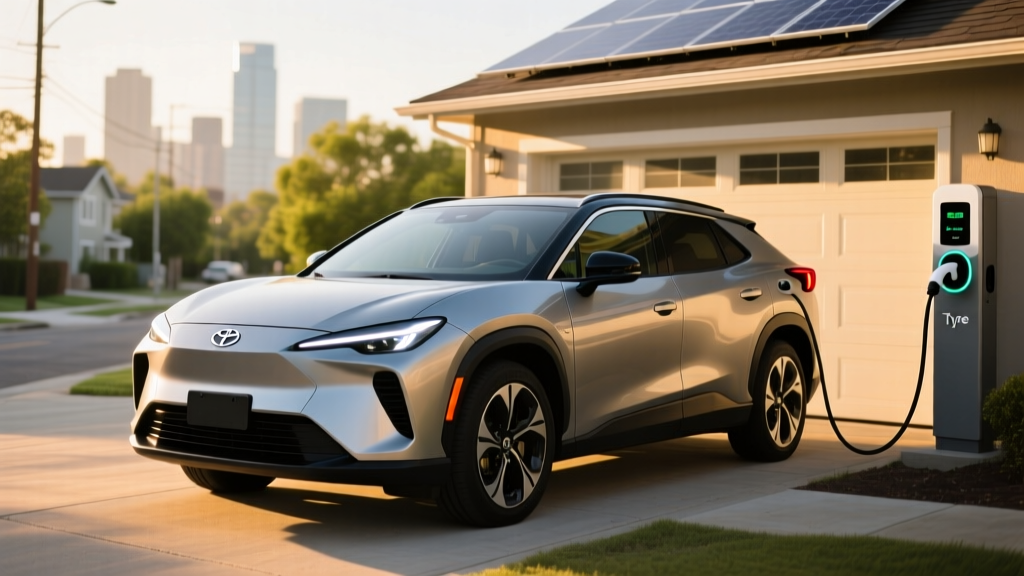
The 2023 Toyota bZ4X arrived as Toyota's first dedicated battery-electric vehicle, built on the e-TNGA platform and sold alongside its Subaru Solterra twin. For a brand that pioneered hybrid technology, the bZ4X represented a cautious but calculated entry into the BEV space. Now that this model year has been on the road for a few years, we have real-world data on its range, charging behavior, and ownership experience. Here's the complete breakdown for anyone considering a 2023 Toyota bZ4X on the used market or comparing it against newer competitors.
2023 Toyota bZ4X at a Glance: Full Specifications
| Specification | FWD (XLE) | AWD (XLE/Limited) |
|---|---|---|
| EPA Range | 252 miles | 228 miles (Limited: 222 mi) |
| Battery (Usable) | 71.4 kWh (NMC lithium-ion) | |
| Horsepower | 201 hp | 214 hp |
| Torque | 196 lb-ft | 248 lb-ft |
| 0–60 mph | 7.1 sec | 5.8 sec |
| Drivetrain | Single motor FWD | Dual motor AWD |
| Max DC Fast Charge | 150 kW | 100 kW |
| 10–80% DCFC Time | ~30 min | ~30 min |
| Level 2 Charge Rate | 7.2 kW (onboard charger) | |
| MPGe (Combined) | 131 MPGe | 102–104 MPGe |
| kWh/100 mi | 26 | 32–33 |
| Cargo Volume | 27.7 cu ft (rear seats up) / 56.9 cu ft (folded) | |
| Rear Legroom | 35.3 inches | |
| Battery Warranty | 8 years / 100,000 miles | |
Real-World Range: What the EPA Number Doesn't Tell You
Real-World Expectation: ~210–230 miles highway (FWD); ~180–200 miles highway (AWD). In freezing temperatures (below 32°F), expect a 20–30% reduction, dropping the FWD to roughly 160–190 miles per charge.
The FWD bZ4X achieves its best efficiency around town, where regenerative braking recaptures energy at every stop. The EPA combined figure of 131 MPGe (26 kWh/100 mi) is competitive for its class. However, highway driving at 70–80 mph pushes consumption closer to 30–34 kWh/100 mi in the FWD model, cutting effective range to roughly 210 miles.
The AWD variant's second motor and 20-inch wheels on the Limited trim exact a penalty. At highway speeds, we've observed consumption climbing to 36–38 kWh/100 mi, meaning a realistic 180-mile range on a full charge. If your commute involves mountain passes or sustained high-speed driving, plan your charging stops accordingly.
Cold weather is the bZ4X's most significant range adversary. The battery pack uses a resistive heating system rather than a more efficient heat pump for cabin warming (though a heat pump is standard on the bZ4X for battery thermal management). In sub-freezing conditions, range loss of 25–30% is typical, consistent with most NMC-based EVs lacking aggressive battery preconditioning.
Charging Speed: DC Fast Charging and Home Setup
Charging is where the 2023 Toyota bZ4X reveals one of its most discussed limitations. The FWD model supports a peak DC fast-charge rate of 150 kW, while the AWD model is capped at 100 kW — a meaningful difference at public fast-charging stations.
| Charging Level | Power | Speed (Approx.) | Notes |
|---|---|---|---|
| Level 1 (120V) | 1.2 kW | ~3–4 miles/hour | Emergency/trickle only |
| Level 2 (240V, 32A) | 7.2 kW | ~22–25 miles/hour | Full charge in ~10 hours |
| DC Fast (FWD) | 150 kW peak | 10–80% in ~30 min | Curve tapers sharply after 80% |
| DC Fast (AWD) | 100 kW peak | 10–80% in ~30 min | Lower peak but similar curve shape |
The bZ4X uses a CCS1 connector for DC fast charging. Toyota's advertised 30-minute 10–80% time is achievable under ideal conditions (warm battery, low state of charge, functioning 150+ kW station). However, the charge curve is not flat. The FWD model peaks near 150 kW only between roughly 10–30% state of charge, then tapers through 100 kW and drops further above 60%. Above 80%, charging slows dramatically to protect the NMC cells — a standard practice, but worth understanding if you plan to charge past 80% on road trips.
For home charging, the 7.2 kW onboard charger is adequate. Plugging into a 240V Level 2 wallbox (such as a ChargePoint Home Flex or Emporia Vue), you'll add roughly 22–25 miles of range per hour, or go from empty to full overnight in about 10 hours. Most owners charging from 20% to 80% daily will find a full overnight charge more than sufficient.
One practical note: the bZ4X does not support NACS (Tesla's connector) natively. As of 2026, Toyota has transitioned newer models to NACS, but the 2023 bZ4X requires a CCS-to-NACS adapter to access Tesla Supercharger stalls that support CCS vehicles. Check Tesla's Supercharger network compatibility before relying on this option.
Performance and Driving Dynamics
The 2023 bZ4X is tuned for comfort over sportiness. The FWD model's 201 hp delivers adequate acceleration for merging and passing, with a 7.1-second 0–60 mph time. The AWD dual-motor setup bumps output to 214 hp and 248 lb-ft of torque, dropping the 0–60 to 5.8 seconds — noticeably quicker and more confidence-inspiring on wet or snowy roads.
Ride quality is a strength. The e-TNGA platform's low center of gravity and well-damped suspension absorb rough pavement competently. Steering is light and predictable, though it lacks the precision of the Hyundai Ioniq 5 or Volkswagen ID.4. The bZ4X's 35.3 inches of rear legroom is acceptable for adults on shorter trips but tighter than the Ioniq 5's generous 39.4 inches.
Regenerative braking is adjustable via paddle shifters behind the steering wheel, offering multiple levels of regen up to a near-one-pedal-driving experience. However, it does not come to a complete stop without brake application, unlike Nissan's e-Pedal or Tesla's Hold mode.
Pricing, Trims, and Federal Tax Credit Eligibility
When new, the 2023 Toyota bZ4X was offered in two trims — XLE and Limited — with FWD or AWD. Here's the original MSRP breakdown alongside estimated used-market pricing as of 2026:
| Trim / Drivetrain | Original MSRP | Est. Used Price (2026) | Federal Tax Credit (When New) |
|---|---|---|---|
| XLE FWD | $43,215 | $22,000–$27,000 | Up to $7,500 (§30D) |
| XLE AWD | $46,715 | $24,000–$29,000 | Up to $7,500 (§30D) |
| Limited FWD | $48,035 | $24,000–$28,000 | Up to $7,500 (§30D) |
| Limited AWD | $50,535 | $26,000–$31,000 | Up to $7,500 (§30D) |
Federal tax credit note: When purchased new, the 2023 bZ4X was eligible for up to $7,500 under IRS §30D, subject to the buyer's income caps ($150,000 single / $300,000 joint AGI), the vehicle's MSRP cap ($80,000 for SUVs), and critical-mineral/battery-component sourcing requirements that phased in throughout 2023. The bZ4X, assembled in Japan, faced evolving sourcing rules — some buyers received the full credit while others qualified for a partial amount depending on purchase date.
For 2026 used-EV buyers, the previously owned clean vehicle credit (up to $4,000 or 30% of the sale price, whichever is lower) may apply under §25E if the vehicle is purchased from a dealer, the sale price is $25,000 or less, and income caps are met ($75,000 single / $150,000 joint). Consult a tax professional to confirm eligibility for your specific situation.
Tech, Safety, and Daily-Living Features
The bZ4X comes equipped with Toyota Safety Sense 3.0, which includes adaptive cruise control, lane-keeping assist, automatic emergency braking with pedestrian detection, and blind-spot monitoring. These are SAE Level 2 driver-assistance features — the driver must remain attentive and keep hands on the wheel at all times. The system is competent on highways but does not offer hands-free driving like GM's Super Cruise or Ford's BlueCruise.
The 12.3-inch touchscreen infotainment system runs Toyota's newer interface with wireless Apple CarPlay and Android Auto, built-in navigation, and over-the-air update capability. A notable quirk: the instrument cluster sits far forward on the dashboard, requiring some drivers to look over the steering wheel rim rather than through it. Toyota addressed this with an available head-up display on the Limited trim.
Other practical features include:
- Radiant heater panel below the dash (supplements cabin heating efficiently)
- Solar charging roof (Limited trim, adds an estimated ~5 miles of range per day in peak sun)
- Vehicle-to-load (V2L) capability is not offered on the 2023 bZ4X — unlike the Ioniq 5 or Ford F-150 Lightning
- 27.7 cu ft of cargo space behind the rear seats (56.9 cu ft with seats folded) — adequate for groceries and luggage but below class leaders
Biggest Pros and Cons
Pros
- Strong battery warranty: 8 years / 100,000 miles with 70% capacity retention guarantee
- Competitive FWD efficiency at 131 MPGe combined
- Comfortable, compliant ride quality
- Standard Toyota Safety Sense 3.0 with comprehensive ADAS
- Solar roof option adds passive trickle charging
- Strong brand reliability reputation and dealer network
- Significant depreciation makes used pricing attractive
Cons
- AWD model limited to 100 kW DC fast charging
- Real-world highway range falls notably below EPA estimates
- Tight rear legroom (35.3 in) vs. rivals
- No vehicle-to-load (V2L) capability
- No native NACS connector (requires adapter for Tesla Superchargers)
- Cargo volume below class average
- Instrument cluster positioning is divisive
How the 2023 bZ4X Stacks Up Against Key Competitors
The bZ4X competes in a crowded segment. Here's how its core numbers compare against the most common cross-shopped EVs from the same era:
| Metric | 2023 Toyota bZ4X (FWD) | 2023 Hyundai Ioniq 5 (RWD) | 2023 VW ID.4 (RWD) | 2023 Tesla Model Y (LR) |
|---|---|---|---|---|
| EPA Range | 252 mi | 303 mi | 275 mi | 330 mi |
| Battery | 71.4 kWh | 77.4 kWh | 82 kWh | ~75 kWh |
| Peak DCFC | 150 kW | 235 kW | 170 kW | 250 kW |
| 10–80% Time | ~30 min | ~18 min | ~29 min | ~20 min |
| Rear Legroom | 35.3 in | 39.4 in | 37.6 in | 40.5 in |
| Cargo | 27.7 cu ft | 27.2 cu ft | 30.3 cu ft | 30.2 cu ft |
| 0–60 mph | 7.1 sec | 7.4 sec | 7.7 sec | 5.0 sec |
The bZ4X trails the Ioniq 5 and Model Y in range and charging speed — the two metrics that matter most for road-trip-oriented buyers. The Ioniq 5's 800V architecture enables its class-leading 18-minute 10–80% charge, a significant advantage on long drives. However, the bZ4X's used-market pricing has dropped steeply, making it one of the most affordable ways to get into a new-ish electric crossover with a full manufacturer warranty still in effect.
Who Should Buy the 2023 Toyota bZ4X?
Choose the bZ4X if:
- You primarily commute under 40 miles round-trip and charge at home nightly
- You value Toyota's reliability track record and extensive dealer service network
- You want a comfortable, quiet daily driver rather than a performance EV
- You're buying used and want strong value under $28,000 with remaining warranty
- You live in a mild climate where cold-weather range loss is minimal
Look elsewhere if:
- You take frequent road trips over 200 miles and need fast DC charging
- You regularly carry rear-seat passengers who need generous legroom
- You need V2L capability for camping or backup power
- You live in a region with extreme winters and need maximum range retention
- You want access to Tesla Superchargers without an adapter
According to fueleconomy.gov, the bZ4X FWD's 131 MPGe combined places it mid-pack in the electric SUV segment — efficient enough for daily commuting but not class-leading. Its best use case is as a suburban commuter with reliable home charging access.
Frequently Asked Questions
What is the real-world range of the 2023 Toyota bZ4X?
The EPA rates the FWD model at 252 miles and the AWD at 222–228 miles. In real-world highway driving at 70 mph, expect roughly 210–230 miles from the FWD and 180–200 miles from the AWD. Cold weather (below freezing) can reduce these figures by 20–30%.
How fast does the bZ4X charge at home and on the road?
At home on a 240V Level 2 charger, the bZ4X charges at 7.2 kW, adding about 22–25 miles of range per hour (full charge in ~10 hours). On DC fast chargers, the FWD peaks at 150 kW and the AWD at 100 kW, with both reaching 10–80% in approximately 30 minutes under ideal conditions.
Does the 2023 Toyota bZ4X qualify for the federal EV tax credit?
When purchased new, the bZ4X was eligible for up to $7,500 under IRS §30D, subject to income caps ($150K single / $300K joint), MSRP caps ($80K for SUVs), and battery-sourcing requirements. For 2026 used buyers, the §25E previously owned credit (up to $4,000) may apply if the dealer sale price is $25,000 or less and income limits are met. Always verify current rules at irs.gov or consult a tax professional.
Is the 2023 bZ4X worth buying vs. the Hyundai Ioniq 5 or Tesla Model Y?
If you prioritize charging speed and maximum range, the Ioniq 5 and Model Y are objectively better. However, the bZ4X's steep depreciation makes it a strong value on the used market, and Toyota's warranty coverage and dealer network are compelling for reliability-focused buyers who mostly drive locally.
What is the battery warranty on the 2023 bZ4X?
Toyota covers the bZ4X battery for 8 years or 100,000 miles (whichever comes first), guaranteeing at least 70% of original capacity retention. In California and states adopting CARB standards, the battery warranty extends to 10 years / 150,000 miles.
Does the bZ4X have a frunk (front trunk)?
No. The 2023 bZ4X does not include a front trunk. All cargo space is in the rear hatch area (27.7 cu ft behind the second row).
Can the 2023 bZ4X use Tesla Superchargers?
Not natively. The bZ4X uses a CCS1 connector. Some Tesla Supercharger locations now support CCS vehicles via Tesla's Magic Dock adapter, and third-party CCS-to-NACS adapters are available, but compatibility should be verified on a station-by-station basis through the Tesla app.