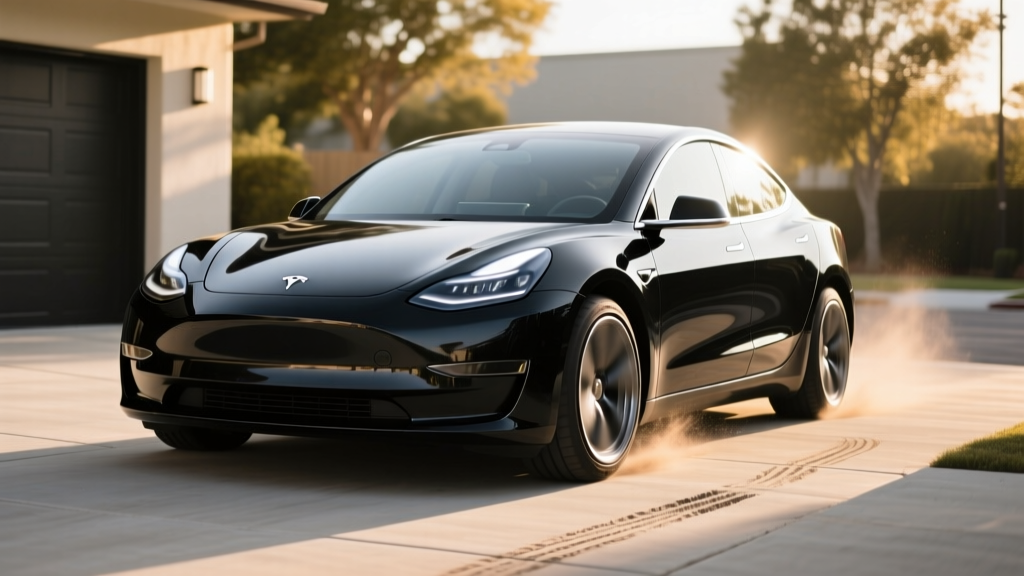
The Baseline EV Sedan: 2023 Model 3 RWD at a Glance
The 2023 Tesla Model 3 Rear-Wheel Drive (RWD) served as Tesla's entry point into the electric sedan market before the "Highland" refresh arrived late that year. With a 5.8-second 0-60 mph time, EPA-estimated 272 miles of range, and a sub-$40,000 sticker price before incentives, it became the volume seller in the lineup. For buyers evaluating used 2023 examples or comparing them against the refreshed 2024+ Model 3, understanding the exact performance envelope — especially the 0-60 sprint, real-world range, and charging behavior — is essential.
This profile covers the pre-refresh 2023 Model 3 RWD with the lithium iron phosphate (LFP) battery pack. Specs, pricing, and tax credit details reflect the vehicle as originally sold and its standing in the 2026 used-EV market.
| Spec | Value |
|---|---|
| EPA Range | 272 miles |
| Battery (usable) | ~57.5 kWh (LFP chemistry) |
| 0-60 mph | 5.8 seconds |
| Horsepower | 283 hp |
| Drivetrain | Rear-Wheel Drive (single motor) |
| Top Speed | 140 mph |
| MPGe (combined) | 132 MPGe |
| Efficiency | 25 kWh/100 mi |
| Max DC Fast Charge | 170 kW peak |
| 10-80% DC Fast Charge | ~30 minutes |
| Level 2 Home Charge Rate | 11.5 kW (~44 mi/hr) |
| Cargo Volume | 23 cu ft (trunk + frunk combined) |
| Rear Legroom | 35.2 inches |
| Battery Warranty | 8 years / 100,000 miles (70% retention) |
| Original Base MSRP | $38,990 (before destination) |
0-60 mph and Performance: What 5.8 Seconds Feels Like
The 2023 Model 3 RWD hits 60 mph from a standstill in 5.8 seconds, per Tesla's official figures and independently verified by multiple automotive testers. That time places it squarely in the territory of sporty gas-powered compact sedans — roughly on par with a Volkswagen GTI or a base BMW 330i — but with the instantaneous torque delivery unique to electric motors.
The single rear-mounted permanent magnet motor produces 283 horsepower and approximately 302 lb-ft of torque. Because there's no transmission to shift, acceleration is linear and uninterrupted from 0 through highway speeds. The RWD layout also contributes to a more engaging driving feel compared to the dual-motor Long Range and Performance variants, which trade some steering feedback for all-weather traction.
In real-world driving, the 0-60 time holds up well even with partial battery charge. Unlike internal combustion engines that lose power at altitude or when the battery is low, electric motors maintain consistent torque output down to roughly 20% State of Charge (SoC), after which Tesla's software begins to limit peak power to protect the battery.
Real-World Range vs. the EPA Sticker
Real-World Expectation: 230–255 miles in mixed driving; 200–220 miles sustained highway at 75+ mph; 170–195 miles in freezing temperatures with cabin heat.
The EPA's 272-mile estimate for the 2023 Model 3 RWD assumes a mix of city and highway driving at moderate temperatures. In practice, range varies significantly based on speed, climate, and terrain.
City and suburban driving is where the LFP Model 3 shines. Regenerative braking recaptures energy at every stop, and the car's low-speed efficiency is excellent. Drivers who commute at 35–55 mph routinely report 260–280 miles on a full charge, sometimes exceeding the EPA sticker.
Highway driving at 70–80 mph is where range drops most noticeably. Aerodynamic drag increases with the square of speed, and the Model 3's efficiency falls to roughly 28–30 kWh/100 mi at 75 mph. Expect 200–220 miles of real range on a flat interstate run at those speeds, per data aggregated from owner logs on platforms like fueleconomy.gov.
Cold weather (below 32°F) introduces the largest penalty. The LFP battery's internal resistance increases in cold temperatures, and cabin heating draws significant energy (the 2023 RWD uses a heat pump, which helps, but resistive heating still loads the pack). Owners in northern climates report 170–195 miles of usable range in sub-freezing conditions — a 25–35% reduction from the EPA figure.
Charging Speeds: DC Fast, Level 2, and the LFP Curve
Charging behavior is one of the most consequential differences between the RWD's LFP battery and the Long Range's NMC pack. Understanding the charge curve is critical for road-trip planning.
| Charging Level | Power / Rate | Miles Added per Hour | Notes |
|---|---|---|---|
| Level 1 (120V household) | ~1.4 kW | ~5 mi/hr | Emergency/trickle only |
| Level 2 (240V, 48A) | 11.5 kW | ~44 mi/hr | Full charge in ~6 hours |
| DC Fast Charge (peak) | 170 kW | — | Peak rate at low SoC, warm battery |
| DC Fast Charge (10–80%) | ~30 minutes | — | Sustained average ~100–110 kW |
DC fast charging on the 2023 RWD peaks at 170 kW, but only under ideal conditions: battery preconditioned via navigation to a Supercharger, SoC below 20%, and moderate ambient temperature. The LFP charge curve is relatively flat through the mid-range, then tapers sharply above 80%. Most road-trip charging sessions will average 100–110 kW across the 10–80% window, making the ~30-minute estimate realistic.
Level 2 home charging at 11.5 kW (48 amps on a 60-amp circuit) adds roughly 44 miles of range per hour. A full 0–100% charge takes approximately 6 hours. Tesla recommends charging LFP packs to 100% at least once per week to maintain cell balancing and accurate SoC estimation — a key difference from NMC packs, which prefer an 80% daily limit.
One LFP advantage: you can charge to 100% daily without the accelerated degradation concerns that apply to NMC chemistry. This effectively gives you the full 272-mile EPA range for daily use, whereas Long Range owners typically set an 80% daily limit (~280 of 358 miles).
Pricing, Tax Credits, and 2026 Used-Market Value
When new, the 2023 Model 3 RWD carried a base MSRP of $38,990 plus a $1,390 destination fee, totaling $40,380 before incentives. In the 2026 used market, well-maintained examples with 25,000–40,000 miles typically list between $22,000 and $27,000 depending on condition, color, and Autopilot configuration.
| Item | Amount |
|---|---|
| Original Base MSRP | $38,990 |
| Destination Fee | $1,390 |
| Enhanced Autopilot (option) | $6,000 |
| Full Self-Driving Capability (option) | $12,000 (2023 pricing) |
| Federal §30D Credit (new, if eligible) | Up to $7,500 |
| Used EV Credit (§25E, 2026) | Up to $4,000 (30% of sale price, max $4,000) |
| 2026 Used Market Range | $22,000–$27,000 |
Federal tax credit for new purchases (2023): The Model 3 RWD qualified for the full $7,500 §30D credit for eligible buyers in 2023, subject to the buyer's adjusted gross income caps ($150,000 single / $300,000 joint) and the vehicle's MSRP falling under the $55,000 sedan cap. Battery sourcing and critical mineral requirements phased in during 2023, and the RWD's LFP cells (sourced from CATL in China) faced evolving eligibility rules throughout the year. Always verify current rules at IRS.gov.
Used EV credit (§25E) in 2026: Buyers purchasing a used 2023 Model 3 RWD from a licensed dealer may qualify for up to $4,000 (30% of the sale price, capped at $4,000) under the Previously-Owned Clean Vehicles Credit. Income caps apply ($75,000 single / $150,000 joint), and the vehicle must be purchased for $25,000 or less to maximize the credit. This makes a $24,000 used example effectively $20,000 after the point-of-sale transfer — a compelling value proposition.
Interior, Tech, and Daily Livability
The 2023 Model 3's cabin follows Tesla's minimalist philosophy: a single 15-inch landscape touchscreen handles all infotainment, climate, and vehicle controls. There is no instrument cluster — speed and navigation appear in the upper-left corner of the main display. The steering wheel houses scroll wheels and buttons, but turn signals remain on the traditional stalk (unlike the post-refresh Highland model, which moved them to the wheel).
Cargo space totals approximately 23 cubic feet: 19.8 cu ft in the trunk (which opens as a hatchback, improving usability) and 3.1 cu ft in the frunk. Rear legroom measures 35.2 inches — adequate for adults on shorter trips but tight for anyone over six feet tall on longer rides. The rear seat cushion sits low due to the floor-mounted battery, creating a "knees-up" seating position that some passengers find uncomfortable.
Tech highlights:
- Basic Autopilot included (Traffic-Aware Cruise Control + Autosteer) — SAE Level 2 driver assistance requiring constant supervision
- Over-the-air software updates add features post-purchase
- Sentry Mode (dashcam-based security recording)
- Tesla Supercharger network access (most reliable DC fast-charging network in North America)
- Native route planning with automatic battery preconditioning for Supercharger stops
Notable drawbacks:
- No Apple CarPlay or Android Auto
- Rear visibility is compromised by the sloping roofline and small rear window
- Ride quality on the 18-inch aero wheels is firm; road noise is noticeable on rough pavement
- Panel gaps and paint quality were inconsistent on 2023 Fremont-built examples
- Lack of physical buttons for climate and wipers can be distracting while driving
Pros
- 132 MPGe combined — one of the most efficient EVs sold
- LFP battery tolerates daily 100% charging
- Access to Tesla Supercharger network
- Low maintenance costs (no oil, minimal brake wear)
- Strong safety ratings (IIHS Top Safety Pick+)
- Over-the-air updates keep software current
Cons
- 272-mile EPA range is modest vs. Long Range (358 mi)
- 170 kW peak DC charge is slower than competitors at 250–350 kW
- Rear seat comfort is limited for tall passengers
- No smartphone integration (CarPlay/Android Auto)
- Cold-weather range loss is significant on LFP packs
- Build quality inconsistencies on pre-refresh models
How It Compares: Model 3 RWD vs. Key Alternatives
In the 2026 used market, the 2023 Model 3 RWD competes against several compelling alternatives:
- 2023 Hyundai Ioniq 6 SE Standard Range: EPA 240 mi, 250 kW DC charging (via 800V architecture), more comfortable rear seat, but smaller dealer/service network and no CarPlay at launch.
- 2023 Chevrolet Bolt EUV: EPA 247 mi, far cheaper ($18,000–$21,000 used), but slower DC charging (~55 kW peak) and discontinued after 2023.
- 2023 Tesla Model 3 Long Range AWD: EPA 358 mi, 250 kW DC charging, dual-motor AWD, 4.2-second 0-60 — but $5,000–$8,000 more on the used market and NMC battery requires 80% daily charge limit.
The RWD's strongest advantage is efficiency and the Supercharger network. Its weakest link relative to competitors is the 170 kW DC charge ceiling — Hyundai/Kia's 800V vehicles charge from 10–80% in roughly 18 minutes, compared to the Model 3 RWD's ~30 minutes.
Who Should Buy the 2023 Model 3 RWD?
Choose the 2023 Model 3 RWD if:
- You commute 40–80 miles round-trip and can charge at home nightly
- You prioritize efficiency and low running costs over maximum range
- You want Supercharger network access for occasional road trips
- You prefer the simplicity of RWD and don't need AWD for snow
- You want to charge to 100% daily without long-term degradation concerns
Look elsewhere if:
- You regularly drive 200+ miles between charging stops (consider Long Range)
- You live in a cold climate and need maximum winter range
- You prioritize fast DC charging for frequent road trips (consider Ioniq 6 or 2024+ Highland)
- You need a comfortable rear seat for adult passengers regularly
Frequently Asked Questions
What is the real-world range of the 2023 Tesla Model 3 RWD?
Expect 230–255 miles in mixed driving conditions, 200–220 miles at sustained highway speeds of 75 mph, and 170–195 miles in sub-freezing temperatures. The EPA sticker reads 272 miles, but that reflects a moderate-speed, moderate-temperature test cycle.
How fast does it charge at home and on the road?
On a 240V Level 2 home charger (48A), the Model 3 RWD charges at up to 11.5 kW, adding roughly 44 miles of range per hour — a full charge takes about 6 hours. On DC fast chargers, it peaks at 170 kW and takes approximately 30 minutes to go from 10% to 80% State of Charge.
Does the 2023 Model 3 RWD qualify for a federal tax credit in 2026?
As a used vehicle, it may qualify for the §25E Previously-Owned Clean Vehicles Credit — up to $4,000 (30% of sale price) if purchased from a dealer for $25,000 or less, subject to buyer income caps ($75,000 single / $150,000 joint). Verify current eligibility at IRS.gov. When new in 2023, it was eligible for up to $7,500 under §30D, depending on battery sourcing rules in effect at time of delivery.
Is the LFP battery a concern for longevity?
LFP (lithium iron phosphate) batteries generally exhibit slower degradation than NMC chemistry and tolerate frequent 100% charges. Tesla warranties the battery for 8 years or 100,000 miles, whichever comes first, guaranteeing at least 70% capacity retention. Real-world data from high-mileage LFP Tesla owners suggests 10–12% degradation over 100,000 miles is typical.
How does the 5.8-second 0-60 time compare to competitors?
The 5.8-second time is competitive with sporty gas sedans (VW GTI: ~5.6s, BMW 330i: ~5.6s) but slower than the Model 3 Long Range AWD (4.2s) and the Hyundai Ioniq 6 AWD (5.1s). For daily driving, 5.8 seconds is brisk and provides confident highway merging and passing.
Is it worth buying vs. the refreshed 2024+ Model 3 Highland?
The 2024+ "Highland" refresh brought improved ride quality, a quieter cabin, ventilated front seats, rear touchscreen, and slightly better range (EPA 272 mi on a smaller battery due to efficiency gains). However, used Highland models command a significant premium ($30,000+). If budget is the priority and you can accept the pre-refresh interior and ride quality, the 2023 RWD at $22,000–$27,000 (potentially $18,000–$23,000 after the used EV credit) is a strong value.