Quick Verdict: The 2023 Model 3 at a Glance
The 2023 Tesla Model 3 remains the benchmark compact electric sedan for buyers who value efficiency, software polish, and access to the Supercharger network. The base rear-wheel-drive trim uses a lithium iron phosphate (LFP) battery that can be charged to 100% daily without degradation concerns — a genuine ownership advantage over nickel-based chemistries. The 2023 Tesla Model 3 interior is minimalist to a fault: a single 15-inch touchscreen controls nearly every function, including climate vents and mirror adjustments. That design choice polarizes buyers, but the material quality and fit-and-finish improved meaningfully over earlier build years.
This review covers the 2023 model year specifically — the final year before Tesla's "Highland" refresh arrived for 2024. If you're shopping the used or certified pre-owned market in 2026, the 2023 Model 3 is a strong value proposition, especially given its federal tax credit eligibility at the time of original purchase and its proven LFP battery longevity.
| Spec | RWD (Base) | Long Range AWD | Performance |
|---|---|---|---|
| EPA Range | 272 mi | 333 mi | 315 mi |
| Battery (usable) | ~57.5 kWh (LFP) | ~75 kWh (NMC) | ~75 kWh (NMC) |
| Max DC Fast Charge | 170 kW | 250 kW | 250 kW |
| 10–80% DCFC Time | ~30 min | ~27 min | ~27 min |
| Level 2 Home Charge | 7.6 kW (~30 mi/hr) | 11.5 kW (~44 mi/hr) | 11.5 kW (~44 mi/hr) |
| 0–60 mph | 5.8 sec | 4.2 sec | 3.1 sec |
| Horsepower | 283 hp | 346 hp | 450 hp |
| Drivetrain | RWD single motor | AWD dual motor | AWD dual motor |
| MPGe (combined) | 132 MPGe | 131 MPGe | 125 MPGe |
| Efficiency | 25 kWh/100mi | 25 kWh/100mi | 27 kWh/100mi |
| Original Base MSRP | $40,240 | $47,240 | $53,240 |
2023 Tesla Model 3 Interior: Design, Space, and Technology
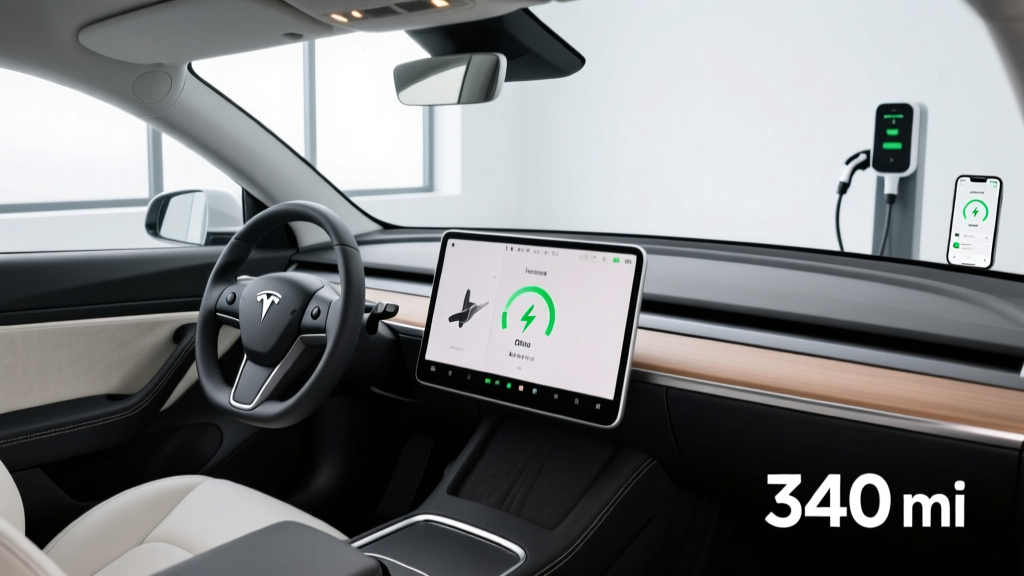
The 2023 Tesla Model 3 interior is defined by radical minimalism. There is no instrument cluster — all information, including speed and navigation, appears on the central 15-inch touchscreen. The steering wheel carries two scroll wheels and turn-signal stalks (note: the 2024 Highland refresh removed the stalks, making the 2023 the last year with conventional controls). Materials include vegan leather upholstery, soft-touch dash surfaces, and an Alcantara-like headliner on Long Range and Performance trims.
Passenger and Cargo Dimensions
Despite its sleek roofline, the Model 3 offers competitive interior volume for the compact luxury sedan segment:
- Front headroom: 40.3 inches
- Front legroom: 42.7 inches
- Rear headroom: 37.8 inches (tighter for tall passengers due to the sloping roof)
- Rear legroom: 35.2 inches
- Trunk (rear): 23.0 cubic feet
- Frunk (front trunk): 3.1 cubic feet — enough for a charging cable kit or small bag
- Total cargo: 26.1 cubic feet
The rear seat fits two adults comfortably; a third middle passenger is a squeeze on longer trips. The trunk opening is relatively narrow compared to a hatchback like the Model Y or Hyundai Ioniq 5, which limits loading bulky items. If cargo flexibility is a priority, the Model 3's sedan form factor is a genuine limitation.
Infotainment and Driver Assistance
Tesla's software remains the industry's most responsive. The 2023 Model 3 runs Tesla's proprietary infotainment stack with over-the-air updates, integrated navigation with real-time Supercharger routing, and streaming apps (Netflix, YouTube, Spotify) usable while parked. There is no Apple CarPlay or Android Auto — a deliberate Tesla choice that frustrates some buyers.
Standard Autopilot includes Traffic-Aware Cruise Control and Autosteer (lane centering). This is an SAE Level 2 driver-assistance system: you must keep your hands on the wheel and eyes on the road at all times. Full Self-Driving (Supervised) was available as a $15,000 add-on (or $199/month subscription) in 2023, adding features like automatic lane changes and Navigate on Autopilot. It remains Level 2 — not autonomous — despite the marketing name.
Range and Efficiency: EPA vs. Real-World
The EPA range figures for the 2023 Model 3 are among the most accurate in the industry, but real-world results vary based on driving style, temperature, and terrain. Tesla's thermal management system — including a heat pump standard on all 2023 trims — helps mitigate cold-weather losses better than many competitors.
- Mixed suburban/city driving (65°F): ~255–270 miles — close to EPA
- Highway at 75 mph (65°F): ~220–240 miles — sustained high speed increases consumption
- Cold weather (25°F, mixed driving): ~195–220 miles — expect 15–25% loss; cabin heating and battery thermal management draw energy
- Cold weather highway (25°F, 75 mph): ~175–200 miles — worst-case scenario
Long Range AWD (333 mi EPA) scales proportionally: expect ~270–290 mi real-world highway in moderate temps, ~230–260 mi in cold.
The RWD model's LFP battery chemistry is worth highlighting. LFP cells tolerate daily 100% charging without the degradation penalties that NMC batteries face. Tesla recommends charging the RWD to 100% at least once weekly for battery calibration. For Long Range and Performance (NMC chemistry), Tesla recommends a daily limit of 80–90%, reserving 100% for road trips.
Efficiency is a Tesla strong suit. The RWD achieves 132 MPGe combined (25 kWh per 100 miles) per EPA data on fueleconomy.gov, making it one of the most efficient EVs in its class. For context, that translates to roughly $0.04–$0.06 per mile when charging at home on a national-average electricity rate of $0.16/kWh.
Charging Speed: DC Fast Charging and Home Level 2
Charging speed is where the RWD and Long Range/Performance trims diverge significantly. The RWD's LFP battery tops out at 170 kW peak DC fast-charging power, while the NMC-equipped Long Range and Performance models can reach 250 kW at V3 Superchargers.
| Charging Level | Power / Rate | RWD (mi/hr added) | Long Range (mi/hr added) |
|---|---|---|---|
| Level 1 (120V household) | ~1.4 kW | ~4 mi/hr | ~4 mi/hr |
| Level 2 (240V, 32A Mobile Connector) | 7.6 kW | ~30 mi/hr | ~30 mi/hr |
| Level 2 (240V, 48A Wall Connector) | 11.5 kW | ~30 mi/hr (RWD onboard limit) | ~44 mi/hr |
| DC Fast Charge (V3 Supercharger) | 170 kW (RWD) / 250 kW (LR/Perf) | ~130 mi in 15 min | ~175 mi in 15 min |
Important charging-curve context: Peak kW is not sustained kW. The Long Range hits 250 kW only at a low state of charge (roughly 5–15% SoC) and tapers progressively. The 10–80% time of ~27 minutes reflects this taper. The RWD's 170 kW peak also tapers, and its 10–80% session takes about 30 minutes. Above 80%, charging slows dramatically to protect the battery — plan to charge to 80% on road trips and move on rather than waiting for a full battery.
For home charging, a Tesla Wall Connector on a 60-amp circuit delivers the fastest Level 2 experience. Installation costs typically range from $500–$1,500 for the electrician work (assuming your panel has capacity), plus $475 for the Wall Connector hardware. If your home has a 200-amp panel with spare capacity, you're likely set. Older homes with 100-amp service may need a panel upgrade ($1,500–$3,000+).
The 2023 Model 3 uses Tesla's proprietary NACS connector. As of 2026, NACS has become the dominant North American standard, with Ford, GM, Rivian, Hyundai, and others adopting it — giving the Model 3 native access to the expanding Supercharger network without adapters.
Pricing, Trims, and Federal Tax Credit Eligibility
The 2023 Model 3 was sold in three trims. Prices below reflect the original MSRP at launch (prices fluctuated throughout 2023 as Tesla adjusted pricing multiple times):
| Trim | Original MSRP | Federal §30D Credit (2023) | Effective Price |
|---|---|---|---|
| RWD | $40,240 | Up to $7,500 | ~$32,740 |
| Long Range AWD | $47,240 | Up to $7,500 | ~$39,740 |
| Performance | $53,240 | Up to $7,500 | ~$45,740 |
IRS §30D tax credit eligibility for the 2023 Model 3: In 2023, the Model 3 qualified for the full $7,500 federal tax credit for eligible buyers. However, eligibility depends on several factors that changed throughout the year as IRS rules evolved:
- Buyer income caps (2023): Modified AGI ≤ $150,000 (single), $225,000 (head of household), $300,000 (married filing jointly)
- MSRP cap: Sedans must be ≤ $55,000 — the RWD and Long Range qualify; the Performance at $53,240 also qualified in 2023
- Battery sourcing requirements: Phased in starting April 2023; the Model 3 RWD (built with CATL LFP cells in China) faced partial credit restrictions at certain points in 2023, while the Long Range (assembled in Fremont with different sourcing) maintained eligibility
- Point-of-sale transfer: Starting January 1, 2024, buyers can transfer the credit to the dealer for an immediate price reduction. For 2023 purchases, it was claimed on your tax return (Form 8936)
If you're buying a used 2023 Model 3 in 2026, the used EV tax credit (up to $4,000 or 30% of the sale price, whichever is lower) may apply, subject to separate income caps and a $25,000 maximum sale price. Consult a tax professional for your specific situation.
Driving Experience and Performance
The RWD Model 3 delivers 283 horsepower and a 5.8-second 0–60 mph time — adequate for merging and passing but noticeably less thrilling than the dual-motor variants. The single-motor rear-wheel-drive layout gives it a more traditional driving feel, with predictable weight transfer and a slightly lighter front end.
The Long Range AWD (346 hp, 4.2 seconds) is the sweet spot for most buyers: dual-motor all-wheel drive adds confidence in rain and snow, and the 333-mile EPA range eliminates range anxiety on road trips. The Performance trim (450 hp, 3.1 seconds) is a genuine sports-sedan rival to the BMW M3 in straight-line acceleration, with Track Mode enabling adjustable stability control and torque distribution.
Ride quality on the 2023 Model 3 is firm. The sport-tuned suspension transmits road imperfections more than a Hyundai Ioniq 6 or BMW i4. Tesla improved the acoustic glass and sound deadening for 2023, reducing cabin noise noticeably over 2021–2022 models, but it's still not luxury-quiet on coarse pavement.
Regenerative braking in the 2023 Model 3 is strong and enables one-pedal driving in most conditions. Tesla removed the adjustable regen setting in 2023 (it was briefly available in earlier years), so the default regen strength is the only option — most owners adapt within a week.
Battery Longevity, Warranty, and Ownership Costs
Tesla's battery and drive unit warranty for the 2023 Model 3 is competitive:
- Battery warranty: 8 years / 100,000 miles (RWD), 8 years / 120,000 miles (Long Range & Performance) — whichever comes first, with minimum 70% capacity retention
- Basic vehicle warranty: 4 years / 50,000 miles
- Drive unit warranty: Matches battery warranty period
Real-world degradation data from Tesla's fleet and third-party tracking (including NHTSA service bulletins and owner surveys) shows LFP batteries in the RWD Model 3 losing roughly 5–8% capacity over the first 100,000 miles, with the curve flattening significantly afterward. NMC batteries in Long Range models show a similar trajectory, though the 100% charge avoidance requirement adds a behavioral consideration for daily use.
Battery replacement cost out of warranty is approximately $12,000–$16,000 for the Model 3, depending on the pack and labor. However, catastrophic battery failure within the warranty period is rare — degradation is gradual and the 70% retention threshold is conservative enough that most packs will exceed it comfortably.
Total Cost of Ownership (5-Year Estimate, RWD Trim)
| Category | Estimated Cost |
|---|---|
| Purchase price (after $7,500 credit) | ~$32,740 |
| Home charging (12,000 mi/yr × $0.16/kWh) | ~$4,800 |
| Insurance (national avg, EV-adjusted) | ~$12,500 |
| Maintenance (tires, cabin filter, fluid top-off) | ~$2,200 |
| Depreciation (est. 5-yr) | ~$14,000 |
| Total 5-year cost | ~$66,240 |
Insurance is a notable cost driver. Tesla Model 3 premiums run 15–30% higher than comparable non-EV sedans, driven by higher repair costs and Tesla's direct body-shop network limitations. Shop quotes from multiple carriers — Tesla's own insurance product is available in many states and can be competitive for clean-record drivers.
Pros and Cons: The Honest Assessment
✅ Pros
- Best-in-class efficiency: 132 MPGe, lowest cost-per-mile in segment
- LFP battery on RWD allows daily 100% charging without degradation worry
- Supercharger network access (NACS) — the most reliable public charging ecosystem
- Over-the-air updates continuously add features and improve performance
- Strong resale value relative to most EVs
- Excellent safety ratings: IIHS Top Safety Pick+ and NHTSA 5-star
❌ Cons
- No Apple CarPlay or Android Auto — Tesla-only infotainment
- Minimalist interior polarizes: no physical buttons, all controls on-screen
- Rear headroom limited by sloping roofline; tight for tall passengers
- Firm ride quality over rough pavement
- RWD DC fast charging capped at 170 kW — slower road-trip charging than LR
- No hatchback — trunk opening is narrow for a sedan
- Insurance premiums higher than segment average
Who Should Buy the 2023 Tesla Model 3?
Frequently Asked Questions
What is the real-world range of the 2023 Tesla Model 3?
The RWD delivers roughly 255–270 miles in moderate mixed driving, dropping to 220–240 on the highway and 195–220 in cold weather. The Long Range AWD provides 270–290 miles highway in moderate conditions and 230–260 in cold weather. These figures assume moderate climate-control use and no extreme terrain.
How fast does the 2023 Model 3 charge at home and on the road?
At home on a 240V/48A Tesla Wall Connector, the Long Range adds ~44 miles per hour (11.5 kW), while the RWD is limited to ~30 mi/hr (7.6 kW) by its onboard charger. On a V3 Supercharger, the Long Range peaks at 250 kW (10–80% in ~27 min), and the RWD peaks at 170 kW (10–80% in ~30 min).
Does the 2023 Tesla Model 3 qualify for the federal EV tax credit?
When new in 2023, the Model 3 qualified for up to $7,500 under IRS §30D, subject to buyer income limits ($150K single / $300K joint), the $55,000 sedan MSRP cap, and battery critical-mineral sourcing rules that shifted throughout 2023. For used purchases in 2026, the used EV credit (up to $4,000) may apply if the sale price is $25,000 or less and buyer income is within lower thresholds. Always verify current rules at IRS.gov.
Is the 2023 Model 3 worth buying vs. competitors in 2026?
On the used market, the 2023 Model 3 competes with the Hyundai Ioniq 6, BMW i4, and Polestar 2. The Model 3 wins on efficiency, Supercharger network access, and software. The Ioniq 6 offers 800V charging (faster DC sessions), CarPlay, and a more conventional interior. The BMW i4 delivers a more refined ride and traditional luxury feel but at a higher price. If Supercharger access and software matter most, the Model 3 is still the pick.
How long will the 2023 Model 3 battery last?
Tesla warranties the battery for 8 years / 100,000 miles (RWD) or 8 years / 120,000 miles (Long Range/Performance) with a minimum 70% capacity retention guarantee. Real-world fleet data suggests LFP packs retain 92–95% capacity at 100K miles, and NMC packs retain 90–93%. Many Model 3 batteries are projected to outlast 200,000 miles before reaching the 70% threshold.
Does the 2023 Model 3 have a heat pump?
Yes. All 2023 Model 3 trims include Tesla's heat pump as standard equipment, improving cold-weather efficiency by drawing heat from the ambient air and powertrain rather than relying solely on resistive heating. This reduces winter range loss compared to EVs without a heat pump.