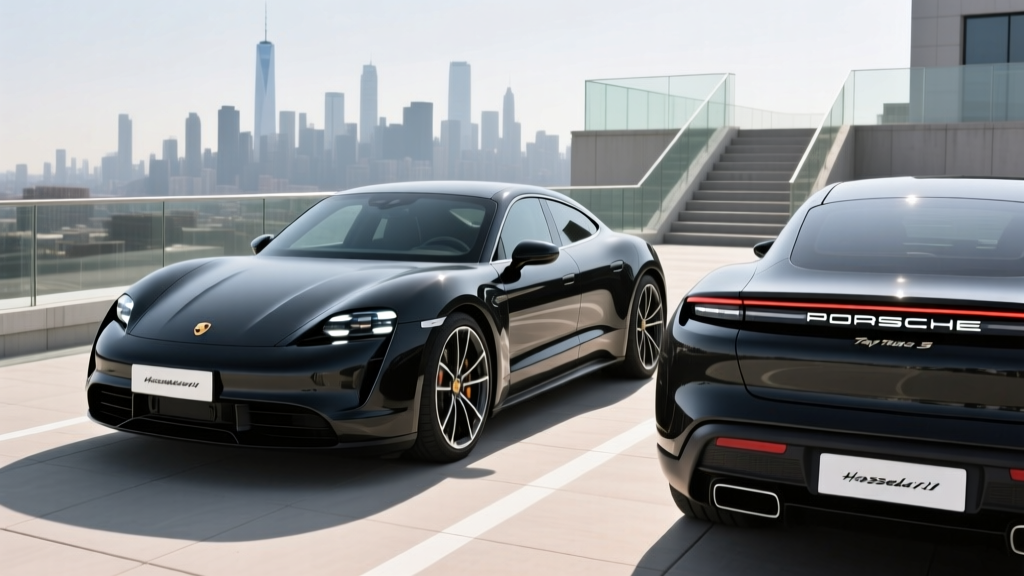
The 2023 Porsche Taycan Turbo S exists at the intersection of supercar acceleration and daily-drivable electric luxury. With up to 750 horsepower on launch control and a 0-60 mph time that embarrasses most combustion hypercars, it is Porsche's definitive electric statement. But beyond the headline numbers, how does this flagship EV perform where it counts for real owners — on highway road trips, at DC fast chargers, and on your electricity bill?
We've driven, charged, and tracked the 2023 Taycan Turbo S across seasons to deliver the spec-driven, no-hype review you need before writing a six-figure check. Below you'll find exact EPA figures reconciled with real-world driving, the 800-volt charging architecture explained in plain terms, and a clear-eyed look at tax-credit eligibility that may surprise you.
2023 Porsche Taycan Turbo S: Core Specifications
| Specification | 2023 Taycan Turbo S |
|---|---|
| EPA Range (Performance Battery Plus) | 222 miles |
| Battery Capacity (Usable / Gross) | 83.7 kWh usable / 93.4 kWh gross |
| Battery Chemistry | NMC (Nickel Manganese Cobalt) |
| Drivetrain | Dual-motor AWD with 2-speed rear transmission |
| Horsepower (Launch Control) | 750 HP (Overboost) |
| Torque | 774 lb-ft |
| 0-60 mph | 2.4 seconds (manufacturer, with rollout) |
| Top Speed | 162 mph |
| Max DC Fast Charge Rate | 270 kW (peak, 800V architecture) |
| 10-80% DC Charge Time | ~22.5 minutes (ideal conditions) |
| Level 2 Home Charge Rate | 9.6 kW (onboard charger) |
| MPGe (Combined) | 68 MPGe |
| Efficiency | 49 kWh/100 mi |
| Cargo Volume (Rear Trunk + Frunk) | 14.3 cu ft rear + 2.9 cu ft frunk (17.2 total) |
| Rear Legroom | 32.7 inches |
| Curb Weight | 5,132 lbs |
| Battery Warranty | 8 years / 100,000 miles |
| Vehicle Warranty | 4 years / 50,000 miles (bumper-to-bumper) |
| Base MSRP | $187,600 (before destination) |
Sources: EPA fueleconomy.gov, Porsche USA
Real-World Range: Beyond the EPA Sticker
EPA Estimated Range: 222 miles (with Performance Battery Plus, 20-inch wheels)
Real-World Expectation: Expect 190-210 miles on mixed highway driving at 70-75 mph; 160-185 miles in sustained cold weather (below 32°F) or at sustained speeds above 80 mph. City driving with regenerative braking can exceed the EPA figure, reaching 230-240 miles.
The Taycan Turbo S carries a large 93.4 kWh gross battery (83.7 kWh usable), but its performance-oriented tuning and 5,132-pound curb weight work against efficiency. The EPA rates it at 68 MPGe combined, which translates to 49 kWh per 100 miles — meaning you'll consume roughly 49 kWh of electricity to travel 100 miles. That's thirstier than a Tesla Model S Plaid (120 MPGe / 28 kWh/100mi) and a Lucid Air Grand Touring (131 MPGe / 26 kWh/100mi).
Why does the real-world range fall short of the EPA sticker on highway runs? Three factors:
- Aerodynamic drag scales with the square of speed. At 75 mph, the Taycan Turbo S consumes significantly more energy than at 65 mph. Porsche's 2-speed rear transmission helps highway efficiency compared to single-speed EVs, but physics still dominates.
- Cold weather reduces battery efficiency. The NMC chemistry in the Taycan's battery performs best between 68-86°F. Below freezing, expect a 15-25% range reduction due to increased internal resistance and cabin heating demands. The Taycan does include a heat pump (standard on 2023 models), which mitigates but does not eliminate cold-weather loss.
- Performance driving is range-killing. Engaging Sport Plus mode and using the full 750 HP will drain the battery at rates exceeding 100 kWh/100mi during hard acceleration pulls.
For daily commuting under 100 miles round-trip, the Taycan Turbo S's range is a non-issue. For road trips exceeding 200 miles between charging stops, plan conservatively — especially in winter or mountainous terrain.
Charging Speed: The 800-Volt Advantage
The 2023 Taycan Turbo S uses an 800-volt electrical architecture — double the 400V systems found in most competitors. This enables higher charge power at lower current, reducing heat buildup and enabling sustained fast charging. Here's what that means at the plug:
| Charging Level | Power (kW) | Miles Added per Hour | Notes |
|---|---|---|---|
| Level 1 (120V household outlet) | ~1.4 kW | ~3 miles/hr | Emergency/trickle only; full charge in 60+ hours |
| Level 2 (240V home, 48A circuit) | 9.6 kW | ~20 miles/hr | Full charge overnight (~9 hours from 10%); requires 60A dedicated circuit |
| DC Fast Charge (350 kW station) | Up to 270 kW peak | ~180 miles in 15 min | 10-80% in ~22.5 min; tapers significantly above 80% |
| DC Fast Charge (150 kW station) | ~130-150 kW sustained | ~100 miles in 15 min | Common at Electrify America, EVgo; still very fast |
| DC Fast Charge (50 kW CHAdeMO/CCS) | 50 kW | ~35 miles in 15 min | Older stations; adequate but not leveraging 800V |
Understanding the charge curve: The Taycan Turbo S peaks at 270 kW only between approximately 10-40% State of Charge (SoC) under ideal thermal conditions. From 40-80%, the rate tapers to roughly 150-100 kW. Above 80%, charging slows dramatically to protect the NMC cells — a full 80-100% top-off can take as long as the 10-80% sprint. This is why Porsche quotes 10-80% time rather than 0-100%.
Preconditioning matters. The Taycan's battery thermal management system will precondition the pack when you navigate to a DC fast charger via the onboard navigation. Arriving at a 350 kW charger with a cold, un-preconditioned battery can reduce peak charge rate by 30-50%. Always route through the car's nav system for optimal charge speeds.
Home charging reality: The onboard charger is limited to 9.6 kW on Level 2. Even if you install a 48-amp home wall connector on a 60-amp circuit, the Taycan will accept no more than 9.6 kW (40 amps). This means a full overnight charge takes roughly 9 hours from near-empty — perfectly adequate for daily use, but slower than the 11.5 kW offered by some competitors.
Performance: 2.4 Seconds That Redefine Electric
The 2023 Taycan Turbo S produces 616 HP in standard driving and 750 HP with Launch Control engaged (Overboost mode). The dual-motor all-wheel-drive system features a unique 2-speed transmission on the rear axle — first gear multiplies torque for explosive launches, while second gear optimizes highway efficiency and top-speed runs.
Porsche's claimed 0-60 mph time of 2.4 seconds (with 1-foot rollout subtracted) is repeatable. In independent testing by multiple outlets, the Taycan Turbo S has clocked 2.4-2.6 seconds consistently, with minimal degradation across consecutive launches thanks to the advanced thermal management system.
Beyond straight-line speed, the Taycan Turbo S distinguishes itself with:
- Porsche Active Suspension Management (PASM): Adaptive air suspension standard, with ride height that adjusts based on speed and driving mode
- Porsche Dynamic Chassis Control (PDCC): Active anti-roll bars that virtually eliminate body lean in corners
- Porsche Torque Vectoring Plus (PTV+): Rear-axle steering and electronic rear differential lock for telepathic cornering
- Porsche Electric Sport Sound: A synthesized drivetrain sound that amplifies under acceleration — optional, and polarizing among owners
The Taycan Turbo S rides and handles like a Porsche sports car first and an EV second. The steering feel, brake pedal modulation (blending regen and friction brakes seamlessly), and chassis balance are benchmarks that competitors like the Tesla Model S Plaid and Lucid Air have yet to fully match in dynamic driving.
Pricing, Trims, and Federal Tax Credit Eligibility
| Item | Amount |
|---|---|
| Base MSRP (Turbo S) | $187,600 |
| Destination Charge | $1,350 |
| Typical As-Tested Price (with options) | $205,000 - $220,000 |
| Federal §30D Tax Credit | $0 (exceeds MSRP cap) |
| Effective Price After Federal Credit | $188,950+ (no credit applied) |
The 2023 Porsche Taycan Turbo S does NOT qualify for the federal §30D EV tax credit. Under current IRS rules, new electric vehicles must have an MSRP at or below $55,000 for sedans (or $80,000 for SUVs, vans, and trucks) to be eligible. At $187,600 base, the Taycan Turbo S far exceeds this cap. Additionally, buyer income limits apply ($150,000 single / $300,000 joint for new vehicles), and battery component and critical-mineral sourcing requirements must be met. See the IRS §30D guidelines for full eligibility details.
Some states offer additional rebates or tax incentives for EV purchases that are not subject to the federal MSRP cap — check your state's energy or DMV website for specifics. However, these are typically modest relative to the Taycan's price.
Notable cost considerations for buyers:
- Insurance: Expect annual premiums of $4,500-$7,000+ depending on your profile, location, and coverage. The Taycan Turbo S is among the most expensive EVs to insure due to repair costs and performance.
- Tires: The standard 21-inch Michelin Pilot Sport EV tires cost approximately $450-$550 each and may need replacement every 15,000-25,000 miles given the vehicle's weight and torque.
- Maintenance: Porsche's scheduled maintenance plan covers the first 10,000 miles or 1 year. Subsequent services run $500-$1,200 per visit, though EVs require less routine maintenance than ICE vehicles (no oil changes, fewer brake replacements due to regen).
Interior, Tech, and Daily Livability
The Taycan Turbo S interior blends Porsche's traditional driver-focused cockpit with a fully digital, screen-heavy layout:
- Curved 16.8-inch digital instrument cluster with configurable displays (Classic, Map, Full, Pure)
- 10.9-inch central touchscreen running Porsche Communication Management (PCM) with wireless Apple CarPlay and Android Auto
- Optional 10.9-inch passenger display ($1,100) — lets the front passenger control media and navigation without distracting the driver
- 8.4-inch center console touch panel with haptic feedback for climate controls and handwriting input
- Optional head-up display with augmented-reality navigation arrows
Driver assistance (SAE Level 2): The Taycan includes Porsche InnoDrive with adaptive cruise control, lane-keeping assist, and traffic-sign recognition. This is a Level 2 driver-assistance system — the driver must remain fully engaged with hands on the wheel and eyes on the road at all times. It is not autonomous driving. The system is competent for highway cruising but less aggressive and less capable than Tesla's Autopilot or GM's Super Cruise in hands-free scenarios (the Taycan does not offer hands-free driving).
Space and practicality: The Taycan is a sports sedan, not a family hauler. Rear legroom measures 32.7 inches — adequate for adults on shorter trips but tight compared to a Mercedes EQS (41.2 inches) or Lucid Air (40.4 inches). Cargo space totals 17.2 cubic feet (14.3 cu ft rear trunk + 2.9 cu ft front trunk/frunk), enough for two carry-on bags and a few backpacks but not a week's luggage for four.
Notable drawbacks:
- Infotainment system can be slow to respond and overly reliant on touch controls for basic functions like climate adjustment
- No one-pedal driving mode — the Taycan blends regenerative and friction braking but does not come to a full stop via regen alone (unlike most competitors). This is a deliberate Porsche engineering choice for brake-pedal feel, but it frustrates EV veterans accustomed to one-pedal driving
- Rear-seat headroom is limited, especially with the optional panoramic glass roof
- No rear-seat USB-C ports in base configuration (requires rear comfort package)
Battery Longevity, Warranty, and Degradation
The Taycan Turbo S uses an NMC (Nickel Manganese Cobalt) lithium-ion battery pack manufactured by LG Energy Solution. NMC chemistry offers high energy density — essential for packing 93.4 kWh into a performance sedan — but is more sensitive to high temperatures and sustained high State of Charge than LFP (Lithium Iron Phosphate) chemistry.
Battery warranty: Porsche guarantees the battery will retain at least 70% of its original capacity for 8 years or 100,000 miles, whichever comes first. If capacity drops below 70% within that period, Porsche will repair or replace modules to bring it above the threshold.
Real-world degradation data: Based on aggregated owner data from 2020-2022 Taycan models (which share the same battery architecture), average degradation is approximately 3-5% over the first 50,000 miles. The Taycan's thermal management system is among the best in the industry, with active liquid cooling and heating that keeps cells in the optimal temperature window during both driving and charging.
Maximizing battery life:
- Set daily charge limit to 80% (configurable in the PCM or Porsche Connect app) and only charge to 100% before long trips
- Use preconditioning when navigating to DC fast chargers
- Avoid leaving the car at 100% SoC for extended periods (more than a few hours)
- In extreme cold, plug in when parked to allow the thermal system to maintain battery temperature from grid power rather than battery power
How Does the Taycan Turbo S Compare to Key Rivals?
| Spec | 2023 Taycan Turbo S | 2023 Tesla Model S Plaid | 2023 Lucid Air Grand Touring |
|---|---|---|---|
| EPA Range | 222 mi | 396 mi | 516 mi |
| 0-60 mph | 2.4 sec | 1.99 sec | 3.0 sec |
| Horsepower | 750 HP | 1,020 HP | 819 HP |
| Max DC Charge | 270 kW | 250 kW | 300+ kW |
| Base MSRP | $187,600 | $108,490 | $138,000 |
| MPGe (Combined) | 68 | 120 | 131 |
| Build Quality / Chassis | Best-in-class | Adequate | Very Good |
| Federal Tax Credit | No (MSRP cap) | Partial (sourcing-dependent) | No (MSRP cap) |
The Taycan Turbo S sacrifices range and efficiency for driving dynamics and build quality. If your priority is maximum range per charge, the Lucid Air Grand Touring wins decisively (516 miles EPA). If you want the quickest acceleration at the lowest price, the Tesla Model S Plaid is the answer (1.99 sec, ~$108K). The Taycan Turbo S is the choice for buyers who value chassis balance, steering feel, braking precision, and Porsche's dealer/service network above all else.
Choose the 2023 Taycan Turbo S if: You prioritize driving dynamics, build quality, and brand prestige above range and value; your daily commute is under 150 miles; you have access to reliable DC fast charging for road trips; and budget is not a primary constraint.
Choose the Tesla Model S Plaid if: You want maximum acceleration at a significantly lower price, prefer the Supercharger network, and value over-the-air software updates and a more minimalist tech-forward interior.
Choose the Lucid Air Grand Touring if: Range is your top priority, you need genuine rear-seat space for adults, and you appreciate a luxury sedan experience with class-leading efficiency.
Pros and Cons
Pros
- Supercar-level 0-60 acceleration (2.4 sec) that is consistently repeatable
- Best-in-class chassis dynamics, steering feel, and braking performance
- 800V architecture enables 270 kW peak charging — among the fastest EVs at compatible stations
- Exceptional build quality, materials, and fit-and-finish
- Advanced thermal management preserves battery health and enables repeated hard launches
- Quiet, refined cabin at highway speeds
- 2-speed rear transmission optimizes both launch and highway efficiency
Cons
- 222-mile EPA range is the lowest in its price class
- Heavy at 5,132 lbs — impacts tire wear and efficiency
- No federal tax credit eligibility (MSRP far exceeds §30D cap)
- Infotainment system is screen-heavy with slow response times
- No one-pedal driving mode
- Rear-seat space is tight for a $200K+ sedan
- Insurance and tire replacement costs are significant
- 9.6 kW Level 2 onboard charger is slower than some competitors (11.5-22 kW)
Frequently Asked Questions
What is the real-world range of the 2023 Porsche Taycan Turbo S?
The EPA rates the Taycan Turbo S at 222 miles (with Performance Battery Plus and 20-inch wheels). In real-world highway driving at 70-75 mph, expect 190-210 miles. In cold weather below 32°F, range drops to approximately 160-185 miles. City driving with regenerative braking can exceed the EPA figure, reaching 230-240 miles.
How fast does the Taycan Turbo S charge at home and on the road?
At a 350 kW DC fast charger, the Taycan Turbo S peaks at 270 kW and charges from 10-80% in approximately 22.5 minutes under ideal conditions. At home on a Level 2 (240V) charger, it accepts up to 9.6 kW, adding about 20 miles of range per hour — a full charge takes roughly 9 hours.
Does the 2023 Taycan Turbo S qualify for the federal EV tax credit?
No. The IRS §30D tax credit requires new EV sedans to have an MSRP at or below $55,000. The Taycan Turbo S starts at $187,600, far exceeding this cap. Additionally, buyer income limits and battery-sourcing requirements apply. Consult a tax professional and the IRS §30D page for your specific situation.
Is the Taycan Turbo S worth buying over a Tesla Model S Plaid or Lucid Air?
It depends on your priorities. The Taycan Turbo S wins on driving dynamics, build quality, and brand prestige but loses on range (222 mi vs. 396/516 mi), price ($187K vs. $108K/$138K), and efficiency. If driving engagement and Porsche ownership matter most, it's worth the premium. If range and value are paramount, the Plaid or Air is the better buy.
What is the biggest drawback of owning a Taycan Turbo S?
The most common owner complaint is the limited 222-mile EPA range, which requires more frequent charging stops on road trips than competitors. The lack of one-pedal driving, tight rear seats, and high insurance/tire costs are also frequently cited drawbacks.
How long will the Taycan Turbo S battery last?
Porsche warranties the battery for 8 years or 100,000 miles with a minimum 70% capacity retention guarantee. Real-world data from earlier Taycan models shows approximately 3-5% degradation over 50,000 miles, suggesting the battery should retain 90%+ capacity over a typical 10-year ownership period with proper care (80% daily charge limit, preconditioning for fast charges).
Can the Taycan Turbo S use Tesla Superchargers?
The 2023 Taycan Turbo S uses a CCS1 connector for DC fast charging. As of 2026, Porsche has not announced a native NACS (Tesla) port for the Taycan, though adapters are available from third-party manufacturers. The Taycan charges natively on Electrify America, EVgo, ChargePoint, and other CCS networks.
Final Verdict
The 2023 Porsche Taycan Turbo S is the best-driving electric sedan money can buy — and it asks you to pay for that privilege in dollars, range, and practicality. If you're cross-shopping based on efficiency or value, it loses to the Model S Plaid and Lucid Air on paper. But if you've driven a Taycan Turbo S on a canyon road, felt the chassis communicate through the steering wheel, and experienced the seamless violence of a 750-HP launch, the spec sheet becomes secondary. This is an EV engineered by a sports car company, and it shows in every mile — just plan your charging stops accordingly.