Quick Verdict: A Capable Commuter Held Back by Its Charge Port
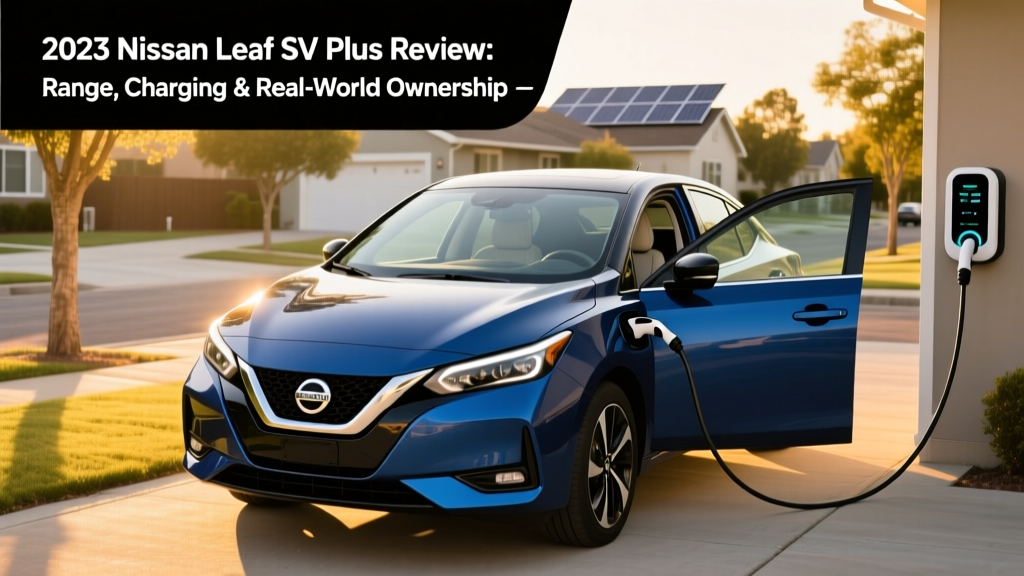
The 2023 Nissan Leaf SV Plus occupies a specific and increasingly narrow lane in the EV market. It delivers a usable 212 miles of EPA-estimated range, a comfortable ride, and one of the lowest entry prices among long-range electric hatchbacks — but its CHAdeMO fast-charging connector and passively cooled battery pack are legacy liabilities that matter more every year as the industry consolidates around NACS and CCS.
If you're evaluating a 2023 Leaf SV Plus on the used market in 2026, or you still own one and want to benchmark your experience, this review covers the exact numbers that matter: real-world range, charging curves, ownership costs, and how the tax credit applies to a used purchase today.
Range and Efficiency: EPA Sticker vs. Reality
Real-World Expectation: 175–195 miles at sustained highway speeds (70+ mph); 155–170 miles in cold weather (below 32°F) with cabin heat active. City/regenerative driving can match or slightly exceed the EPA figure.
The 2023 Leaf SV Plus uses a 62 kWh lithium-ion battery pack (NMC chemistry — nickel manganese cobalt). Nissan quotes 212 miles on the EPA combined cycle, and fueleconomy.gov lists the SV Plus at 114 MPGe combined (29 kWh/100 miles).
That efficiency figure is competitive with peers like the Chevrolet Bolt EUV and Hyundai Kona Electric from the same era. However, the Leaf's passive air-cooling system (no active liquid thermal management) means battery temperature swings directly affect range and charging performance. In summer heat above 95°F or winter cold below freezing, expect the pack to thermally throttle — reducing both range and charge acceptance rates.
On a 200-mile round-trip highway commute in moderate (60–75°F) weather, the SV Plus completes the trip with roughly 15–25 miles of buffer remaining. Push speeds above 75 mph or encounter headwinds and hills, and that buffer narrows to single digits. Cold weather is the Leaf's biggest range enemy: without a heat pump (the 2023 Leaf uses resistive PTC heating), cabin warmth draws heavily from the traction battery, and cold-soaked cells lose 15–25% of usable capacity.
Charging: The CHAdeMO Problem in a NACS World
Charging is where the 2023 Leaf SV Plus shows its age most clearly. The specs:
| Charge Level | Connector | Max Power | Speed / Time |
|---|---|---|---|
| Level 1 (120V) | J1772 | ~1.4 kW | ~3–4 miles per hour |
| Level 2 (240V) | J1772 | 6.6 kW (onboard charger) | ~20–22 miles per hour; 0–100% in ~11.5 hours |
| DC Fast Charge | CHAdeMO | ~100 kW peak | 10–80% in ~45 minutes (optimal conditions) |
DC fast charging reality check: The 100 kW peak rate only holds briefly at low state of charge (roughly 10–30% SoC) and moderate battery temperatures. Because the Leaf lacks active thermal management, consecutive fast charges or hot-weather sessions cause the battery to heat up, and the BMS (battery management system) progressively throttles charge acceptance. Nissan owners colloquially call this "Rapidgate." On a warm day after highway driving, you may see peak rates closer to 50–60 kW, extending 10–80% to 60+ minutes.
The CHAdeMO connector itself is the bigger structural concern. As of 2026, the North American charging infrastructure has decisively moved to NACS (Tesla's standard, now adopted by Ford, GM, Rivian, Hyundai, and others) and CCS1. Electrify America and most major networks have reduced or stopped adding new CHAdeMO stalls. While existing CHAdeMO infrastructure hasn't disappeared, its growth trajectory is flat-to-negative, making road-trip planning increasingly difficult for Leaf owners outside major metro corridors.
For home charging, the 6.6 kW onboard charger is adequate: plugging in overnight on a Level 2 home station replenishes a full day's driving in 3–4 hours. Most Leaf SV Plus owners report that home charging covers 90%+ of their needs, and the car's modest pack size means you're never waiting long for a full charge.
Performance and Drivetrain
| Motor | Single front-mounted AC synchronous |
| Horsepower | 214 hp |
| Torque | 250 lb-ft |
| Drivetrain | FWD (front-wheel drive) |
| 0–60 mph | ~6.5 seconds |
| Top Speed | ~98 mph (electronically limited) |
The 214-hp motor in the SV Plus (the S trim with the smaller 40 kWh pack makes only 147 hp) provides genuinely quick acceleration from stops. The instant torque delivery makes the Leaf feel peppier than its 0–60 time suggests in city driving, and highway merging is effortless. FWD is a limitation in snow and ice compared to AWD competitors, though the car's low center of gravity (battery pack under the floor) helps stability.
Regenerative braking is adjustable via the e-Pedal mode, which enables one-pedal driving in most situations. However, the Leaf's regen isn't as aggressive as Tesla or Hyundai's strongest settings, and it tapers off as the battery approaches full charge — a common EV behavior, but worth noting for new owners transitioning from gas cars.
Interior, Cargo, and Technology
The 2023 Leaf SV Plus interior is functional rather than luxurious. Cloth seating, a leather-wrapped steering wheel, and soft-touch materials on the dash distinguish the SV Plus from the base S trim. Key dimensions:
- Front legroom: 42.1 inches
- Rear legroom: 33.5 inches
- Cargo volume (rear seats up): 23.6 cu ft
- Cargo volume (rear seats folded): 38.5 cu ft
- No front trunk (frunk): The motor and power electronics occupy the space under the hood
Rear-seat room is tight for adults over six feet tall, and the cargo area, while adequate for groceries and luggage, falls short of crossover competitors like the Bolt EUV (39.3 cu ft seats-up) or Kona Electric. There's no spare tire — Nissan provides a tire-repair kit.
Tech highlights:
- 8-inch touchscreen with Apple CarPlay and Android Auto (wired)
- Nissan ProPILOT Assist — a competent Level 2 driver-assistance system with adaptive cruise control and lane-centering. It requires hands on the wheel and full driver attention; this is not autonomous driving.
- Nissan Safety Shield 360: automatic emergency braking, blind-spot warning, rear cross-traffic alert, lane departure warning, rear automatic braking
- Bose 7-speaker audio system (SV Plus exclusive)
- Portable Level 1 charging cable included; no home Level 2 unit bundled
The infotainment system is straightforward but dated compared to 2024–2026 EV interiors. No wireless CarPlay/Android Auto, no over-the-air software updates for the powertrain, and the digital instrument cluster is a small screen between analog-style gauges rather than a full digital display.
Pricing, Trims, and Federal Tax Credit
The 2023 Leaf was offered in three trims. Original MSRP at launch:
| Trim | Battery | EPA Range | MSRP (incl. destination) |
|---|---|---|---|
| S | 40 kWh | 149 mi | $28,140 |
| SV Plus | 62 kWh | 212 mi | $36,190 |
| SL Plus | 62 kWh | 212 mi | $38,690 |
Federal tax credit (new purchase, 2023): The 2023 Leaf SV Plus did not qualify for the full $7,500 §30D federal tax credit when purchased new. Under the Inflation Reduction Act's battery-sourcing and critical-mineral requirements that took effect in 2023, the Leaf's Japan-assembled battery pack failed to meet the domestic-content thresholds. Buyers could claim a partial credit (typically $3,750 for meeting one of the two sourcing criteria) depending on the exact production date and IRS guidance at time of purchase. Always verify with IRS §30D guidance or a tax professional.
Used EV credit (2026 purchase): If you're buying a 2023 Leaf SV Plus on the used market in 2026, you may qualify for the Used Clean Vehicle Credit — up to $4,000 or 30% of the sale price (whichever is less), subject to buyer income caps ($75,000 single / $150,000 joint AGI) and a dealer sale price cap of $25,000. The vehicle must be at least two model years old (a 2023 model qualifies in 2026). This credit can be transferred to the dealer at point of sale as an upfront discount. Confirm eligibility on IRS.gov before purchase.
Warranty and Battery Longevity
EV System Warranty: 8 years / 100,000 miles (covers motor, inverter, charger, and related components)
Bumper-to-Bumper: 3 years / 36,000 miles
Powertrain (conventional): 5 years / 60,000 miles
Nissan's battery warranty threshold is less generous than competitors. Hyundai, Kia, and Tesla warrant their packs to retain 70% capacity over 8 years/100,000–150,000 miles. Nissan's 9-bar threshold (~66% capacity) means a Leaf could lose a third of its range before the warranty kicks in. In practice, most Leaf owners in temperate climates report 5–8% degradation over the first 50,000 miles, but hot-climate owners (Arizona, Texas, Southern California) historically see faster degradation due to the passive cooling system. The 2023 model's improved battery chemistry is more resilient than earlier generations, but thermal management remains a limiting factor for long-term health in extreme climates.
A full battery replacement out of warranty costs approximately $6,500–$9,000 (parts and labor) at a Nissan dealer as of 2025–2026, depending on availability of refurbished packs.
Who Should Buy the 2023 Leaf SV Plus?
- You're a single-driver commuter with reliable home Level 2 charging and a round-trip commute under 150 miles
- You find a well-priced used example ($16,000–$20,000 range) and qualify for the $4,000 used-EV credit
- You live in a temperate climate where passive battery cooling isn't a major concern
- You rarely road-trip more than 200 miles one-way
- You depend on public DC fast charging for daily needs — CHAdeMO infrastructure is shrinking
- You live in a hot or very cold climate and need consistent range and charge performance year-round
- You need cargo space for a family — the Bolt EUV, ID.4, or Ioniq 5 offer significantly more room
- You plan to keep the car 8+ years and are concerned about battery degradation without liquid cooling
Pros and Cons
Pros
- Low used-market entry price — often $16K–$22K in 2026
- 212-mile EPA range is adequate for most commutes
- Comfortable ride quality and quiet cabin at highway speeds
- Competent ProPILOT Assist for highway cruising
- Strong standard safety suite (Safety Shield 360)
- 214 hp provides genuinely quick city acceleration
- Eligible for up to $4,000 used-EV federal credit in 2026
Cons
- CHAdeMO connector — declining public charging infrastructure
- No active thermal management — range and charging suffer in extreme temps
- Modest 100 kW peak DC charge rate; ~45 min 10–80% best case
- No heat pump — cold-weather range loss is significant
- Dated infotainment (no wireless phone integration, small screen)
- Tight rear legroom (33.5 in) and no frunk
- Battery warranty threshold less generous than rivals
Frequently Asked Questions
What is the real-world range of the 2023 Nissan Leaf SV Plus?
The EPA rates it at 212 miles combined. In real-world driving, expect 175–195 miles at highway speeds in moderate weather, and 155–170 miles in freezing temperatures. City driving with regenerative braking can approach or slightly exceed the EPA figure.
How fast does the 2023 Leaf SV Plus charge?
On DC fast charge (CHAdeMO), it peaks at roughly 100 kW, achieving 10–80% in about 45 minutes under ideal conditions. Real-world sessions often take 50–65 minutes due to thermal throttling. At home on Level 2 (240V, 6.6 kW), a full charge takes approximately 11.5 hours, adding about 20–22 miles of range per hour.
Does the 2023 Nissan Leaf SV Plus qualify for the federal EV tax credit?
As a new vehicle, it did not qualify for the full $7,500 §30D credit due to battery-sourcing requirements. As a used vehicle purchased in 2026, it may qualify for the Used Clean Vehicle Credit — up to $4,000 — if the sale price is $25,000 or less and the buyer meets income limits. Verify current rules at IRS.gov.
Is the 2023 Leaf SV Plus worth buying vs. competitors?
On the used market, the Leaf SV Plus competes against the Chevrolet Bolt EUV, Hyundai Kona Electric, and Kia Niro EV from the same era. The Leaf wins on price and ride comfort but loses on charging infrastructure (CHAdeMO vs. CCS/NACS), thermal management, and interior space. If you find a Leaf SV Plus for $18,000 or less and primarily charge at home, it's a solid value. If road trips or extreme climates are part of your routine, a Bolt EUV or Kona Electric is the more future-proof choice.
How long will the 2023 Leaf battery last?
Nissan warranties the battery for 8 years/100,000 miles against dropping below 9 of 12 capacity bars (~66%). Most owners in moderate climates report 85–92% capacity retention at 50,000 miles. Hot-climate owners may see faster degradation. With proper care (avoiding frequent DC fast charging and extreme SoC levels), the pack should provide 150,000+ miles of service before significant range loss.
Can I use a Tesla Supercharger with the 2023 Leaf?
No. The Leaf uses a CHAdeMO DC connector and J1772 AC connector. There is no commercially available, reliable CHAdeMO-to-NACS adapter as of 2026. You are limited to CHAdeMO-equipped public stations and J1772 Level 2 chargers.