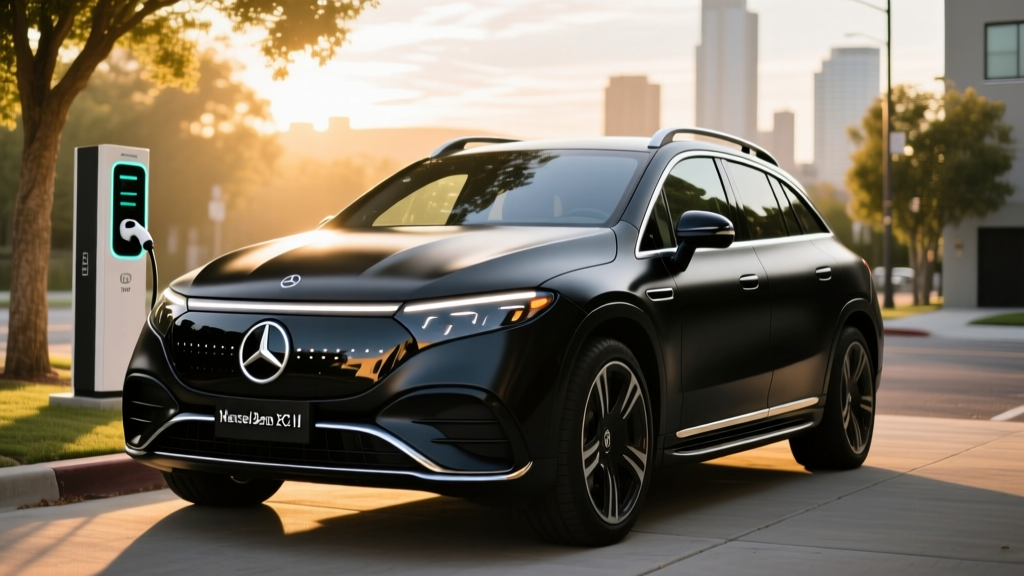
Quick Verdict: The 2023 Mercedes-Benz EQS SUV Defined
The 2023 Mercedes-Benz EQS SUV is the brand's flagship electric luxury hauler — a three-row, dual-motor (or single-motor) BEV that trades sporty pretensions for whisper-quiet comfort, class-leading interior tech, and genuine cross-country capability. With up to 305 miles of EPA-estimated range on the EQS 580 4MATIC and a usable battery of 108.4 kWh, it's built for buyers who want the S-Class experience without a tailpipe. But at a starting MSRP near $104,400, the real question is whether its real-world efficiency, charging speed, and tax-credit eligibility justify the premium over rivals like the BMW iX, Tesla Model X, and Rivian R1S.
This review breaks down every number that matters: EPA range versus what you'll actually see on the highway, DC fast-charging curves, home Level 2 speeds, IRS §30D tax credit eligibility, and the ownership realities Mercedes brochures don't highlight.
Range, Battery & Efficiency
EPA estimate: 305 miles (EQS 580 4MATIC), 330 miles (EQS 450+ RWD), 285 miles (EQS 450 4MATIC)
Real-world highway: Expect 240–270 miles at 70–75 mph sustained. The EQS SUV's tall, heavy platform (nearly 5,900 lbs) and 21-inch optional wheels cut efficiency at speed.
Cold-weather impact: In sub-freezing conditions (20–35°F), plan for 20–30% range loss, yielding roughly 200–230 miles on the 580 4MATIC. The heat pump is standard, which helps cabin efficiency but doesn't fully offset battery chemistry limitations in deep cold.
| Spec | EQS 450+ (RWD) | EQS 450 4MATIC (AWD) | EQS 580 4MATIC (AWD) |
|---|---|---|---|
| EPA Range | 330 mi | 285 mi | 305 mi |
| Battery (Usable) | 108.4 kWh | 108.4 kWh | 108.4 kWh |
| Chemistry | NMC (Nickel Manganese Cobalt) | NMC | NMC |
| Horsepower | 355 hp | 355 hp | 536 hp |
| Torque | 419 lb-ft | 590 lb-ft | 633 lb-ft |
| 0–60 mph | 6.5 sec | 5.8 sec | 4.4 sec |
| Drivetrain | Single-motor RWD | Dual-motor AWD | Dual-motor AWD |
| EPA MPGe (Combined) | 84 MPGe | 79 MPGe | 79 MPGe |
| Efficiency (kWh/100 mi) | 40 | 43 | 43 |
| Base MSRP | $104,400 | $107,400 | $125,950 |
The 108.4 kWh usable capacity (from a 120 kWh gross pack) uses NMC lithium-ion cells — the standard for energy-dense luxury EVs prioritizing range over cycle-life longevity. Mercedes includes a buffer of roughly 11.6 kWh to protect long-term battery health. Unlike LFP chemistries found in some Tesla and BYD models, NMC offers higher energy density but degrades slightly faster if routinely charged to 100% or deeply discharged. For daily use, Mercedes recommends setting charge limits to 80% unless a long trip requires full capacity.
According to fueleconomy.gov, the EQS 580 4MATIC achieves 79 MPGe combined, translating to 43 kWh per 100 miles. That's respectable for a 5,888-pound luxury SUV but trails the lighter BMW iX xDrive50 (87 MPGe combined, 39 kWh/100 mi).
Charging Speed: DC Fast, Level 2 & Home Setup
| Charging Level | Power / Rate | Time or Miles Added |
|---|---|---|
| Level 1 (120V, 12A) | ~1.4 kW | ~3–4 miles per hour |
| Level 2 (240V, 48A) | 11.5 kW | ~28–32 miles per hour; 0–100% in ~11 hours |
| DC Fast Charge (Peak) | 200 kW (CCS) | 10–80% in ~31 minutes |
| DC Fast Charge (Sustained avg.) | ~140–160 kW avg. | 80–100% adds another ~25 min (taper) |
The EQS SUV's 200 kW peak DC fast-charge rate is the headline, but real-world charging curves tell a more nuanced story. At a 350 kW Electrify America or Ionity station, the EQS will ramp to roughly 190–200 kW between 10–30% state of charge (SoC), then progressively taper. By 60% SoC, you're seeing roughly 130–150 kW; above 80%, the rate drops sharply to under 50 kW to protect battery health. This is normal for NMC packs with active thermal management, but it means a 10–80% session takes approximately 31 minutes under ideal conditions — and longer if the pack is cold or the station is power-sharing.
For home charging, the onboard 11.5 kW AC charger is excellent. On a 48-amp Level 2 circuit (requiring a 60-amp breaker), you'll add roughly 30 miles of range per hour, easily replenishing a full day's driving overnight. A full 0–100% charge takes about 11 hours. If your home electrical panel supports a 60-amp dedicated circuit, installation typically runs $800–$2,000 depending on run length and permitting. Mercedes includes a basic mobile charger, but most owners invest in a wall-mounted unit like the ChargePoint Home Flex or Emporia Vue for reliability and app-based scheduling.
Preconditioning tip: The EQS SUV can precondition its battery when you enter a DC fast-charger destination into the MBUX navigation. This warms or cools the pack to optimal temperature, shaving 5–10 minutes off your charge session in cold weather. Always use navigation-routed charging for the fastest results.
Performance, Ride & Drivetrain
The EQS 580 4MATIC's 536 hp and 633 lb-ft of torque deliver a 4.4-second 0–60 mph sprint — brisk for a luxury SUV but not sports-car territory. The 450+ RWD model feels adequate at 6.5 seconds, though its single-motor layout sacrifices all-weather confidence. The dual-motor 450 4MATIC splits the difference: 355 hp, 5.8 seconds, and genuine all-weather traction at a $3,000 premium over the RWD.
Ride quality is where the EQS SUV earns its flagship badge. Standard AIRMATIC air suspension with adaptive damping smooths out rough pavement with a compliance that rivals the S-Class sedan. Rear-axle steering (standard on 580, optional on 450 trims) shrinks the turning circle to 36.1 feet — remarkable for a 207-inch-long SUV — making parking lots and tight city streets manageable. The cabin is isolated from wind and road noise to an almost unnatural degree; at 80 mph, conversation requires no raised voices.
Regenerative braking offers three levels via steering-wheel paddles (D+, D, D−) plus an intelligent D-Auto mode that uses radar and navigation data to adjust regen dynamically. It's not quite one-pedal driving in the Tesla sense — the EQS doesn't come to a full stop in D-Auto — but it's effective for highway deceleration and recovers meaningful energy in stop-and-go traffic.
Interior, Cargo & Standout Tech
The EQS SUV's cabin is dominated by the available MBUX Hyperscreen — a 56-inch curved glass panel spanning the entire dashboard, combining a 12.3-inch instrument cluster, 17.7-inch central OLED touchscreen, and 12.3-inch passenger display. The system runs Mercedes' latest MBUX software with natural-language voice control ("Hey Mercedes"), wireless Apple CarPlay/Android Auto, and over-the-air updates. It's visually stunning, though some drivers find the multi-layer menu structure distracting compared to Tesla's minimalist interface.
Passenger space is generous across two rows. Front headroom measures 40.4 inches; rear legroom is 41.5 inches — enough for tall adults to sit comfortably for hours. The optional third row is best reserved for children or short trips, with 28.5 inches of legroom. Cargo volume behind the third row is a modest 14.0 cubic feet; fold the third row and you get 43.0 cu ft; fold both rear rows for a maximum of 74.0 cu ft. That trails the Tesla Model X (88.1 cu ft max) and Rivian R1S (104.7 cu ft max), a trade-off for the EQS's sleek roofline.
Notable tech features include:
- Driver Assistance: Distronic adaptive cruise with stop-and-go, Active Lane Keeping, Active Steering Assist, and available DRIVE PILOT (SAE Level 3 — currently limited to specific highways in Nevada and California at speeds up to 40 mph in heavy traffic)
- DIGITAL LIGHT headlamps: 2.6 million pixels per headlamp, projecting navigation arrows and hazard warnings onto the road
- Burmester 4D surround sound: 15 speakers with seat-mounted exciters for bass you feel
- Energiizing Comfort: Coordinated ambient lighting, seat massage, fragrance, and sound programs
- Rear-axle steering: Up to 10 degrees for tight maneuvering
DRIVE PILOT is SAE Level 3 — the vehicle handles all driving tasks in approved conditions (specific divided highways, under 40 mph, heavy traffic), and the driver may disengage but must be ready to resume within seconds. This is distinct from Level 2 systems like Tesla Autopilot or GM Super Cruise, which require continuous driver supervision. DRIVE PILOT is only available in limited U.S. regions and specific conditions. Outside those parameters, the EQS SUV operates at SAE Level 2 with Active Steering Assist.
Pricing, Tax Credits & Total Cost
| Trim | Base MSRP | §30D Credit Eligible? | Effective Price (if eligible) |
|---|---|---|---|
| EQS 450+ | $104,400 | No (MSRP cap: $80,000 for SUVs) | $104,400 |
| EQS 450 4MATIC | $107,400 | No | $107,400 |
| EQS 580 4MATIC | $125,950 | No | $125,950 |
Under IRS §30D rules, the federal EV tax credit of up to $7,500 applies only to new electric SUVs with an MSRP at or below $80,000 (IRS clean vehicle credit guidelines). Every 2023 EQS SUV trim exceeds this cap, making none eligible for the federal credit. Additionally, §30D imposes buyer income limits ($300,000 joint / $150,000 single for new EVs) and battery-sourcing requirements that the EQS's internationally sourced NMC cells likely wouldn't satisfy regardless.
For buyers seeking a tax-advantaged luxury EV SUV, the only current path is the used-EV credit (§25E): if you purchase a qualifying pre-owned EQS SUV for $25,000 or more from a dealer, you may claim 30% of the sale price up to $4,000, subject to income caps ($150,000 joint / $75,000 single). A 2023 EQS SUV on the used market in 2026 may qualify — consult a tax professional for your specific situation.
Ownership cost snapshot (5-year estimate, EQS 580 4MATIC):
- Electricity (15,000 mi/yr, $0.16/kWh national avg): ~$5,160
- Equivalent gasoline SUV (18 MPG, $3.50/gal): ~$14,580
- Estimated fuel savings: ~$9,420 over 5 years
- Insurance (luxury EV premium): ~$2,800–$3,500/year
- Maintenance (no oil changes, reduced brake wear): ~$600–$900/year
Warranty & Battery Longevity
Mercedes covers the EQS SUV with a 4-year/50,000-mile limited vehicle warranty and an 8-year/100,000-mile high-voltage battery warranty. The battery warranty guarantees the pack will retain at least 70% of its original capacity (roughly 76 kWh usable) during that period. If degradation exceeds 30%, Mercedes will repair or replace the battery at no cost.
Real-world degradation data for the EQS platform is still accumulating, but NMC packs with active liquid thermal management — like those in the EQS — typically lose 8–12% capacity over 150,000 miles under normal use patterns. Owners who avoid routine 100% charges and minimize DC fast-charging frequency will see better long-term retention. Mercedes provides a State of Health (SoH) readout in the MBUX service menu, allowing owners to monitor degradation proactively.
A full battery replacement out of warranty is expensive: industry estimates for a 108+ kWh NMC pack range from $18,000 to $28,000 including labor, though modular repairs (replacing individual cell groups) can reduce this significantly. This is a known cost risk for all large luxury EVs past warranty age.
Pros, Cons & Who Should Buy
- Class-leading ride comfort and cabin isolation
- 305-mile EPA range (580 4MATIC) enables genuine road trips
- MBUX Hyperscreen is visually unmatched in the segment
- DRIVE PILOT Level 3 autonomy (limited regions) is a genuine technology milestone
- Rear-axle steering makes a large SUV surprisingly maneuverable
- 200 kW DC fast charging is competitive for 2023 model year
- 8-year/100,000-mile battery warranty
- No federal tax credit eligibility (MSRP exceeds $80,000 SUV cap)
- Cargo space (74.0 cu ft max) trails Model X and R1S significantly
- Third row is cramped for adults
- Real-world highway range drops to ~240–270 miles — a concern for cross-country trips
- High insurance premiums ($2,800–$3,500/year)
- MBUX menu complexity can distract while driving
- Out-of-warranty battery replacement cost: $18,000–$28,000
- Heavy (5,888 lbs) — tire wear and efficiency suffer
Choose the EQS SUV if: You prioritize ride comfort, cabin quietness, and flagship-level technology over maximum cargo space or sporty handling. You have home Level 2 charging access, drive primarily in urban/suburban settings with occasional highway trips, and value Mercedes brand prestige. The available DRIVE PILOT Level 3 system appeals to you for approved heavy-traffic commuting.
Look elsewhere if: You need maximum cargo capacity (Rivian R1S offers 104.7 cu ft), you want federal tax credit eligibility (BMW iX xDrive50 starts at ~$87,000 but also exceeds the cap — consider the Tesla Model X at ~$79,990 for borderline eligibility), you regularly carry adults in the third row (Model X or R1S are better), or you prioritize driving dynamics over comfort (BMW iX or Porsche Cayenne E-Hybrid).
Competitor Comparison: EQS SUV vs. BMW iX vs. Tesla Model X
| Attribute | Mercedes EQS 580 4MATIC | BMW iX xDrive50 | Tesla Model X Plaid |
|---|---|---|---|
| EPA Range | 305 mi | 324 mi | 333 mi |
| Battery (Usable) | 108.4 kWh (NMC) | 105.2 kWh (NMC) | 100 kWh (est., NMC) |
| 0–60 mph | 4.4 sec | 4.4 sec | 2.5 sec |
| Horsepower | 536 hp | 516 hp | 1,020 hp |
| DC Fast Charge (Peak) | 200 kW | 200 kW | 250 kW |
| 10–80% Time | ~31 min | ~34 min | ~28 min |
| Max Cargo (cu ft) | 74.0 | 77.9 | 88.1 |
| Base MSRP | $125,950 | $87,250 | $94,990 |
| §30D Credit Eligible | No | No | No (MSRP $94,990) |
The BMW iX xDrive50 offers comparable range and luxury at a $38,700 lower starting price, though it lacks a third row entirely. The Tesla Model X delivers superior range, cargo space, and absurd performance, but its build quality and ride comfort don't match Mercedes' standards. The EQS SUV occupies a narrow niche: buyers who want the most refined, quietest, and most technologically advanced cabin in the segment and are willing to pay a significant premium for it.
Frequently Asked Questions
What is the real-world range of the 2023 Mercedes-Benz EQS SUV?
The EPA rates the EQS 580 4MATIC at 305 miles, the 450+ RWD at 330 miles, and the 450 4MATIC at 285 miles. In real-world highway driving at 70–75 mph, expect 240–270 miles from the 580 and 260–290 from the RWD. Cold weather (below freezing) reduces range by 20–30%, bringing the 580 down to roughly 200–230 miles. City driving with regenerative braking recovers more energy, often matching or slightly exceeding EPA estimates.
How fast does the EQS SUV charge at home and on the road?
At home on a 240V Level 2 charger (48 amps), the EQS SUV charges at 11.5 kW, adding about 30 miles of range per hour and fully replenishing in roughly 11 hours. On DC fast chargers, it peaks at 200 kW and charges from 10–80% in approximately 31 minutes under ideal conditions. Charging tapers significantly above 80% SoC — plan for an additional 25 minutes if you need a full charge.
Does the 2023 EQS SUV qualify for the federal EV tax credit?
No. Under IRS §30D rules, new electric SUVs must have an MSRP of $80,000 or less to qualify for the up-to-$7,500 federal credit. Every EQS SUV trim starts above $104,000, disqualifying it entirely. The used-EV credit (§25E) may apply if you buy a pre-owned EQS SUV — you could receive up to $4,000 (30% of the sale price) if you meet income caps and the vehicle is purchased from a dealer. Consult a tax professional for your specific eligibility.
Is the EQS SUV worth buying versus the BMW iX or Tesla Model X?
It depends on your priorities. The EQS SUV delivers the quietest, most comfortable ride and the most advanced interior technology (MBUX Hyperscreen, available DRIVE PILOT Level 3). If those are paramount and budget is flexible, it's the segment leader. If you want similar luxury at a lower price, the BMW iX xDrive50 saves nearly $39,000 with comparable range and build quality. If cargo space, performance, and Supercharger network access matter most, the Tesla Model X is the pragmatic choice — though it lacks the Mercedes' refinement.
What are the biggest drawbacks of the EQS SUV?
The most significant are: no federal tax credit eligibility, limited cargo space (74.0 cu ft max) compared to rivals, a cramped third row unsuitable for adults, real-world highway range falling to 240–270 miles (a concern for road trips), high insurance costs ($2,800–$3,500/year), and an out-of-warranty battery replacement cost of $18,000–$28,000. The MBUX infotainment system's menu complexity also draws criticism from some drivers.
How long will the EQS SUV battery last?
Mercedes warranties the high-voltage battery for 8 years or 100,000 miles, guaranteeing it retains at least 70% of original capacity. Industry data on NMC packs with active thermal management suggests 8–12% degradation over 150,000 miles under normal use. Avoiding routine 100% charges and minimizing DC fast-charging frequency extends longevity. A full out-of-warranty replacement costs $18,000–$28,000, though modular repairs can reduce this.
Can the EQS SUV tow?
Yes. The EQS 450 4MATIC and 580 4MATIC are rated to tow up to 3,500 pounds when properly equipped with the factory tow package. The RWD 450+ is not rated for towing. Towing significantly reduces range — expect a 30–50% reduction depending on trailer weight and aerodynamics.
Sources: EPA fueleconomy.gov, IRS §30D Clean Vehicle Credit, Mercedes-Benz USA EQS SUV specifications.