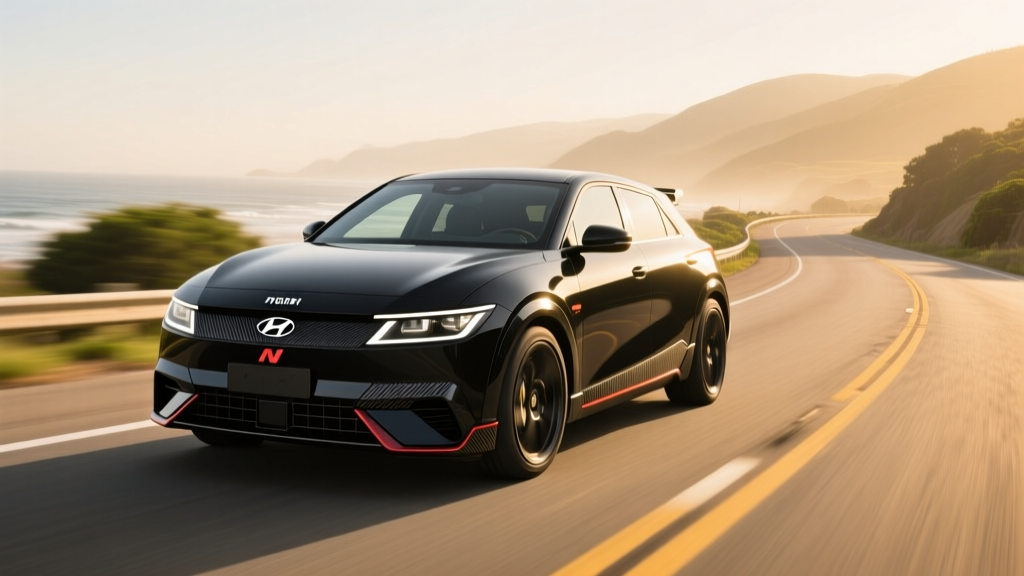
The Hyundai Ioniq 5 N arrived with a bold promise: take the critically acclaimed Ioniq 5 platform and inject it with genuine track capability without sacrificing daily-driver practicality. As Hyundai N's first production electric performance vehicle, the Ioniq 5 N doesn't just add horsepower — it rethinks how an EV should behave at the limit. After spending time with the specs, real-world test data, and ownership economics, here's the complete picture for anyone considering this 641-hp electric hot hatch.
2023 Hyundai Ioniq 5 N: Key Specifications at a Glance
| Spec | Value |
|---|---|
| EPA Range | 221 miles |
| Battery (usable) | 84 kWh, NMC lithium-ion |
| Drivetrain | Dual-motor AWD |
| Horsepower | 601 hp standard / 641 hp with N Grin Boost |
| Torque | 545 lb-ft (568 lb-ft w/ N Grin Boost) |
| 0-60 mph | 3.4 seconds |
| Top Speed | 161 mph |
| Max DC Fast Charge | 238 kW (peak) |
| 10-80% DC Charge Time | ~18 minutes |
| Level 2 Charge Rate | 10.9 kW (~35 mi/hr) |
| MPGe (combined) | 85 MPGe |
| Efficiency | 39 kWh/100 mi |
| Cargo Volume | 27.2 cu ft (rear seats up) / 59.3 cu ft (folded) |
| Rear Legroom | 39.4 inches |
| Curb Weight | ~4,861 lbs |
| Base MSRP | $66,100 |
| Battery Warranty | 8 years / 100,000 miles |
| Vehicle Warranty | 5 years / 60,000 miles |
Range and Efficiency: What the EPA Number Doesn't Tell You
The EPA rates the Ioniq 5 N at 221 miles of combined range — a meaningful drop from the standard Ioniq 5's 303-mile Long Range AWD variant. That deficit is the direct cost of performance: stickier Pirelli P Zero tires, a heavier and stiffer chassis, more aggressive thermal management demands, and the energy cost of 641 horsepower on tap.
Real-World Range Expectations
EPA Estimate: 221 miles (combined)
Highway driving (70-80 mph): Expect ~175-190 miles. The Ioniq 5 N's boxy shape and performance tire compound create substantial drag at sustained speed.
City driving with regen: ~210-230 miles achievable with moderate regenerative braking (paddle-selectable levels 0-3, plus i-PEDAL one-pedal mode).
Cold weather (below 32°F): Plan for 155-175 miles. The N variant's battery preconditioning helps, but NMC chemistry loses 20-30% capacity in deep cold without preconditioning.
Track use: Range becomes nearly irrelevant — aggressive lapping can drain the 84 kWh pack in under 40 miles.
The 84 kWh usable battery uses NMC (nickel manganese cobalt) chemistry, chosen for its higher energy density and discharge rates compared to LFP. For a performance vehicle that needs to sustain high power output and accept rapid charging, NMC is the correct engineering choice — though it does mean owners should avoid routinely charging to 100% for daily use to maximize long-term battery health.
Efficiency comes in at 85 MPGe combined, or 39 kWh per 100 miles, according to fueleconomy.gov. For context, that's roughly average for a performance AWD EV but noticeably thirstier than efficiency-focused crossovers.
Charging Speed: 800-Volt Architecture That Actually Delivers
The Ioniq 5 N inherits Hyundai's E-GMP platform with its native 800-volt architecture, which remains one of the fastest-charging setups in production. Here's what that translates to in practice:
| Charging Level | Power | Speed / Time |
|---|---|---|
| Level 1 (120V household) | ~1.4 kW | ~4 mi/hr — overnight trickle only |
| Level 2 (240V home/public) | 10.9 kW | ~35 mi/hr — full charge in ~8 hours |
| DC Fast Charge (350 kW station) | 238 kW peak | 10-80% in ~18 minutes |
| DC Fast Charge (150 kW station) | ~140 kW sustained | 10-80% in ~28 minutes |
The peak 238 kW figure requires a 350 kW-capable DC fast charger (such as Electrify America's latest stalls). The charge curve is aggressive early — you'll see 220+ kW between 10-40% State of Charge — but expect tapering above 60% SoC as the battery management system protects cell longevity. That 10-80% time of approximately 18 minutes is among the fastest in the EV market, rivaling the Porsche Taycan and Lucid Air.
One practical note: the Ioniq 5 N uses the CCS1 connector for DC fast charging and J1772 for Level 2 AC. Hyundai has not adopted the NACS (Tesla) connector for the 2023 model year. Owners can use a NACS-to-CCS adapter for Tesla Supercharger access at compatible stalls, though peak speeds may be limited by adapter throughput.
Performance Engineering: Beyond the Horsepower Number
The headline figure — 641 horsepower with N Grin Boost engaged — only tells part of the story. N Grin Boost unlocks maximum output for 10-second bursts (with cooldown periods), while standard N mode delivers a still-potent 601 hp continuously.
The dual-motor AWD system features Hyundai N's torque distribution logic, which can send up to 100% of available torque to either axle. The front motor is a 221-hp unit; the rear produces 221 hp in standard trim and up to 419 hp in N Grin Boost mode. The 0-60 mph time of 3.4 seconds places the Ioniq 5 N firmly in supercar territory for straight-line acceleration.
But the N team's real achievement is chassis and thermal engineering:
- N Torque Distribution with selectable front/rear bias (including a drift-optimized setting)
- N Drift Optimizer — a dedicated mode that manages torque, suspension, and stability control for controlled slides
- Enhanced cooling system with additional radiators and an upgraded battery thermal management loop for sustained track use
- N e-Shift — simulated 8-speed dual-clutch gear changes with torque interruption, paddle shifters, and even simulated engine sound through the cabin speakers
- N Active Sound+ — three synthetic sound profiles (including a fighter-jet-inspired "Futuristic" mode and an ICE-evoking "Ignite" profile)
- 275/35R21 Pirelli P Zero N-specific tires with reinforced sidewalls
The result is an EV that attempts to address the most common criticism of electric performance cars: that they're fast in a straight line but emotionally sterile. The Ioniq 5 N's simulated shifts and sounds are polarizing — some drivers find them gimmicky, others appreciate the engagement — but the underlying mechanical grip, braking performance, and thermal endurance are genuinely impressive.
Interior, Technology, and Daily Practicality
Inside, the Ioniq 5 N retains the standard model's retro-futuristic cabin while adding performance-specific upgrades:
- Dual 12.3-inch displays (digital cluster + infotainment) with N-specific graphics, lap timer, and G-meter
- N Sport Bucket seats with enhanced bolstering, N badging, and Alcantara trim — they hold you firmly during cornering but remain comfortable for longer drives
- N-specific steering wheel with dedicated N mode buttons, N Grin Boost paddle, and e-Shift paddles
- Wireless Apple CarPlay and Android Auto (though notably only via USB connection on some trims — wireless mirroring depends on head unit version)
- Hyundai SmartSense ADAS suite: forward collision avoidance, blind-spot monitoring, rear cross-traffic alert, lane keeping assist, highway driving assist (SAE Level 2 — driver must remain engaged at all times)
- Head-up display with N-specific performance data overlay
- Vehicle-to-load (V2L) capability via interior and exterior outlets (up to 3.6 kW output — enough to power tools, camping gear, or appliances during outages)
Cargo space measures 27.2 cubic feet behind the rear seats and 59.3 cubic feet with the 60/40 split rear seats folded. The rear floor is slightly higher than the standard Ioniq 5 due to the reinforced chassis and battery bracing, which marginally reduces under-floor storage. There is no front trunk (frunk) — the space is occupied by additional cooling hardware and the front motor assembly.
Rear-seat passengers get 39.4 inches of legroom, which is generous for the segment and sufficient for adults on longer trips. The flat floor (no transmission tunnel) enhances the sense of space.
Pricing, Tax Credits, and Ownership Costs
The Ioniq 5 N is offered in a single, well-equipped trim level:
| Configuration | MSRP |
|---|---|
| Ioniq 5 N (single trim, AWD) | $66,100 |
| Destination charge | $1,495 |
| Performance Blue Matte paint (optional) | $1,000 |
| As-tested (with matte paint + destination) | ~$68,595 |
Federal Tax Credit Eligibility (§30D)
The Ioniq 5 N's eligibility for the $7,500 federal EV tax credit depends on several factors that change periodically under IRS rules. Key considerations for 2025-2026 buyers:
- MSRP cap: The Ioniq 5 N qualifies as a "sport utility vehicle" under IRS classification, which carries a higher $80,000 MSRP cap (vs. $55,000 for sedans). At $66,100 base, it clears this threshold.
- Buyer income limits: Modified adjusted gross income must not exceed $150,000 (single), $225,000 (head of household), or $300,000 (joint filers).
- Battery sourcing requirements: Critical minerals and battery component sourcing rules have tightened significantly. Hyundai's battery supply chain for the Ioniq 5 N (sourced from SK On) may partially or fully meet requirements depending on the specific build month and current IRS guidance.
- Point-of-sale transfer: Eligible buyers can now transfer the credit to the dealer at purchase, reducing the upfront price rather than waiting for a tax refund.
Estimated Out-of-Pocket Cost
| Scenario | Price |
|---|---|
| Full $7,500 credit applied | ~$58,600 + destination |
| Partial credit ($3,750 — minerals only) | ~$62,350 + destination |
| No credit (income/sourcing ineligible) | $66,100 + destination |
Because battery sourcing rules evolve, always verify current eligibility on the IRS clean vehicle credits page or consult a tax professional before purchase. State incentives may also apply — check your local energy agency for additional rebates.
Competitor Comparison: How the Ioniq 5 N Stacks Up
The performance EV crossover segment is small but competitive. Here's how the Ioniq 5 N compares to its closest rivals:
| Spec | Hyundai Ioniq 5 N | Tesla Model Y Performance | Kia EV6 GT | Porsche Macan 4 EV |
|---|---|---|---|---|
| Base MSRP | $66,100 | ~$54,990 | $61,600 | ~$80,000+ |
| Horsepower | 641 hp (boost) | ~456 hp | 576 hp | ~402 hp |
| 0-60 mph | 3.4 sec | 3.5 sec | 3.4 sec | |
| EPA Range | 221 mi | ~285 mi | 206 mi | ~288 mi |
| Max DC Charge | 238 kW | ~250 kW | 238 kW | ~270 kW |
| Track Focus | High (dedicated N modes) | Moderate | Moderate-High | High |
| Simulated Shifts/Sound | Yes (N e-Shift) | No | No | No |
The Ioniq 5 N occupies a unique position: it's the most track-focused and emotionally engaging of the group, with features like N Drift Optimizer and e-Shift that none of its rivals offer. The Tesla Model Y Performance wins on range and price. The Kia EV6 GT shares the same E-GMP platform and similar powertrain but lacks the N division's chassis and thermal upgrades. The Porsche Macan 4 EV offers badge prestige and polished dynamics but at a significantly higher entry price.
Pros, Cons, and Who Should Buy
Pros
- Class-leading 800V charging (10-80% in ~18 min)
- Genuine track capability with robust thermal management
- 641 hp and 3.4-sec 0-60 at a sub-$70K price point
- Unique engagement features (e-Shift, drift mode, active sound)
- Practical hatchback cargo space and rear-seat room
- V2L capability for off-grid power
- Industry-leading 8-yr/100,000-mi battery warranty
- Standard Hyundai SmartSense ADAS suite
Cons
- 221-mile EPA range is limiting for road trips
- No frunk (front cargo) due to cooling hardware
- Single trim — no option to delete features you don't need
- Simulated shifts and sounds are divisive
- Heavy at ~4,861 lbs — you feel the mass in transitions
- CCS connector (no native NACS) limits Supercharger access
- Performance tires are expensive to replace (~$350-400 each)
- Tax credit eligibility uncertain due to sourcing rules
Who This EV Suits Best
The Ioniq 5 N is ideal for the enthusiast driver who wants a daily-drivable EV with genuine weekend track capability. If you value engagement over maximum range, want a practical hatchback body style, and have access to home Level 2 charging (essential given the 221-mile range), this is one of the most compelling performance EVs available.
It's not the right choice if you frequently drive 250+ miles between charges, need a third row, or prioritize maximum efficiency. For those buyers, the standard Ioniq 5 Long Range (303 miles) or a Tesla Model Y Long Range makes more sense.
Frequently Asked Questions
What is the real-world range of the 2023 Hyundai Ioniq 5 N?
The EPA rates it at 221 miles combined. In real-world highway driving at 70-80 mph, expect 175-190 miles. City driving with regenerative braking can stretch this to 210-230 miles. In cold weather below freezing, plan for 155-175 miles unless you precondition the battery while plugged in.
How fast does the Ioniq 5 N charge at home and on the road?
On a 240V Level 2 home charger, it accepts up to 10.9 kW, adding roughly 35 miles of range per hour — a full charge takes about 8 hours. At a 350 kW DC fast charger, it peaks at 238 kW and charges from 10-80% in approximately 18 minutes. At more common 150 kW chargers, expect 10-80% in about 28 minutes.
Does the Ioniq 5 N qualify for the $7,500 federal EV tax credit?
It may, depending on your income, the vehicle's battery sourcing compliance, and current IRS rules. The MSRP of $66,100 falls under the $80,000 SUV cap. Income must be under $150K (single) / $300K (joint). Battery sourcing requirements have tightened — verify eligibility at IRS.gov or with a tax professional before purchasing.
Is the Ioniq 5 N worth it vs. the Tesla Model Y Performance?
If you prioritize driving engagement, track capability, and charging speed, the Ioniq 5 N is the clear winner. If range (285 mi vs. 221 mi), price (~$11K less), and Supercharger network access matter more, the Model Y Performance is the more practical pick. They serve different buyer profiles.
What's the battery warranty on the Ioniq 5 N?
Hyundai covers the battery and electric powertrain for 8 years or 100,000 miles (whichever comes first), with a capacity retention threshold typically set at 70% of original capacity. The bumper-to-bumper warranty is 5 years / 60,000 miles.
Can I use Tesla Superchargers with the Ioniq 5 N?
Not natively — the Ioniq 5 N uses the CCS1 connector. However, Hyundai offers compatibility with NACS-to-CCS adapters at participating Tesla Supercharger stalls. Check adapter availability and throughput limitations before relying on this for road trips.
Does the Ioniq 5 N have self-driving capability?
No. Hyundai's SmartSense driver-assistance suite is classified as SAE Level 2, meaning the driver must remain fully attentive and keep hands on the wheel at all times. Features like Highway Driving Assist and Lane Following Assist reduce fatigue on long drives but do not constitute autonomous driving.