Quick Verdict: The Budget EV That Still Holds Up
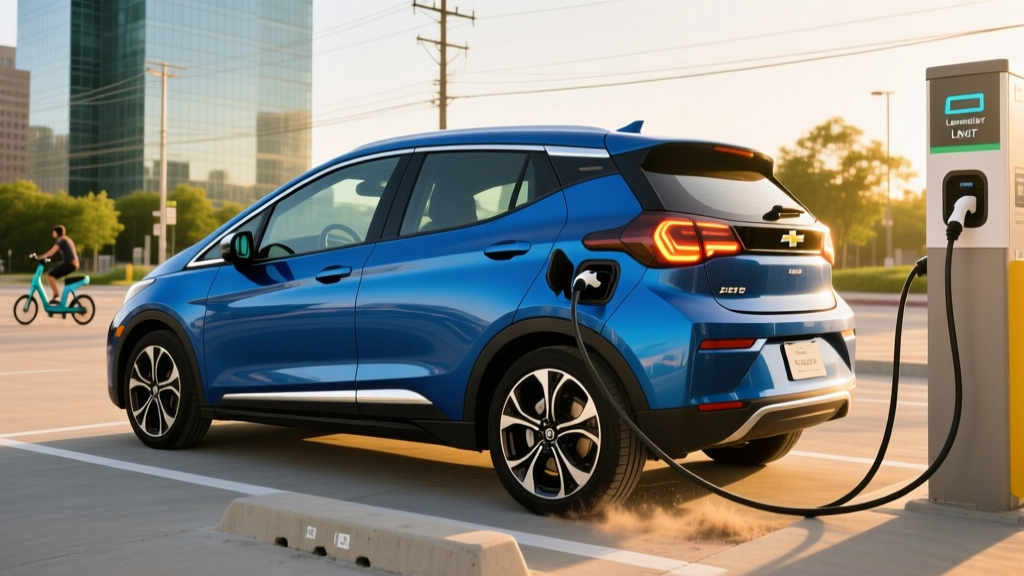
The 2023 Chevrolet Bolt EV 1LT occupies a unique space in the used-EV market of 2026. Originally launched with aggressive pricing and a solid 259-mile EPA range, this compact hatchback remains one of the most affordable ways to get into a proven, long-range battery-electric vehicle. But its slow DC fast-charging speed (55 kW peak) and aging infotainment platform are impossible to ignore as competitors like the Hyundai Kona Electric and Nissan Leaf have moved on. If your daily routine is a predictable commute with home Level 2 charging, the Bolt EV 1LT delivers outstanding value per mile. If you road-trip often, its charging curve will test your patience.
EPA Range vs. Real-World Expectations
EPA Estimated Range: 259 miles (1LT trim)
Real-World Range: Expect 230–245 miles in mixed city/highway driving at moderate temperatures (60–80°F). Sustained highway speeds above 70 mph drop range to roughly 210–225 miles. In cold weather (below 30°F), plan for 180–200 miles due to battery resistance and cabin heating load. The Bolt EV lacks a heat pump, so resistive heating draws directly from the 65 kWh battery pack.
Spec Sheet: 2023 Chevrolet Bolt EV 1LT at a Glance
| Specification | 2023 Bolt EV 1LT |
|---|---|
| EPA Range | 259 miles |
| Battery Capacity (Usable) | ~65 kWh (NMC lithium-ion) |
| EPA Efficiency | 120 MPGe combined / 28 kWh per 100 mi |
| Motor Output | 200 hp / 266 lb-ft torque |
| Drivetrain | Front-wheel drive (single motor) |
| 0–60 mph | ~6.5 seconds |
| Max DC Fast Charge Rate | 55 kW (CCS1 connector) |
| DC 10–80% Charge Time | ~65–70 minutes |
| Level 2 Home Charging | 11.5 kW onboard charger (~39 mi/hr) |
| Cargo Volume | 16.3 cu ft (rear seats up) / 56.6 cu ft (folded) |
| Rear Legroom | 36.0 inches |
| Base MSRP (2023 New) | $26,500 (before destination) |
| Battery/Powertrain Warranty | 8 years / 100,000 miles |
Battery, Range, and Efficiency
The 2023 Bolt EV uses a 65 kWh (usable) NMC (nickel-manganese-cobalt) lithium-ion battery pack manufactured by LG Energy Solution at the Ultium Cells plant in Ohio. Unlike the newer Bolt EUV (which shares the same pack), the standard Bolt EV's lighter curb weight (~3,563 lbs) helps it squeeze out the same 259-mile EPA rating as its longer sibling.
Efficiency is a genuine strong point. At 28 kWh per 100 miles (120 MPGe combined), the Bolt EV sips electrons more thriftily than many larger crossovers. In city driving where regenerative braking recovers energy at every stoplight, owners frequently report beating the EPA estimate — sometimes seeing 270+ miles of range on a full charge. Highway efficiency is less impressive, however, as the Bolt EV's boxy hatchback shape creates more aerodynamic drag than a sleeker sedan.
One important note for 2026 buyers evaluating used examples: GM issued a battery recall on 2017–2019 Bolt EVs due to manufacturing defects that could cause fires at high states of charge. The 2023 model year is not affected by this recall, as GM retooled the battery production process for 2020+ models. Still, it's wise to pull a vehicle history report and confirm no outstanding service bulletins apply to any specific VIN you're considering.
Charging: The Bolt EV's Biggest Limitation
Here's where the 2023 Bolt EV 1LT reveals its most significant weakness in the modern EV landscape. The DC fast-charging peak rate is just 55 kW via its CCS1 connector. For context, most 2025–2026 EVs in this price bracket charge at 100–150 kW, and premium models push 250–350 kW.
| Charging Level | Power / Rate | Time / Miles Added |
|---|---|---|
| Level 1 (120V household) | ~1.2 kW | ~4 miles per hour |
| Level 2 (240V home) | 11.5 kW (48A) | ~39 miles per hour / full charge in ~7 hours |
| DC Fast Charge (CCS1) | 55 kW peak | 10–80% in ~65–70 min; ~100 mi in ~30 min |
What does a 55 kW peak mean in practice? On a road trip, a 10–80% charge takes roughly 65–70 minutes at a compatible DC fast charger. That's nearly double the time you'd spend at a 150 kW charger in a Hyundai Kona Electric. The charge curve is relatively flat — the Bolt EV sustains close to its peak rate from 10% to about 55% state of charge, then tapers gradually. But the low ceiling means even the best portion of the curve is slow by 2026 standards.
For home charging, the 11.5 kW onboard charger is excellent. A Level 2 home station (like a ChargePoint Home Flex or Emporia Level 2) wired to a 60-amp circuit will refill the pack from empty overnight in about 7 hours. This is the Bolt EV's ideal use case: plug in at night, wake up with 259 miles every morning.
One connector note: the 2023 Bolt EV uses the CCS1 (Combined Charging System) standard. With the industry's shift toward NACS (the Tesla connector), CCS1 chargers remain widely available at Electrify America, EVgo, and ChargePoint stations, but GM's newer models have transitioned to NACS. A CCS-to-NACS adapter (available from GM-approved suppliers) may become useful for accessing Tesla Superchargers as networks open up.
Performance and Driving Impressions
The Bolt EV's single front-mounted permanent-magnet motor produces 200 horsepower and 266 lb-ft of torque. That torque is available instantly from zero RPM, giving the hatchback a punchy, eager feel around town. The 0–60 mph sprint takes approximately 6.5 seconds — quick enough to merge confidently onto highways and overtake slower traffic without drama.
Ride quality is compliant for a compact car, though the heavy battery pack (mounted low in the floor) gives the Bolt EV a planted, almost crossover-like stance. Body roll is well-controlled in corners, but the all-season eco tires prioritize efficiency over grip. Steering is light and numb — perfectly adequate for commuting, less engaging on a canyon road.
Regenerative braking offers two modes: standard (coasting with light regen) and one-pedal driving (strong regen that can bring the car to a complete stop without touching the brake pedal). The Bolt EV's one-pedal mode is one of the best-implemented in the segment — smooth, predictable, and easy to modulate. Many owners rarely touch the friction brakes in daily driving.
Interior, Tech, and Driver Assistance
The 1LT trim (the base and only trim for the standard Bolt EV in 2023) includes a 10.2-inch diagonal touchscreen running Chevrolet Infotainment 3 Plus. Wireless Apple CarPlay and Android Auto are standard — a welcome feature that eliminates cable clutter. The interface is functional and responsive, though the graphics feel dated compared to the larger, more modern displays in rivals like the Volkswagen ID.4 or Tesla Model 3.
A 8-inch digital driver cluster replaces traditional gauges, showing range, energy flow, and navigation prompts. A Wi-Fi hotspot, six-speaker audio system, and two USB ports round out the connectivity suite.
On the driver-assistance front, the 2023 Bolt EV 1LT includes Chevy Safety Assist as standard:
- Automatic Emergency Braking with pedestrian detection
- Forward Collision Alert
- Lane Keep Assist with Lane Departure Warning
- Following Distance Indicator
- IntelliBeam automatic high beams
Notably absent: adaptive cruise control is not available on the 1LT trim. You get basic cruise control only. For a car often used as a daily commuter, this omission is a real gap — competitors like the Nissan Leaf and Hyundai Kona Electric offer adaptive cruise even on base trims. Blind-spot monitoring and rear cross-traffic alert are also unavailable on the 1LT (they were included on the 2LT and Premier trims of earlier model years, but 2023 simplified to the single 1LT configuration).
Pricing, Tax Credits, and Value in 2026
When new, the 2023 Chevrolet Bolt EV 1LT carried a base MSRP of $26,500 (plus $995 destination), making it the least expensive 250+ mile EV sold in the United States at the time. GM's aggressive pricing undercut competitors by thousands of dollars.
In the 2026 used-EV market, well-maintained examples with 20,000–40,000 miles typically trade between $14,000 and $18,000 depending on condition, mileage, and regional demand. That positions the Bolt EV as one of the cheapest ways to acquire a long-range, modern EV.
| Cost Factor | Amount |
|---|---|
| Original 2023 MSRP (1LT) | $26,500 + $995 destination |
| Typical 2026 Used Price (20k–40k mi) | $14,000 – $18,000 |
| Federal Used EV Credit (§25E) | Up to $4,000 (30% of sale price, capped) |
| Estimated Price After Credit | $10,000 – $14,000 |
Federal Tax Credit Eligibility: Because the Bolt EV was discontinued after 2023 (with a next-generation model expected later), new-purchase §30D credits no longer apply. However, the §25E Used Clean Vehicle Credit is the relevant incentive for 2026 buyers. This credit provides 30% of the sale price, up to a maximum of $4,000, for qualifying used EVs. Key requirements per the IRS:
- Sale price must be $25,000 or less (the Bolt EV easily qualifies)
- Buyer income caps: $75,000 single / $112,500 head of household / $150,000 joint (modified AGI)
- Vehicle must be at least two model years old (2023 qualifies in 2026)
- Must be purchased from a licensed dealer (private-party sales do not qualify)
- Credit can be transferred to the dealer at point of sale as a down-payment reduction
The Bolt EV is one of the best vehicles to leverage the §25E credit because its used price is well under the $25,000 cap, meaning many buyers can capture the full $4,000 benefit. Always consult a tax professional to confirm eligibility for your specific situation.
Who Should Buy the 2023 Bolt EV 1LT?
Choose the Bolt EV 1LT if:
- You commute 30–80 miles round trip and can charge at home overnight
- Budget is your top priority — you want the lowest cost per mile of EV range
- You rarely take road trips over 200 miles (or don't mind long charge stops)
- You want a compact, easy-to-park hatchback with decent cargo flexibility
- You qualify for the §25E used-EV credit, bringing effective cost below $14,000
Look elsewhere if:
- You road-trip frequently and need fast DC charging (look at the Hyundai Ioniq 5 or Tesla Model 3)
- You need adaptive cruise control or advanced driver assists
- You regularly carry four adults (rear legroom is tight at 36.0 inches)
- You live in an area with limited CCS1 charging infrastructure and no home charging access
Pros and Cons
Pros
- Outstanding value — lowest cost-per-mile-of-range in the used EV market
- Excellent home Level 2 charging speed (11.5 kW onboard charger)
- Strong regenerative braking with intuitive one-pedal driving
- Proven battery chemistry with no recall concerns on 2023 models
- Qualifies for the full $4,000 §25E used-EV credit for eligible buyers
- Wireless Apple CarPlay / Android Auto standard
- Surprisingly roomy cargo area (56.6 cu ft with seats folded)
Cons
- DC fast charging limited to 55 kW — painfully slow for road trips
- No adaptive cruise control available on any 2023 trim
- Dated infotainment graphics and small screen by 2026 standards
- CCS1 connector in a market shifting to NACS
- Tight rear legroom for taller passengers
- No heat pump — cold-weather range loss is significant
- Discontinued model — long-term parts and support questions remain
Frequently Asked Questions
What is the real-world range of the 2023 Chevrolet Bolt EV 1LT?
The EPA rates the Bolt EV 1LT at 259 miles. In real-world mixed driving at moderate temperatures, expect 230–245 miles. Highway-only driving at 75+ mph reduces this to roughly 210–225 miles, and cold weather (below 30°F) can drop range to 180–200 miles due to the lack of a heat pump and increased battery resistance.
How fast does the Bolt EV charge at home and on the road?
At home on a Level 2 (240V) charger, the Bolt EV accepts up to 11.5 kW, adding about 39 miles of range per hour and fully recharging in approximately 7 hours. On DC fast chargers, the peak rate is only 55 kW, meaning a 10–80% charge takes 65–70 minutes — significantly slower than most modern EVs.
Does the 2023 Bolt EV qualify for a federal tax credit in 2026?
As a used vehicle in 2026, the Bolt EV can qualify for the §25E Used Clean Vehicle Credit — up to $4,000 (30% of sale price). Eligibility requires buyer income below IRS caps, a sale price of $25,000 or less, purchase from a licensed dealer, and the vehicle must be at least two model years old. Consult a tax professional for your specific situation.
Is the 2023 Bolt EV worth buying over competitors in 2026?
For budget-conscious commuters with home charging, the Bolt EV is arguably the best value in the used-EV market — especially when the §25E credit brings the effective price below $14,000. However, if you need fast road-trip charging, adaptive cruise control, or a more modern interior, the used Hyundai Kona Electric, Nissan Leaf, or a higher-mileage Tesla Model 3 may serve you better at a slightly higher price point.
What is the battery warranty on the 2023 Bolt EV?
GM covers the Bolt EV's battery pack and electric powertrain for 8 years or 100,000 miles (whichever comes first). The warranty guarantees the battery will retain a minimum capacity threshold (typically 60–70% of original capacity, per GM's warranty documentation). For a 2023 model, this coverage extends through 2031 or 100,000 miles.
Can I charge the Bolt EV at Tesla Superchargers?
The 2023 Bolt EV uses the CCS1 connector. As of 2026, Tesla has opened portions of its Supercharger network to non-Tesla EVs via the Tesla app, but only at stations equipped with the Magic Dock CCS adapter or designated as open to CCS vehicles. Availability varies by region. A GM-approved CCS-to-NACS adapter may expand access further.
Sources: EPA Fuel Economy – 2023 Chevrolet Bolt EV, IRS §25E Used Clean Vehicle Credit, Chevrolet Bolt EV Official Page