Quick Verdict: The Electric Gran Coupe That Drives Like a BMW
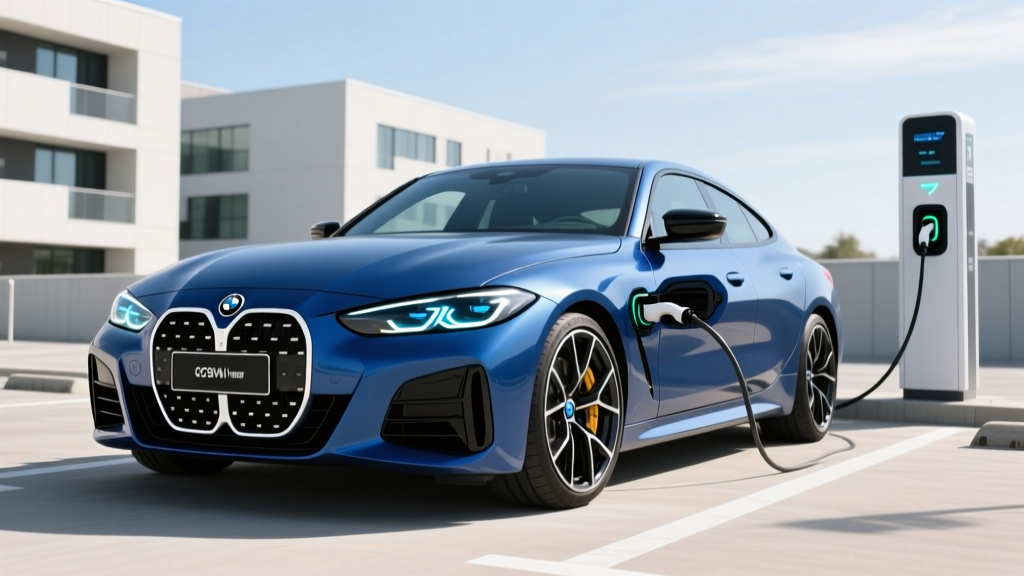
The 2023 BMW i4 is the automaker's first all-electric gran coupe, built on the same CLAR platform as the 4 Series Gran Coupe. That shared architecture is both its greatest strength and its defining compromise. The i4 drives with the poise, steering feedback, and chassis balance that BMW loyalists expect — but it also carries the packaging limitations of a vehicle not designed from the ground up as an EV. The result is a compelling electric sports sedan with a prominent rear floor hump, modest trunk space, and genuine driver engagement that's increasingly rare in the EV space.
Available in two trims — the single-motor rear-wheel-drive eDrive40 and the dual-motor all-wheel-drive M50 — the 2023 i4 covers buyers seeking refined daily commuting through those wanting M-badge performance. Both share the same 83.9 kWh (gross) battery pack, but their efficiency and range profiles diverge significantly.
Range, Efficiency, and Real-World Expectations
| Spec | eDrive40 | M50 |
|---|---|---|
| EPA Range | 301 miles (18" wheels) / 270 miles (19" wheels) | 270 miles (18" wheels) / 227 miles (20" wheels) |
| Battery (Gross / Usable) | 83.9 kWh / ~80.7 kWh | 83.9 kWh / ~80.7 kWh |
| Battery Chemistry | NMC (Nickel Manganese Cobalt) | NMC (Nickel Manganese Cobalt) |
| MPGe (Combined) | 109 MPGe | 91 MPGe |
| kWh / 100 mi | 31 kWh/100mi | 37 kWh/100mi |
| Drivetrain | RWD (single rear motor) | AWD (dual motor) |
Data sourced from fueleconomy.gov. Wheel size has an outsized effect on the i4's range — the 19" and 20" options cost you roughly 30-40 miles of EPA-rated range compared to the base 18" Aero wheels.
Real-World Range Reality Check
EPA Sticker: 301 miles (eDrive40, 18" wheels)
Expect in practice: ~255–275 miles on a mixed highway commute at 70–75 mph in moderate temperatures. Sustained highway driving at 80+ mph drops this to ~230–250 miles. In cold weather (below 32°F), budget for a 20–30% reduction — real-world winter range of ~200–220 miles is typical without aggressive preconditioning. City driving with regen braking can match or slightly exceed EPA figures.
Why it matters: The i4's NMC battery uses a conservative buffer (~3.2 kWh top and bottom) to protect long-term health. You'll rarely see the full 80.7 kWh usable capacity on the dash. Plan road trips assuming 250 miles of comfortable range in the eDrive40 and 210 miles in the M50, especially in winter or at highway speeds.
Charging Speed: DC Fast and Home Level 2
The i4 supports up to 205 kW peak DC fast charging via its CCS1 connector. BMW quotes a 10–80% charge time of approximately 31 minutes under ideal conditions. In real-world testing at 350 kW Electrify America or comparable stations, the i4's charge curve is respectable but not class-leading. Peak rate holds through roughly 30–40% State of Charge (SoC), then tapers progressively. Expect 10–80% in 31–36 minutes depending on battery temperature and station output. If you arrive with a cold battery, preconditioning via the BMW iDrive navigation routing to a charger is essential — without it, peak rates can be cut in half for the first several minutes.
| Charging Level | Power / Rate | Speed | Notes |
|---|---|---|---|
| Level 1 (120V household) | ~1.4 kW | ~4–5 miles/hour | Emergency/trickle only; full charge in ~55+ hours |
| Level 2 (240V home/public) | Up to 11 kW (48A) | ~30–35 miles/hour | Full 0–100% in ~8.25 hours; ideal overnight |
| DC Fast Charge (CCS1) | Up to 205 kW peak | 10–80% in ~31 min | Tapers above 80%; precondition via nav for best results |
For home charging, the i4's onboard charger maxes at 11 kW (three-phase) or approximately 9.6 kW on a typical US single-phase 48A Level 2 circuit. This is solid — it means a near-empty battery fully replenishes overnight in about 8–9 hours. Most owners will plug in nightly and rarely need a full 0–100% cycle, keeping daily charging well within a 3–4 hour window for typical commutes.
Performance and Driving Dynamics
| Spec | eDrive40 | M50 |
|---|---|---|
| Horsepower | 335 hp | 536 hp (Sport Boost) |
| Torque | 317 lb-ft | 586 lb-ft |
| 0–60 mph | 5.5 seconds | 3.7 seconds |
| Top Speed | 118 mph | 130 mph |
| Drivetrain | Rear-wheel drive | Dual-motor AWD |
| Curb Weight | ~4,682 lbs | ~4,997 lbs |
The eDrive40's single rear-mounted electric motor delivers 335 horsepower with a linear, lag-free torque curve that makes it genuinely quick in daily driving. The 5.5-second 0–60 time undersells how responsive it feels at part-throttle around town. The eDrive40 is also the more efficient and balanced-feeling variant — its lighter front end (no motor) and RWD bias give it a classic BMW character that's increasingly hard to find.
The M50 is a different animal entirely. With dual motors and 536 hp on Sport Boost (available in 10-second bursts via the paddle shifter), it hits 60 mph in 3.7 seconds — firmly M3 territory. The adaptive M suspension and variable sport steering are standard, and the chassis manages its ~5,000 lb curb weight with impressive composure. However, the M50's efficiency penalty is steep: you give up roughly 30–40 miles of EPA range compared to the eDrive40.
Both trims feature BMW's adaptive regenerative braking, which uses radar and navigation data to adjust regen intensity based on traffic and upcoming road conditions. It works well in practice, though some drivers may prefer the manual regen paddle settings (high, medium, low) for more predictable one-pedal driving. Unlike some competitors, the i4 does not offer a true one-pedal mode that brings the car to a complete stop without touching the brake — it will creep at low speeds.
Interior, Technology, and Cargo Space
The 2023 i4 debuts BMW's iDrive 8 infotainment system on a sweeping curved display that combines a 12.3" digital instrument cluster and a 14.9" central touchscreen. The system is fast, graphically rich, and supports wireless Apple CarPlay and Android Auto. Physical shortcut buttons below the screen are a welcome retention, though climate controls are now embedded in the touchscreen — a frustration for some drivers.
The BMW Intelligent Personal Assistant responds to natural voice commands and can control vehicle settings, navigation, and media. Over-the-air (OTA) updates are supported for continuous feature improvements.
Driver Assistance (ADAS)
SAE Automation Level: Level 2
The i4's Driving Assistance Professional Package (adaptive cruise, lane centering, automated lane changes) is a Level 2 driver-assist system. The driver must remain fully engaged, keep hands on the wheel, and monitor the road at all times. This is not autonomous or "self-driving" capability.
The available Driving Assistance Professional Package adds stop-and-go adaptive cruise control, active lane keeping with automated lane changes, and evasion assist. The standard Active Driving Assistant includes forward collision warning, automatic emergency braking, lane departure warning, and rear cross-traffic alert. It's a competent Level 2 system, though not as assertive in lane centering as GM's Super Cruise or Ford's BlueCruise on compatible highways.
Passenger and Cargo Dimensions
| Dimension | Measurement |
|---|---|
| Front Headroom | 38.3 in |
| Rear Headroom | 36.3 in |
| Front Legroom | 42.2 in |
| Rear Legroom | 34.5 in |
| Cargo Volume (rear seats up) | 16.6 cu ft |
| Cargo Volume (rear seats folded) | 45.6 cu ft |
| Frunk (front trunk) | None — charging cables stored in rear under-floor |
The gran coupe liftback design gives the i4 a wide trunk opening and decent utility, but the 16.6 cu ft of cargo space is modest for the class — and there's no frunk to compensate. The rear floor hump (a legacy of the shared ICE platform) intrudes on the center rear footwell, making three-across seating uncomfortable. Rear legroom at 34.5 inches is tight for taller adults on longer trips. If cargo versatility or rear-seat comfort is a priority, competitors like the Tesla Model 3 or Hyundai Ioniq 6 offer more practical layouts.
Pricing, Trims, and Federal Tax Credit Eligibility
| Trim | Base MSRP (2023) | As-Tested Range | Est. After §30D Credit |
|---|---|---|---|
| eDrive40 | $55,900 | $58,000–$68,000 (w/ options) | $48,400–$60,500* |
| M50 | $69,700 | $72,000–$85,000 (w/ options) | $62,200–$77,500* |
*Tax credit estimates assume full eligibility. Actual credit varies based on battery sourcing compliance, buyer income, and MSRP caps.
Does the 2023 BMW i4 Qualify for the Federal EV Tax Credit?
The 2023 i4's eligibility for the IRS §30D Clean Vehicle Credit (up to $7,500) is complex and trim/batch-dependent. Here's what buyers must verify:
- MSRP Cap: The i4 qualifies as a sedan under §30D, so the MSRP cap is $55,000. The eDrive40's base MSRP of $55,900 exceeds this cap, meaning new 2023 eDrive40 units may not qualify unless optioned below the threshold (unlikely). The M50 at $69,700 base far exceeds the cap.
- Buyer Income Limits: Modified Adjusted Gross Income must not exceed $150,000 (single), $225,000 (head of household), or $300,000 (joint filing).
- Battery Sourcing: A percentage of critical minerals and battery components must be sourced from the US or FTA partners. BMW's supply chain has been evolving, and compliance varies by production batch.
- Final Assembly: The i4 is assembled in Munich, Germany — this disqualifies it from the new-vehicle §30D credit under the Inflation Reduction Act's North American final assembly requirement.
Critical note: Because the 2023 BMW i4 is manufactured in Germany, it does not meet the North American final assembly requirement for the new-vehicle §30D federal tax credit. Buyers should not expect the $7,500 credit on a new 2023 i4. However, the i4 may qualify for the used EV tax credit (up to $4,000 or 30% of sale price, whichever is less) when purchased from a dealer as a qualifying used vehicle — subject to income caps, dealer reporting, and a sale price below $25,000. Always verify current rules at IRS.gov and consult a tax professional before purchasing.
Warranty and Ownership Costs
| Coverage | Term |
|---|---|
| Basic Vehicle Warranty | 4 years / 50,000 miles |
| Powertrain Warranty | 4 years / 50,000 miles |
| High-Voltage Battery | 8 years / 100,000 miles (retains ≥70% capacity) |
| Corrosion Perforation | 12 years / unlimited miles |
| Roadside Assistance | 4 years / unlimited miles |
| Complimentary Maintenance | 3 years / 36,000 miles |
BMW's battery warranty guarantees the high-voltage pack will retain at least 70% of its original capacity over 8 years or 100,000 miles — an industry-standard threshold shared with most competitors. NMC chemistry in the i4 has shown minimal degradation in early fleet data, with most owners reporting 95%+ State of Health (SoH) after 30,000+ miles. BMW's thermal management system (liquid cooling/heating) actively conditions the battery, which supports long-term longevity.
BMW includes 3 years of complimentary scheduled maintenance, which is a genuine value-add compared to rivals. EVs require less routine maintenance than ICE vehicles (no oil changes, fewer brake replacements thanks to regen), so ownership costs are primarily driven by insurance premiums (typically 15–25% higher than a comparable gas 4 Series), tire replacement (EVs wear tires faster due to weight and instant torque), and electricity costs.
Pros and Cons
Pros
- Exceptional driving dynamics — genuine BMW steering feel and chassis balance
- Up to 301 miles EPA range (eDrive40 with 18" wheels)
- Refined, quiet cabin with premium materials
- iDrive 8 curved display is fast and intuitive
- 205 kW DC fast charging is adequate for road trips
- Adaptive regen braking works well in traffic
- 3 years complimentary maintenance included
- Strong build quality and fit/finish
Cons
- No federal tax credit on new units (German assembly, MSRP cap issues)
- Modest cargo space (16.6 cu ft) and no frunk
- Prominent rear floor hump limits center-seat usability
- Tight rear legroom (34.5 in) for the class
- Climate controls buried in touchscreen
- No true one-pedal driving to a full stop
- Wheel upgrades penalize range significantly (up to ~40 mi loss)
- Charging port on driver-side rear (inconvenient at some stations)
Who Should Buy the 2023 BMW i4?
Choose the i4 eDrive40 if:
- You prioritize driving dynamics and brand prestige over maximum cargo space
- Your daily commute is under 80 miles round-trip with home charging access
- You want a refined, quiet luxury EV sedan that doesn't look like a "tech pod"
- Rear-seat passengers are occasional or small (children, shorter adults)
Choose the i4 M50 if:
- You want M3-rivaling performance (3.7s 0–60) with daily-driver comfort
- You live in a climate where AWD traction is valuable
- Range sacrifice (~30–40 mi less than eDrive40) is acceptable for the performance
Look elsewhere if:
- Federal tax credit eligibility is a dealbreaker (consider the Tesla Model 3, Ford Mustang Mach-E, or Hyundai Ioniq 6 — all assembled in North America)
- You need generous rear-seat space or cargo versatility
- You want a frunk or dedicated EV platform packaging
- Ultra-fast DC charging (250+ kW sustained) is a priority — consider Hyundai/Kia E-GMP vehicles
How Does the 2023 BMW i4 Compare to Key Rivals?
| Spec | BMW i4 eDrive40 | Tesla Model 3 Long Range | Hyundai Ioniq 6 SEL |
|---|---|---|---|
| EPA Range | 301 mi | 341 mi | 361 mi |
| Base MSRP | $55,900 | $47,740 | $42,450 |
| DC Fast Charge Peak | 205 kW | 250 kW | 235 kW (350 kW capable) |
| 10–80% Time | ~31 min | ~30 min | ~18 min |
| 0–60 mph | 5.5 sec | 4.2 sec | 5.1 sec |
| Cargo Volume | 16.6 cu ft | 23 cu ft | 12.3 cu ft (trunk) |
| §30D Credit Eligible | No (German assembly) | Yes (partial, sourcing dependent) | Yes (GA assembly) |
The i4's premium is justified by build quality, driving refinement, and BMW's dealer network — but on pure range-per-dollar and charging speed, the Model 3 Long Range and Ioniq 6 are objectively more efficient and faster-charging. The Ioniq 6's 800V architecture enables 10–80% in roughly 18 minutes at a 350 kW station, a meaningful advantage for road trippers. The Model 3 still leads in range and Supercharger network access.
Safety ratings from IIHS and NHTSA should be checked for the specific model year, as the i4's shared platform with the 4 Series Gran Coupe provides a strong structural foundation.
Frequently Asked Questions
What is the real-world range of the 2023 BMW i4?
The eDrive40 with 18" wheels achieves an EPA-estimated 301 miles. In real-world mixed driving at highway speeds (70–75 mph), expect 255–275 miles. Cold weather (below freezing) can reduce this to 200–220 miles. The M50's real-world range is approximately 210–240 miles depending on driving style and conditions.
How fast does the BMW i4 charge at home and on the road?
At home on a 240V Level 2 charger (48A), the i4 charges at up to 11 kW, adding roughly 30–35 miles per hour and reaching a full charge in about 8 hours. On DC fast chargers, it peaks at 205 kW and charges from 10–80% in approximately 31 minutes. Always precondition the battery via navigation routing for best DC charging speeds.
Does the 2023 BMW i4 qualify for the $7,500 federal EV tax credit?
Generally, no. The i4 is assembled in Munich, Germany, which disqualifies it from the new-vehicle §30D credit's North American final assembly requirement. Additionally, the eDrive40's base MSRP of $55,900 exceeds the $55,000 sedan cap. Buyers may qualify for the used EV credit (up to $4,000) when purchasing a pre-owned i4 under $25,000 from a dealer, subject to income limits. Always verify eligibility at IRS.gov.
Is the BMW i4 worth buying vs. the Tesla Model 3 or Hyundai Ioniq 6?
The i4 is worth considering if you value BMW's driving dynamics, interior luxury, and dealer service experience over maximum range and charging speed. The Model 3 Long Range offers more range (341 mi), Supercharger access, and a lower price. The Ioniq 6 offers the best range (361 mi), fastest charging (18 min 10–80%), and qualifies for the federal credit. If driving feel and brand cachet matter most, the i4 earns its premium. If efficiency and value lead your decision, look at the alternatives.
What's the biggest drawback of the BMW i4?
The most common complaints center on packaging: the lack of a frunk, a prominent rear floor hump that compromises the center rear seat, and cargo volume (16.6 cu ft) that trails rivals. The i4's adapted ICE platform means it doesn't offer the flat-floor, space-maximized layout of a purpose-built EV like the Tesla Model 3 or Hyundai Ioniq 5/6. For a luxury sedan buyer who rarely uses the rear seats, this is a minor trade-off. For families, it's a genuine limitation.
What battery chemistry does the BMW i4 use?
The 2023 BMW i4 uses an NMC (Nickel Manganese Cobalt) lithium-ion battery with a gross capacity of 83.9 kWh and approximately 80.7 kWh usable. NMC offers high energy density (enabling the 301-mile range in a compact pack) but requires more careful thermal management and typically shows slightly more long-term degradation than LFP chemistry. BMW's liquid thermal management system and conservative buffer strategy help mitigate this.