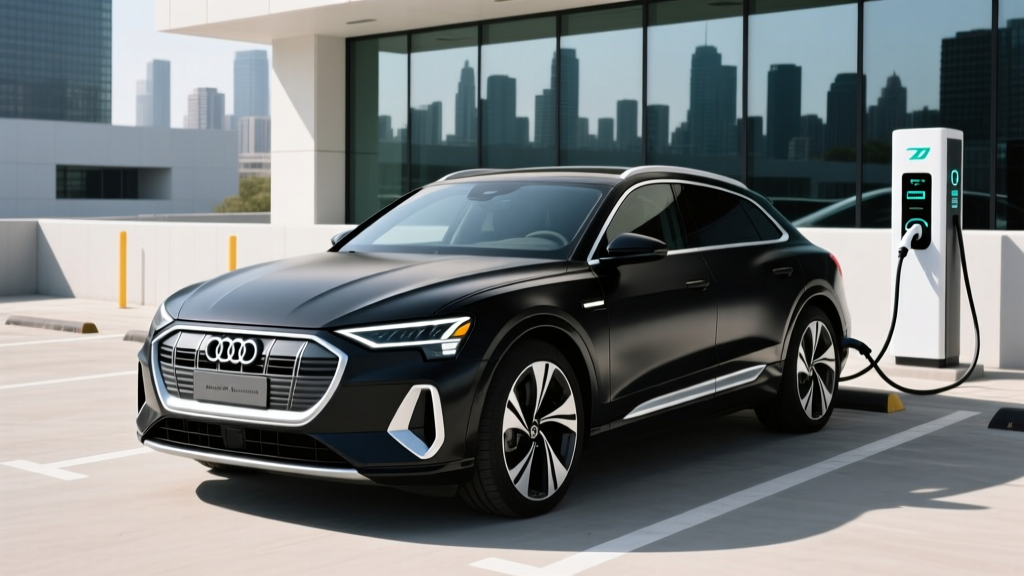
The 2023 Audi e-tron occupies a specific niche in the luxury EV space: it doesn't chase Tesla-beating range numbers or headline-grabbing 0-60 times. Instead, it delivers the build quality, cabin isolation, and understated design that traditional luxury buyers expect — wrapped in a fully electric package. But with competitors like the BMW iX, Mercedes EQE SUV, and even Audi's own Q8 e-tron successor pushing further on range and charging speed, the 2023 model year represents a critical inflection point. Here's everything you need to know before buying one on the new or certified pre-owned market.
Spec Sheet: 2023 Audi e-tron at a Glance
| Spec | 2023 Audi e-tron (Premium Plus) | 2023 Audi e-tron S |
|---|---|---|
| EPA Range | 222 miles | 208 miles |
| Battery (usable) | 86.5 kWh (NMC) | 86.5 kWh (NMC) |
| Max DC Fast Charge | 150 kW | 150 kW |
| 10-80% DC Charge Time | ~30 minutes | ~30 minutes |
| Level 2 Charge Rate | 9.6 kW (~21 mi/hr) | 9.6 kW (~21 mi/hr) |
| 0-60 mph | 5.5 seconds | 4.5 seconds |
| Horsepower | 355 hp (402 hp boost) | 434 hp (503 hp boost) |
| Drivetrain | Dual-motor AWD (quattro) | Tri-motor AWD |
| MPGe (combined) | 78 MPGe | 74 MPGe |
| Efficiency | 43 kWh/100 mi | 45 kWh/100 mi |
| Cargo (rear seats up) | 28.5 cu ft | 28.5 cu ft |
| Cargo (rear seats folded) | 57.0 cu ft | 57.0 cu ft |
| Base MSRP | $70,800 | $88,200 |
| Battery Warranty | 8 yr / 100,000 mi | 8 yr / 100,000 mi |
Real-World Range: What the EPA Number Doesn't Tell You
Real-World Highway (70 mph, 72°F): ~190-205 miles
Real-World Cold Weather (32°F, mixed driving): ~155-175 miles
Real-World City/Commuter (regenerative braking active): ~210-225 miles
The 2023 Audi e-tron's 222-mile EPA rating sits well below rivals — the BMW iX xDrive50 achieves 324 miles, and the Tesla Model X Long Range posts 348 miles. Audi engineered the e-tron with a conservative battery buffer (roughly 9 kWh reserved from the 95 kWh gross pack) to protect long-term battery health, which is smart for longevity but limits usable range today.
In practice, the e-tron's efficiency of 43 kWh per 100 miles means you're consuming more energy per mile than lighter competitors. The dual-motor quattro system adds weight (5,280 lbs curb weight), and the aerodynamic profile, while handsome, isn't as slippery as purpose-built EV platforms. On a 70-mph highway loop in moderate temperatures, expect roughly 190-205 miles before the battery indicator pushes you toward a charger. In freezing conditions, the heat pump (standard on 2023 models) helps, but 25-30% range loss is typical for any EV without preconditioning the battery.
For daily commuting under 80 miles round-trip with home charging, the range is perfectly adequate. For frequent 300+ mile road trips, you'll be stopping every 2.5-3 hours — manageable with DC fast charging, but noticeably more often than in a 300+ mile EV.
Charging Speed and Infrastructure
Audi equipped the 2023 e-tron with a 150 kW peak DC fast-charging capability on a CCS1 connector. The charge curve is one of the e-tron's genuine engineering strengths: it sustains near-peak power longer than many competitors, holding above 120 kW well past 60% state of charge before tapering.
| Charging Method | Power / Rate | Time / Range Added |
|---|---|---|
| Level 1 (120V household) | 1.4 kW | ~3 miles per hour |
| Level 2 (240V, 40A circuit) | 9.6 kW | ~21 miles per hour; full charge in ~10 hours |
| DC Fast Charge (CCS1) | 150 kW peak | 10-80% in ~30 minutes; ~130 miles in 20 min |
At home on a Level 2 wallbox, the 9.6 kW onboard charger replenishes the 86.5 kWh usable battery in roughly 10 hours from near-empty. Most owners who plug in nightly will never deplete below 30%, meaning a typical overnight session adds 100-150 miles in 5-7 hours — more than enough for daily needs.
On the road, the 150 kW peak rate means a 10-80% session takes approximately 30 minutes at a properly functioning Electrify America or EVgo station. The e-tron's thermal management system excels here: preconditioning the battery via the navigation-routed charging feature brings the pack to optimal temperature, and the flat charge curve means you're not waiting around at low power above 80% as dramatically as some rivals. However, 150 kW is now a step behind — Hyundai's E-GMP platform and Porsche's Taycan both accept 270-350 kW on 800V architectures.
The 2023 e-tron uses the CCS1 connector standard. It does not have a native NACS (Tesla) port, though Audi has committed to NACS adoption on future models. For Supercharger access, a CCS-to-NACS adapter is required; Audi has not officially endorsed a specific adapter for the 2023 e-tron as of early 2026.
Performance and Driving Dynamics
The standard e-tron's dual-motor quattro setup produces 355 horsepower in normal driving, with a boost mode (activated via the transmission selector) that temporarily raises output to 402 hp and 490 lb-ft of torque. The 0-60 mph sprint completes in 5.5 seconds — quick for a 5,280-pound SUV, but not thrilling by EV standards.
The e-tron S variant adds a tri-motor configuration (one front, two rear) producing 434 hp standard and 503 hp in boost mode, dropping 0-60 to 4.5 seconds. The rear torque-vectoring motors provide noticeably sharper cornering behavior, making the S feel more agile than its weight suggests.
Where the e-tron truly excels is refinement. The cabin isolation at highway speeds rivals anything in the luxury SUV segment. The adaptive air suspension (standard) absorbs road imperfections with composure, and the steering — while not communicative — is precise and confidence-inspiring. Regenerative braking offers three levels selectable via steering-wheel paddles, but the e-tron does not offer true one-pedal driving to a full stop; you'll still use the brake pedal at low speeds. This is a deliberate Audi choice that frustrates some EV veterans but feels natural to drivers transitioning from ICE vehicles.
Pricing, Trims, and Federal Tax Credit Eligibility
The 2023 Audi e-tron launched with the following MSRP structure (destination charge included):
| Trim | MSRP | Key Additions |
|---|---|---|
| e-tron Premium Plus | $70,800 | Matrix LED headlights, panoramic roof, virtual cockpit, 10.1" + 8.6" MMI touchscreens |
| e-tron Prestige | $76,600 | Head-up display, Bang & Olusen 3D audio, Night Vision assist, power soft-close doors |
| e-tron S Premium Plus | $88,200 | Tri-motor powertrain, sport rear differential, S-specific styling |
| e-tron S Prestige | $94,000 | Full S equipment with Prestige luxury package |
Federal Tax Credit (§30D) — 2026 Rules
Under current IRS §30D rules, the 2023 Audi e-tron's federal tax credit eligibility depends on several factors that shift annually:
- MSRP Cap: SUVs must be at or below $80,000. The e-tron Premium Plus ($70,800) and Prestige ($76,600) qualify. The e-tron S trims ($88,200+) exceed the cap and are ineligible.
- Buyer Income Cap: Modified AGI must not exceed $150,000 (single), $225,000 (head of household), or $300,000 (joint filers).
- Battery Sourcing Requirements: Critical minerals and battery component sourcing rules tighten each year. As of 2026, vehicles with battery components from a "foreign entity of concern" (FEOC) are disqualified. Audi sources its LG Energy Solution battery cells from plants that have been subject to shifting FEOC determinations — verify current eligibility on fueleconomy.gov before purchasing.
- Point-of-Sale Transfer: Eligible buyers can transfer the credit to the dealer at purchase, reducing the upfront price rather than waiting for a tax refund.
If fully eligible, the maximum credit is $7,500 — bringing an e-tron Premium Plus to an effective ~$63,300. However, battery sourcing rules have disqualified many European-built EVs from the full credit in recent years. Confirm with your dealer and a tax professional before counting on the full amount.
Interior, Cargo, and Technology
The e-tron's cabin is where Audi's luxury credentials shine most clearly. Dual-touchscreen MMI (10.1-inch upper, 8.6-inch lower) handles infotainment and climate controls with haptic feedback that confirms inputs. The 12.3-inch Virtual Cockit instrument cluster is standard, and the available head-up display (Prestige trim) projects navigation and speed into your sightline.
Passenger space is generous for a mid-size SUV: 41.4 inches of front legroom and 38.5 inches in the rear accommodate tall adults comfortably. The flat floor (no transmission tunnel) makes the middle rear seat more usable than in ICE Audi SUVs.
Cargo volume measures 28.5 cubic feet behind the second row and 57.0 cubic feet with rear seats folded. There is no front trunk (frunk) — the space under the hood houses electronics and the HVAC system. Compared to the Tesla Model X (up to 88.1 cu ft max) or the BMW iX (65.5 cu ft), the e-tron's cargo area is modest but well-shaped and lined with premium materials.
Driver assistance comes via Audi's Adaptive Cruise Assist with lane guidance — a Level 2 SAE system that requires hands on the wheel and continuous driver supervision. It performs competently on highways but does not approach the hands-free capability of GM's Super Cruise or Ford's BlueCruise on mapped roads. Automatic emergency braking, blind-spot monitoring, rear cross-traffic alert, and a 360-degree camera are standard across all trims.
Ownership Costs and Warranty
Audi backs the 2023 e-tron with a 4-year/50,000-mile limited warranty and an 8-year/100,000-mile battery warranty covering defects and capacity loss below 70% of original capacity. The 70% threshold is standard for the industry but means a degraded battery at 71% capacity won't trigger a warranty replacement — something to understand for long-term ownership.
Insurance costs for the e-tron run higher than comparable ICE SUVs; expect quotes 15-25% above an equivalently priced Audi Q5, reflecting EV repair costs and parts pricing. Average annual premiums land in the $2,400-$3,200 range depending on state, age, and driving record.
Electricity costs are the e-tron's clear ownership advantage. At the national average residential rate of $0.16/kWh (EIA data), fully charging the 86.5 kWh usable battery costs roughly $13.84 — versus approximately $55-$65 to fill a comparable gas SUV's tank at $3.50/gallon. Over 15,000 miles annually, the e-tron uses approximately 6,450 kWh ($1,032/year) versus a 22-mpg gas SUV burning 682 gallons ($2,387/year). That's roughly $1,350 in annual fuel savings, or $6,750 over five years — offsetting a meaningful portion of the price premium.
How It Stacks Up Against Key Competitors
| 2023 Audi e-tron | 2023 BMW iX xDrive50 | 2023 Tesla Model X LR | 2023 Mercedes EQE 350+ SUV | |
|---|---|---|---|---|
| EPA Range | 222 mi | 324 mi | 348 mi | 305 mi |
| Battery (usable) | 86.5 kWh | 105.2 kWh | 100 kWh | 90.6 kWh |
| DC Fast Charge | 150 kW | 195 kW | 250 kW | 170 kW |
| 0-60 mph | 5.5 sec | 4.6 sec | 3.8 sec | 6.4 sec |
| Base MSRP | $70,800 | $84,100 | $79,990 | $77,900 |
| Cargo (max) | 57.0 cu ft | 65.5 cu ft | 88.1 cu ft | 59.2 cu ft |
The e-tron's range deficit is its most obvious competitive weakness. Buyers prioritizing road-trip capability will find the BMW iX or Tesla Model X substantially more capable between charging stops. The iX also charges faster and offers more cargo room, though at a higher starting price.
Where the e-tron wins is cabin quality and ride comfort. The materials, switchgear feel, and sound insulation are a tier above the Tesla and competitive with the BMW and Mercedes. If your priority is a serene, beautifully finished cabin for daily commuting and moderate-distance travel, the e-tron delivers a luxury experience that spec sheets don't capture.
- Luxury buyers transitioning from ICE who value build quality over range maximization
- Daily commuters with sub-80-mile round trips and reliable home Level 2 charging
- Buyers who find a strong CPO deal or qualify for the full $7,500 federal credit
- Those who prefer Audi's design language and MMI interface over Tesla's minimalism
- Frequent road-trippers who need 300+ miles of range
- Buyers who prioritize the fastest possible DC charging
- Those who want hands-free Level 2 driving assist on highways
- Shoppers who need maximum cargo volume (families with large gear)
Pros and Cons
- Exceptional cabin quietness and ride refinement
- Flat DC fast-charge curve sustains high power longer than rivals
- Premium materials and build quality throughout
- Standard air suspension with adaptive damping
- Strong regenerative braking system with paddle-select levels
- Heat pump standard (improves cold-weather efficiency)
- 222-mile EPA range trails competitors by 80-120+ miles
- 150 kW peak DC charging now below segment average
- No frunk (front trunk) for additional storage
- No true one-pedal driving to a complete stop
- e-tron S trims exceed $80K MSRP cap for federal tax credit
- CCS1 connector; no native NACS/Supercharger access
- Modest cargo volume for the vehicle's exterior size
Frequently Asked Questions
What is the real-world range of the 2023 Audi e-tron?
Expect 190-205 miles on the highway in moderate temperatures, 155-175 miles in freezing cold, and up to 225 miles in city commuting with regenerative braking active. The 222-mile EPA estimate is achievable in mixed driving under ideal conditions, but highway-heavy trips at 70+ mph will fall short.
How fast does the 2023 e-tron charge at home and on the road?
At home on a Level 2 (240V/40A) charger, the 9.6 kW onboard charger adds roughly 21 miles of range per hour, fully replenishing the battery in about 10 hours. On a DC fast charger, the 150 kW peak rate delivers a 10-80% charge in approximately 30 minutes. The e-tron's charge curve is notably flat, meaning it holds higher power deeper into the session than many competitors.
Does the 2023 Audi e-tron qualify for the $7,500 federal EV tax credit?
The e-tron Premium Plus ($70,800) and Prestige ($76,600) are below the $80,000 SUV MSRP cap. The e-tron S trims ($88,200+) exceed it and are ineligible. Buyer income caps ($150K single / $300K joint) and battery sourcing requirements (FEOC rules) also apply. Check current eligibility on fueleconomy.gov and consult a tax professional, as sourcing rules change annually.
Is the 2023 Audi e-tron worth buying versus a BMW iX or Tesla Model X?
If range and charging speed are your top priorities, the BMW iX (324 mi, 195 kW) or Tesla Model X (348 mi, 250 kW) are stronger choices. If cabin luxury, ride comfort, and build quality matter most — and your daily driving stays under 150 miles — the e-tron's refinement advantage is real, especially at the Premium Plus price point with a tax credit.
What is the battery warranty on the 2023 e-tron?
Audi covers the battery for 8 years or 100,000 miles against defects and capacity loss below 70% of original capacity. The general vehicle warranty is 4 years/50,000 miles. For CPO purchases, verify remaining warranty coverage with the dealer.
Can the 2023 e-tron use Tesla Superchargers?
Not natively. The 2023 e-tron uses the CCS1 connector. A third-party CCS-to-NACS adapter may enable Supercharger access, but Audi has not officially validated adapter compatibility for this model year. Future Audi models are transitioning to native NACS ports.