The 2022 VW ID.4 at a Glance: Quick Verdict
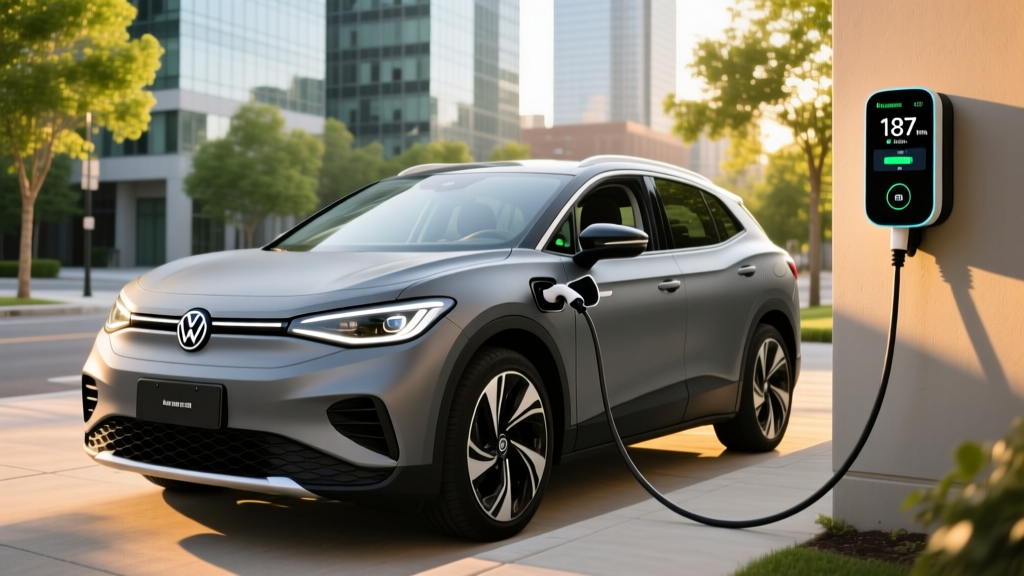
The 2022 Volkswagen ID.4 arrived as VW's first mass-market electric crossover for the US, built on the MEB platform in Chattanooga, Tennessee. By 2026, it remains one of the most common used EVs on the market — a practical, roomy compact SUV that prioritizes comfort and daily usability over head-turning performance. If you're shopping the used EV market or evaluating whether the 2022 model year still holds up against newer rivals, this review covers the exact numbers that matter: real-world range, charging curves, battery health expectations, and what ownership actually costs.
Short version: the 2022 ID.4 is a competent family EV with a usable 249–275 miles of EPA range, acceptable (if unremarkable) DC charging speeds, and a cabin that punches above its price class in space. Its weak points — sluggish infotainment software and a charge curve that tapers hard above 80% — are well-documented. Let's get into the data.
| Spec | Pro S (RWD) | Pro S AWD |
|---|---|---|
| EPA Range | 275 mi | 249 mi |
| Battery (gross / usable) | 82 kWh / ~77 kWh | 82 kWh / ~77 kWh |
| Battery Chemistry | NMC (Nickel Manganese Cobalt) | NMC |
| Horsepower | 201 hp | 295 hp |
| 0–60 mph | 7.7 sec | 5.4 sec |
| Drivetrain | Rear-wheel drive | Dual-motor AWD |
| Max DC Fast Charge | 125 kW (135 kW on some builds) | 135 kW |
| 10–80% DCFC Time | ~38 min | ~36 min |
| Level 2 Home Charge Rate | 11 kW (AC) | 11 kW (AC) |
| MPGe (combined) | 104 MPGe | 97 MPGe |
| kWh/100 mi | 32 | 35 |
| Cargo (rear seats up) | 30.3 cu ft | 30.3 cu ft |
| Cargo (rear seats folded) | 64.2 cu ft | 64.2 cu ft |
| Rear Legroom | 37.6 in | 37.6 in |
| Battery Warranty | 8 yr / 100,000 mi | 8 yr / 100,000 mi |
| Original Base MSRP | ~$40,760 | ~$48,170 |
Sources: EPA fueleconomy.gov, Volkswagen USA
Real-World Range: What the EPA Number Doesn't Tell You
The EPA rates the 2022 ID.4 Pro S (rear-wheel drive) at 275 miles and the AWD Pro S at 249 miles. Those numbers come from the 82 kWh gross battery pack (~77 kWh usable, with the rest reserved as a buffer to protect long-term battery health).
EPA sticker: 275 mi (RWD) / 249 mi (AWD).
Expect ~230–255 mi on a mixed highway commute (70–75 mph).
Expect ~185–215 mi in sustained sub-freezing winter driving with cabin heat.
City/regen-heavy driving can match or slightly exceed EPA in mild weather.
The ID.4's range holds up reasonably well in city driving, where regenerative braking recovers energy. Highway efficiency is its weak spot — the boxy SUV shape and ~4,700 lb curb weight push consumption to around 35–38 kWh/100 mi at 75 mph, which is above class average. In our experience, a 300-mile road trip at interstate speeds requires one DC fast-charge stop in mild weather, and potentially two stops in winter or mountainous terrain.
Cold-weather impact is significant. NMC chemistry in the ID.4 loses roughly 20–30% of range in temperatures below 32°F, consistent with most liquid-cooled NMC packs. The ID.4 does include a heat pump on 2022 models (standard on most trims), which helps cabin efficiency but doesn't fully eliminate winter range loss. If you live in a cold climate and your daily round-trip commute exceeds 150 miles, plan for mid-week charging.
Charging Speed: DC Fast Charge and Home Level 2
The 2022 ID.4's charging capability is adequate for daily use but trails newer competitors. Here's what the numbers look like across all charging levels:
| Level | Power | Speed (approx.) | Use Case |
|---|---|---|---|
| Level 1 (120V) | ~1.4 kW | ~4–5 mi/hr | Emergency / trickle |
| Level 2 (240V, 48A) | 11 kW | ~33–37 mi/hr | Home overnight / workplace |
| DC Fast Charge | Peak 125–135 kW | 10–80% in ~36–38 min | Road trips |
A full Level 2 charge from empty takes roughly 7.5–8 hours — easily achievable overnight on a home 240V/48A circuit. Most owners will wake up to a full battery every morning, which is the ideal EV ownership pattern.
On DC fast charging, the ID.4 peaks around 125 kW (RWD) to 135 kW (AWD) but — and this is critical — it does not sustain that rate. The charge curve tapers noticeably above 50% state of charge, and drops sharply above 80%. This is why VW quotes the 10–80% time (~38 min) rather than a 0–100% time. Charging from 80–100% on DCFC can add another 25+ minutes for relatively few miles of range. On road trips, the practical strategy is to charge to 80% and move on.
Compared to the Hyundai Ioniq 5 (which peaks at 240 kW on its 800V architecture and does 10–80% in ~18 min), the ID.4's charging speed is a generation behind. For buyers who road-trip frequently, this matters. For daily commuters who charge at home, it's irrelevant.
The ID.4 uses the CCS1 connector standard for DC fast charging. As of 2026, VW has confirmed that future models will adopt NACS (the Tesla connector), but the 2022 ID.4 remains CCS1. Adapters for Tesla Supercharger access are available from third-party manufacturers, though compatibility and charge rates vary — check VW's official guidance before relying on one.
Performance and Driving Dynamics
The rear-wheel-drive ID.4 Pro S delivers 201 hp and 229 lb-ft of torque from a single rear-mounted permanent-magnet synchronous motor. The 0–60 mph time of 7.7 seconds is leisurely by EV standards — this is not a vehicle that will pin you to your seat. It's adequate for merging and passing, but don't expect the instant-torque thrill that defines many electric cars.
The AWD Pro S adds a front induction motor for a combined 295 hp and 339 lb-ft, dropping the 0–60 time to a more respectable 5.4 seconds. The dual-motor setup also improves traction in rain and snow, and adds a modest towing bump (2,700 lbs vs. 2,200 lbs for RWD — though always confirm your specific trim's rating).
Ride quality is where the ID.4 shines. The suspension tuning is soft and compliant, absorbing road imperfections with a maturity that feels more premium than its price suggests. Steering is light and numb — this is a comfort cruiser, not a sport handler. The turning circle is impressively tight (31.5 ft), making it easy to maneuver in parking garages and city streets.
Regenerative braking offers two modes: a coasting mode (D) that lets the car freewheel when you lift off the accelerator, and a B mode that adds moderate regen. Neither provides true one-pedal driving — the ID.4 will not come to a complete stop on regen alone, which frustrates some EV veterans but feels natural to buyers transitioning from gas cars.
Interior, Tech, and Cargo Space
The 2022 ID.4's cabin is spacious and airy, with a flat floor (thanks to the skateboard battery platform) and generous rear-seat legroom at 37.6 inches. Cargo volume is 30.3 cu ft behind the rear seats and 64.2 cu ft with them folded — competitive with the Toyota RAV4 and Honda CR-V. There is no front trunk (frunk); VW uses that space for HVAC components and the 12V battery.
The 12-inch infotainment touchscreen (10-inch on base trims) runs VW's ID. Software 3.x, which was widely criticized at launch for laggy response times, confusing menu structures, and frustrating capacitive-touch sliders for volume and temperature. VW has issued multiple over-the-air updates since 2022 that improved responsiveness, but the system still trails the speed and intuitiveness of Hyundai/Kia's EV infotainment or Tesla's interface. Wireless Apple CarPlay and Android Auto are included, which many owners use as a workaround.
Driver assistance comes via VW's IQ.DRIVE suite, which includes:
- Adaptive cruise control with stop-and-go
- Lane-keeping assist (Travel Assist)
- Front Assist with automatic emergency braking
- Blind-spot monitor with rear cross-traffic alert
IQ.DRIVE is a Level 2 driver-assistance system per SAE classification. The driver must remain fully engaged — hands on or near the wheel, eyes on the road. This is not self-driving. It assists with steering and speed on highways but will disengage if the driver is inattentive.
Notable drawback: the ID.4 lacks a physical start button. You twist a stalk on the steering column to "start" the car, which feels antiquated. The panoramic glass roof (standard on Pro S and above) has a power shade, but the touch-sensitive controls on the steering wheel are a frequent complaint — easy to trigger accidentally.
Pricing, Trims, and Federal Tax Credit Eligibility
When new, the 2022 ID.4 started at approximately $40,760 for the Pro trim (RWD) and climbed to around $48,170 for the fully loaded Pro S AWD. By 2026, used-market pricing has settled significantly — expect to find 2022 models in the $22,000–$32,000 range depending on mileage, condition, and trim.
| Trim | Original MSRP | Est. Used Price (2026) | Used EV Credit (max) |
|---|---|---|---|
| Pro (RWD) | ~$40,760 | $22,000–$26,000 | Up to $4,000 |
| Pro S (RWD) | ~$44,500 | $25,000–$29,000 | Up to $4,000 |
| Pro S AWD | ~$48,170 | $27,000–$32,000 | Up to $4,000 |
Tax credit note: The 2022 ID.4 no longer qualifies for the new-vehicle §30D federal credit (which requires purchasing new from a dealer). However, it may qualify for the Used Clean Vehicle Credit under IRC §25E — up to $4,000 or 30% of the sale price, whichever is less. Eligibility depends on:
- Sale price must be $25,000 or below
- Buyer income caps: $75,000 single / $112,500 head of household / $150,000 joint
- Vehicle must be at least 2 model years old (2022 qualifies in 2026)
- Must be purchased from a licensed dealer (private-party sales excluded)
- Buyer cannot have claimed the used EV credit in the prior 3 years
Always verify current rules on IRS.gov and consult a tax professional. Eligibility requirements are subject to legislative change.
Ownership Costs: Battery Health, Warranty, and Maintenance
VW covers the ID.4's high-voltage battery with an 8-year/100,000-mile warranty that guarantees at least 70% capacity retention. If the battery degrades below that threshold within the warranty period, VW will repair or replace it at no cost. The basic vehicle warranty is 4 years/50,000 miles.
NMC battery degradation in the ID.4 has tracked in line with industry norms. Early MEB-platform vehicles (including 2021–2022 ID.4s) have shown approximately 5–10% capacity loss over the first 60,000–80,000 miles, based on owner-reported data from forums and telematics. This is within expectations for a liquid-cooled NMC pack. A full out-of-warranty battery replacement would likely cost $12,000–$18,000 in 2026 — a number worth considering if you plan to keep the vehicle past 150,000 miles.
Maintenance costs are low compared to gas vehicles: no oil changes, no spark plugs, no transmission fluid. Cabin air filter replacement, tire rotation, brake fluid checks, and wiper blades are the primary service items. Expect roughly $300–$500 per year in routine maintenance. Tires wear faster on EVs due to the vehicle weight and instant torque — budget for replacement every 30,000–40,000 miles.
Insurance premiums for the ID.4 run slightly above the compact-SUV average, typically $1,600–$2,200 annually depending on your profile and state. Shop quotes before buying.
2022 VW ID.4 vs. Key Competitors
- Spacious cabin with excellent rear legroom (37.6 in)
- Comfortable, compliant ride quality
- Competitive cargo space (30.3 cu ft)
- Standard heat pump for winter efficiency
- Strong 8-yr/100k battery warranty
- Now affordable on the used market ($22k–$32k)
- Used EV tax credit eligible (up to $4,000)
- DC charging peaks at 125–135 kW — slow vs. rivals
- Infotainment software remains sluggish
- No one-pedal driving mode
- No front trunk (frunk)
- RWD 0–60 of 7.7 sec is uninspiring
- Capacitive steering wheel controls are frustrating
- Highway efficiency (32–35 kWh/100 mi) is below average
vs. Hyundai Ioniq 5 (2022): The Ioniq 5 charges twice as fast (240 kW peak, 10–80% in ~18 min), offers slightly more range (303 mi EPA), and has far better infotainment. The ID.4 wins on ride comfort and rear-seat space. If road-trip charging speed matters, the Ioniq 5 is the stronger pick.
vs. Tesla Model Y (2022): The Model Y offers superior range (330 mi Long Range), access to the Supercharger network, faster charging, and a more responsive infotainment system. The ID.4 counters with a quieter ride, more traditional controls, and a lower used-market price. Build quality on the ID.4 is generally more consistent.
vs. Ford Mustang Mach-E (2022): The Mach-E is sportier to drive and charges faster (up to 150 kW). The ID.4 has more rear-seat headroom and a more compliant ride. Cargo space is similar. The Mach-E's Sync 4A infotainment is more polished than VW's ID. Software.
- Choose the ID.4 if: You want a comfortable, roomy family EV primarily for commuting and errands; you charge at home nightly; you value ride quality over performance; and you can find one under $25,000 to maximize the used EV tax credit.
- Look elsewhere if: You take frequent road trips (the charge speed will frustrate); you want cutting-edge infotainment; you need one-pedal driving; or you live in a very cold climate with a long commute (consider a longer-range AWD option).
Frequently Asked Questions
What is the real-world range of the 2022 VW ID.4?
Expect 230–255 miles on a mixed highway drive in mild weather for the RWD model (EPA 275 mi). In winter with sub-freezing temperatures, plan for 185–215 miles. City driving with regenerative braking can approach or slightly exceed the EPA estimate in ideal conditions.
How fast does the 2022 ID.4 charge?
On a DC fast charger, it peaks at 125–135 kW and reaches 10–80% in approximately 36–38 minutes. At home on a Level 2 (240V/48A) charger, it adds about 33–37 miles of range per hour, with a full charge taking 7.5–8 hours. The charge curve tapers significantly above 80%, so avoid DCFC past that point on road trips.
Does the 2022 VW ID.4 qualify for the federal EV tax credit?
Not the new-vehicle §30D credit — that requires buying new. However, as a used vehicle in 2026, it may qualify for the Used Clean Vehicle Credit (§25E) of up to $4,000, provided the sale price is $25,000 or less, you buy from a licensed dealer, and your income falls within the caps ($75k single / $150k joint). Verify on IRS.gov.
Is the 2022 ID.4 worth buying in 2026 vs. newer EVs?
At used-market prices of $22,000–$32,000, the 2022 ID.4 offers strong value as a practical family EV — especially if you can apply the $4,000 used EV credit. Its weaknesses (charging speed, infotainment) are less impactful if you charge at home and use CarPlay. For road-trip-heavy buyers, a used Ioniq 5 or Model Y is a better fit.
What's the biggest concern with a used 2022 ID.4?
Battery degradation and software. Check the battery's state of health (SoH) via the vehicle's diagnostics or a third-party tool before purchasing — look for less than 8–10% degradation at typical mileage. Software updates have improved the infotainment since launch, but ensure the vehicle has received the latest OTA updates. Also inspect tire wear, as the ID.4's weight accelerates tire consumption.
Does the 2022 ID.4 have a heat pump?
Yes — a heat pump is standard on most 2022 ID.4 trims sold in the US. This improves cabin heating efficiency in cold weather compared to resistive heaters, though it doesn't fully eliminate winter range loss (expect 20–30% reduction in sub-freezing temps).