The 2022 Tesla Model X Plaid arrived with a singular mission: prove that a three-row family SUV could also be the quickest production vehicle Tesla had ever built. With 1,020 horsepower, a claimed 1.99-second 0-60 mph time, and a 100-kWh battery pack, it tried to reconcile supercar acceleration with school-run practicality. Now that several model years have passed and thousands of Plaid units are on the road, we can evaluate this flagship SUV with real ownership data, verified charging behavior, and a clear picture of where it fits — and where it falls short — in the luxury electric SUV segment.
This review covers the 2022 Model X Plaid specifically, including its original MSRP, current used-market positioning, EPA and real-world range, DC fast-charging performance, and whether the §30D federal tax credit applies if you're buying one today on the used market.
2022 Tesla Model X Plaid: Core Specifications
| Specification | Value |
|---|---|
| EPA Range | 333 miles (20" wheels) / 311 miles (22" wheels) |
| Battery Capacity | ~100 kWh usable (NMC chemistry) |
| Drivetrain | Tri-Motor AWD (1 front, 2 rear) |
| Horsepower | 1,020 hp |
| 0-60 mph | 2.5 sec (Tesla); 1.99 sec with rollout subtraction |
| Top Speed | 163 mph |
| Max DC Fast Charge | 250 kW (peak) |
| 10-80% DC Charge Time | ~30 minutes |
| Level 2 Home Charging | 11.5 kW (~34 miles/hr at 48A) |
| EPA Efficiency | 102 MPGe combined (20" wheels) |
| Energy Consumption | 33 kWh/100 mi |
| Cargo Volume | 88.1 cu ft (behind 1st row, 5-seat) |
| Seating | 5, 6, or 7 passengers |
| Towing Capacity | 5,000 lbs |
| Original MSRP | $138,990 (before delivery fees) |
| Battery/Drive Unit Warranty | 8 years / 150,000 miles |
| Basic Vehicle Warranty | 4 years / 50,000 miles |
Range and Efficiency: EPA vs. the Real World
The EPA rates the 2022 Model X Plaid at 333 miles on 20-inch wheels and 311 miles on the optional 22-inch Arachnid wheels. Those numbers are competitive for a 5,200-pound tri-motor SUV, but the Plaid's real-world range tells a more nuanced story.
EPA: 333 miles (20" wheels).
Highway cruising (70-75 mph, mild weather): Expect 260–290 miles before needing to stop.
Cold weather (below 32°F, highway): Range drops to approximately 210–240 miles due to battery resistance and cabin heating demands.
City/mixed driving (moderate climate): 290–320 miles is achievable thanks to regenerative braking recovery.
The Plaid's tri-motor AWD and heavy curb weight (~5,185 lbs) impose an efficiency penalty versus dual-motor Model X variants. Plan road trips around ~250 miles of usable range between charge stops for a comfortable buffer.
The Model X Plaid uses an NMC (nickel manganese cobalt) battery pack with approximately 100 kWh of usable capacity. NMC chemistry provides high energy density — critical for fitting enough cells into the Model X platform to hit 333 EPA miles — but it is more sensitive to sustained 100% state of charge than LFP packs. Tesla recommends daily charging to 80–90% for routine use and saving 100% for road trips. This effectively reduces your everyday usable range to roughly 265–300 miles from a typical overnight charge.
Efficiency lands at 102 MPGe combined (20-inch wheels), or 33 kWh per 100 miles, according to fueleconomy.gov. That's roughly 15–20% less efficient than the dual-motor Long Range variant, which trades 348 hp for about 348 EPA miles and 109 MPGe. The Plaid's third rear motor and aggressive power delivery extract a clear efficiency tax.
Charging Performance: DC Fast, Level 2, and the Supercharger Advantage
The 2022 Model X Plaid supports up to 250 kW peak DC fast charging on Tesla's V3 Supercharger network. Tesla quotes a 10-80% charge time of approximately 30 minutes, though real-world behavior depends heavily on battery preconditioning and ambient temperature.
| Charging Level | Power | Speed (Approx.) | Use Case |
|---|---|---|---|
| Level 1 (120V household) | ~1.4 kW | ~4 miles/hr | Emergency / trickle only |
| Level 2 (240V, 48A Wall Connector) | 11.5 kW | ~34 miles/hr | Overnight home charging |
| Level 2 (240V, 32A Mobile Connector) | 7.7 kW | ~23 miles/hr | Portable / outlet-based |
| DC Fast (V3 Supercharger) | 250 kW peak | ~175 miles in 15 min (peak) | Road trips |
| DC Fast (CCS adapter, 3rd-party) | Up to 250 kW | Varies by station | Non-Tesla networks |
Charging curve reality: The Plaid hits peak 250 kW only between roughly 10–25% state of charge. By 50% SoC, the rate tapers to approximately 150 kW, and above 80% it drops below 60 kW. This is typical for NMC packs at high charge rates, but it means the advertised "175 miles in 15 minutes" applies only to the lowest portion of the battery. A full 10-80% session takes closer to 30 minutes under ideal conditions — preconditioned battery, warm ambient temperature, V3 Supercharger with no power sharing.
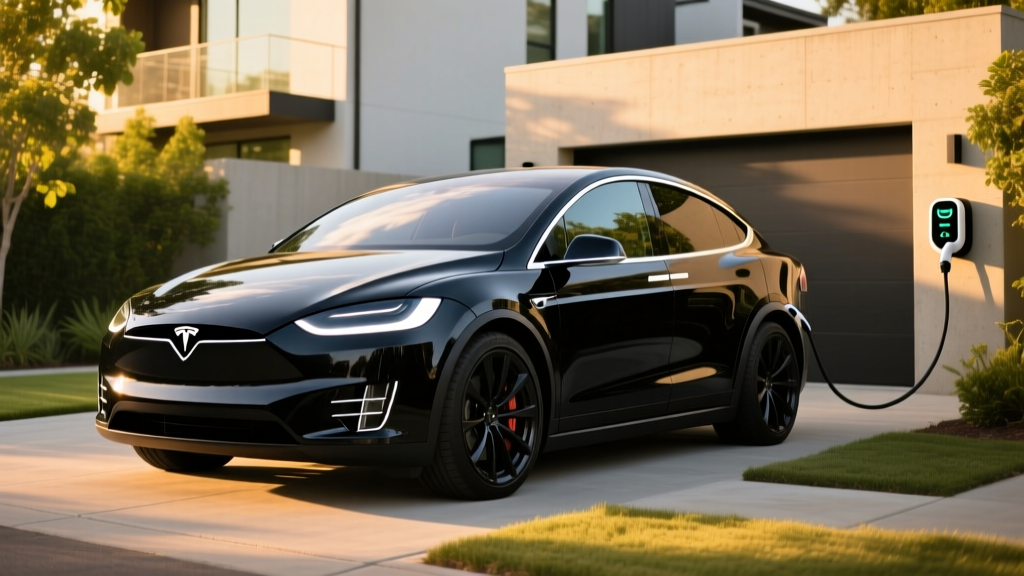
For home charging, Tesla's Gen 3 Wall Connector at 48 amps delivers 11.5 kW, adding roughly 34 miles of range per hour. A full charge from 10% to 90% takes about 7–8 hours overnight. Most owners will need a NEMA 14-50 outlet or hardwired Wall Connector installation on a 60-amp circuit. Expect installation costs between $500 and $2,500 depending on panel proximity and local permitting, though older homes may require a panel upgrade adding $1,500–$3,500.
The Model X Plaid uses Tesla's proprietary connector (now standardized as NACS). Tesla began opening Supercharger access to non-Tesla EVs in 2024, but Model X owners retain native plug-and-charge access across the full network — still the most reliable DC fast-charging ecosystem in North America as of 2026.
Performance: What 1,020 Horsepower Actually Feels Like
The Plaid's tri-motor configuration — one motor up front, two carbon-sleeved rotors in the rear — produces 1,020 horsepower and launches the 5,185-pound SUV to 60 mph in 2.5 seconds (measured with a 1-foot rollout, Tesla's standard methodology). Independent testing by outlets like Motor Trend and Car and Driver has confirmed 0-60 times in the 2.5–2.7 second range on prepped surfaces.
That makes the Model X Plaid quicker to 60 mph than a Lamborghini Urus, a Porsche Cayenne Turbo GT, and virtually every other SUV ever produced. The acceleration is instantaneous and relentless — electric motors deliver peak torque at 0 RPM, so there's no turbo lag, no gear hunting, just a sustained push that presses you into the seat for the entire pull.
Beyond straight-line speed, the Plaid's torque-vectoring rear motors provide sharp cornering response unusual for a vehicle this size. The adaptive air suspension lowers the ride height at speed for improved aerodynamics and handling, though the Model X's tall roofline and 5,000+ pound mass are always present in transitions. This is a quick SUV, not a sports car — but nothing else in the three-row segment comes close to its acceleration.
The dual-motor all-wheel-drive system provides confident traction in rain and light snow, though the Plaid's low-profile 22-inch tire option sacrifices some ride comfort and winter capability compared to the 20-inch setup. For cold-climate buyers, dedicated winter tires on 20-inch wheels are a worthwhile investment.
Interior, Tech, and the Yoke Debate
The 2022 Model X Plaid introduced Tesla's redesigned interior, anchored by a 17-inch landscape-oriented touchscreen with an AMD Ryzen processor — a significant upgrade over the older Intel Atom chip that plagued earlier Model X infotainment with sluggish response times. The system handles navigation, media, climate, and vehicle settings with tablet-like responsiveness.
A second 8-inch screen for rear passengers controls climate, seat heating, and media. A rear-facing camera enables video calls, and the gaming capability (Cyberpunk 2077 runs natively) is genuinely impressive, though it's a niche feature.
The Yoke steering wheel was standard on the 2022 Plaid — a rectangular, Formula 1-inspired design that eliminates the upper rim. Reactions remain polarized. At highway speeds and on straight roads, the Yoke offers unobstructed instrument visibility. In parking lots, three-point turns, and low-speed maneuvers requiring hand-over-hand steering, the missing upper rim forces an awkward palm-shuffle technique. Tesla later offered a round steering wheel as a no-cost option; most buyers in 2026 should request it unless they're committed to the aesthetic.
Build quality on the 2022 Model X Plaid improved over the notoriously inconsistent 2016–2020 production, but panel gaps, minor interior rattles, and falcon-wing door seal alignment issues still surface in owner forums. Tesla's Fremont factory has improved, but the Model X — with its complex falcon-wing hinges and aluminum body — remains harder to build consistently than the Model 3 or Model Y.
Autopilot and FSD (Supervised): The Model X Plaid ships with Basic Autopilot (lane centering + adaptive cruise control). Tesla's Full Self-Driving (Supervised) package, priced at $8,000 or $99/month as of 2026, adds automatic lane changes, navigate-on-autopilot, traffic light/stop sign recognition, and the FSD city-streets neural network.
Autopilot and FSD (Supervised) are SAE Level 2 driver-assistance systems. The driver must remain fully engaged, hands on the wheel (or applying torque with the Yoke), and eyes on the road at all times. These systems do not make the vehicle self-driving. Only Level 4 services like Waymo operate without a human driver — and those are geofenced robotaxis, not consumer vehicles.
Cargo, Passenger Space, and Practicality
The Model X Plaid offers genuine three-row utility, though space varies significantly by seating configuration:
- 5-seat layout: 88.1 cu ft cargo behind the first row; 41.1 cu ft behind the second row. Most practical for cargo-heavy buyers.
- 6-seat layout (captain's chairs): Second-row individual seats with a center pass-through. More comfortable for adults in row two, but eliminates the fold-flat bench advantage.
- 7-seat layout: Adds a third-row bench. Third-row legroom is approximately 32.7 inches — suitable for children or short trips, not full-size adults on long drives.
The falcon-wing rear doors are the Model X's signature feature. They open upward with a double-hinged design, providing dramatic overhead access to the second and third rows. In tight parking spaces, ultrasonic sensors adjust the door arc to avoid adjacent vehicles. However, the doors are slower to open and close than conventional doors, can struggle in heavy rain (water drips from the upper hinge into the cabin during entry), and are the single most common source of warranty service visits for the Model X.
A small front trunk (frunk) provides approximately 6.5 cu ft of additional storage — enough for a charging cable kit and a small bag, but considerably smaller than the Rivian R1S or even the Model S frunk.
Towing: The Model X Plaid is rated to tow 5,000 pounds with the factory tow package. Expect range to drop by 30–50% when towing near max capacity — plan for 150–200 miles between Supercharger stops with a loaded trailer.
Pricing, Tax Credits, and Used-Market Value
The 2022 Model X Plaid launched at an MSRP of $138,990 (before the $1,390 destination fee). Fully loaded with 22-inch wheels, FSD, and premium paint, as-tested prices frequently exceeded $150,000.
| Item | Amount |
|---|---|
| Original Base MSRP | $138,990 |
| Destination Fee | $1,390 |
| FSD (Supervised) Add-On | $8,000 (or $99/mo) |
| Typical As-Tested Price | $145,000–$152,000 |
| Federal §30D New EV Credit | NOT eligible (MSRP exceeds $80,000 SUV cap) |
| Federal §25E Used EV Credit | Up to $4,000 (30% of sale price, capped) |
| §25E Income Cap (2026) | $75K single / $112.5K HOH / $150K MFJ |
| §25E Sale Price Cap | $25,000 maximum sale price |
New vehicle tax credit: The Model X Plaid has never qualified for the §30D new clean vehicle credit. Its MSRP far exceeds the $80,000 cap for SUVs/vans/pickups set by the Inflation Reduction Act. There is no workaround for this — it is simply too expensive.
Used vehicle tax credit (§25E): If you purchase a 2022 Model X Plaid on the used market, the §25E previously owned clean vehicle credit offers up to $4,000 (30% of the sale price). However, the sale price must be $25,000 or less to qualify. As of early 2026, used Model X Plaid listings typically range from $70,000 to $95,000 depending on mileage and condition — well above the $25,000 threshold. In practice, the §25E credit is not available for the Model X Plaid on the current used market. Buyers should not factor any federal tax credit into their purchase calculation for this vehicle. Consult a tax professional and review current rules at IRS.gov for your specific situation.
Some states offer additional incentives that may apply — check the AFDC state incentive database for your jurisdiction.
Ownership Costs: Warranty, Insurance, and Depreciation
Tesla's warranty coverage for the 2022 Model X Plaid includes:
- Basic Vehicle: 4 years / 50,000 miles
- Battery & Drive Units: 8 years / 150,000 miles (minimum 70% capacity retention)
The battery warranty guarantees that the pack will retain at least 70% of its original capacity over 8 years or 150,000 miles, whichever comes first. Based on data aggregated by sources like Teslanomics and Recurrent Auto, NMC packs in Model X vehicles typically show 5–8% degradation over the first 50,000 miles, with the curve flattening significantly afterward. A Plaid owner driving 12,000 miles annually can reasonably expect 85–90%+ state of health at the 8-year mark under normal charging habits (avoiding frequent 100% charges and DC fast-charging exclusively).
Insurance: The Model X Plaid carries high insurance premiums due to its $140,000+ replacement value, high repair costs (aluminum body, specialized parts), and extreme performance. Expect annual premiums of $3,500–$6,000+ depending on your state, driving record, and coverage level. Tesla Insurance is available in some states and may offer competitive rates, but shop multiple quotes.
Depreciation: The Model X Plaid has experienced significant depreciation, typical of high-end luxury EVs. Three-to-four-year-old Plaid examples have lost 35–50% of their original MSRP. This is painful for original buyers but creates a compelling value proposition on the used market — a 2022 Plaid with 25,000 miles can be found for $75,000–$85,000, which is extraordinary performance-per-dollar.
Pros, Cons, and the Verdict
- Quickest SUV ever built — 2.5 sec 0-60 mph is supercar territory
- 333-mile EPA range is usable for road trips with Supercharger network
- Tri-motor AWD with torque vectoring provides exceptional traction
- AMD Ryzen infotainment is responsive and feature-rich
- Three-row seating with falcon-wing doors offers unique access
- 5,000-lb towing capacity
- Over-the-air updates continue adding features years after purchase
- Strong used-market depreciation creates value for second owners
- Original MSRP of $138,990+ — no federal tax credit eligibility
- Real-world highway range drops to ~260-290 miles
- Falcon-wing doors are slow, can leak, and are expensive to repair
- Yoke steering is impractical for low-speed maneuvers (round wheel now optional)
- Third row is cramped for adults
- Insurance premiums are among the highest of any SUV
- Build quality, while improved, still trails Mercedes/Porsche/BMW at this price point
- 250 kW peak charge rate is surpassed by newer 800V architectures (Hyundai, Porsche, Lucid)
Who Should Buy the 2022 Model X Plaid?
Best for: Performance-obsessed families who need three rows, want the quickest SUV available, and rely on Tesla's Supercharger network for road trips. On the used market at $75K–$90K, it offers staggering performance-per-dollar that nothing else in the segment can match.
Consider alternatives if: You prioritize interior luxury and build quality (BMW iX, Mercedes EQS SUV), need maximum range over performance (Model X Long Range), want a more conventional SUV experience (Rivian R1S), or need the latest 800V fast-charging architecture (Kia EV9 GT-Line with its faster charge curve, though it lacks the Plaid's power).
Frequently Asked Questions
What is the real-world range of the 2022 Tesla Model X Plaid?
The EPA rates it at 333 miles (20" wheels). In real-world highway driving at 70-75 mph, expect 260–290 miles. In cold weather (below freezing), plan for 210–240 miles. City driving with regenerative braking can approach 300+ miles in moderate temperatures.
How fast does the Model X Plaid charge at home and on the road?
At home on a Level 2 Wall Connector (11.5 kW), it adds approximately 34 miles of range per hour — a full overnight session replenishes the battery. On a V3 Supercharger, it peaks at 250 kW and charges from 10-80% in about 30 minutes under ideal conditions. The charge curve tapers significantly above 50% SoC.
Does the 2022 Model X Plaid qualify for the federal EV tax credit?
No. The new-vehicle §30D credit has an $80,000 MSRP cap for SUVs, which the Plaid far exceeds. The used-vehicle §25E credit requires a sale price of $25,000 or less, and used Plaids currently sell for $70,000–$95,000. No federal credit applies. State incentives may be available — check your local programs.
Is the Model X Plaid worth buying over the Rivian R1S or BMW iX?
If raw acceleration and Supercharger access are your priorities, the Plaid is unmatched. The Rivian R1S (quad-motor) offers superior off-road capability, a more conventional SUV design, and better third-row space. The BMW iX M60 provides a more luxurious interior and refined ride quality. The Plaid wins on speed and charging infrastructure; it loses on interior refinement and practicality.
How reliable are the falcon-wing doors?
Falcon-wing doors remain the Model X's most common service item. Issues include sensor calibration failures, hydraulic strut wear, seal leaks in heavy rain, and slower open/close cycles compared to conventional doors. Tesla has issued multiple service bulletins, and reliability has improved on 2022+ models, but they are more complex and costly to repair than standard doors. Budget for potential out-of-warranty door service if buying used.
What is the battery replacement cost for the Model X Plaid?
Out-of-warranty battery replacement for a 100 kWh Model X pack typically ranges from $15,000 to $22,000 including labor, based on service center quotes aggregated through 2025. Under warranty, Tesla covers replacement if capacity drops below 70% within 8 years / 150,000 miles. Most Plaid packs show gradual, manageable degradation and are unlikely to need full replacement within the warranty period under normal use.
Sources: fueleconomy.gov (EPA range and efficiency data), IRS.gov (§30D and §25E credit rules), Tesla Model X Owner's Manual (specifications and warranty).