The 2022 Tesla Model 3 remains one of the most sought-after used electric vehicles in 2026, thanks to a significant mid-cycle battery chemistry shift, class-leading efficiency, and access to the Supercharger network. Whether you are evaluating a Certified Pre-Owned example or a private-party listing, understanding the exact powertrain, battery chemistry, and charging behavior of the 2022 model year is critical to making an informed purchase.
This review covers the three trims available for the 2022 model year: the Standard Range Plus (later renamed Standard Range), the Long Range AWD, and the Performance. We break down the LFP versus NMC battery differences introduced that year, real-world range expectations, DC fast-charging curves, and whether a used 2022 Model 3 can qualify for the federal used-EV tax credit under current IRS §25E rules.
2022 Tesla Model 3: Core Specifications at a Glance
| Spec | Standard Range (RWD) | Long Range (AWD) | Performance (AWD) |
|---|---|---|---|
| EPA Range | 272 miles | 358 miles | 315 miles |
| Usable Battery (kWh) | ~57.5 kWh (LFP) | ~75 kWh (NMC/NCA) | ~75 kWh (NMC/NCA) |
| Battery Chemistry | LFP (CATL) | NMC (Panasonic/LG) | NMC (Panasonic/LG) |
| Drivetrain | Rear-Wheel Drive | Dual-Motor AWD | Dual-Motor AWD |
| Horsepower | 283 hp | 346 hp | 450 hp (est.) |
| 0–60 mph | 5.3 sec | 4.2 sec | 3.1 sec |
| MPGe (Combined) | 132 MPGe | 134 MPGe | 113 MPGe |
| kWh / 100 mi | 25 kWh | 25 kWh | 30 kWh |
| Max DC Fast Charge | ~170 kW (peak) | ~250 kW (peak) | ~250 kW (peak) |
| 10–80% DCFC Time | ~30 min | ~25–30 min | ~25–30 min |
| Level 2 (11.5 kW) Rate | ~44 mi/hr | ~44 mi/hr | ~44 mi/hr |
| Cargo Volume | 23 cu ft (trunk 15 cu ft + frunk 3.1 cu ft + rear seats folded) | ||
| Rear Legroom | 35.2 inches | ||
| Battery Warranty | 8 yr / 100,000 mi | 8 yr / 120,000 mi | |
| Original MSRP (2022) | $46,990 | $53,990 | $61,990 |
Sources: EPA fueleconomy.gov, Tesla 2022 press materials.
Real-World Range: What to Expect Beyond the EPA Sticker
EPA Estimate: 358 miles
Real-World Highway (70 mph, 72°F): ~300–320 miles
Real-World Highway (70 mph, 30°F): ~240–270 miles
City / Suburban Mixed: ~330–350 miles
The 2022 Model 3 Long Range's 358-mile EPA rating was among the highest of any mass-market EV at the time. However, as with all EVs, the EPA test cycle is conducted partly at lower speeds and includes regenerative braking recovery that favors city driving. On sustained highway trips at 70–75 mph in moderate temperatures, expect approximately 300–320 miles before the buffer depletes to 10%.
Cold weather significantly impacts range. At 30°F or below, lithium-ion cells increase internal resistance, and cabin heating demands energy even with the Model 3's efficient heat pump (standard on 2022 models). Plan for a 20–30% range reduction in winter highway driving, bringing a Long Range down to roughly 240–270 miles. The Standard Range RWD, with its smaller 57.5 kWh LFP pack, will see a similar proportional drop — from 272 EPA miles to approximately 195–220 miles in cold highway conditions.
The Performance trim's 315-mile EPA figure drops to roughly 260–280 miles in real-world highway driving and 210–240 miles in cold weather, owing to its stickier tires and more aggressive powertrain tuning.
Battery Chemistry: LFP vs NMC in the 2022 Model 3
The 2022 model year was pivotal for the Model 3 because Tesla began equipping the Standard Range trim with a lithium iron phosphate (LFP) battery supplied by CATL, while the Long Range and Performance retained nickel-manganese-cobalt (NMC/NCA) chemistry from Panasonic and LG Energy Solution.
| Attribute | LFP (Standard Range) | NMC/NCA (Long Range / Performance) |
|---|---|---|
| Energy Density | Lower — heavier pack for same kWh | Higher — lighter, more range |
| Recommended Charge Limit | 100% daily (Tesla recommends weekly 100%) | 80% daily; 100% only for trips |
| Cycle Life | 3,000+ cycles (superior longevity) | 1,500–2,000 cycles |
| Cold-Weather Performance | Greater range loss; slower charge when cold | Better cold tolerance; faster cold preconditioning |
| State-of-Charge Accuracy | Voltage curve is flat — BMS may show inaccurate % near mid-range | More linear voltage — accurate SoC readout |
| Cobalt Content | Zero cobalt | Contains cobalt and nickel |
What this means for a 2026 used buyer: The LFP-equipped Standard Range is the better choice if you want maximum battery longevity and plan to charge to 100% regularly. However, if you live in a cold climate and need maximum range per charge, the NMC Long Range is the more practical option. LFP packs also precondition more slowly for DC fast charging in cold weather, so plan for longer charge stops in winter.
Charging Performance: DC Fast Charging and Home Level 2
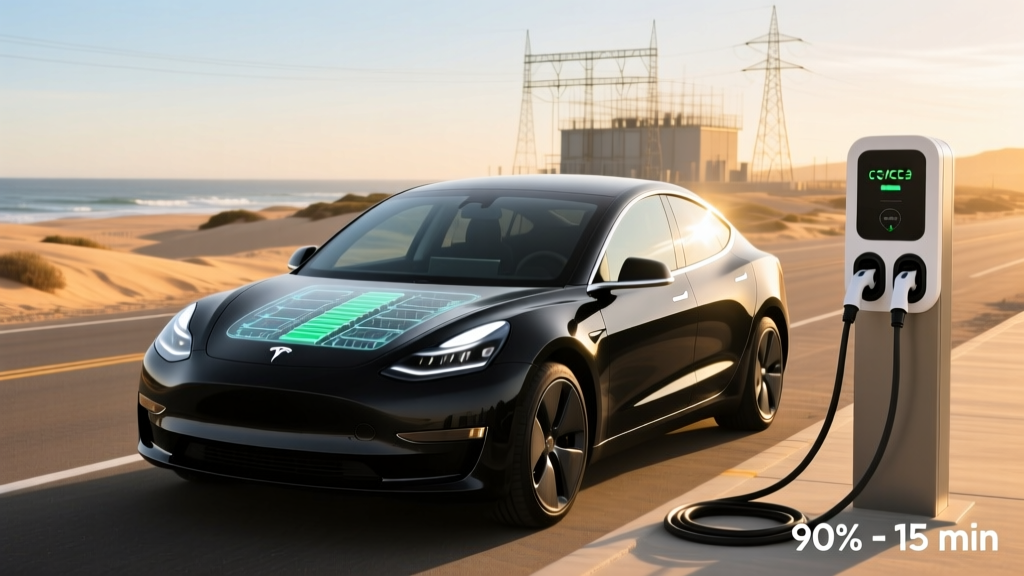
Charging speed is where the 2022 Model 3 trims diverge meaningfully. The Standard Range RWD, with its smaller LFP pack, peaks at approximately 170 kW on a V3 Supercharger or compatible CCS/NACS DC fast charger. The Long Range and Performance can peak at 250 kW under ideal conditions (low state of charge, preconditioned battery, warm ambient temperature).
| Charging Level | Power (kW) | Standard Range | Long Range / Performance |
|---|---|---|---|
| Level 1 (120V household) | ~1.2 kW | ~3–4 mi/hr | ~3–4 mi/hr |
| Level 2 (240V / 48A) | 11.5 kW | ~44 mi/hr | ~44 mi/hr |
| DC Fast (V3 Supercharger) | Up to 170–250 kW | 10–80% in ~30 min | 10–80% in ~25–30 min |
Charging curve reality: Neither trim sustains peak kW for the entire session. The Long Range typically holds 250 kW only between roughly 10% and 20% state of charge, then tapers to ~150 kW by 50% and ~60 kW by 70%. A 10–80% session takes 25–30 minutes in ideal conditions but can stretch to 40+ minutes if the battery is cold or you arrive at a high state of charge. Always use the car's built-in navigation to route to a Supercharger — this triggers battery preconditioning, which warms the pack for faster charging.
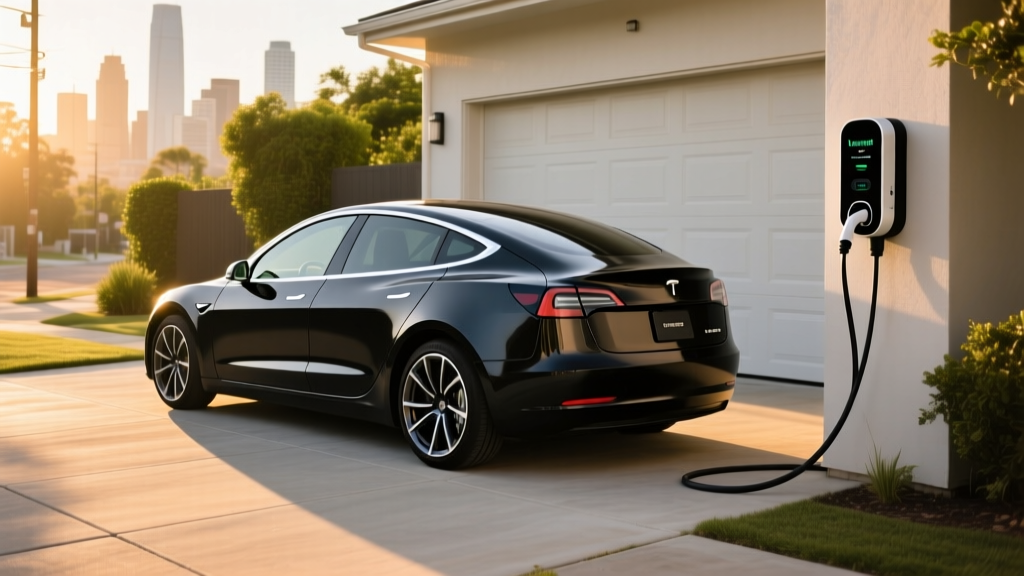
For home Level 2 charging, the onboard charger accepts up to 11.5 kW (48 amps on a 60-amp circuit). A full overnight charge from 20% to 100% takes approximately 5 hours for the Standard Range and 6.5 hours for the Long Range. Most owners with a home Level 2 setup wake up to a full battery every morning, making public charging relevant primarily for road trips.
Driving Performance, Interior, and Technology
The 2022 Model 3 delivers the performance and handling that established its segment reputation. The RWD Standard Range posts a 5.3-second 0–60 mph time — brisk for daily commuting. The Long Range AWD drops that to 4.2 seconds, while the Performance achieves a sports-car-rivaling 3.1 seconds. All trims feature a low center of gravity from the underfloor battery pack, resulting in flat cornering and responsive steering.
Interior and cargo: The minimalist cabin centers on a 15-inch touchscreen that controls virtually all vehicle functions — there are no physical buttons for climate, audio, or glovebox release. Front seats are comfortable and supportive; rear legroom at 35.2 inches is adequate for adults on shorter trips but tight compared to midsize sedans. Cargo space totals 23 cubic feet with the rear seats folded (15 cu ft trunk + 3.1 cu ft frunk + rear fold-down area). This is less than a crossover like the Model Y but sufficient for a couple's road-trip luggage.
Driver assistance: Every 2022 Model 3 comes with Basic Autopilot (SAE Level 2), which includes Traffic-Aware Cruise Control and Autosteer for highway lane centering. Full Self-Driving (FSD) Supervised was available as a $12,000 option at the time. Critical clarification: FSD Supervised remains an SAE Level 2 system — the driver must remain fully engaged, hands on the wheel, and eyes on the road at all times. It is not autonomous driving.
Notable tech: Over-the-air updates continue to add features to 2022 vehicles. Sentry Mode (dashcam/security), Dog Mode, theater mode on the touchscreen, and the Tesla app's remote preconditioning are all included. One drawback: the 2022 Model 3 does not include a driver attention camera (added in the 2024 Highland refresh), relying instead on steering-wheel torque sensing for engagement monitoring.
Used Pricing and Federal Tax Credit Eligibility (2026)
As of early 2026, used 2022 Model 3 pricing varies significantly by trim, mileage, and condition. Expect the following approximate ranges from Tesla Certified Pre-Owned, Carvana, and private sellers:
| Trim | Original MSRP (2022) | Used Price Range (2026) | After §25E Credit (if eligible) |
|---|---|---|---|
| Standard Range RWD | $46,990 | $22,000–$27,000 | $18,000–$23,000 |
| Long Range AWD | $53,990 | $27,000–$33,000 | $23,000–$29,000 |
| Performance AWD | $61,990 | $32,000–$39,000 | $28,000–$35,000 |
Does a used 2022 Model 3 qualify for a federal tax credit?
The new-vehicle §30D credit no longer applies to 2022 purchases made in 2026. However, the §25E Used Clean Vehicle Credit may apply if you meet all of the following conditions, per IRS guidelines:
- Credit amount: 30% of the sale price, up to a maximum of $4,000
- Vehicle price cap: The used sale price must be $25,000 or less
- Buyer income limits (MAGI): $75,000 single / $112,500 head of household / $150,000 married filing jointly
- Vehicle age: Must be at least 2 model years old (2022 qualifies in 2026)
- Prior credit history: The vehicle must not have been transferred to a qualified buyer after August 16, 2022 with a §25E credit already claimed on it — the credit is one-time per vehicle
- Dealer requirement: Must be purchased from a licensed dealer (not a private party) to claim the credit
- First use: The buyer cannot be the original owner
Practical implication: Only the Standard Range RWD, and possibly lower-mileage Long Range examples priced at or below $25,000, can qualify. The Performance trim almost always exceeds the $25,000 cap. Always verify the vehicle's credit history through the dealer and consult a tax professional before relying on the credit. State incentives vary by jurisdiction — check your state's energy office for additional rebates.
Pros and Cons: The 2022 Model 3 in 2026
- Class-leading efficiency (25 kWh/100 mi on LR)
- Supercharger network access (now open to other brands via adapter, but native for Tesla)
- LFP battery on RWD offers exceptional cycle life
- Strong OTA update support continues
- Over-the-air heated steering and seats (no cold-weather package needed)
- Heat pump standard — efficient winter cabin heating
- IIHS Top Safety Pick+ (2022 testing)
- No physical buttons — all controls via touchscreen
- Rear legroom tight for taller adults on long trips
- LFP Standard Range loses more range in cold weather
- No driver attention camera (relies on torque sensing)
- Ride quality firm on rough roads (pre-2024 suspension)
- No Apple CarPlay / Android Auto
- FSD option expensive and still SAE Level 2
Who Should Buy a Used 2022 Model 3?
- Choose the Standard Range RWD if: You commute under 80 miles round-trip, have home Level 2 charging, live in a mild climate, and prioritize battery longevity (LFP) and the lowest purchase price.
- Choose the Long Range AWD if: You take regular road trips over 250 miles, live in a cold-weather state, need dual-motor traction in snow, or want maximum range per charge without stepping to a larger vehicle.
- Choose the Performance if: Acceleration and track capability are priorities, you accept the range trade-off (315 EPA), and the higher used price (typically above the $25,000 §25E cap) fits your budget.
- Look elsewhere if: You need more than 23 cu ft of cargo space (consider a used Model Y or Ioniq 5), require physical climate controls, or want Apple CarPlay integration.
How It Compares to Key Competitors
Against a used 2022 Hyundai Ioniq 5 (EPA 303 mi, ~77.4 kWh, 220 kW DCFC), the Model 3 Long Range offers more range (358 vs 303 mi) and faster real-world charging but less interior volume and no V2L capability. The 2022 BMW i4 eDrive40 (EPA 301 mi) offers a more traditional luxury interior and physical controls at a higher used price. The 2022 Polestar 2 Long Range (EPA 270 mi) provides a premium Scandinavian cabin and Google Automotive OS but trails significantly on range and efficiency.
The Model 3's efficiency advantage — 25 kWh per 100 miles on the Long Range versus 28–30 kWh/100mi for most competitors — means lower charging costs over time, especially on paid public DC fast chargers where you pay per kWh.
Frequently Asked Questions
What is the real-world range of the 2022 Model 3?
The Long Range AWD achieves approximately 300–320 miles on the highway in moderate temperatures, dropping to 240–270 miles in cold weather (30°F or below). The Standard Range RWD delivers roughly 230–250 miles highway in mild conditions and 195–220 miles in cold weather. City driving with regenerative braking recovers more energy, bringing figures closer to the EPA sticker.
How fast does the 2022 Model 3 charge?
On a 250 kW V3 Supercharger, the Long Range and Performance charge from 10–80% in approximately 25–30 minutes under ideal conditions. The Standard Range RWD peaks at ~170 kW and takes about 30 minutes for the same session. On a home Level 2 charger (11.5 kW / 48A), all trims add roughly 44 miles per hour of charging.
Does a used 2022 Model 3 qualify for the federal EV tax credit?
It may qualify for the §25E Used Clean Vehicle Credit of up to $4,000, but only if the sale price is $25,000 or less, the buyer's income falls below IRS MAGI caps ($75K single / $150K joint), the vehicle is purchased from a licensed dealer, and the credit has not been previously claimed on that specific VIN. Verify eligibility with your dealer and a tax professional. See IRS §25E guidelines.
Is the 2022 Model 3 worth buying vs competitors in 2026?
Yes, if efficiency, range, and Supercharger access are your top priorities. The 2022 Model 3 Long Range remains one of the most efficient long-range EVs ever sold. However, if you need more cargo space, prefer physical controls, or want CarPlay, a used Ioniq 5, BMW i4, or Polestar 2 may suit you better despite the range trade-off.
What is the battery warranty on a 2022 Model 3?
The Standard Range RWD carries an 8-year/100,000-mile battery and drive unit warranty. The Long Range and Performance carry an 8-year/120,000-mile warranty. Tesla guarantees at least 70% battery capacity retention during the warranty period. For a 2022 model in 2026, approximately 4 years and the remaining mileage allowance are still in effect from the original in-service date.
Should I be concerned about LFP battery performance in cold weather?
LFP batteries experience greater internal resistance in cold temperatures, leading to higher range loss (25–35% in sub-freezing highway driving) and slower DC fast charging until the pack warms up. If you live in a northern state and regularly drive in winter, precondition the battery using Tesla's navigation routing to a charger, and expect longer charge stops. For cold-climate buyers, the NMC Long Range is the more practical choice.