The Quick Verdict on the 2022 Model 3 Performance
If you are shopping the used EV market in 2026, the 2022 Tesla Model 3 Performance remains one of the sharpest sport sedans ever sold with a plug. It pairs dual-motor all-wheel drive, a sub-3.5-second 0-60 time, and access to the most reliable DC fast-charging network in North America — all at a depreciated price that undercuts many new EVs. But buying a 2022 model year means navigating older NMC battery chemistry, a CCS1 charge port (not the newer NACS standard native on 2024+ models), and the reality that 2022 Tesla Model 3 Performance horsepower output sits at an estimated 480 hp — formidable, yet no longer the class leader it was at launch.
This review breaks down the real-world range, charging curve behavior, total ownership cost, and whether the 2022 Model 3 Performance is still a smart buy against competitors like the BMW i4 M50, Hyundai Ioniq 6, and the refreshed Highland Model 3.
Performance Specs: Horsepower, 0-60, and Drivetrain
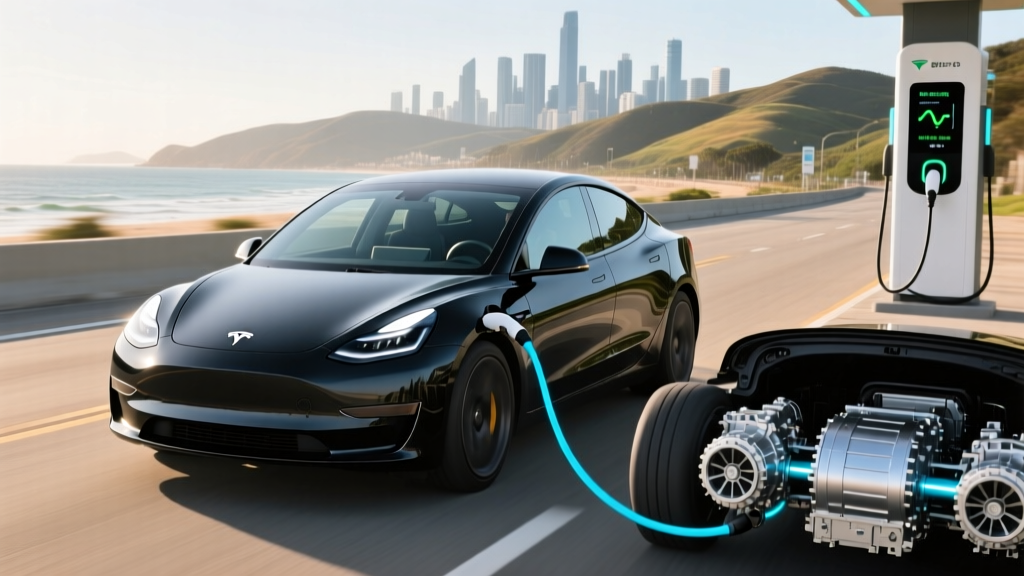
The 2022 Model 3 Performance uses a dual-motor all-wheel-drive layout with a permanent-magnet rear motor and an induction front motor. Tesla does not publish official horsepower figures, but independent dyno testing and EPA documentation place combined output at approximately 480 hp and 471 lb-ft of torque.
| Spec | Value |
|---|---|
| Horsepower (combined) | ~480 hp |
| Torque | ~471 lb-ft |
| 0-60 mph | 3.1 seconds (with rollout) |
| Top Speed | 162 mph |
| Drivetrain | Dual-Motor AWD |
| Battery (usable) | ~75 kWh (NMC) |
| EPA Range | 315 miles |
| MPGe (combined) | 125 MPGe |
| kWh/100 mi | 26 kWh/100 mi |
| Curb Weight | 4,065 lbs |
What makes this powertrain special is not just the peak number — it is the instantaneous torque delivery. There is no turbo lag, no gear shift, and no power band to manage. The front induction motor disconnects under light-load cruising to reduce drag, a subtle efficiency trick that helps the Model 3 outperform heavier competitors on the highway.
Track Mode, included on the Performance trim, allows adjustable torque bias between front and rear axles, increased regenerative braking, and active thermal management for sustained lap use. It is a genuine differentiator that no rival in this price range matches.
Real-World Range: What 315 EPA Miles Actually Means
Real-World Highway (70-75 mph): ~255–275 miles
Real-World City / Mixed: ~285–305 miles
Cold Weather (below 30°F): ~210–240 miles
The 315-mile EPA rating applies to the 2022 Model 3 Performance with 18-inch Aero wheels. Models equipped with the optional 19-inch Sport wheels saw the EPA rating drop to approximately 299 miles due to higher rolling resistance and less aerodynamic efficiency. According to fueleconomy.gov, the combined efficiency is 125 MPGe (26 kWh/100 mi), which remains among the best in the performance EV segment.
In practice, efficiency at sustained highway speeds drops noticeably. The Model 3's low drag coefficient (0.23 Cd) helps, but the dual-motor system and performance-oriented tires increase consumption versus the Long Range variant. Expect roughly 28–32 kWh/100 mi at 75 mph on a flat, dry road — translating to 235–270 usable miles before you need to plan a stop.
Cold weather is the bigger range killer. The NMC battery in the 2022 model lacks the heat pump that Tesla introduced on later Model 3 builds (the "Highland" refresh). Instead, it uses a resistive PTC heater and the octovalve thermal system, which recovers waste heat from the drive units but still consumes significant energy in sub-freezing conditions. Plan for 20–30% range loss in winter climates.
Charging Speed: DC Fast, Level 2, and the NACS Adapter Reality
| Level | Power / Rate | Time / Miles Added |
|---|---|---|
| Level 1 (120V) | ~1.4 kW | ~3–4 mi/hr |
| Level 2 (240V, 48A) | 11.5 kW | ~44 mi/hr |
| DC Fast Charge (peak) | 250 kW | 10–80% in ~27 min |
| DC Fast Charge (sustained avg.) | ~150 kW | ~180 mi in 30 min |
The 2022 Model 3 Performance charges via a CCS1 port (in North America) and peaks at 250 kW at V3 Superchargers. However, peak rate is not sustained rate. The charging curve tapers progressively: you will hold close to 250 kW from roughly 5% to 25% State of Charge, then step down to ~170 kW through 50%, and further taper to ~100 kW approaching 80%. The full 10–80% session takes approximately 27 minutes under ideal thermal conditions.
Preconditioning is essential. When you navigate to a Supercharger in the Tesla navigation system, the car automatically warms the battery to optimal charging temperature. If you arrive at a charger without preconditioning — especially in cold weather — peak rates can drop below 100 kW, adding 10–15 minutes to your session.
The NACS Adapter Situation in 2026
The 2022 Model 3 ships with a CCS1 connector. As of 2026, Tesla's North American Charging Standard (NACS) is the dominant connector in the US, and Tesla provides a free CCS-to-NACS adapter for older vehicles. This adapter allows you to use all Tesla Superchargers and the growing number of NACS-equipped third-party networks (Electrify America, EVgo). Keep the adapter in your frunk — it is your lifeline to the widest fast-charging network available.
Home Charging Setup
At 11.5 kW on a 48-amp Level 2 circuit (requiring a 60-amp breaker), you will recover roughly 44 miles of range per hour. A full overnight charge from 20% to 80% takes about 4 hours — more than enough for daily use. Installation of a Tesla Wall Connector or equivalent hardwired Level 2 charger typically costs $500–$1,500 depending on panel proximity and whether a 200-amp service upgrade is needed.
Pricing, Depreciation, and Federal Tax Credit Eligibility
| Item | Amount |
|---|---|
| Original MSRP (2022) | ~$57,990 (before incentives) |
| Average Used Price (2026, ~35k mi) | $30,000–$35,000 |
| Federal Used EV Credit (§25E) | Up to $4,000 (30% of sale price, capped) |
| Estimated Out-of-Pocket (after credit) | $26,000–$31,000 |
| Estimated Annual Insurance | $2,200–$3,000 |
Here is the critical distinction: because you are buying a used 2022 Model 3 in 2026, the new-vehicle §30D credit ($7,500) does not apply. Instead, you may qualify for the §25E Previously Owned Clean Vehicle Credit, which provides 30% of the sale price up to a maximum of $4,000. Eligibility requires:
- Sale price at or below $25,000 (this is a hard cap — many 2022 Performance models exceed it)
- Buyer adjusted gross income: ≤$75,000 (single), ≤$112,500 (head of household), ≤$150,000 (joint)
- Purchased from a licensed dealer (private-party sales do not qualify)
- Vehicle must be at least two model years old (2022 qualifies in 2026)
Because many 2022 Model 3 Performance examples sell above the $25,000 used-credit cap, a significant number of buyers will not qualify for the federal credit. Always verify current rules at IRS.gov and consult a tax professional before finalizing your purchase.
Interior, Cargo, and Daily Practicality
The 2022 Model 3 interior follows Tesla's minimalist philosophy: a single 15-inch landscape touchscreen controls virtually every function, from climate to mirrors to glovebox release. There is no instrument cluster — speed and navigation live on the left third of the main screen.
| Measurement | 2022 Model 3 Performance |
|---|---|
| Front Legroom | 42.7 in |
| Rear Legroom | 35.2 in |
| Cargo (trunk) | 19.8 cu ft |
| Frunk (front trunk) | 3.1 cu ft |
| Total Cargo | 22.9 cu ft |
Rear-seat space is adequate for adults under 5'10" on shorter trips, but the low roofline and firm cushion make it less comfortable than a BMW i4 or Hyundai Ioniq 6 for long highway rides. The glass roof provides an airy feel but contributes to cabin heat in summer — window tint is a near-universal owner upgrade.
The 19.8 cu ft trunk is deep and wide, with a hatchback-style opening (the 2022 Model 3 is technically a liftback). Combined with the 3.1 cu ft frunk, total cargo capacity beats most sport sedans but falls well short of the Model Y crossover.
Tech, Driver Assistance, and Standout Features
Every 2022 Model 3 Performance includes Tesla's Basic Autopilot (Traffic-Aware Cruise Control and Autosteer) as standard. The controversial Full Self-Driving (Supervised) package was available as a $12,000 add-on at purchase or a $15,000 one-time purchase / $199/month subscription later.
Autopilot and FSD (Supervised) are Level 2 driver-assistance systems. The driver must remain fully engaged, hands on or near the wheel, and eyes on the road at all times. These are not self-driving systems. Tesla's naming convention has drawn scrutiny from NHTSA — do not treat FSD as a substitute for attentive driving.
Other standout tech includes:
- Over-the-air updates: Tesla continues to push software improvements to 2022 models, including UI refinements and efficiency optimizations.
- Sentry Mode: Uses the car's cameras to record surroundings when parked — a genuine theft deterrent.
- Dashcam: Built-in four-camera recording with USB storage.
- Tesla app: Remote climate control, location tracking, charging status, and Summon (short-range remote parking).
- 15-speaker premium audio: Among the best factory sound systems in any vehicle under $60,000.
- No Apple CarPlay or Android Auto — Tesla's proprietary infotainment only.
- Phantom braking incidents reported with Autopilot — remain vigilant.
- Minimalist interior lacks physical controls; climate and mirror adjustments require screen taps.
- No head-up display or traditional instrument cluster.
- Ride quality is firm, especially on the Performance's lowered sport suspension.
Warranty and Battery Longevity
Tesla's warranty coverage for the 2022 Model 3 Performance:
| Component | Coverage |
|---|---|
| Basic Vehicle | 4 years / 50,000 miles |
| Battery & Drive Unit | 8 years / 120,000 miles |
| Battery Capacity Retention | ≥70% over warranty period |
The NMC (nickel manganese cobalt) battery in the 2022 Performance has proven durable. Tesla's own impact report shows average degradation of approximately 12% at 100,000 miles across the Model 3/Y fleet. Real-world owner data on forums like Tesla Motors Club suggests most 2022 Performance examples retain 90–94% State of Health at 35,000–45,000 miles. Before buying used, request a battery health screenshot from the vehicle's service menu or use third-party tools like Tessie or Recurrent to verify SoH.
Tesla recommends daily charging to 80–90% for NMC batteries (unlike LFP chemistry, which tolerates 100% daily). Reserve 100% charges for road trips to minimize long-term degradation.
2022 Model 3 Performance vs. Key Competitors
| Spec | 2022 Tesla Model 3 Perf. | 2023 BMW i4 M50 | 2023 Hyundai Ioniq 6 SE |
|---|---|---|---|
| Horsepower | ~480 hp | 536 hp | 320 hp |
| 0-60 mph | 3.1 sec | 3.7 sec | 5.1 sec |
| EPA Range | 315 mi | 270 mi | 361 mi |
| DC Fast Charge (peak) | 250 kW | 205 kW | 235 kW |
| Used Price (2026) | $30k–$35k | $40k–$48k | $28k–$33k |
| Charging Network | Tesla Supercharger (NACS adapter) | CCS (EA, etc.) | CCS (EA, etc.) |
- You prioritize acceleration, handling, and track capability over luxury.
- You want access to the Tesla Supercharger network — still the most reliable in the US.
- You value OTA software updates and a strong used-EV community for support.
- BMW i4 M50: You want more horsepower, a traditional luxury interior, and CarPlay.
- Hyundai Ioniq 6: Maximum range and 800V ultra-fast charging matter more than 0-60 times.
- 2024+ Model 3 Highland: You want the refreshed interior, heat pump, and native NACS port (but will pay $38k+ used).
Pros and Cons
- 3.1-second 0-60 with instant torque — still thrilling in 2026
- 315-mile EPA range is strong for a performance EV
- 250 kW peak DC charging with Supercharger network access
- Track Mode is unique in this price class
- Strong OTA update support keeps the car current
- Depreciated price makes it one of the best performance-per-dollar EVs available
- No Apple CarPlay / Android Auto
- Firm ride and minimalist interior not for everyone
- NMC battery requires 80% daily charge limit (unlike LFP)
- CCS1 port requires NACS adapter for newest chargers
- Used §25E credit often unavailable due to $25k sale-price cap
- Rear seat comfort lags behind BMW i4 and Hyundai Ioniq 6
Frequently Asked Questions
What is the real-world range of the 2022 Tesla Model 3 Performance?
The EPA rates it at 315 miles, but expect 255–275 miles on the highway at 70–75 mph, and 210–240 miles in sub-freezing winter conditions. City driving with regenerative braking can approach the EPA figure.
How fast does it charge at home and on the road?
On a 48-amp Level 2 home charger (11.5 kW), it adds about 44 miles per hour — a full overnight top-up is effortless. On a V3 Supercharger, it peaks at 250 kW and charges 10–80% in roughly 27 minutes under ideal conditions.
Does the 2022 Model 3 Performance qualify for a federal tax credit in 2026?
As a used vehicle, it may qualify for the §25E Previously Owned Clean Vehicle Credit (up to $4,000), but only if the sale price is $25,000 or less and the buyer meets income caps. Many Performance examples exceed the price cap, making them ineligible. Verify current rules at IRS.gov.
Is the 2022 Model 3 Performance still worth buying in 2026?
Yes, if you value performance and charging infrastructure above all else. At $30,000–$35,000 used, it delivers supercar-level acceleration, strong range, and Supercharger access. However, if luxury, rear-seat comfort, or CarPlay are priorities, the BMW i4 or refreshed 2024+ Model 3 Highland may serve you better.
How many horsepower does the 2022 Tesla Model 3 Performance have?
Tesla does not publish official horsepower numbers, but independent dyno testing and EPA data indicate approximately 480 hp and 471 lb-ft of combined torque from its dual-motor AWD powertrain.
What is the battery chemistry, and how should I charge it daily?
The 2022 Performance uses an NMC (nickel manganese cobalt) lithium-ion pack with approximately 75 kWh usable capacity. Tesla recommends setting the daily charge limit to 80–90% and only charging to 100% when needed for long trips.