The Tesla Model Y has been the best-selling EV in America for years, but for growing families, one question dominates the research phase: does the optional third row actually work? The Model Y 3rd row transforms the crossover from a five-seater into a seven-passenger EV, but adding two extra seats costs more than just money — it eats into cargo space, adds weight, and changes the ownership equation. In this review, we break down exactly what you get, what you give up, and whether the 7-seat Model Y is a practical family hauler or a compromise best avoided.
2026 Tesla Model Y 7-Seat: Quick Verdict
The Model Y's third-row option is best understood as an occasional-use solution. It fits children and smaller teens reasonably well, but adults will find the 26.5 inches of legroom cramped beyond short trips. If your household regularly needs to carry more than five passengers, a three-row SUV like the Kia EV9 or Rivian R1S will serve you better. But if you need seven seats maybe 10-15% of the time — carpools, visiting grandparents, weekend sports teams — the Model Y 7-seat keeps you in a compact, efficient, Supercharger-compatible package the rest of the year.
| Spec | Value |
|---|---|
| EPA Range | 308 miles (est. 7-seat config) |
| Battery Capacity | ~75 kWh usable (NMC) |
| Drivetrain | Dual-Motor AWD |
| Horsepower | 384 hp |
| 0-60 mph | 4.8 seconds |
| Max DC Fast Charge | 250 kW peak |
| 10-80% DC Charge Time | ~25 minutes |
| Level 2 Home Charge Rate | 11.5 kW (~44 mi/hr) |
| MPGe (combined) | 122 MPGe |
| Efficiency | 28 kWh/100 mi |
| Cargo (behind 3rd row) | 12.8 cu ft |
| Cargo (3rd row folded) | 30.2 cu ft |
| Cargo (all rows folded) | 72.1 cu ft |
| 3rd-Row Legroom | 26.5 in |
| Battery Warranty | 8 years / 120,000 miles |
| Base MSRP (7-seat) | $51,490 (incl. destination) |
Range, Battery, and Real-World Efficiency
The 2026 Model Y Long Range AWD carries an approximately 75 kWh usable battery pack using NMC (nickel manganese cobalt) chemistry. NMC offers higher energy density than LFP (lithium iron phosphate), which is why Tesla reserves it for the Long Range and Performance trims — you need those denser cells to hit 300+ miles in a crossover this size.
Real-World Range vs. EPA Sticker
EPA estimate: ~308 miles (7-seat configuration, which adds roughly 50 lbs and marginally reduces range vs. the 5-seat Long Range AWD at 320 miles).
Expect in practice:
- Mixed city/suburban driving (65-70°F): 280-300 miles — Tesla's heat pump and regen are highly efficient at lower speeds.
- Highway cruising at 75 mph: 240-265 miles. Aerodynamic drag dominates above 70 mph, and the Model Y's crossover profile is less sleek than the Model 3 sedan.
- Cold weather (20-30°F): 210-240 miles. Battery chemistry slows, cabin heating draws energy, and regenerative braking is limited until the pack warms. Preconditioning helps but doesn't eliminate the penalty.
- Full load (7 passengers + cargo): Subtract another 5-8% from whatever baseline applies. More mass means more energy per mile.
On a 300-mile road trip with a full cabin, plan one 20-minute Supercharger stop. That's realistic, not pessimistic.
Efficiency lands at approximately 28 kWh per 100 miles (combined), translating to 122 MPGe per EPA data on fueleconomy.gov. That's among the best in the electric compact-SUV segment, though the 5-seat configuration ekes out 1-2 MPGe better due to lower weight.
Charging Speed: DC Fast, Level 2, and the Charge Curve Reality
Tesla's Supercharger network remains the gold standard for public charging reliability, and the Model Y takes full advantage. Here's the complete charging picture:
| Charge Level | Max Power | Speed (Miles/Hour) | Notes |
|---|---|---|---|
| Level 1 (120V household) | ~1.4 kW | ~3-4 mi/hr | Emergency/trickle only; 300 mi takes ~80+ hours |
| Level 2 (240V home, 48A) | 11.5 kW | ~44 mi/hr | Full overnight charge in ~7-8 hours; requires NEMA 14-50 or hardwired Wall Connector |
| DC Fast (V3 Supercharger) | 250 kW peak | ~162 mi in 15 min | 10-80% in ~25 min; peak rate only sustained from ~10-35% SoC |
| DC Fast (V4 Supercharger) | 250 kW (current vehicles) | Same as V3 | V4 hardware supports higher rates, but Model Y is capped at 250 kW by its onboard architecture |
The charge curve matters more than peak kW. The Model Y hits 250 kW only in the lower portion of the battery (roughly 10-35% state of charge). From 35-60%, expect ~150-170 kW. Above 80%, the rate tapers sharply to protect the NMC cells — charging from 80-100% at a Supercharger can take as long as 10-80%. For road trips, the 10-80% window is your practical charging envelope, and ~25 minutes is competitive though not class-leading. The Hyundai Ioniq 5, with its 800V architecture, does 10-80% in roughly 18 minutes at a 350 kW charger.
For home charging, Tesla's Wall Connector at 48 amps on a 60A circuit delivers 11.5 kW — enough to add roughly 44 miles of range per hour. Most owners plug in overnight and wake up full. A licensed electrician should evaluate your panel; a 200-amp service is usually sufficient, but older homes with 100-amp panels may need an upgrade ($1,500-$3,000).
Performance and Driving Dynamics
The Long Range AWD pairs dual permanent-magnet motors for 384 combined horsepower and all-weather traction. The 0-60 mph sprint takes 4.8 seconds — genuinely quick for a family crossover and more than adequate for highway merging with a full load.
With seven aboard, the Model Y doesn't feel strained thanks to instant electric torque, but you'll notice the extra mass through corners and during braking. The suspension tuning is firm (a long-standing Tesla trait), and third-row passengers will feel road imperfections more than those up front. On smooth highways, it's composed; on broken pavement, the ride can get choppy in the back.
Regenerative braking is strong and enables near one-pedal driving in most conditions. Tesla's heat pump, standard on all current trims, significantly improves cold-weather efficiency compared to older resistive-heater EVs.
Interior, Third-Row Space, and Cargo Practicality
This is where the Model Y 3rd row debate gets real. Let's talk dimensions:
- Third-row legroom: 26.5 inches. For reference, the Kia EV9 offers 32.0 inches in its third row. Children under about 5'4" will be fine; adults will not be comfortable beyond 20-30 minutes.
- Third-row headroom: The Model Y's sloping roofline cuts into headroom back there. Taller kids will notice.
- Access: The second row tilts and slides forward, but the opening is tighter than body-on-frame SUVs. Loading car seats into the third row requires patience.
- Cargo behind 3rd row: 12.8 cu ft — enough for a couple of backpacks and grocery bags, but not luggage for seven people. A stroller requires folding the third row on one side.
- Cargo with 3rd row folded: 30.2 cu ft — competitive with compact SUVs in five-seat mode.
- Total cargo (all rows flat): 72.1 cu ft plus the front trunk (frunk) at 4.1 cu ft.
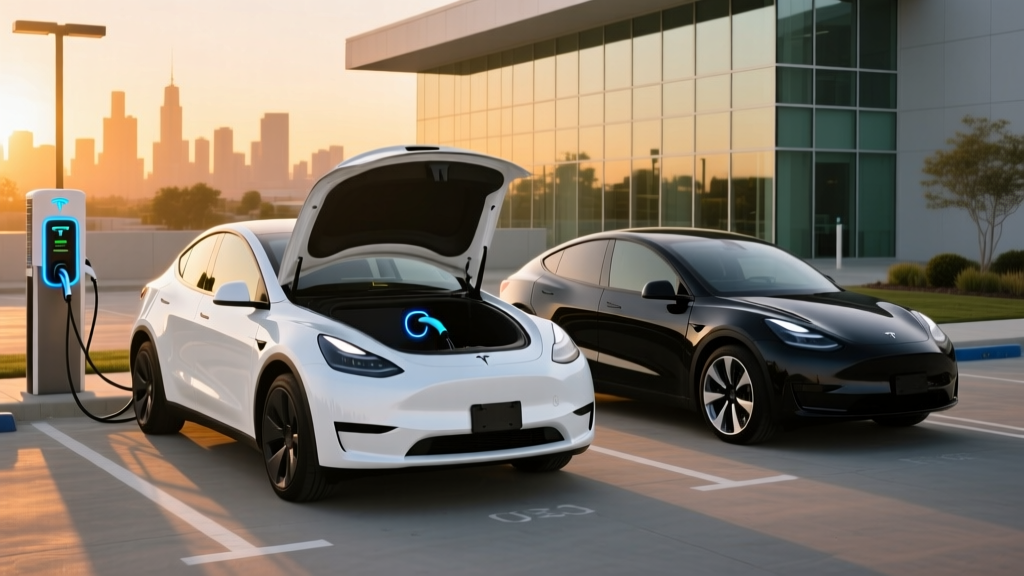
The front trunk (frunk) is a bonus the Model Y retains regardless of seating configuration — useful for charging cables, a small cooler, or a laptop bag.
Tech and Driver Assistance
The 2026 Model Y continues with Tesla's minimalist 15.4-inch center touchscreen controlling virtually all vehicle functions. The infotainment system remains one of the fastest and most responsive in the industry, with native navigation, streaming apps, and over-the-air updates that regularly add features.
SAE Automation Level: Level 2
Tesla's Autopilot (standard) and Full Self-Driving Supervised ($8,000 option or $99/month) are SAE Level 2 driver-assistance systems. Despite the "Full Self-Driving" branding, the driver must remain fully engaged — hands on or near the wheel, eyes on the road, ready to take over at any moment. These are not autonomous driving systems. Level 4 driverless operation (no human needed) exists only in geofenced robotaxi services like Waymo, not in any consumer vehicle you can buy.
Autopilot includes adaptive cruise control and lane-centering on highways. FSD Supervised adds automatic lane changes, on/off-ramp navigation, traffic-light recognition, and city-street steering assistance. It works impressively well on well-marked roads but can struggle with construction zones, faded lane markings, and complex intersections. Treat it as a fatigue-reducer, not a replacement for driving.
Pricing, Trims, and Federal Tax Credit Eligibility
The 7-seat option is available exclusively on the Model Y Long Range AWD. Here's the pricing landscape for 2026:
| Trim | MSRP (incl. destination) | Est. After §30D Credit |
|---|---|---|
| Long Range AWD (5-seat) | $49,990 | From $42,490* |
| Long Range AWD (7-seat) | $51,490 | From $43,990* |
| Performance (5-seat only) | $53,490 | From $45,990* |
*Tax credit pricing assumes full $7,500 §30D credit eligibility. See rules below — not all buyers qualify.
The 7-seat option adds $1,500 to the Long Range AWD. That's a reasonable premium for the flexibility, but it's only available on one trim — you can't get it on the Performance model.
Federal EV Tax Credit (§30D) — 2026 Rules
The Model Y Long Range AWD qualifies for the up-to-$7,500 federal tax credit under IRS §30D, but eligibility depends on several factors that change periodically. Here's the checklist per current IRS guidance:
- MSRP cap: The Model Y is classified as an SUV, so the cap is $80,000. All trims clear this easily.
- Buyer income cap: Modified adjusted gross income must not exceed $300,000 (married filing jointly), $225,000 (head of household), or $150,000 (single).
- Battery sourcing: At least a percentage of critical minerals must be sourced from the U.S. or free-trade-agreement countries, and battery components must be manufactured/ assembled in North America. Tesla has largely localized its supply chain, and the Model Y has qualified for the full $7,500 in recent years. However, sourcing rules tighten annually — verify current-year status on the IRS website or with a tax professional before purchasing.
- Point-of-sale transfer: As of 2024, you can transfer the credit to the dealer at purchase, reducing your out-of-pocket cost immediately rather than waiting to claim it on your tax return. Tesla supports this at delivery.
Important: Tax credit rules are subject to legislative and regulatory changes. Always confirm eligibility with irs.gov or a qualified tax advisor before making a purchase decision based on credit assumptions.
Model Y 7-Seat vs. Three-Row EV Competitors
If you genuinely need three rows, the Model Y isn't the only electric option. Here's how it stacks up against purpose-built three-row EVs:
| Vehicle | EPA Range | 3rd-Row Legroom | Cargo (behind 3rd) | Base MSRP | 10-80% DC Charge |
|---|---|---|---|---|---|
| Tesla Model Y LR AWD (7-seat) | ~308 mi | 26.5 in | 12.8 cu ft | $51,490 | ~25 min (250 kW) |
| Kia EV9 GT-Line AWD | 270 mi | 32.0 in | 20.2 cu ft | $63,900 | ~20 min (350 kW, 800V) |
| Rivian R1S Dual-Motor | 352 mi (Max Pack) | 30.4 in | 18.0 cu ft | $79,900 | ~28 min (220 kW) |
The takeaway: The Model Y is the most affordable and most efficient 7-seat EV available, but it's also the smallest inside. The EV9 offers meaningfully better third-row comfort and cargo space for about $12,000 more. The R1S is a generation ahead in off-road capability and interior room but starts nearly $30,000 higher. If third-row usability is a daily need, the EV9 is the stronger family pick. If it's an occasional convenience, the Model Y's price and Supercharger network advantage are hard to beat.
Pros
- Lowest entry price for a 7-seat EV in the U.S. market
- Access to Tesla Supercharger network — still the most reliable DC charging infrastructure
- Excellent efficiency (122 MPGe) keeps per-mile cost very low
- Strong performance (4.8s 0-60) even with a full cabin
- Continuous OTA updates add features post-purchase
- Class-leading frunk adds bonus cargo space
Cons
- Third row is tight — children only for anything beyond short trips
- Just 12.8 cu ft of cargo behind the third row (strollers won't fit easily)
- Firm ride quality amplified for third-row passengers
- 250 kW DC peak is competitive but not class-leading (Ioniq 5, EV9 charge faster)
- No physical instrument cluster or traditional controls — everything through the touchscreen
- FSD Supervised is expensive ($8,000) and remains Level 2, not autonomous
Who Should Buy the Model Y with the 3rd Row?
Decision Framework
Choose the Model Y 7-seat if:
- You need 7 seats occasionally (carpools, visiting family, team rides) but drive a compact SUV footprint 85% of the time
- Budget is a priority — this is the cheapest path to a 7-seat EV
- You value Supercharger access for regular road trips
- Your third-row passengers are primarily children or small teens
Look elsewhere if:
- You need three adults in the third row regularly — get the Kia EV9 or Rivian R1S
- Cargo space with all seats up is critical — the Model Y's 12.8 cu ft won't cut it for airport runs with seven people
- You prioritize ride comfort over sportiness — the Model Y's firm suspension is noticeable in the back
- You want the fastest possible DC charging — 800V competitors like the EV9 and Ioniq 5 charge meaningfully faster
Warranty and Long-Term Ownership
Tesla covers the Model Y's battery and drive units for 8 years or 120,000 miles (whichever comes first), with a guaranteed minimum 70% capacity retention over that period. The NMC chemistry in the Long Range has shown good longevity in fleet data, with typical degradation of 8-12% over the first 100,000 miles — meaning you'd still have roughly 275+ miles of range at the warranty threshold.
The basic vehicle limited warranty runs 4 years / 50,000 miles. This is average for the segment, though some competitors (Hyundai, Kia) offer longer basic coverage at 5 years / 60,000 miles or 10-year / 100,000-mile powertrain warranties.
Insurance costs for the Model Y tend to run 15-25% higher than comparable gas crossovers, a factor worth quoting from your insurer before purchase. Tesla's own insurance product, available in many states, uses real-time driving data and can be competitive for safe drivers.
Frequently Asked Questions
What is the real-world range of the Model Y 7-seat?
The EPA rates the Model Y Long Range AWD (7-seat) at approximately 308 miles. In real-world mixed driving at moderate temperatures, expect 280-300 miles. Highway cruising at 75 mph drops that to 240-265 miles, and cold weather (below 30°F) can reduce range to 210-240 miles. A full passenger load shaves another 5-8% off these figures.
How fast does the Model Y charge at home and on the road?
On a home Level 2 charger (Tesla Wall Connector at 48A / 11.5 kW), the Model Y adds roughly 44 miles of range per hour, fully charging overnight in 7-8 hours. At a V3 or V4 Supercharger, it peaks at 250 kW and charges from 10-80% in about 25 minutes. Above 80%, the charge rate tapers significantly to protect the battery — plan your road-trip stops around the 10-80% window.
How much does the Model Y 7-seat cost after tax credits?
The 2026 Model Y Long Range AWD with the 7-seat option starts at $51,490 including destination. If you qualify for the full $7,500 federal §30D tax credit (income under limits, battery sourcing requirements met), the effective price drops to approximately $43,990. Eligibility depends on your filing status, MAGI, and current-year battery sourcing rules — verify with the IRS or a tax professional.
Does the Tesla Model Y qualify for the federal EV tax credit?
Yes — the Model Y Long Range AWD has qualified for the full $7,500 §30D credit in recent years because its MSRP is under the $80,000 SUV cap, Tesla manufactures it domestically, and its battery supply chain meets critical-mineral and component sourcing thresholds. However, these rules tighten annually and are subject to legislative change. Always check the fueleconomy.gov tax credit tracker and IRS guidance for the latest status before purchasing.
Is the Model Y 3rd row worth it vs. a Kia EV9 or Rivian R1S?
It depends on frequency of use. If you need seven seats daily or for long trips with adults, the Kia EV9 ($63,900) offers substantially more third-row legroom (32.0 vs. 26.5 inches), more cargo space, and faster 800V charging. The Rivian R1S ($79,900) adds serious off-road capability and even more room. But if seven seats are a 10-15% use case, the Model Y saves you $12,000-$28,000, delivers better efficiency, and gives you Supercharger access — a compelling trade-off.
Can adults fit in the Model Y third row?
Technically yes, but not comfortably. With 26.5 inches of legroom and a sloping roofline cutting headroom, adults over about 5'6" will find their knees pressed into the second-row seatback and their heads near the rear glass. It's viable for a 15-minute ride across town; it's not viable for a 3-hour road trip. Children and smaller teens are the intended third-row occupants.
Does the third row affect the Model Y's safety rating?
The Model Y has earned a 5-star overall rating from NHTSA. The third-row seats include three-point belts, and Tesla designs the rear structure to manage crash energy. However, the proximity of third-row occupants to the rear hatch means less crumple zone than in a longer vehicle like the EV9 or R1S — a physics reality worth noting for families who'll have children riding back there regularly.
Sources: EPA fueleconomy.gov, Tesla.com specifications, IRS §30D guidance, NHTSA safety ratings. Pricing and tax credit rules reflect 2026 model year information available at time of publication and are subject to change. Always verify current incentive eligibility with official sources before purchasing.