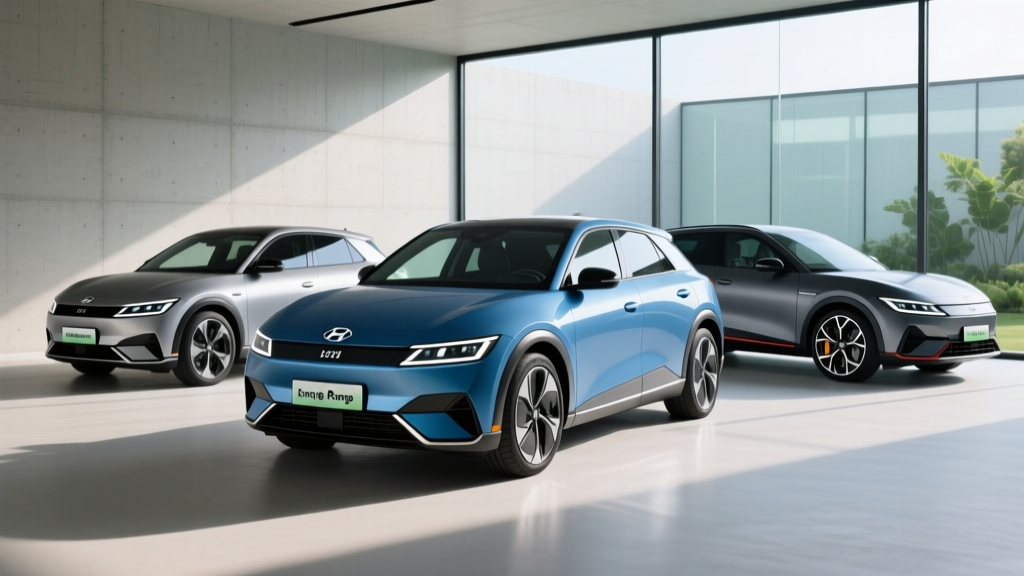
The 2022 Hyundai Ioniq 5 arrived as the automaker's first dedicated EV built on the Electric Global Modular Platform (E-GMP), and it quickly became a benchmark in the compact electric crossover segment. Now that the used-EV market is flooded with ex-lease examples, understanding the differences between the three 2022 Ioniq 5 trims — SE, SEL, and Limited — is critical for buyers evaluating pre-owned inventory in 2026. This review breaks down every spec that matters: real-world range, 800-volt charging capability, trim-level pricing, and whether a used 2022 model qualifies for the federal used-EV tax credit.
2022 Ioniq 5 Trim Lineup at a Glance
Hyundai offered the 2022 Ioniq 5 in three trims, each available in either rear-wheel drive (RWD) or all-wheel drive (AWD). The SE served as the value-oriented entry point, the SEL added premium comfort and tech features, and the Limited topped the range with every available feature. All trims shared the same battery options and 800V-capable architecture, meaning charging performance is identical across the lineup — only equipment and drivetrain differ.
| Spec | SE RWD | SE AWD / SEL AWD | Limited AWD |
|---|---|---|---|
| EPA Range | 303 mi (Long Range) | 256 mi (Long Range) | 256 mi (Long Range) |
| Battery (Usable) | 77.4 kWh (NMC) | 77.4 kWh (NMC) | 77.4 kWh (NMC) |
| Horsepower | 225 hp | 320 hp | 320 hp |
| 0–60 mph | 7.0 sec | 4.7 sec | 4.7 sec |
| Drivetrain | RWD (single motor) | AWD (dual motor) | AWD (dual motor) |
| Max DC Fast Charge | ~240 kW | ~240 kW | ~240 kW |
| 10–80% DCFC Time | ~18 min | ~18 min | ~18 min |
| Level 2 Home Charge | 10.9 kW (~44 mi/hr) | 10.9 kW (~44 mi/hr) | 10.9 kW (~44 mi/hr) |
| MPGe (Combined) | 132 MPGe | 110 MPGe | 110 MPGe |
| Efficiency | 26 kWh/100 mi | 30 kWh/100 mi | 30 kWh/100 mi |
| 2022 Base MSRP | $44,875 | $48,375 (SEL AWD) | $53,475 |
Source: fueleconomy.gov and Hyundai Motor America press materials. MSRP figures are before destination charges.
Real-World Range: What the EPA Sticker Doesn't Tell You
RWD Long Range (EPA 303 mi): Expect 260–280 mi in mixed highway driving at 70–75 mph. In cold weather (below 30°F), plan for 210–230 mi without preconditioning. City driving with regen braking can push past 290 mi in mild conditions.
AWD Long Range (EPA 256 mi): Expect 220–240 mi on highway road trips. Cold-weather highway driving can drop usable range to 175–195 mi. The AWD dual-motor setup consumes roughly 15–18% more energy than the RWD variant at sustained speeds.
The Ioniq 5's NMC (nickel manganese cobalt) lithium-ion battery pack delivers strong energy density, but like all current lithium chemistries, it is sensitive to temperature extremes. Hyundai's battery thermal management system includes active liquid cooling and heating, which helps mitigate cold-weather losses when preconditioning is enabled — but owners who charge at home without preconditioning before highway trips will see the full impact of winter range reduction.
In independent highway-range testing, the RWD Long Range variant has demonstrated 270–280 miles at 65 mph in 70°F conditions, falling short of the 303-mile EPA sticker by roughly 8–10%. This is typical for EVs driven at sustained highway speeds, where aerodynamic drag dominates efficiency. At 75+ mph, the gap widens further. The AWD models lose a similar percentage but start from a lower baseline, making route planning more critical on longer trips.
800V Charging Architecture: Speeds That Still Compete in 2026
The 2022 Ioniq 5's standout engineering feature is its 800-volt electrical architecture — shared with the Kia EV6 and Genesis GV60. This allows the vehicle to accept up to approximately 240 kW at 350 kW DC fast chargers, delivering a 10–80% charge in roughly 18 minutes under optimal conditions. Even as newer EVs have entered the market, this charging speed remains among the fastest available on a production vehicle in 2026.
| Charge Level | Power / Rate | Time (10–80%) | Miles Added per Hour |
|---|---|---|---|
| Level 1 (120V household) | ~1.4 kW | ~72 hours | ~3–4 mi/hr |
| Level 2 (240V, 48A) | 10.9 kW | ~6.5 hours | ~44 mi/hr |
| DC Fast (50 kW) | 50 kW | ~65 min | ~150 mi/hr (peak) |
| DC Fast (150 kW) | ~150 kW | ~25 min | ~450 mi/hr (peak) |
| DC Fast (350 kW) | ~240 kW peak | ~18 min | ~650 mi/hr (peak) |
Charging-curve reality check: The ~240 kW peak rate is not sustained across the entire 10–80% window. The Ioniq 5 typically holds above 200 kW from roughly 10–55% state of charge, then tapers progressively. From 80–100%, charging slows dramatically — Hyundai (like most manufacturers) recommends charging to 80% for daily use to preserve battery longevity. The onboard charger is rated at 10.9 kW for Level 2 AC charging, meaning a full 0–100% home charge takes roughly 7–8 hours on a 48-amp circuit.
Connector note for 2026 buyers: The 2022 Ioniq 5 ships with a CCS1 (Combined Charging System) port. As Hyundai transitions to the NACS (Tesla-style) connector for new models, owners of 2022 CCS-equipped vehicles can use Hyundai-provided or third-party CCS-to-NACS adapters to access Tesla Supercharger V3 and V4 stations. Verify adapter compatibility before relying on Supercharger access for road trips.
Interior, Cargo, and Daily Livability
The Ioniq 5's flat floor and long 118.1-inch wheelbase (longer than the Tucson's) translate into genuinely generous interior space. Hyundai claims 106.5 cubic feet of passenger volume and 59.3 cubic feet of cargo space behind the front seats (27.2 cu ft behind the second row). Rear legroom measures 39.4 inches — enough for tall adults on longer trips without complaint.
The dual 12.3-inch display setup (instrument cluster and infotainment) was competitive in 2022 and remains functional in 2026, though the interface shows its age compared to newer EV infotainment systems. Wireless Apple CarPlay and Android Auto are standard across all trims. The center console slides fore and aft ("Universal Island"), a clever feature for tight parking-space egress. The Limited trim adds a panoramic fixed glass roof, ventilated front seats, heated rear seats, a head-up display with augmented-reality navigation, and a premium Bose audio system.
Notable drawback: The 2022 Ioniq 5 lacks a front trunk (frunk). The small compartment that exists on some market variants holds only the charging cable. There is also no rear wiper on the hatchback glass — a frequently cited annoyance in rain and snow. Towing capacity is limited to 1,650 lbs (braked), ruling out most travel trailers and boat hauls.
Trim-by-Trim Breakdown: What You Get at Each Level
SE ($44,875 RWD / $48,375 AWD): The SE includes the full 77.4 kWh battery, 10.9 kW onboard charger, 800V DC fast charging, heated front seats, dual 12.3-inch displays, Hyundai SmartSense (forward collision-avoidance assist, lane-keeping assist, blind-spot monitoring, rear cross-traffic alert, adaptive cruise control with stop-and-go), LED headlights, and 19-inch alloy wheels. The SE Standard Range variant (58 kWh battery, 220 mi EPA, RWD only) was also available at $43,650 but is far less common on the used market.
SEL ($48,375 AWD only): Adds wireless phone charging, a power-adjustable passenger seat, leatherette-trimmed seats with H-Tex upholstery, a leather-wrapped steering wheel, auto-dimming rearview mirror, Digital Key (phone-as-key via NFC), and front parking sensors. The SEL was the volume seller and is the most common trim in 2026 used listings.
Limited ($53,475 AWD only): The range-topper includes everything on the SEL plus the panoramic fixed glass roof, ventilated front seats, heated rear seats, head-up display (HUD) with augmented-reality navigation, Bose 8-speaker premium audio, Highway Driving Assist 2 (HDA2 — hands-on lane-centering with automatic lane changes), a 360-degree surround-view monitor, remote smart parking assist, and 20-inch alloy wheels with a distinct aero-blade design.
Federal Tax Credit Eligibility in 2026
| Credit Type | Amount | Key Requirements |
|---|---|---|
| New-Vehicle Credit (§30D) | Up to $7,500 | Must meet critical-mineral and battery-component sourcing rules; buyer income caps ($150K single / $300K joint); MSRP cap $80K for SUVs. The 2022 Ioniq 5 was largely ineligible for the full credit when new due to South Korean battery sourcing. |
| Used-Vehicle Credit (§25E) | Up to $4,000 (30% of sale price) | Sale price must be ≤$25,000; buyer income caps ($75K single / $150K joint); vehicle must be at least 2 model years old; purchased from a licensed dealer; available once per buyer per 3 years. |
For 2026 buyers shopping the used market, the §25E Used Clean Vehicle Credit is the relevant incentive. A 2022 Ioniq 5 now qualifies as a vehicle that is at least two model years old. However, the sale price must be $25,000 or less to trigger eligibility. As of early 2026, used 2022 Ioniq 5 pricing typically ranges from $26,000 to $35,000 depending on trim, mileage, and condition — meaning many examples sit just above the $25,000 threshold.
Buyers with flexibility on trim and mileage may find high-mileage SE models that clear the $25,000 cap, yielding up to $4,000 in federal credit (30% of the sale price). Income limits apply: modified adjusted gross income must not exceed $75,000 (single filers), $112,500 (head of household), or $150,000 (joint filers). Consult a tax professional and review current IRS §25E guidance before finalizing a purchase.
Driving Impressions and Performance
The AWD dual-motor Ioniq 5 delivers 320 horsepower and 446 lb-ft of torque, launching to 60 mph in approximately 4.7 seconds. That puts it in the same acceleration bracket as a Tesla Model Y Long Range and noticeably quicker than the Volkswagen ID.4 AWD. The RWD variant's 225 hp and 7.0-second 0–60 time are adequate for commuting but lack the urgency that makes EV acceleration addictive.
Ride quality is a strong point. The Ioniq 5 uses a multi-link rear suspension that absorbs road imperfections with composure uncommon in this price class. Steering is light and precise, though feedback is minimal — this is a comfort-oriented cruiser, not a sport sedan. The regenerative braking system offers adjustable levels via steering-wheel paddles, including an i-Pedal mode that enables one-pedal driving to a complete stop. Brake feel is progressive and avoids the grabby regen transitions that plague some competitors.
All 2022 Ioniq 5 trims include Hyundai SmartSense, a suite of SAE Level 2 driver-assistance features. The Limited trim's Highway Driving Assist 2 (HDA2) adds lane-centering and automatic lane changes, but the driver must keep hands on the steering wheel at all times. This is not autonomous or self-driving technology — it is a driver-support system that requires continuous engagement and situational awareness.
Pros, Cons, and the Verdict
- 800V architecture delivers ~18-minute 10–80% DC fast charging — still best-in-class for the segment
- 303-mile EPA range on RWD Long Range trims is competitive
- Spacious flat-floor cabin with 39.4 inches of rear legroom
- Strong value proposition on the used market in 2026
- Hyundai's 10-year/100,000-mile battery warranty may be transferable to second owners (verify with dealer)
- Distinctive retro-futuristic styling that ages well
- No rear window wiper — significant visibility issue in rain/snow
- Minimal frunk space; no practical front storage
- CCS1 connector requires adapter for Tesla Supercharger access
- AWD range drops to 256 mi EPA; real-world highway figure closer to 220–240 mi
- Infotainment interface feels dated compared to 2025+ competitors
- Limited towing capacity (1,650 lbs) rules out most trailers
Who Should Buy a Used 2022 Ioniq 5?
Choose the 2022 Ioniq 5 SEL AWD if: You need all-weather traction and want the best balance of features and value. The SEL is the most common used-market find and includes upgraded interior materials and Digital Key.
Choose the 2022 Ioniq 5 Limited AWD if: You want every available feature — HUD, ventilated seats, premium audio, HDA2 — and don't mind paying a premium on the used market. Best for tech-focused buyers who plan to keep the vehicle long-term.
Look elsewhere if: You need to tow more than 1,650 lbs, require NACS-native Supercharger access without an adapter, or frequently drive in heavy rain/snow where the missing rear wiper becomes a genuine safety concern.
2022 Ioniq 5 Ownership Costs and Warranty
Hyundai backed the 2022 Ioniq 5 with a 5-year/60,000-mile new-vehicle limited warranty and a 10-year/100,000-mile battery and powertrain warranty. The battery warranty guarantees that the high-voltage pack will retain at least 70% of its original capacity during the coverage period. For second owners, the 10-year powertrain warranty typically reverts to 5-year/60,000-mile coverage unless the vehicle was certified pre-owned through a Hyundai dealer — always confirm warranty transferability before purchasing.
Insurance premiums for the Ioniq 5 tend to run 10–20% higher than comparable gas-powered crossovers, consistent with EV insurance trends driven by higher repair costs for battery-adjacent damage. Electricity costs for home charging average roughly $0.13–0.17 per kWh nationally, translating to approximately $3.50–4.50 per 100 miles of driving in the RWD variant — roughly one-third the per-mile fuel cost of a 25-MPG gas crossover at $3.50/gallon.
Frequently Asked Questions
What is the real-world range of the 2022 Ioniq 5?
The RWD Long Range achieves 303 miles EPA, but expect 260–280 miles in real-world highway driving and 210–230 miles in cold weather below 30°F. The AWD variant rates at 256 miles EPA, with real-world highway figures around 220–240 miles and cold-weather range dropping to 175–195 miles.
How fast does the 2022 Ioniq 5 charge?
On a 350 kW DC fast charger, the Ioniq 5 peaks at approximately 240 kW and charges from 10–80% in about 18 minutes. At home on a Level 2 (240V, 48A) charger, it accepts 10.9 kW, adding roughly 44 miles of range per hour and completing a full charge in 7–8 hours.
Does the 2022 Ioniq 5 qualify for a federal tax credit in 2026?
As a used vehicle, the 2022 Ioniq 5 may qualify for the §25E Used Clean Vehicle Credit of up to $4,000 — but only if the dealer sale price is $25,000 or less and the buyer meets income caps ($75K single / $150K joint). Many used examples currently price above $25,000, so verify the final negotiated price before counting on the credit. See IRS guidance on §25E.
Is the 2022 Ioniq 5 worth buying vs. the Tesla Model Y or VW ID.4?
The Ioniq 5's 800V charging speed is a genuine advantage over the VW ID.4 (which tops out around 135 kW on DC fast charging) and remains competitive with the Tesla Model Y. The Model Y offers access to the Supercharger network natively and slightly more cargo space, but the Ioniq 5 counters with a more comfortable ride, a more distinctive interior, and strong used-market value. If fast public charging is a priority and you can secure a CCS-to-NACS adapter, the Ioniq 5 is a strong pick.
What battery chemistry does the 2022 Ioniq 5 use?
The 2022 Ioniq 5 uses an NMC (nickel manganese cobalt) lithium-ion battery. NMC offers higher energy density than LFP (lithium iron phosphate), enabling the 303-mile range in a compact package, but it is more sensitive to sustained high states of charge. Hyundai recommends charging to 80% for daily use and reserving 100% charges for long trips.
Can I charge a 2022 Ioniq 5 at Tesla Superchargers?
Yes, but not natively. The 2022 Ioniq 5 uses a CCS1 connector. Hyundai has provided CCS-to-NACS adapters for owners, and third-party adapters are also available. With a compatible adapter, you can access Tesla V3 and V4 Supercharger stalls, though charging speed will be limited by the adapter's rated capacity and the vehicle's onboard charge management.