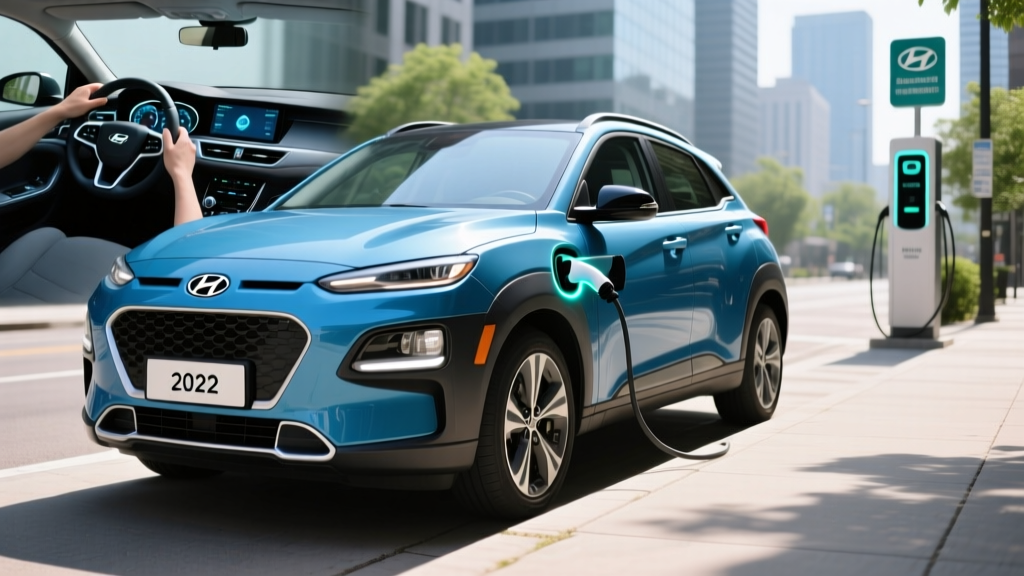
The 2022 Hyundai Kona Electric occupies a specific niche in the 2026 used-EV market: a compact crossover with genuine daily-driver range, competitive efficiency, and a price point that—when paired with the federal used-EV tax credit—makes it one of the most accessible electric vehicles available. Now that Hyundai has moved to the redesigned 2024+ Kona Electric platform (with NACS charging and a larger footprint), the 2022 model has depreciated into a compelling bargain for commuters and urban drivers who can charge at home.
This review breaks down every number that matters for a prospective used buyer: real-world range expectations, the charging curve reality at DC fast stations, battery chemistry and degradation outlook, and whether the §25E used-EV credit can knock $4,000 off the purchase price.
Range and Efficiency: EPA Sticker vs Real-World Miles
Real-World Expectation: 220–245 miles in mixed driving; 195–215 miles sustained highway at 70+ mph; 170–195 miles in sub-30°F winter conditions with cabin heat.
The 2022 Kona Electric carries an EPA rating of 258 miles across all trims (SEL, Limited, Ultimate), powered by a 64 kWh usable lithium-ion battery pack. On the EPA's fuel economy site, it posts a combined efficiency of 120 MPGe (city: 134 MPGe / highway: 106 MPGe), which translates to approximately 28 kWh per 100 miles—a strong efficiency figure for a crossover in this weight class.
In real-world use, the Kona Electric's range holds up well in city and suburban driving where regenerative braking recaptures energy. Highway efficiency drops noticeably above 65 mph due to the vehicle's bluff frontal area and lack of an active aero shutter system. Cold weather is the more significant range variable: the 2022 model uses a resistive PTC heater rather than a heat pump (which Hyundai introduced on the Ioniq 5 and later Kona generations). In freezing temperatures, expect a 20–30% range reduction when using cabin heating, bringing effective range down to roughly 170–195 miles on a full charge.
For a commuter covering 40–60 miles round trip, the Kona Electric's real-world range provides a comfortable buffer. Road-trippers should plan around 180–200 miles between fast-charge stops to keep the battery in its optimal charging window.
Battery Chemistry, Capacity, and Long-Term Degradation
The 2022 Kona Electric uses a 64 kWh usable battery pack (approximately 67.5 kWh gross) with NMC (nickel-manganese-cobalt) cathode chemistry. This is a higher energy-density chemistry compared to LFP (lithium iron phosphate), which gives the Kona its strong range-to-weight ratio but requires more careful state-of-charge management for long-term health.
| Specification | Value |
|---|---|
| Battery (usable) | 64 kWh, NMC chemistry |
| EPA Range | 258 miles |
| Combined Efficiency | 120 MPGe / 28 kWh/100 mi |
| Motor Output | 150 kW (201 hp), 290 lb-ft torque |
| Drivetrain | Front-wheel drive (single motor) |
| 0–60 mph | ~6.4 seconds |
| Max DC Fast Charge | 75 kW (CCS1) |
| 10–80% DC Charge Time | ~47 minutes |
| Level 2 Charge Rate | 7.2 kW (onboard charger) |
| Level 2 Full Charge Time | ~9 hours (0–100%) |
| Cargo Volume (rear seats up) | 19.2 cu ft |
| Cargo Volume (rear seats folded) | 45.8 cu ft |
| Rear Legroom | 34.6 inches |
| Battery Warranty | 8 years / 100,000 miles |
| Original Base MSRP | $34,000 (SEL) |
NMC batteries typically degrade 8–12% over the first 100,000 miles, with the steepest loss occurring in the first 20,000 miles. Hyundai's battery warranty covers capacity loss below 70% of original capacity for 8 years or 100,000 miles. Since the 2022 model is now four years old in 2026, buyers should request a State of Health (SoH) reading from a Hyundai dealer or use an OBD-II diagnostic tool to verify remaining capacity. A well-maintained 2022 Kona Electric with 40,000–60,000 miles should still retain 90–94% of its original battery capacity.
Best practices for NMC longevity: avoid sustained 100% or 0% states of charge, use Level 2 charging as the daily norm, and limit DC fast charging to road trips. The Kona Electric's infotainment system includes a configurable charge limit (set to 80% or 90%) to automate this.
Charging Speed: DC Fast, Level 2, and the 75 kW Ceiling
The 2022 Kona Electric's most-cited limitation is its DC fast-charge rate. The vehicle peaks at 75 kW on a CCS1 connector, which was competitive in 2019 when the Kona Electric launched but trails the 150–350 kW rates now common on newer EVs.
| Level | Power | Time | Miles Added |
|---|---|---|---|
| Level 1 (120V, 12A) | ~1.4 kW | ~45 hours (0–100%) | ~4 mi/hr |
| Level 2 (240V, 32A) | 7.2 kW | ~9 hours (0–100%) | ~25 mi/hr |
| DC Fast (CCS1, peak) | 75 kW | ~47 min (10–80%) | ~140 mi in 30 min |
The charging curve is the practical reality behind the spec sheet. The Kona Electric holds close to its 75 kW peak between approximately 10% and 40% state of charge, then tapers progressively: dropping to ~55 kW by 60%, ~35 kW by 75%, and ~15 kW above 85%. This taper means the 10–80% session takes roughly 47 minutes at a properly functioning 150+ kW CCS station (the car limits the draw, not the station).
For home charging, the 7.2 kW onboard charger is adequate. A standard 240V/32A Level 2 installation adds approximately 25 miles of range per hour, meaning an overnight session (8–9 hours) fully replenishes the battery. Most owners will arrive home with 30–50% remaining and wake to a full charge every morning.
The CCS1 connector is now a legacy format as the industry shifts to NACS (Tesla's North American Charging Standard). Hyundai's 2024+ models have adopted NACS natively. For the 2022 Kona Electric, CCS1 adapters for Tesla Supercharger access are available from third-party manufacturers, though compatibility varies and Hyundai does not officially endorse them. The Electrify America, EVgo, and ChargePoint networks continue to support CCS1, so public charging access remains viable in most metro areas.
Performance, Driving Dynamics, and Practicality
The 2022 Kona Electric's single front-mounted motor produces 201 horsepower and 290 lb-ft of torque, delivering a 0–60 mph time of approximately 6.4 seconds. That's brisk for a compact crossover and provides confident highway merging. The instant torque delivery makes it feel quicker in urban stop-and-go than the horsepower figure alone suggests.
Driving dynamics are car-like rather than SUV-like—the Kona Electric rides on the same platform as the gasoline Kona, so the floor-mounted battery gives it a low center of gravity with minimal body roll. The steering is light and precise, and the four-level regenerative braking system (controlled by steering-wheel paddles) allows near one-pedal driving at its maximum setting, though it doesn't achieve a complete stop without brake application.
Interior space is the Kona Electric's most honest limitation. Rear legroom measures 34.6 inches, which is tight for adults on longer trips. Cargo volume behind the rear seats is 19.2 cubic feet (expanding to 45.8 cu ft with seats folded)—adequate for groceries and carry-ons but less than competitors like the Chevrolet Bolt EUV (which offers 16.3 cu ft but a more usable shape) or the Volkswagen ID.4 (30.3 cu ft). There is no front trunk (frunk); the space under the hood houses the power electronics and the 12V auxiliary battery.
Tech, Safety, and Driver-Assistance Features
The 2022 Kona Electric comes well-equipped across its three trims. The SEL (base) includes a 10.25-inch touchscreen with Apple CarPlay and Android Auto (wired, not wireless on this model year), a 10.25-inch digital instrument cluster, wireless phone charging pad, and Hyundai's SmartSense safety suite.
SmartSense includes forward collision-avoidance assist with pedestrian detection, lane-keeping assist, lane-following assist, blind-spot collision warning, rear cross-traffic collision-avoidance, and driver attention warning. The Limited and Ultimate trims add highway driving assist (a Level 2 system combining adaptive cruise control with lane centering), which functions similarly to early Tesla Autopilot but requires hands on the wheel at all times.
The Ultimate trim (top tier, original MSRP ~$42,500) adds a head-up display, Harman Kardon premium audio, leather-trimmed seats, a sunroof, and a 360-degree camera system. For a used buyer in 2026, the Limited trim offers the best value-to-feature ratio, adding the highway driving assist and leatherette seats without the Ultimate's premium.
Pricing, Used Market Value, and Federal Tax Credit Eligibility
The 2022 Kona Electric's original MSRP ranged from $34,000 (SEL) to $42,500 (Ultimate), before any incentives. In the 2026 used market, well-maintained examples with 30,000–50,000 miles are listing between $16,000 and $23,000 depending on trim, condition, and region.
| Trim | Typical Used Price | §25E Credit (if eligible) | Effective Price |
|---|---|---|---|
| SEL | $16,000–$18,500 | Up to $4,000 | $12,000–$14,500 |
| Limited | $18,500–$21,000 | Up to $4,000 | $14,500–$17,000 |
| Ultimate | $20,500–$23,000 | Up to $4,000 | $16,500–$19,000 |
The §25E Previously-Owned Clean Vehicle Credit (not §30D, which applies only to new vehicles) provides up to $4,000 or 30% of the sale price (whichever is less) for eligible used EVs. Per IRS guidelines, key eligibility requirements include:
- Sale price must be $25,000 or less (most 2022 Kona Electric listings qualify)
- Buyer's modified adjusted gross income must not exceed $75,000 (single) / $112,500 (head of household) / $150,000 (joint)
- Vehicle must be purchased from a licensed dealer (private-party sales do not qualify)
- Buyer must not have claimed the §25E credit on another vehicle in the prior 3 years
- The credit can be transferred to the dealer at point of sale as an immediate price reduction (effective 2024 onward)
This credit is the single biggest financial lever for a 2022 Kona Electric purchase. A Limited trim at $20,000 with the full $4,000 credit applied comes in at $16,000 out of pocket—an exceptional value for a 258-mile-range EV with modern safety tech. Consult a tax professional to confirm personal eligibility, as income limits and dealer-participation requirements apply.
Pros, Cons, and the Verdict vs Competitors
- 258-mile EPA range is practical for most daily needs and weekend trips
- 120 MPGe combined is among the most efficient in its class
- Eligible for up to $4,000 §25E used-EV credit, dropping effective price below $15K
- Strong Hyundai SmartSense safety suite standard on all trims
- 8-year/100,000-mile battery warranty may still have years of coverage remaining
- Responsive 201-hp motor with punchy low-end torque
- 10.25-inch infotainment with navigation on Limited/Ultimate
- 75 kW peak DC charge rate is slow by 2026 standards (~47 min 10–80%)
- No heat pump — significant cold-weather range loss (20–30%)
- CCS1 connector is legacy; NACS adapter needed for Tesla Supercharger access
- Rear seat legroom (34.6 in) and cargo space (19.2 cu ft) are tight
- Wired-only Apple CarPlay/Android Auto (no wireless)
- No frunk for additional storage
- Level 2 driver assist requires constant hand-on-wheel supervision
How does it compare? The 2022 Chevrolet Bolt EUV offers similar range (247 miles) with a more spacious interior but slower DC charging (55 kW peak). The 2022 Nissan Leaf Plus (226 miles, CHAdeMO connector) is increasingly stranded as CHAdeMO infrastructure declines. The 2022 Volkswagen ID.4 (260 miles, 125 kW DC charging) is more practical for families but commands $5,000–$8,000 more on the used market. For a single commuter or couple who charges at home and rarely road-trips, the Kona Electric at $12,000–$17,000 (after credit) is difficult to beat on pure value.
Who Should Buy the 2022 Hyundai Kona Electric?
- You commute 40–80 miles daily and can charge at home (Level 2)
- Your budget is $12,000–$18,000 after the used-EV tax credit
- You prioritize efficiency and low operating cost over interior space
- You live in a mild-to-moderate climate (less cold-weather range penalty)
- Road trips are occasional, not weekly, and you can tolerate 45-minute charge stops
- You need rear-seat space for adult passengers or bulky car seats
- You live in a region with harsh winters and no garage charging
- Frequent 300+ mile road trips are your norm
- You want NACS native charging and access to the Tesla Supercharger network without adapters
Frequently Asked Questions
What is the real-world range of the 2022 Hyundai Kona Electric?
The EPA rates it at 258 miles combined. In real-world mixed driving, expect 220–245 miles. Sustained highway driving at 70+ mph drops that to roughly 195–215 miles, and sub-30°F winter conditions with cabin heat can reduce it to 170–195 miles due to the resistive PTC heater (no heat pump).
How fast does the 2022 Kona Electric charge?
On DC fast charging (CCS1), it peaks at 75 kW, completing a 10–80% charge in approximately 47 minutes. At home on a 240V Level 2 charger (7.2 kW), a full 0–100% charge takes about 9 hours, adding roughly 25 miles of range per hour. Level 1 (120V) adds only about 4 miles per hour.
How much does a used 2022 Kona Electric cost after tax credits?
Used prices in 2026 range from approximately $16,000 (SEL) to $23,000 (Ultimate). If you qualify for the §25E used-EV credit (income under $75K single / $150K joint, purchased from a dealer, sale price ≤$25,000), you can receive up to $4,000 as a point-of-sale reduction, bringing effective prices as low as $12,000–$19,000 depending on trim.
Does the 2022 Kona Electric qualify for the federal EV tax credit?
Not the §30D new-vehicle credit, which applies only to new purchases. However, it can qualify for the §25E Previously-Owned Clean Vehicle Credit of up to $4,000, subject to buyer income limits, a $25,000 sale-price cap, and dealer-purchase requirement. Check IRS.gov for current rules.
Is the 2022 Kona Electric worth buying vs competitors in 2026?
For budget-conscious commuters, yes. At $12,000–$17,000 after the used-EV credit, it offers 258 miles of EPA range, strong efficiency (120 MPGe), and a comprehensive safety suite. Its main drawback—75 kW DC charging—matters primarily for road-trippers. If you charge at home nightly and drive under 100 miles daily, the slow fast-charging rate is a minor inconvenience, not a dealbreaker.
How long will the 2022 Kona Electric battery last?
Hyundai warranties the battery for 8 years or 100,000 miles against capacity loss below 70%. As a 2022 model, it has warranty coverage through 2030 or 100,000 miles (whichever comes first). NMC batteries typically retain 88–94% capacity at 60,000 miles with proper care (avoiding extreme states of charge and excessive DC fast charging). A pre-purchase SoH diagnostic is strongly recommended for any used example.