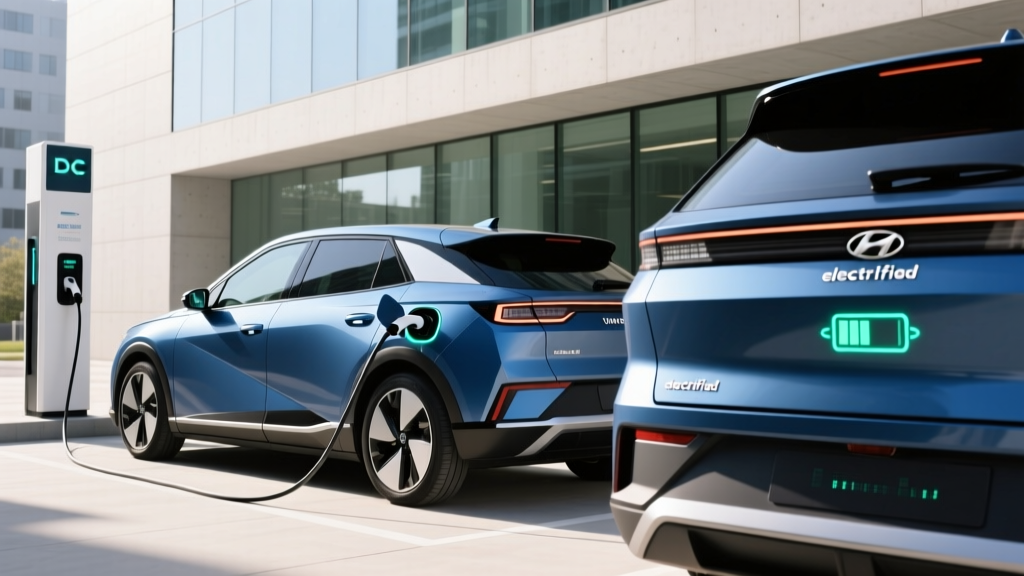
The 2022 Hyundai Ioniq 5 arrived as a watershed moment for mainstream electric vehicles. Built on Hyundai Motor Group's dedicated Electric-Global Modular Platform (E-GMP), it brought 800-volt architecture — previously the domain of Porsche and Audi — to a sub-$45,000 crossover. Its striking retro-futuristic design and rapid DC charging capability made it one of the most talked-about EVs of the year, and sales data confirmed the enthusiasm: the Ioniq 5 became one of the fastest-selling new EVs in the U.S. market throughout 2022 and into 2023, consistently ranking among the top non-Tesla electric vehicles by unit volume.
If you're evaluating a used 2022 Ioniq 5 in 2026 or simply researching what made this model a benchmark, this review covers every number that matters — from real-world range to charging curves, tax credit rules, and how it stacks up against the competition.
2022 Hyundai Ioniq 5 Core Specifications at a Glance
| Specification | SE/SEL RWD | SE/SEL AWD | Limited AWD |
|---|---|---|---|
| EPA Range | 303 miles | 256 miles | 256 miles |
| Battery (usable) | 77.4 kWh (NMC) | 77.4 kWh (NMC) | 77.4 kWh (NMC) |
| Horsepower | 168 hp | 320 hp | 320 hp |
| Torque | 258 lb-ft | 446 lb-ft | 446 lb-ft |
| 0-60 mph | ~7.0 sec | ~5.0 sec | ~5.0 sec |
| Drivetrain | Rear-Wheel Drive | Dual-Motor AWD | Dual-Motor AWD |
| Max DC Fast Charge | ~235 kW (peak) | ~235 kW (peak) | ~235 kW (peak) |
| 10-80% DCFC Time | ~18 min | ~18 min | ~18 min |
| Level 2 Charge Rate | 10.9 kW | 10.9 kW | 10.9 kW |
| MPGe (combined) | 132 MPGe | 110 MPGe | 110 MPGe |
| EPA Efficiency | 25 kWh/100mi | 30 kWh/100mi | 30 kWh/100mi |
| Original Base MSRP | $43,650 | $47,100 | $52,600 |
Sources: fueleconomy.gov, Hyundai Motor America 2022 Ioniq 5 specifications.
Real-World Range: What the EPA Sticker Doesn't Tell You
EPA Estimated: 303 miles (RWD) / 256 miles (AWD)
Real-World Expectation: 240–270 miles highway (RWD); 200–230 miles highway (AWD). In freezing temperatures (below 30°F), expect a 20–30% reduction, bringing the RWD model down to roughly 210–240 miles and the AWD to 175–205 miles.
The 2022 Ioniq 5's Long Range battery pack holds 77.4 kWh of usable energy using NMC (nickel manganese cobalt) chemistry. This chemistry offers higher energy density than LFP, which is why Hyundai could package a competitive range into a midsize crossover footprint.
In independent highway testing at sustained 70–75 mph speeds, the RWD model typically delivers between 240 and 270 miles before reaching a low state of charge. The AWD variants, with their additional motor mass and higher consumption (30 kWh/100 mi vs. 25 kWh/100 mi for RWD), land closer to 200–230 miles on the highway. City driving with frequent regenerative braking opportunities pushes efficiency higher, and some owners report matching or slightly exceeding EPA figures in stop-and-go commuting.
Cold weather is the great equalizer for all EVs. The 2022 Ioniq 5 uses a heat pump (standard on Limited, available on other trims depending on market) which mitigates cabin-heating energy draw. However, battery chemistry itself becomes less efficient in cold temperatures. Plan conservatively if you live in northern climates — a 303-mile EPA RWD Ioniq 5 realistically delivers around 220 miles on a cold winter highway run.
Charging Performance: 800V Architecture Makes the Difference
This is where the 2022 Ioniq 5 genuinely separates itself from most competitors. Its 800-volt electrical architecture allows it to accept DC fast charging at rates that rival vehicles costing twice as much.
| Charging Method | Power / Rate | Time / Miles Added |
|---|---|---|
| Level 1 (120V household) | ~1.4 kW | ~3-4 miles per hour |
| Level 2 (240V, 48A) | 10.9 kW | ~35-40 miles per hour; full charge in ~7.5 hours |
| DC Fast Charge (50 kW station) | 50 kW | 10-80% in ~55 minutes |
| DC Fast Charge (150 kW station) | ~150 kW sustained | 10-80% in ~25 minutes |
| DC Fast Charge (250-350 kW station) | Peak ~235 kW | 10-80% in ~18 minutes |
Understanding the charge curve: The Ioniq 5 peaks at roughly 235 kW when connected to a 350 kW-capable charger (such as Electrify America's fastest stalls). However, that peak rate is not sustained across the entire session. Like all EVs, charging speed tapers as the battery fills. You'll see the highest rates between roughly 10% and 40% state of charge. Above 60%, the rate drops progressively, and above 80%, it slows significantly to protect battery health. The 18-minute 10-80% figure represents an optimized session with a preconditioned battery and a capable charger.
For home charging, the onboard charger accepts up to 10.9 kW on Level 2 (240V at 48 amps). That means a full overnight charge from near-empty takes about 7.5 hours — easily manageable with a standard home Level 2 wall connector installation. Note that kW (kilowatts) measures power — the rate of energy delivery — while kWh (kilowatt-hours) measures total energy capacity. The Ioniq 5's 77.4 kWh battery charged at 10.9 kW takes roughly 77.4 ÷ 10.9 = 7.1 hours theoretically, with some overhead for losses.
One practical note: the 2022 model year came with a CCS1 connector. Hyundai transitioned to NACS (Tesla-style) for later model years, and adapters are available for 2022 owners who want Tesla Supercharger access. Hyundai also included a complimentary Electrify America charging period for original purchasers.
Performance and Driving Dynamics
The dual-motor AWD Ioniq 5 produces 320 horsepower and 446 lb-ft of torque, launching from 0-60 mph in approximately 5.0 seconds. That's genuinely quick for a family crossover — comparable to a V6 sports sedan from a decade ago. The single-motor RWD version, at 168 hp and 258 lb-ft, hits 60 mph in roughly 7.0 seconds. It's adequate for daily driving but noticeably less eager, especially at highway merging speeds.
The E-GMP platform gives the Ioniq 5 a low center of gravity (the battery pack sits under the floor) and a near 50/50 weight distribution in AWD form. The result is composed handling that belies the vehicle's ~4,400–4,600 lb curb weight. The ride quality is firm but compliant — Hyundai tuned it for European roads, and it shows. Road noise is well-managed, though the 20-inch wheels on the Limited trim transmit more harshness than the 18s on lower trims.
The regenerative braking system offers multiple levels, adjustable via steering wheel paddles. At the maximum setting (i-Pedal mode), the Ioniq 5 approaches one-pedal driving, though it doesn't always come to a complete stop without brake pedal input. The transition between regen and friction braking is generally smooth, a common weak point in lesser EVs.
Interior, Cargo, and Technology
The Ioniq 5's interior design leans heavily into a minimalist, lounge-like aesthetic. The flat floor (enabled by the skateboard platform) and slim center console create an airy cabin. Hyundai's "Universal Island" sliding center console can move back 140 mm, providing flexible storage between front seats.
Passenger space:
- Front headroom: 39.4 inches
- Front legroom: 41.7 inches
- Rear headroom: 38.7 inches
- Rear legroom: 39.4 inches
Rear legroom is particularly generous — among the best in the compact EV crossover class. Three adults can sit abreast in the rear with reasonable comfort, though the center position sits on a firmer cushion section.
Cargo volume:
- Behind rear seats: 27.2 cubic feet
- Rear seats folded: 59.3 cubic feet
- Front trunk (frunk): 0.85 cu ft (RWD) / 2.1 cu ft (AWD — smaller due to front motor)
The frunk on the 2022 model is modest — essentially a shallow compartment suitable for charging cables and a small bag. It's noticeably smaller than the Tesla Model Y's frunk or the Ford Mustang Mach-E's.
Technology highlights:
- Dual 12.3-inch displays (instrument cluster + infotainment) in a single curved housing
- Wireless Apple CarPlay and Android Auto
- Hyundai SmartSense suite: forward collision avoidance, blind-spot monitoring, rear cross-traffic alert, lane-keeping assist, adaptive cruise with stop-and-go
- Highway Driving Assist (HDA) with lane centering — an SAE Level 2 driver-assistance system requiring hands-on-wheel attention
- Vehicle-to-Load (V2L): the Ioniq 5 can output up to 3.6 kW of AC power through an interior outlet or external adapter, enough to power appliances, tools, or even trickle-charge another EV
- Digital side mirrors (available in select markets, not standard on U.S. 2022 models)
Notable drawbacks: The infotainment system uses capacitive touch buttons for climate controls rather than physical knobs — a common complaint about usability while driving. The 2022 model year lacks the over-the-air update sophistication of Tesla's ecosystem, though Hyundai improved OTA capabilities in subsequent years. There is no rear wiper on the 2022 model, which is a genuine annoyance in rain and snow.
Pricing, Tax Credits, and Ownership Cost
| Trim | Original MSRP | Federal Credit Potential | Effective Price (if eligible) |
|---|---|---|---|
| SE Standard Range RWD | $43,650 | Up to $7,500* | ~$36,150* |
| SE RWD (Long Range) | $45,000 | Up to $7,500* | ~$37,500* |
| SEL AWD | $48,600 | Up to $7,500* | ~$41,100* |
| Limited AWD | $52,600 | Up to $7,500* | ~$45,100* |
*Federal EV tax credit eligibility under IRS §30D is subject to multiple requirements that change periodically. As of current rules, qualifying depends on buyer income caps ($150K single / $300K joint MAGI), vehicle MSRP caps ($80K for SUVs/crossovers), battery component and critical mineral sourcing thresholds, and final assembly in North America. The 2022 Ioniq 5 was built in South Korea, which initially complicated credit eligibility until Hyundai shifted U.S. production. Consult IRS.gov or a tax professional for your specific eligibility.
For 2026 buyers shopping the used market, the used EV tax credit (up to $4,000 or 30% of sale price, whichever is lower) may apply if the vehicle is purchased from a dealer for under $25,000, subject to income limits. Given the Ioniq 5's strong resale value, finding one under the $25K threshold is challenging but not impossible for higher-mileage examples.
Warranty coverage remains a Hyundai strong point:
- Battery & electric powertrain: 10 years / 100,000 miles
- New vehicle limited: 5 years / 60,000 miles
- Roadside assistance: 5 years / unlimited miles
The 10-year battery warranty guarantees that the high-voltage battery will retain at least 70% of its original capacity. In practice, Hyundai's NMC packs have shown degradation rates of roughly 1-2% per year under normal use, based on early owner data — meaning a 5-year-old 2022 model should still hold approximately 90-95% of its original capacity.
How the 2022 Ioniq 5 Compares to Key Competitors
Pros
- Class-leading DC fast-charge speed (800V, ~18 min 10-80%)
- Striking design with practical, spacious interior
- V2L capability (3.6 kW output) for camping/emergency use
- Generous 10-year/100K-mile battery warranty
- Composed ride and handling for an EV crossover
- Strong real-world efficiency in RWD form (25 kWh/100mi)
Cons
- No rear wiper (2022 model year)
- Small frunk compared to Model Y or Mach-E
- Capacitive touch climate controls lack tactile feedback
- AWD models lose significant range vs. RWD (256 vs. 303 mi)
- South Korea-built 2022 models had complex tax credit eligibility
- Limited OTA update capability vs. Tesla
Versus Tesla Model Y (2022): The Model Y offers more range (330 mi Long Range), a larger frunk, access to the Supercharger network natively, and superior OTA software. But the Ioniq 5 charges faster on non-Tesla DC networks, offers V2L, has a more conventional (and to some, more comfortable) interior layout, and provides physical buttons for critical functions like gear selection.
Versus Ford Mustang Mach-E (2022): The Mach-E delivers sportier driving dynamics and a more driver-focused cockpit. However, its DC charging speed (~115 kW peak for most trims) is significantly slower than the Ioniq 5's 235 kW, making road trips noticeably longer. The Mach-E also uses a CCS connector natively with similar adapter requirements for Tesla access.
Versus Volkswagen ID.4 (2022): The ID.4 offers comparable space and a comfortable ride but charges at roughly 125-135 kW peak — nearly half the Ioniq 5's rate. Its infotainment software was also widely criticized at launch for sluggishness and bugs.
Who Should Buy the 2022 Hyundai Ioniq 5?
Choose the 2022 Ioniq 5 if:
- You take regular road trips and want the fastest possible DC charging outside the Tesla network
- You value distinctive design and a spacious, airy cabin
- V2L power output matters for camping, tailgating, or emergency backup
- You want a 10-year battery warranty for peace of mind on a used EV purchase
- You primarily commute in the RWD model and want strong efficiency
Look elsewhere if:
- You need maximum range above all else (Tesla Model Y Long Range or Ioniq 5's later Long Range AWD update may serve better)
- You rely heavily on the Tesla Supercharger network and don't want adapter dependency
- You need a large frunk for front cargo
- You live in a region with limited DC fast-charging infrastructure and rely on Level 2 exclusively (the 800V advantage is less relevant)
Frequently Asked Questions
What is the real-world range of the 2022 Hyundai Ioniq 5?
The RWD model's EPA estimate is 303 miles, but expect 240-270 miles on the highway and 280-310 miles in city driving with regenerative braking. AWD models drop to 256 EPA miles with a real-world highway expectation of 200-230 miles. Cold weather reduces all figures by 20-30%.
How fast does the 2022 Ioniq 5 charge?
On a 350 kW-capable DC fast charger, it peaks at approximately 235 kW and charges from 10-80% in about 18 minutes. On a typical 150 kW charger, expect 10-80% in roughly 25 minutes. At home on Level 2 (240V/48A), it charges at 10.9 kW, adding about 35-40 miles per hour or a full charge in approximately 7.5 hours.
Does the 2022 Hyundai Ioniq 5 qualify for the federal EV tax credit?
Eligibility is complex. The 2022 Ioniq 5 was manufactured in South Korea, which initially disqualified it from the §30D new-vehicle credit after the Inflation Reduction Act's North American assembly requirement took effect. For used purchases in 2026, the used EV credit (up to $4,000) may apply if the dealer sale price is under $25,000 and buyer income is within limits. Check current rules at IRS.gov.
What battery chemistry does the 2022 Ioniq 5 use?
The 2022 Ioniq 5 uses NMC (nickel manganese cobalt) lithium-ion chemistry with 77.4 kWh of usable capacity. NMC offers higher energy density than LFP, which contributes to its competitive range, but it requires more careful charge management for longevity — Hyundai recommends daily charging to 80% and occasional full charges for calibration.
Is the 2022 Ioniq 5 worth buying in 2026 vs. newer EVs?
Yes, if you find one at a competitive used price. Its 800V charging architecture remains best-in-class among mainstream EVs, and Hyundai's 10-year battery warranty provides long-term security. Newer competitors like the updated Ioniq 5 (2025+), Tesla Model Y refresh, and Kia EV9 offer more range or features, but the 2022 Ioniq 5's combination of charging speed, space, and warranty makes it a strong value on the used market.
Can the 2022 Ioniq 5 use Tesla Superchargers?
The 2022 model has a CCS1 connector. Hyundai has offered NACS adapters that enable Supercharger access, though charging speeds on Superchargers are typically limited to 150 kW (Supercharger V2) or up to ~250 kW at V3/V4 stalls. Adapters and network access policies have evolved — check Hyundai's current adapter program and Tesla's "Open Supercharger" status for CCS vehicles.
For official efficiency and range data, always cross-reference fueleconomy.gov. Safety ratings are available through NHTSA and the IIHS, where the 2022 Ioniq 5 earned top marks as an IIHS Top Safety Pick+.