Quick Verdict: The Budget EV That Refuses to Quit
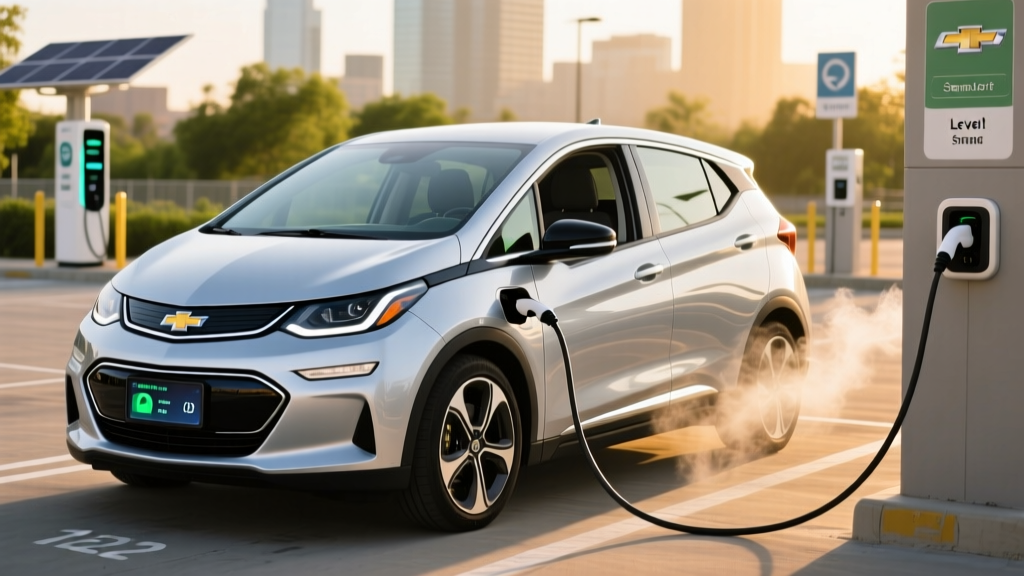
The 2022 Chevy Bolt EV occupies a strange space in 2026. Chevrolet discontinued the Bolt after the 2023 model year, replacing it with the Equinox EV and upcoming next-gen Bolt. Yet on the used market, the 2022 Bolt EV remains one of the most affordable ways to get 259 miles of EPA-rated range, a spacious hatchback body, and a proven 65 kWh NMC battery pack. If you can accept its Achilles' heel — painfully slow DC fast charging — the 2022 Bolt EV is a compelling commuter car that undercuts nearly every new EV on price.
Before diving into specs, understand what you're buying: a front-wheel-drive compact hatchback with a 200-hp motor, a liquid-cooled lithium-ion battery, and a CCS1 charge port. It was never designed for cross-country road trips. It was designed for daily driving under 50 miles with overnight Level 2 charging — and for that use case, it excels.
Spec Table: 2022 Chevy Bolt EV at a Glance
| Specification | 2022 Chevy Bolt EV (1LT / 2LT) |
|---|---|
| EPA Range | 259 miles |
| Battery (Usable) | ~60 kWh usable / 65 kWh gross, NMC (nickel manganese cobalt) |
| Drivetrain | Front-wheel drive (single motor) |
| Horsepower / Torque | 200 hp / 266 lb-ft |
| 0–60 mph | ~6.5 seconds |
| EPA Efficiency | 120 MPGe combined (28 kWh/100 mi) |
| Max DC Fast Charge | 55 kW (CCS1) |
| 10–80% DC Charge Time | ~56 minutes (estimated) |
| Level 2 Home Charging | 11.5 kW onboard charger (~39 mi/hr) |
| Cargo Volume | 16.3 cu ft (rear seats up) / 56.6 cu ft (rear seats folded) |
| Rear Legroom | 36.0 inches |
| Battery Warranty | 8 years / 100,000 miles |
| Original MSRP (1LT) | $31,995 (before incentives) |
| Used Price Range (2026) | $14,000–$21,000 depending on mileage/condition |
Range & Efficiency: 259 EPA Miles, But What's Real?
The Bolt EV's efficiency is genuinely impressive. At 120 MPGe combined (28 kWh per 100 miles), it sips electrons more frugally than most competitors. According to fueleconomy.gov, the Bolt EV costs roughly $550 per year to charge based on 15,000 miles of driving and national-average electricity rates — that's about 3.7 cents per mile, compared to roughly 12–15 cents per mile for a 30 MPG gas car at $3.50/gallon.
The 65 kWh gross battery pack uses NMC (nickel manganese cobalt) chemistry supplied by LG Energy Solution. This chemistry offers higher energy density than LFP but is more sensitive to sustained high state-of-charge. For longevity, GM recommends daily charging to 80% and reserving 100% charges for long trips. The liquid-cooling system helps manage thermal stress during both charging and driving.
Charging: The Bolt's Biggest Weakness
Let's be direct: DC fast charging is where the 2022 Bolt EV falls behind every modern competitor. The car maxes out at just 55 kW on a CCS1 connector. For context, a Hyundai Ioniq 5 peaks at 240 kW, and even the Nissan Leaf manages 100 kW. At 55 kW, a 10–80% charge takes roughly 56 minutes — nearly three times longer than an 800V architecture vehicle.
| Charging Method | Power / Rate | Time / Miles Added |
|---|---|---|
| Level 1 (120V household outlet) | ~1.2 kW | ~4 miles per hour |
| Level 2 (240V home / public) | Up to 11.5 kW | ~39 miles per hour; full charge in ~7 hours |
| DC Fast Charge (CCS1) | Peak 55 kW | 10–80% in ~56 min; ~160 miles in 30 min |
However, the Bolt EV has a hidden advantage: its 11.5 kW onboard AC charger is among the fastest in its class. Most competitors in this price range (and even some more expensive ones) are limited to 7.2 kW or 9.6 kW on Level 2. That means at home or at a workplace Level 2 station, the Bolt EV replenishes faster than you'd expect. A full overnight charge from near-empty takes about 7 hours — perfectly aligned with a typical sleep schedule.
The charge curve on DC fast charging is relatively flat, which is actually beneficial. Unlike vehicles that spike to 250 kW and then taper aggressively, the Bolt holds close to its 55 kW peak for most of the 10–80% window. You won't see dramatic taper until above 85% SoC. The trade-off is that the peak is simply low by 2026 standards.
Performance & Driving Impressions
The 200-hp permanent-magnet motor delivers 266 lb-ft of instant torque to the front wheels. The 0–60 mph time of approximately 6.5 seconds feels quicker than the number suggests, thanks to the linear torque delivery characteristic of all EVs. Around town and in stop-and-go traffic, the Bolt EV is genuinely quick off the line.
Where it shows its age is in chassis dynamics. The suspension is tuned for comfort over sportiness, with noticeable body roll in corners. The steering is light and numb — adequate for parking lots but uncommunicative on winding roads. Regenerative braking offers two modes: standard (which requires brake pedal use for full stops) and one-pedal driving (activated via a button on the shift lever), which can bring the car to a complete stop using regen alone.
Ride quality is surprisingly compliant for a compact hatch, and the low center of gravity from the underfloor battery keeps things planted. Road noise is well-managed at city speeds but becomes noticeable above 65 mph — a reminder that this is an economy-car platform adapted for electric duty.
Interior, Tech & Safety
The cabin is where the Bolt EV punches above its price class. The 1LT trim includes a 10.2-inch touchscreen with wireless Apple CarPlay and Android Auto, a 8-inch digital instrument cluster, and a suite of driver-assist features under the Chevy Safety Assist umbrella: automatic emergency braking, forward collision alert, lane keep assist, following distance indicator, and IntelliBeam automatic high beams.
The 2LT trim adds leather-appointed seats, a heated steering wheel, heated front seats, a Bose premium audio system, and a surround-view camera. Adaptive cruise control was available as part of the Driver Confidence II package on 2LT models.
Passenger space is generous: 42.1 inches of front legroom and 36.0 inches of rear legroom accommodate adults comfortably. The 16.3 cu ft cargo area behind the rear seats is comparable to a Honda Civic hatchback, and folding the 60/40 split rear bench opens up 56.6 cu ft — enough for a week's worth of camping gear or a Costco run.
One tech note: the 2022 Bolt EV does not support over-the-air (OTA) software updates for powertrain or battery management the way Tesla or Rivian vehicles do. Updates require a dealer visit. The infotainment system is responsive and intuitive, but it lacks the app ecosystem or navigation sophistication of newer EV platforms.
Pricing, Tax Credits & Used Market Value
When new, the 2022 Bolt EV started at $31,995 for the 1LT and $35,195 for the 2LT — prices that were aggressively low even before incentives. In 2022, buyers could claim the full $7,500 federal tax credit (before the Inflation Reduction Act reshaped eligibility rules), bringing the effective price below $25,000.
On the used market in 2026, a 2022 Bolt EV typically lists between $14,000 and $21,000 depending on mileage, condition, and trim. Here's the critical incentive question:
Insurance costs are moderate. Based on industry averages, expect $1,400–$1,800 annually for full coverage on a 2022 Bolt EV — less than a Tesla Model 3 but slightly more than a comparable gas-powered Chevy Spark, due to EV-specific repair considerations.
Battery Longevity & Warranty
GM covers the Bolt EV's battery pack for 8 years or 100,000 miles (whichever comes first), guaranteeing at least 60% capacity retention. In practice, real-world degradation data from Bolt owners shows approximately 5–8% capacity loss over the first 100,000 miles — well within the warranty threshold. A 2022 model with average mileage (30,000–45,000 miles by 2026) should still have 93–97% of its original capacity, meaning roughly 245–250 miles of usable range.
If the battery does require replacement out of warranty, expect a cost between $9,000 and $14,000 including labor at a GM dealer — a significant expense relative to the vehicle's used value. However, the liquid-cooled thermal management system and conservative NMC tuning give the Bolt's pack a strong longevity track record. Many Bolts from 2017–2019 (which had a battery recall and replacement program) are still on the road with healthy packs.
The broader vehicle warranty was 3 years/36,000 miles bumper-to-bumper and 5 years/60,000 miles powertrain — both likely expired on a 2022 model by 2026 unless an extended warranty was purchased.
Who Should Buy the 2022 Bolt EV?
- You commute under 60 miles round-trip and can charge at home overnight
- You want the most range per dollar on the used EV market
- You value hatchback practicality with strong cargo space
- You rarely take road trips longer than 150 miles one-way
- You want low operating costs (electricity + minimal maintenance)
- You regularly drive 200+ miles between charging stops
- DC fast-charge speed matters to you (road trips will be slow)
- You need all-wheel drive or towing capability
- You want the latest ADAS features or OTA software updates
- You live in an area with limited CCS1 public charging infrastructure
Pros & Cons
Pros
- 259 miles EPA range — best-in-class for the price
- Fast 11.5 kW Level 2 onboard charging
- Spacious hatchback with 56.6 cu ft max cargo
- Low used prices + potential $4,000 used EV credit
- Proven battery longevity with liquid cooling
- Standard wireless CarPlay/Android Auto
Cons
- 55 kW DC fast charging — painfully slow for road trips
- CCS1 connector (declining standard as NACS expands)
- No OTA powertrain updates
- Discontinued model — long-term parts/support uncertainty
- Modest acceleration and uninspiring handling
- No heat pump (resistance heating drains range in cold)
Frequently Asked Questions
What is the real-world range of the 2022 Chevy Bolt EV?
The EPA rates it at 259 miles. In real-world mixed driving at moderate temperatures, expect 220–245 miles. Highway-only driving at 70+ mph drops this to 200–220 miles, and cold weather (below 30°F) can reduce range to 170–200 miles. The Bolt EV lacks a heat pump, so cabin heating draws directly from the traction battery.
How fast does the 2022 Bolt EV charge?
On a Level 2 (240V) home charger, the 11.5 kW onboard charger adds about 39 miles of range per hour, filling the battery in roughly 7 hours. On DC fast charging, it peaks at just 55 kW via CCS1, making a 10–80% charge take approximately 56 minutes. This is the Bolt's most significant limitation for road-trip use.
Does the 2022 Bolt EV qualify for any tax credit in 2026?
As a used vehicle, the 2022 Bolt EV may qualify for the federal used clean vehicle credit (IRC §25E) of up to $4,000 when purchased from a dealer for $25,000 or less. Buyer income must be under $75,000 (single) or $150,000 (joint). It does not qualify for the new-vehicle §30D credit since it is no longer sold new. Always verify current rules at irs.gov and consult a tax professional.
Is the 2022 Bolt EV worth buying vs. competitors?
At $14,000–$21,000 used, the Bolt EV offers the best range-per-dollar ratio in its segment. The Nissan Leaf (149 or 226 miles) offers less range and uses the outdated CHAdeMO connector. The used Tesla Model 3 offers faster charging and Supercharger access but typically costs $5,000–$10,000 more. The Kia Niro EV (239 miles) is comparable but also suffers from slow DC charging. If road-trip charging speed is not a priority, the Bolt EV is hard to beat on value.
Should I worry about the CCS1 connector being phased out?
CCS1 is not disappearing overnight, but the industry is shifting toward NACS (Tesla's connector, now SAE J3400). Electrify America, EVgo, and ChargePoint are adding NACS cables alongside CCS1. Adapters are becoming available. For home and workplace Level 2 charging (J1772), there is no compatibility issue. For DC fast charging, CCS1 stations will remain widely available for years, but new installations increasingly favor NACS.
What should I check before buying a used 2022 Bolt EV?
Request a battery state-of-health (SoH) report from a GM dealer — this shows remaining capacity as a percentage. Check for open recalls (the 2017–2019 Bolts had a major battery recall; 2022 models were not affected but verify via NHTSA VIN lookup at nhtsa.gov). Confirm the charging cable and CCS1 port are undamaged. Review service records for any battery coolant system maintenance. Finally, verify that the vehicle was not salvaged or flood-damaged, which can compromise the underfloor battery pack.