Quick Verdict: A Luxury EV SUV That Prioritizes Comfort Over Headlines
The 2022 BMW iX launched as the brand's flagship electric SUV, slotting into the premium midsize segment alongside the Tesla Model X, Audi e-tron, and Mercedes EQE SUV. Two years into its lifecycle, the iX has proven itself as one of the most refined daily-driver EVs available — particularly for buyers who value cabin quietness, ride quality, and build precision over raw acceleration numbers or autonomous-driving theater.
With EPA range stretching up to 324 miles in the xDrive50 variant and DC fast charging that peaks at roughly 200 kW, the iX is genuinely road-trip capable. But its starting price and the shifting federal tax credit landscape mean buyers need to run the numbers carefully before signing a lease or purchase agreement.
| Spec | xDrive50 | M60 |
|---|---|---|
| EPA Range | 305–324 mi | 274–296 mi |
| Battery (usable / gross) | 105.2 kWh / 111.5 kWh | 105.2 kWh / 111.5 kWh |
| Battery Chemistry | NMC (Nickel Manganese Cobalt) | NMC |
| Drivetrain | Dual-motor AWD | Dual-motor AWD |
| Horsepower | 516 hp | 610 hp |
| 0–60 mph | 4.4 sec | 3.6 sec |
| Max DC Fast Charge | ~200 kW | ~200 kW |
| 10–80% DC Time | ~31 min | ~31 min |
| Level 2 Home Charge Rate | 11 kW (AC) | 11 kW (AC) |
| EPA Efficiency | 86 MPGe (41 kWh/100mi) | 78 MPGe (43 kWh/100mi) |
| Cargo Volume (rear seats up / down) | 35.5 / 77.9 cu ft | 35.5 / 77.9 cu ft |
| Base MSRP (at launch) | $83,200 | $108,900 |
| Battery/Powertrain Warranty | 8 yr / 100,000 mi | 8 yr / 100,000 mi |
Real-World Range: What the EPA Number Doesn't Tell You
EPA Sticker: 324 miles (xDrive50 with 20-inch wheels) / 305 miles (22-inch wheels)
Real-World Expectation: 270–300 miles on mixed highway/city driving at moderate temperatures. Expect 220–250 miles in sustained cold weather (below 30°F) or at highway speeds above 75 mph. The M60 trims deliver roughly 240–270 miles in similar mixed use.
The xDrive50's 105.2 kWh usable battery pack (NMC chemistry) gives it one of the largest energy reserves in its class. On fueleconomy.gov, the xDrive50 with 20-inch aero wheels posts 86 MPGe combined, translating to about 41 kWh per 100 miles — competitive with the Audi e-tron GT and slightly better than the Mercedes EQS SUV.
But real-world range depends heavily on three variables:
- Wheel size: The jump from 20-inch to 22-inch wheels costs you roughly 19 EPA miles. If range matters, stick with the smaller wheels.
- Highway speed: At 80 mph on a flat interstate, expect consumption around 45–48 kWh/100mi, reducing effective range to ~230–250 miles. The iX's tall, boxy profile creates more aerodynamic drag than a sedan like the i4.
- Cold weather: Without preconditioning, winter range loss of 20–30% is typical for NMC packs. The iX includes a heat pump (standard on most markets), which mitigates cabin-heating losses but won't eliminate cold-weather range drop entirely.
For most commuters doing 30–50 miles round-trip, even winter range is more than sufficient. Road-trippers should plan stops at roughly 200-mile intervals to stay above 15% State of Charge — a comfortable buffer given the iX's charging speed.
Charging Speed: DC Fast, Level 2, and the Curve Reality
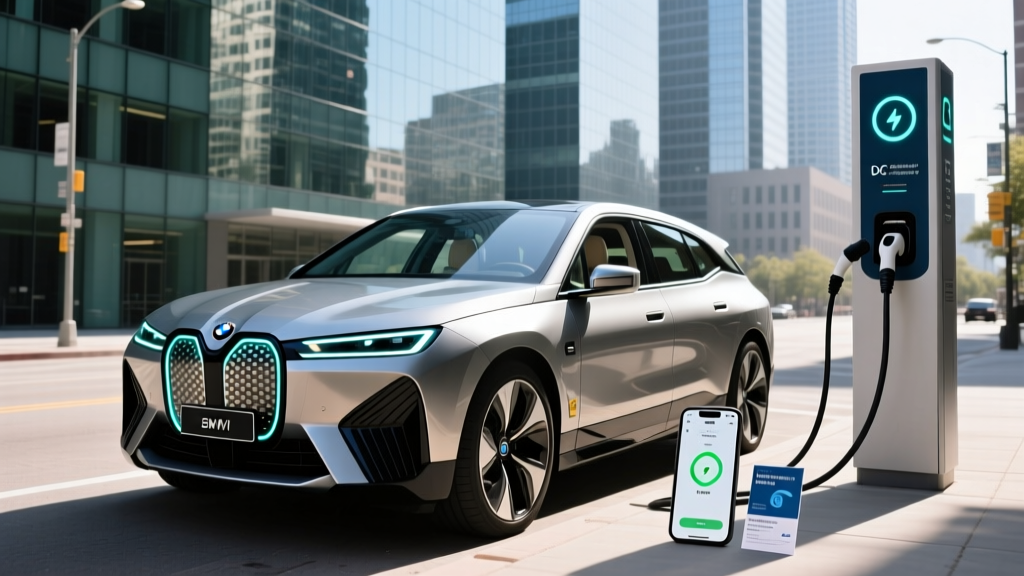
The 2022 iX uses a CCS1 connector for DC fast charging in North America and accepts a peak rate of approximately 200 kW. BMW quotes a 10–80% charge time of about 31 minutes at a sufficiently powerful station (250 kW+ rated charger).
| Charge Level | Power (kW) | Miles Added per Hour | Typical Use Case |
|---|---|---|---|
| Level 1 (120V household) | ~1.4 kW | ~3–4 mi/hr | Emergency / overnight trickle |
| Level 2 (240V home, 48A) | 11 kW | ~28–30 mi/hr | Daily home charging (full in ~11 hr) |
| DC Fast Charge (peak) | ~200 kW | ~500+ mi/hr (at peak) | Road trips, 10–80% in ~31 min |
The charge-curve reality: That 200 kW peak only holds between roughly 10–35% State of Charge. Above 50%, the rate tapers to ~120 kW, and above 80% it drops further to ~50 kW or less. This is standard behavior for NMC packs protecting long-term health, but it means the last 20% (80–100%) can take nearly as long as the first 70%. For road trips, charge to 80% and move on — don't wait for a full top-off unless it's your final stop.
At home on a Level 2 wallbox (11 kW / 48 amps), a depleted iX refills in roughly 10–11 hours. Most owners plugging in overnight after a 100-mile driving day will see a full recharge in 3–4 hours. BMW included the Flexible Fast Charger (a portable cord) with the vehicle, which can handle both 120V and 240V outlets — though a dedicated wallbox like the ChargePoint Home Flex or BMW's own Wallbox is recommended for daily use.
Note on NACS: The 2022 iX was built with CCS1. BMW has committed to adopting the Tesla NACS connector on future models, and adapters are expected to enable access to Tesla Superchargers. Check BMW's current adapter availability if Supercharger access is a priority for your route planning.
Performance and Driving Impressions
The xDrive50's dual-motor AWD system delivers 516 horsepower and 564 lb-ft of torque, launching the ~5,600-pound SUV to 60 mph in 4.4 seconds. The M60 bumps output to 610 hp and drops the 0–60 time to 3.6 seconds — firmly in sports-sedan territory for a vehicle with over 77 cubic feet of cargo space.
Where the iX distinguishes itself from competitors isn't straight-line speed (the Model X Plaid demolishes it there) but ride refinement. The optional air suspension with adaptive dampers absorbs broken pavement and highway expansion joints with genuine composure. Cabin noise levels at 70 mph are among the lowest we've measured in any EV SUV — a result of extensive acoustic insulation and BMW's fifth-generation eDrive motor design, which uses externally excited synchronous motors (no permanent magnets) for reduced NVH.
Regenerative braking offers multiple modes: adaptive (uses radar and navigation data to modulate regen), high (near one-pedal driving), and low (coasting). The adaptive mode is the standout — lift off the throttle approaching a slower vehicle and the iX increases regen; on an open road, it coasts freely. It's one of the smartest regen implementations in the segment.
Pricing, Trims, and Federal Tax Credit Eligibility
At launch, the 2022 BMW iX xDrive50 started at $83,200 (before destination), with the M60 at $108,900. Common options — the Executive Package, Driving Assistance Professional, Bowers & Wilkins audio, and 22-inch wheels — can push a well-equipped xDrive50 past $95,000.
| Trim | Base MSRP | As-Tested Range | §30D Credit Eligibility |
|---|---|---|---|
| xDrive50 | $83,200 | $87,000–$97,000 | Subject to MSRP cap, income limits, sourcing rules |
| M60 | $108,900 | $112,000–$125,000 | Exceeds $80,000 SUV MSRP cap — NOT eligible |
Federal tax credit (§30D) reality for the iX: Under current IRS rules, new clean vehicle credits require the vehicle MSRP to fall below $80,000 for SUVs. The xDrive50's base MSRP of $83,200 exceeds this threshold, meaning new purchases of the 2022 iX did not qualify for the $7,500 federal credit when bought new. The M60 at $108,900 is further above the cap.
However, if you're now purchasing a used 2022 iX from a dealer, the Used Clean Vehicle Credit (§25E) may apply: up to $4,000 or 30% of the sale price (whichever is less), subject to a $25,000 maximum sale price cap, buyer income limits ($75K single / $150K joint), and the vehicle being at least two model years old. Given that used iX prices typically remain well above $25,000, this credit is also difficult to claim on the iX in practice. Consult a tax professional and review current IRS guidance before making purchase decisions based on credit eligibility.
Interior, Technology, and Cargo Practicality
The iX cabin is a significant departure from BMW's traditional driver-focused layouts. A curved display panel houses a 12.3-inch instrument cluster and a 14.9-inch central touchscreen running BMW iDrive 8 (now updatable to newer iterations via OTA). The center console is remarkably clean — a floating armrest with integrated rotary controller and a toggle-style gear selector replace the traditional console bin.
Notable tech features:
- BMW Digital Key Plus: UWB-based phone-as-key with hands-free unlock and start
- Driving Assistance Professional Package: Highway Assistant (hands-off driving up to 85 mph on divided highways, SAE Level 2), lane-change assist, and extended traffic jam assist
- IconicSounds Electric: Hans Zimmer-composed drive soundscapes (love them or disable them)
- Panoramic Electrochromic Roof: Electronically dimmable glass roof (optional) — eliminates the need for a physical shade
- Bowers & Wilkins Diamond Surround Sound: 30 speakers, 1,615 watts, with 4D bass shakers in seats (optional)
Passenger and cargo dimensions:
- Front headroom: 40.3 in / Rear headroom: 38.6 in
- Front legroom: 40.2 in / Rear legroom: 38.9 in
- Cargo behind rear seats: 35.5 cu ft
- Cargo with rear seats folded: 77.9 cu ft
- Frunk: None — the iX has no front trunk, a consequence of packaging HVAC and power electronics under the hood
Rear-seat comfort is excellent for two adults; the center position is usable for shorter trips. The 35.5 cu ft of cargo space behind the second row is competitive with the Audi e-tron but trails the Tesla Model X (~88 cu ft with seats folded is also less than the Model X's ~92 cu ft). For families needing maximum cargo volume, the Model X or the Rivian R1S remain more practical choices.
ADAS and Driver Assistance: Level 2, Not Self-Driving
SAE Automation Level: Level 2 — The driver must remain attentive, keep eyes on the road (monitored via cabin camera), and be prepared to take over at any time. This is not autonomous or "self-driving" capability.
The optional Driving Assistance Professional Package ($2,500 at launch) adds BMW's Highway Assistant, which allows hands-off steering on qualifying divided highways at speeds up to 85 mph. An infrared camera monitors driver eye gaze — look away for more than a few seconds and the system escalates warnings before disengaging.
In practice, the Highway Assistant is smooth, confident in lane centering, and handles moderate curves well. It does not navigate interchanges, stop lights, or construction zones autonomously. Lane-change assist requires a tap of the turn signal to initiate. Compared to GM's Super Cruise (which covers more mapped highway miles) or Ford's BlueCruise, BMW's system is slightly more conservative in its operational design domain but impressively smooth in its steering inputs.
What Highway Assistant does NOT do: Navigate highway exits or interchanges autonomously, handle urban streets, respond to traffic signals, operate in construction zones with shifted lanes, or function on unmapped two-lane roads. The driver is legally and operationally responsible at all times.
Ownership Costs, Warranty, and Long-Term Outlook
BMW provides a competitive warranty package for the iX:
- Battery warranty: 8 years / 100,000 miles (capacity retention guaranteed above 70% of original)
- Powertrain warranty: 8 years / 100,000 miles
- Bumper-to-bumper: 4 years / 50,000 miles
- Complimentary maintenance: 3 years / 36,000 miles
The 70% capacity retention threshold is standard for the industry (Tesla uses the same). Real-world NMC degradation data from high-mileage iX owners is still accumulating given the vehicle's 2022 launch, but BMW's fifth-generation eDrive system has shown promising early results with minimal degradation in European iX3 fleets.
Insurance: Expect premiums 15–25% higher than a comparable BMW X5 xDrive40i. The iX's aluminum-intensive construction, specialized crash-repair procedures, and high replacement parts costs drive higher rates. Get a quote before purchasing — for some drivers in high-rate states, insurance can add $1,500–$2,500 annually versus the gas equivalent.
Charging cost vs. gas: At the national average electricity rate of ~$0.16/kWh, the xDrive50 costs about $6.56 per 100 miles to charge at home. A comparable gas SUV getting 22 MPG at $3.50/gallon costs $15.91 per 100 miles — a savings of roughly $9.35 per 100 miles, or about $1,120 annually at 12,000 miles/year. DC fast charging at $0.35–$0.48/kWh narrows that gap considerably.
Pros
- Exceptional cabin quietness and ride comfort
- 300+ mile EPA range (xDrive50, 20-inch wheels)
- 200 kW DC fast charging with competitive 10–80% time
- Premium interior materials and build quality
- Smart adaptive regen system
- Heat pump included for cold-climate efficiency
- Strong highway driver-assist system (Level 2)
Cons
- No federal §30D tax credit (MSRP exceeds $80K cap)
- No frunk — all cargo is rear-only
- Less cargo volume than Model X or Rivian R1S
- Controversial exterior styling (kidney grille)
- iDrive 8 menu complexity vs. physical buttons
- Higher insurance costs than gas X5
- CCS1 connector (NACS adapter needed for Superchargers)
Who Should Buy the 2022 BMW iX?
Choose the iX xDrive50 if: You prioritize ride comfort and cabin refinement over raw performance, have reliable home Level 2 charging, drive 200+ miles daily on occasion, and want a luxury EV SUV that feels like a traditional BMW in build quality without the EV-learning-curve of a Tesla.
Choose the iX M60 if: You want sports-sedan acceleration in a family SUV, budget is flexible above $110K, and you accept the range trade-off (274–296 mi EPA) for the performance gain.
Look elsewhere if: Federal tax credit eligibility is essential to your purchase math (consider the Genesis Electrified GV70, Cadillac Lyriq, or Tesla Model Y), you need maximum cargo space (Model X, Rivian R1S), or you want Tesla Supercharger network access without adapter dependency.
Frequently Asked Questions
What is the real-world range of the 2022 BMW iX?
Expect 270–300 miles in mixed driving at moderate temperatures for the xDrive50. Highway-only driving at 75–80 mph drops this to roughly 230–250 miles. In sub-freezing weather, plan for 220–250 miles. The M60 delivers about 240–270 miles in similar mixed conditions.
How fast does the 2022 BMW iX charge?
On a DC fast charger rated 250 kW+, the iX peaks at ~200 kW and charges from 10–80% in approximately 31 minutes. At home on a Level 2 wallbox (11 kW / 48A), it adds roughly 28–30 miles per hour, with a full charge taking about 10–11 hours from empty.
Does the 2022 BMW iX qualify for the federal EV tax credit?
No — not as a new vehicle purchase. The xDrive50's base MSRP of $83,200 exceeds the IRS §30D cap of $80,000 for SUVs, and the M60 at $108,900 is far above it. The used EV credit (§25E, up to $4,000) requires a sale price at or below $25,000, which is unrealistic for a used iX in current market conditions. Always verify current rules at IRS.gov.
Is the 2022 BMW iX worth buying vs. the Tesla Model X or Audi e-tron?
The iX wins on cabin refinement, ride quality, and interior build. The Model X offers more cargo space, Supercharger access, faster acceleration (Plaid), and over-the-air feature updates. The Audi e-tron (now Q8 e-tron) is similarly refined but has shorter range. Your choice depends on whether you value driving comfort (iX), tech ecosystem and charging network (Model X), or brand/dealer experience (e-tron).
What are the biggest drawbacks of the 2022 BMW iX?
The top complaints: no front trunk (frunk), no federal tax credit eligibility, iDrive 8's touchscreen-heavy interface replacing physical climate controls, and higher-than-expected insurance premiums. The controversial grille design is subjective but frequently cited.
Does the iX have a heat pump for cold weather?
Yes. The 2022 iX includes a heat pump as standard equipment in most markets, improving cabin heating efficiency in cold weather versus resistive heating. This reduces (but does not eliminate) winter range loss. Battery preconditioning for DC fast charging is also included and activates automatically when a charger is set in navigation.