Quick Verdict: The Electric Gran Coupe That Drives Like a BMW
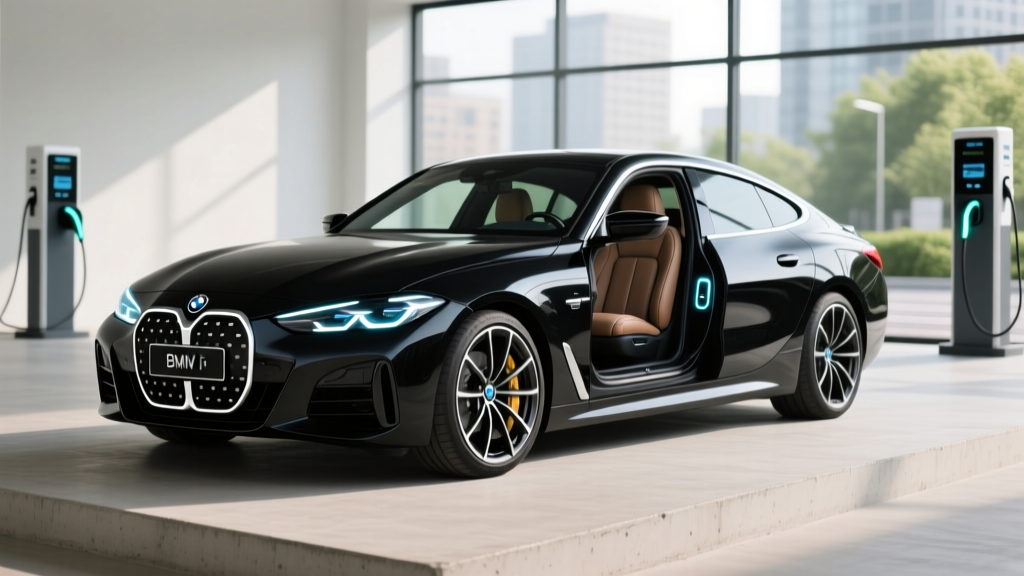
The 2022 BMW i4 arrived as the brand's first fully electric gran coupe, built on the same CLAR platform as the 4 Series Gran Coupe. Rather than designing a dedicated EV skateboard, BMW integrated an 81.5 kWh battery pack into a familiar chassis — a decision that preserves the driving dynamics enthusiasts expect but compromises interior space and efficiency compared to ground-up EV architectures. Four years into its lifecycle, the i4 remains a compelling choice for buyers who want premium badge cachet, strong performance, and CCS fast-charging without crossing into six-figure territory. The eDrive40 trim delivers the best value-to-range ratio, while the M50 variant targets performance buyers willing to sacrifice roughly 30 miles of EPA range for dual-motor all-wheel drive and 536 horsepower.
| Spec | eDrive40 | M50 |
|---|---|---|
| EPA Range | 301 mi (19" wheels) / 282 mi (20") | 270 mi (19") / 245 mi (20") |
| Battery (usable) | 81.5 kWh, NMC | 81.5 kWh, NMC |
| Drivetrain | RWD, single motor | AWD, dual motor |
| Horsepower | 335 hp | 536 hp |
| 0-60 mph | 5.5 sec | 3.7 sec |
| Max DC Fast Charge | 205 kW | 205 kW |
| 10-80% DC Time | ~31 min | ~31 min |
| Level 2 Rate | 11 kW (31 mi/hr) | 11 kW (31 mi/hr) |
| MPGe (combined) | 97 MPGe | 87 MPGe |
| Efficiency | 35 kWh/100 mi | 39 kWh/100 mi |
| Base MSRP (2022) | $55,400 | $65,900 |
| Battery Warranty | 8 yr / 100,000 mi | 8 yr / 100,000 mi |
Range and Real-World Efficiency
EPA Sticker: 301 miles (eDrive40, 19-inch wheels)
Real-World Expectation: Expect 250-270 miles on mixed highway driving at 70-75 mph. In winter conditions (below 32°F), plan for 200-230 miles due to cabin heating demand and battery chemistry limitations. City driving with regenerative braking can push closer to or slightly above the EPA figure.
The i4's NMC (nickel-manganese-cobalt) battery pack provides 81.5 kWh of usable capacity from a gross 83.9 kWh, leaving a top and bottom buffer to protect long-term cell health. The eDrive40's single rear motor and 97 MPGe combined rating make it one of the more efficient luxury electric sedans in its class, trailing only the Tesla Model 3 Long Range (132 MPGe) and roughly matching the Polestar 2 single-motor variant.
On the highway, the gran coupe body shape works against efficiency. The sloping roofline creates a drag coefficient of 0.29 Cd — respectable, but higher than the Tesla Model 3's 0.23 Cd or the Mercedes EQE's 0.20 Cd. At sustained 75 mph speeds, energy consumption typically climbs to 38-42 kWh/100 mi, which is where the real-world range gap emerges. The i4 does feature a heat pump as standard equipment, which mitigates some cold-weather range loss compared to EVs relying solely on resistive cabin heating. According to fueleconomy.gov, the eDrive40 achieves 100 MPGe city / 94 MPGe highway.
Charging Speed and Infrastructure
| Charging Level | Power | Rate / Time | Notes |
|---|---|---|---|
| Level 1 (120V) | 1.4 kW | ~4 mi/hr | Emergency/top-up only |
| Level 2 (240V, 48A) | 11 kW | ~31 mi/hr; 0-100% in ~8.25 hr | Home/public AC charging |
| DC Fast Charge | 205 kW peak | 10-80% in ~31 min | CCS1 connector; tapers above 80% |
The i4's 205 kW peak DC fast-charging capability places it mid-pack among 2022 luxury EVs. The Porsche Taycan peaks at 270 kW, and the Hyundai Ioniq 5 at 240 kW, but both of those vehicles also benefit from 800-volt architectures that sustain higher charge rates longer. The i4 runs on a 400-volt system, which means its charge curve tapers more aggressively past 50% State of Charge. In real-world DC fast-charging sessions on Electrify America or EVgo 350 kW stations, you'll see the peak 205 kW only briefly between 10-25% SoC, after which the rate settles to 120-150 kW through 60%, then drops below 100 kW past 80%.
The practical implication: the published 31-minute 10-80% time is accurate under ideal conditions (preconditioned battery, warm ambient temperature, high-power CCS station). Without battery preconditioning — activated automatically when you navigate to a DC fast charger in the iDrive system — cold-soak charging can add 10-15 minutes to that session. The i4 uses a CCS1 connector natively, granting access to Electrify America, EVgo, ChargePoint, and most non-Tesla public fast-charging networks. BMW does not offer a NACS adapter for the 2022 model year, though third-party CCS-to-NACS adapters became available in 2024-2025 for Tesla Supercharger access.
For home charging, the onboard 11 kW AC charger is a strong point. With a 48-amp Level 2 home station (such as a ChargePoint Home Flex or BMW's own Wallbox), a full overnight charge takes roughly 8.25 hours from empty — practical for daily top-ups. The 11 kW rate is faster than the Tesla Model 3's 11.5 kW but slower than the Lucid Air's 19.2 kW onboard charger.
Performance and Driving Dynamics
The eDrive40's single rear-mounted electric motor produces 335 horsepower and 317 lb-ft of torque, delivering a 5.5-second 0-60 mph time. That puts it in the territory of a BMW 440i gas model, with the instant torque delivery that makes EVs feel quicker in stoplight-to-stoplight driving than their 0-60 numbers suggest. The rear-wheel-drive layout preserves the steering feel and weight distribution BMW owners expect, and the low center of gravity from the floor-mounted battery reduces body roll through corners.
The M50 variant adds a front motor for dual-motor all-wheel drive and a combined 536 hp (586 lb-ft), dropping the 0-60 time to 3.7 seconds. That's M3 Competition territory, though the M50 carries roughly 5,000 pounds of curb weight — you'll feel it under heavy braking and rapid direction changes. Both trims feature BMW's adaptive M suspension and variable sport steering as options, and the i4 supports one-pedal driving through its strongest regenerative braking setting (B mode). The regen is strong enough for most single-pedal scenarios but doesn't bring the car to a complete hold at 0 mph the way Tesla or Nissan Leaf do — you'll still need the friction brake for final stops.
Interior, Technology, and Cargo
The 2022 i4 debuted BMW's iDrive 8 infotainment system, displayed on a curved panel that merges a 12.3-inch instrument cluster with a 14.9-inch central touchscreen. The system supports wireless Apple CarPlay and Android Auto, over-the-air updates, and BMW's Intelligent Personal Assistant voice control. The digital key feature lets you use an iPhone or Apple Watch as the vehicle key, and the system supports plug-and-charge functionality at compatible CCS stations — eliminating the need to open an app or swipe a card to initiate a session.
On the driver-assistance front, the i4 comes standard with Active Driving Assistant, which includes forward collision warning, automatic emergency braking, lane departure warning, and blind-spot monitoring. The optional Driving Assistance Professional Package adds adaptive cruise control with stop-and-go, lane centering, and Emergency Stop Assistant. This is a SAE Level 2 system — the driver must remain engaged with hands on the wheel and eyes on the road at all times. It does not provide autonomous or self-driving capability.
Driver-Assist Limitation: The i4's Driving Assistance Professional is a Level 2 system. It cannot navigate intersections, respond to traffic lights, or handle construction zones autonomously. Hands-off driving is not supported, and the system will issue escalating warnings if driver attention is not detected.
Cargo capacity is the i4's most significant compromise versus dedicated EV platforms. The liftback trunk provides 16.6 cubic feet with all seats up and 45.8 cubic feet with the rear seats folded — adequate for groceries and luggage but less versatile than the Tesla Model 3's 23 cu ft trunk plus frunk. The i4 has no front trunk (frunk); the space under the hood houses electric motor and power electronics. Rear legroom measures 35.2 inches, which is tight for adults on longer trips compared to the Hyundai Ioniq 6 (38.4 inches rear) or the BMW iX crossover.
Pricing, Tax Credits, and Total Cost
| Trim | Base MSRP | Typical As-Tested | §30D Credit Eligibility |
|---|---|---|---|
| eDrive40 | $55,400 | $60,000-$65,000 | See rules below |
| M50 | $65,900 | $72,000-$80,000 |
The federal EV tax credit under IRS §30D has undergone significant changes since the 2022 model year launched. Under current rules (as of 2026), the i4 faces several eligibility hurdles that buyers must evaluate carefully:
- MSRP Cap: Sedans must have an MSRP at or below $55,000 to qualify. The eDrive40's base MSRP of $55,400 exceeds this cap, making new purchases ineligible for the full $7,500 credit unless optioned below the threshold (unlikely with destination charges).
- Buyer Income Cap: Modified adjusted gross income must not exceed $150,000 (single), $225,000 (head of household), or $300,000 (married filing jointly).
- Battery Sourcing: Critical minerals and battery components must meet phased-in domestic sourcing thresholds. BMW's supply chain for the i4 battery (produced in Germany) has historically struggled to meet these requirements.
- Point-of-Sale Transfer: If eligible, the credit can be transferred to the dealer at purchase for an immediate price reduction rather than claimed at tax filing.
For most buyers considering a 2022 i4 in 2026, the used-EV tax credit (§25E) is more relevant. A pre-owned i4 purchased from a dealer for $25,000 or less may qualify for a credit of up to $4,000 (30% of sale price), subject to income caps. Given typical 2022 i4 depreciation to the $28,000-$38,000 range in the used market, finding one under the $25,000 threshold requires patience. Always verify current credit eligibility on IRS.gov or consult a tax professional before purchase.
Pros, Cons, and Competitor Comparison
Pros
- Genuine BMW driving dynamics — steering feel and chassis balance exceed most EV competitors
- 301-mile EPA range (eDrive40) is competitive for the luxury sedan class
- iDrive 8 with curved display is intuitive and responsive
- 11 kW onboard AC charging is faster than many rivals
- Heat pump standard — better cold-weather efficiency
- CCS1 plug-and-charge at major networks
Cons
- No frunk; cargo space limited for the class
- Rear seat legroom tight for adults on long trips
- 400V architecture limits sustained DC fast-charge rates
- MSRP exceeds $55K federal credit cap for sedans
- Regenerative braking does not bring car to full stop
- Gran coupe roofline cuts into rear headroom
Against the Tesla Model 3 Long Range, the i4 gives up efficiency (132 MPGe vs 97 MPGe), Supercharger network exclusivity, and rear-seat space — but wins on build quality, cabin materials, and steering feedback. The Polestar 2 matches the i4 on premium feel and offers a slightly lower starting price, but its 270-mile EPA range and smaller 78 kWh battery trail the BMW. The Hyundai Ioniq 6 undercuts on price and offers faster 800V charging, but its brand positioning and interior materials don't match the BMW badge appeal. The Mercedes EQE 350 offers more rear-seat space and a smoother ride but starts above $75,000 and delivers only 305 miles of EPA range from a much larger 90.6 kWh battery — indicating inferior efficiency.
Who Should Buy the 2022 BMW i4?
Choose the i4 eDrive40 if: You want a premium electric sedan with engaging driving dynamics, commute under 60 miles round-trip, have access to home Level 2 charging, and value brand heritage over maximum interior space or the lowest cost-per-mile.
Choose the i4 M50 if: Performance is a priority, you want dual-motor AWD for inclement weather, and you're willing to accept 30 fewer miles of EPA range and higher insurance premiums for 536 hp and sub-4-second acceleration.
Look elsewhere if: You regularly carry four adults (rear space is tight), need maximum cargo versatility (no frunk, limited hatch opening), rely exclusively on public fast-charging in cold climates (400V taper is a real limitation), or require the maximum possible federal tax credit on a new purchase.
The i4 is best suited for the enthusiast-leaning commuter who has a garage or dedicated parking spot for Level 2 home charging, drives primarily in moderate climates, and wants an EV that doesn't feel like an appliance. It's not the most efficient, most spacious, or most technologically advanced electric sedan in its price range — but it may be the most satisfying to drive on a back road.
Frequently Asked Questions
What is the real-world range of the 2022 BMW i4?
The EPA rates the eDrive40 at 301 miles with 19-inch wheels. In real-world mixed highway driving at 70-75 mph, expect 250-270 miles. In cold weather (below freezing), range can drop to 200-230 miles due to cabin heating and reduced battery efficiency. City driving with regenerative braking can match or slightly exceed the EPA estimate.
How fast does the 2022 BMW i4 charge?
On a DC fast charger, the i4 peaks at 205 kW and charges from 10-80% in approximately 31 minutes under ideal conditions. On a 400V architecture, the charge rate tapers significantly above 50% SoC. At home on a 48-amp Level 2 station (11 kW), a full charge takes about 8.25 hours, adding roughly 31 miles of range per hour.
Does the 2022 BMW i4 qualify for the federal EV tax credit?
For new purchases under current §30D rules, the i4 is unlikely to qualify. The eDrive40's base MSRP of $55,400 exceeds the $55,000 sedan cap, and BMW's battery supply chain has struggled to meet domestic sourcing requirements. For used purchases, the §25E credit of up to $4,000 may apply if the sale price is $25,000 or less and buyer income falls within limits. Always check IRS.gov for current eligibility rules.
Is the 2022 BMW i4 worth buying vs competitors?
The i4 is worth buying if driving dynamics and premium brand positioning are priorities. It sacrifices some efficiency, interior space, and fast-charge speed compared to the Tesla Model 3, Hyundai Ioniq 6, and dedicated-EV platforms. For buyers who value steering feel, build quality, and the BMW badge, it's one of the best-driving electric sedans in its class. For pure efficiency or family practicality, other options rank higher.
What is the battery warranty on the 2022 BMW i4?
BMW covers the i4's high-voltage battery for 8 years or 100,000 miles, whichever comes first. The warranty guarantees the battery will retain at least 70% of its original capacity during that period. The general vehicle warranty is 4 years / 50,000 miles. BMW's battery uses NMC chemistry, which typically shows 5-10% degradation over the first 50,000 miles based on owner-reported data from similar BMW EV powertrains.
Does the i4 have a frunk (front trunk)?
No. The 2022 BMW i4 does not have a front trunk. The space under the hood is occupied by the electric motor, power electronics, and HVAC components. This is a consequence of BMW's flexible CLAR platform, which also underpins internal-combustion 4 Series models, rather than a dedicated EV skateboard architecture.