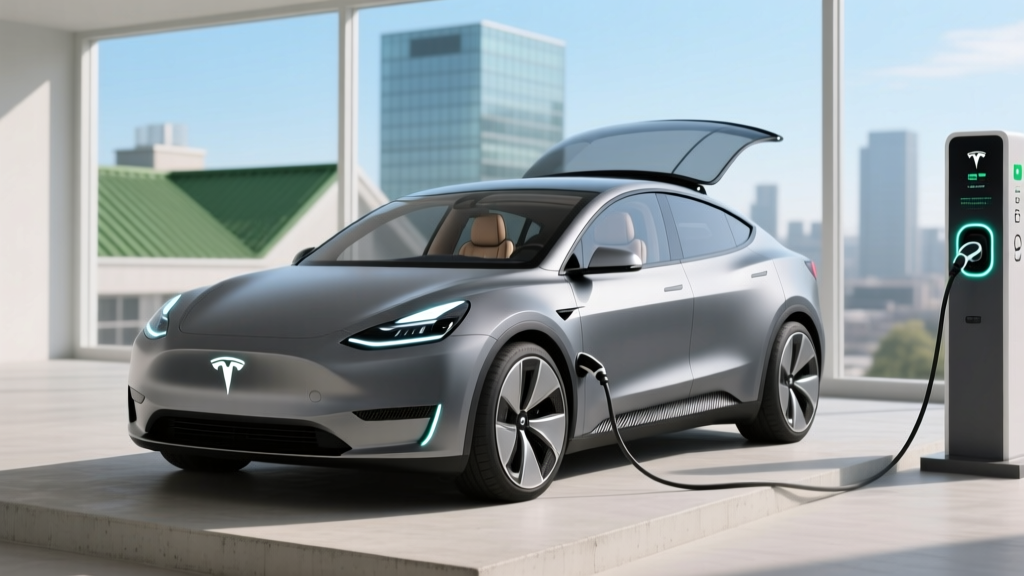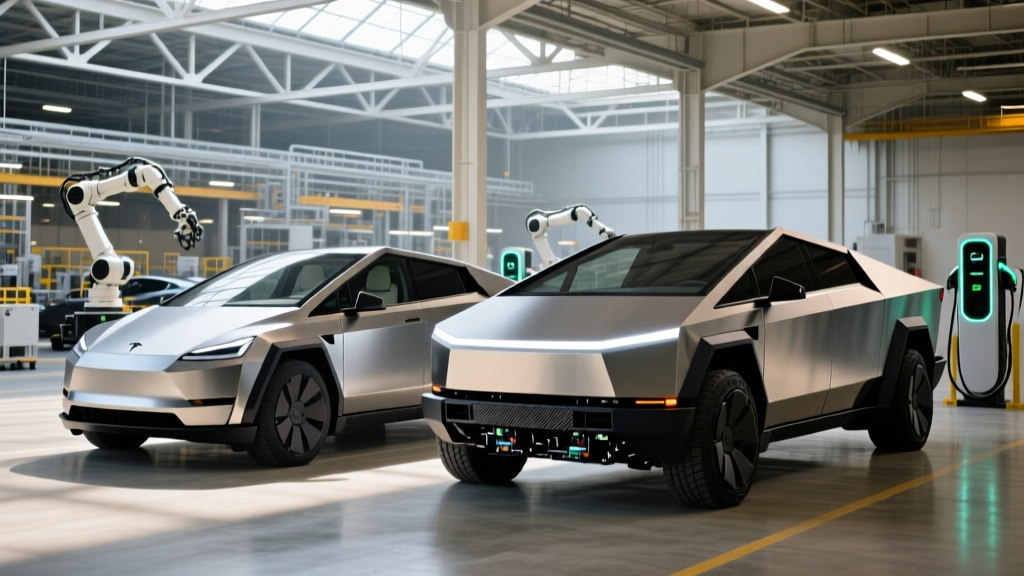
When Elon Musk announced Tesla's corporate relocation from Palo Alto to Austin, Texas, it wasn't just a headline-grabbing stunt — it reshaped the company's manufacturing footprint, supply chain, and ultimately the vehicles rolling off the line at Gigafactory Texas. For EV shoppers in 2026, the Tesla move to Texas has tangible implications: which models are built where, how that affects federal tax credit eligibility under IRS §30D, and what it means for pricing and delivery timelines.
This profile examines the two primary vehicles produced at Giga Texas — the 2026 Tesla Model Y (Long Range AWD) and the 2026 Tesla Cybertruck — through the lens of real buyer concerns: range, charging, cost after credits, and ownership practicality.
Gigafactory Texas at a Glance: What's Built Where
Gigafactory Texas, located in unincorporated Travis County near Austin, began limited production in early 2022 and has since ramped to become Tesla's primary North American manufacturing hub. As of the 2026 model year, the facility produces:
- Model Y (Long Range AWD, Performance variants)
- Cybertruck (AWD, Cyberbeast)
Model 3 production for the North American market remains primarily at the Fremont, California factory and Giga Shanghai (for certain trims). This geographic split matters for buyers because where a vehicle is assembled and where its battery cells are sourced directly determine eligibility for the $7,500 federal EV tax credit under current IRS rules.
2026 Tesla Model Y Long Range AWD — Key Specifications
| Spec | Value |
|---|---|
| EPA Range | 320 miles |
| Battery Capacity | 75 kWh usable (NMC) |
| Drivetrain | Dual-motor AWD |
| Horsepower | 384 hp |
| 0–60 mph | 4.8 seconds |
| Peak DC Fast Charge | 250 kW |
| 10–80% DC Time | ~25 minutes |
| Level 2 Charge Rate | 11.5 kW (~44 mi/hr) |
| Efficiency | 122 MPGe / 28 kWh/100mi |
| Cargo Volume | 76 cu ft (rear seats folded) |
| Base MSRP | $44,990 |
| Battery Warranty | 8 years / 120,000 miles |
Real-World Range: Beyond the EPA Sticker
EPA Estimate: 320 miles (Model Y Long Range AWD)
Real-World Expectation: Plan for ~260–280 miles on sustained highway driving at 70+ mph. In cold weather (below 32°F), expect a 20–30% reduction, bringing effective range to ~220–250 miles without preconditioning.
Tesla's thermal management system, which includes a heat pump across all 2026 trims, mitigates some cold-weather losses compared to older resistance-heater EVs. However, the physics of lithium-ion cells at low temperatures is unavoidable. Owners in northern states should budget for reduced winter range and leverage Tesla's preconditioning feature (navigate to a Supercharger in the nav system to warm the battery en route) for optimal charging speed.
For the Cybertruck, the range picture is less favorable. The 2026 Cybertruck AWD carries an EPA estimate of 340 miles with its ~123 kWh battery pack, but its slab-sided aerodynamics impose a heavy highway penalty. Real-world highway testing consistently yields 270–290 miles, and towing cuts that figure dramatically — expect 150–180 miles when pulling a 5,000-lb trailer.
Charging Speed and Infrastructure
Tesla's Supercharger network remains the gold standard for DC fast charging reliability in North America, and with the industry-wide shift to the NACS connector, non-Tesla EVs now access many Supercharger stalls via the Tesla app. For Tesla owners, the experience is seamless: plug in and walk away.
Charging Speeds: Model Y vs Cybertruck
| Metric | Model Y LR AWD | Cybertruck AWD |
|---|---|---|
| Peak DC Fast Charge | 250 kW | 250 kW (800V architecture capable) |
| 10–80% DC Time | ~25 min | ~28 min |
| Level 2 (240V/48A) | 11.5 kW / ~44 mi/hr | 11.5 kW / ~37 mi/hr |
| Level 1 (120V) | ~3–4 mi/hr | ~3 mi/hr |
A critical note on charge curves: Tesla's 250 kW peak is sustained only from roughly 10–45% state of charge. Above 60%, the curve tapers significantly — you'll see 100 kW or less by 75% SoC. This means charging from 80–100% can take nearly as long as 10–80%. For road trips, the optimal strategy is to charge to 80% and drive, rather than waiting for a full battery.
Home charging on a Level 2 Tesla Wall Connector (hardwired, 60A circuit) delivers the full 11.5 kW, adding roughly 44 miles of range per hour for the Model Y. Most owners charging overnight from 20% to 80% will be fully replenished by morning. Installation costs typically run $800–$2,000 depending on panel capacity and conduit run — factor this into your purchase budget.
Pricing, Tax Credits, and Total Cost
The Tesla move to Texas was partly motivated by business-friendly state policies and proximity to a growing supply chain. For buyers, the critical question remains: does a Giga Texas-built Model Y or Cybertruck qualify for the federal §30D EV tax credit?
2026 Pricing and Federal Tax Credit Eligibility
| Model / Trim | MSRP | §30D Credit | Effective Price |
|---|---|---|---|
| Model Y Long Range AWD | $44,990 | $7,500 (if eligible) | ~$37,490 |
| Model Y Performance | $48,990 | $7,500 (if eligible) | ~$41,490 |
| Cybertruck AWD | $79,990 | $7,500 (if eligible) | ~$72,490 |
| Cybertruck Cyberbeast | $99,990 | $7,500 (if eligible) | ~$92,490 |
Eligibility caveats (2026 rules):
- MSRP Cap: SUVs/trucks (Model Y, Cybertruck) must have an MSRP ≤ $80,000. The Cybertruck Cyberbeast at $99,990 exceeds this cap and is ineligible.
- Income Cap: Buyer AGI must not exceed $150,000 (single), $225,000 (head of household), or $300,000 (joint).
- Battery Sourcing: A percentage of critical minerals and battery components must be sourced from the U.S. or free-trade-agreement countries. Tesla's supply chain has progressively met these thresholds, but buyers should verify current eligibility on fueleconomy.gov at time of purchase.
- Point-of-Sale Transfer: As of 2024, eligible buyers can transfer the credit to the dealer at purchase, reducing the out-of-pocket price immediately rather than waiting for tax filing.
The Model Y Long Range AWD, at ~$37,490 after the credit, competes aggressively with the Hyundai Ioniq 5 ($42,500 base) and Ford Mustang Mach-E ($43,000 base), especially when factoring in Tesla's Supercharger network access and strong residual values.
Technology and Driver Assistance
Tesla's infotainment system remains class-leading in responsiveness and integration. The 15.4-inch center touchscreen handles navigation, media, climate, and vehicle settings with minimal lag. Over-the-air updates continue to add features post-purchase — a differentiator legacy automakers are still chasing.
On the driver-assist front, it's essential to understand what Tesla's Autopilot and Full Self-Driving (Supervised) actually deliver:
SAE Level 2 — Driver Assistance, NOT Self-Driving
Both Autopilot (standard) and FSD Supervised ($8,000 option or $99/month subscription) are Level 2 systems. The driver must remain fully engaged, hands on or near the wheel, and eyes on the road at all times. These systems handle lane centering, adaptive cruise, and some intersection navigation, but they do not replace driver attention. NHTSA continues to investigate Tesla's Autopilot/FSD for misuse patterns.
The Cybertruck introduces steer-by-wire (no mechanical connection between steering wheel and wheels), which enables variable steering ratios and a yoke-style wheel. It's a genuine innovation, though early adopters report an adjustment period for low-speed maneuvering.
Who Should Buy — and Who Shouldn't
The Giga Texas-built Model Y Long Range AWD is an outstanding choice for:
- Daily commuters with home charging access (the 320-mile range covers most round trips for a week)
- Small families needing 76 cu ft of cargo space and five-passenger seating
- Road trippers who value Supercharger network density
It's less ideal for:
- Buyers without reliable home or workplace Level 2 charging (public-only charging is costly and time-consuming)
- Those needing three rows (consider the Model X or Rivian R1S)
- Drivers in extreme cold climates where range loss is compounded by cabin heating demands
The Cybertruck suits buyers who want a distinctive electric truck with genuine utility (11,000-lb towing capacity, stainless steel exoskeleton, 6.5-foot bed) and can absorb the premium price. It does not suit budget-conscious buyers or those who prioritize ride comfort — the Cybertruck's adaptive air suspension improves matters, but it remains a large, heavy vehicle with truck-like dynamics.
Pros
- Supercharger network — best public charging experience in North America
- Strong efficiency (122 MPGe Model Y) minimizes charging cost per mile
- OTA updates add features post-purchase
- Class-leading cargo-to-footprint ratio (Model Y)
- Point-of-sale tax credit transfer reduces upfront cost
Cons
- Panel gaps and paint quality remain inconsistent vs. legacy brands
- FSD Supervised is expensive and still requires full driver attention
- No Apple CarPlay or Android Auto integration
- Cybertruck pricing pushes past tax-credit MSRP cap on top trims
- Insurance costs above segment average (average $2,200–$2,800/yr for Model Y)
Frequently Asked Questions
Does the Tesla move to Texas affect vehicle quality?
Giga Texas is a newer facility with more modern tooling than Fremont, and early data suggests improved panel-gap consistency on Texas-built Model Y vehicles. However, Tesla's overall quality still trails Toyota, Hyundai, and BMW in third-party surveys like J.D. Power's Initial Quality Study.
What is the real-world range of the 2026 Model Y Long Range?
EPA-rated at 320 miles, real-world highway driving at 70 mph yields approximately 260–280 miles. In freezing temperatures, expect 220–250 miles without aggressive preconditioning. City driving with regenerative braking can match or slightly exceed the EPA figure.
How fast does the Model Y charge at home and on the road?
On a Level 2 Tesla Wall Connector (11.5 kW), the Model Y adds ~44 miles per hour, fully charging overnight. On a 250 kW Supercharger, it charges 10–80% in approximately 25 minutes, though the curve tapers significantly above 60% SoC.
How much does the Model Y cost after federal tax credits?
The 2026 Model Y Long Range AWD starts at $44,990. With the full $7,500 §30D credit (subject to income, MSRP, and battery-sourcing eligibility), the effective price drops to ~$37,490. Verify eligibility on fueleconomy.gov before purchasing.
Is the Model Y worth buying over the Hyundai Ioniq 5 or Ford Mach-E?
The Model Y wins on efficiency, Supercharger access, and cargo space. The Ioniq 5 offers faster peak charging (350 kW on 800V architecture), Apple CarPlay, and a more conventional interior layout. The Mach-E provides a more traditional driving feel. Test-drive all three — the decision often comes down to infotainment preference and charging network priority.
Does the Cybertruck qualify for the federal EV tax credit?
The Cybertruck AWD at $79,990 MSRP qualifies (it's under the $80,000 SUV/truck cap). The Cyberbeast at $99,990 does not. Income limits and battery-sourcing rules also apply — consult IRS.gov for current requirements.
What is the battery warranty on Giga Texas-built vehicles?
Tesla provides an 8-year/120,000-mile battery and drive unit warranty on the Model Y, with a guaranteed minimum 70% capacity retention. The Cybertruck carries the same 8-year/120,000-mile coverage. Real-world degradation data from Tesla's fleet suggests most packs retain 85–90% capacity at 100,000 miles.
The Bottom Line
Tesla's move to Texas is more than a corporate address change — it's a manufacturing strategy that positions the Model Y and Cybertruck for competitive pricing, domestic production credentials, and federal tax credit eligibility. The 2026 Model Y Long Range AWD remains one of the most compelling EVs on the market when the $7,500 credit applies, delivering 320 miles of range, best-in-class efficiency, and unmatched charging infrastructure. The Cybertruck is a niche play for buyers who value novelty and utility over value. Either way, verify your tax credit eligibility, budget for home charger installation, and test-drive against the Ioniq 5 and Mach-E before signing.