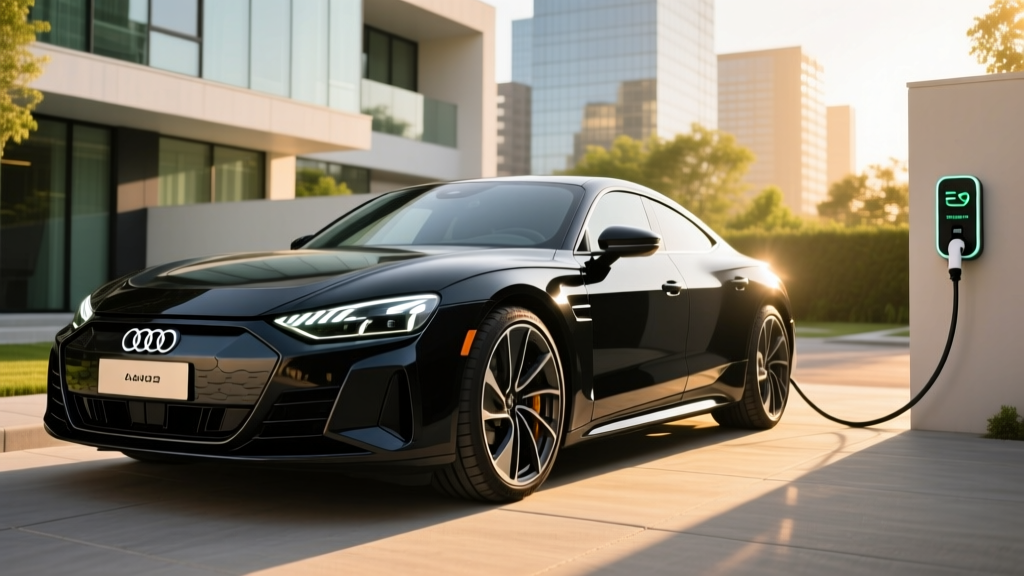
The 2022 Audi e-tron GT Premium Plus occupies a rare space in the electric vehicle market: it's a genuine luxury grand tourer that shares its J1 performance platform with the Porsche Taycan, yet delivers a distinctly more refined, comfort-oriented experience. Now available on the used market at significant discounts from its original $100,000+ sticker, this dual-motor AWD sedan demands a closer look from buyers who want autobahn-bred engineering without paying new-car premiums.
But how does a 2022 model-year EV hold up in 2026? We break down the real-world range, charging behavior, ownership economics, and where this car fits against newer competitors.
Quick Verdict: Who Should Buy the 2022 e-tron GT Premium Plus?
Choose the 2022 Audi e-tron GT Premium Plus if: You want a luxury performance sedan with exceptional build quality, comfortable long-distance touring capability, and 800-volt fast charging — and you're comfortable with ~200-220 real-world highway miles between stops.
Look elsewhere if: You need maximum range (consider a Lucid Air or Tesla Model S), cutting-edge infotainment, or the latest ADAS features standard on 2025-2026 models. Rear seat space is also tight for taller passengers.
Range, Efficiency, and the Real-World Reality
The EPA rates the 2022 Audi e-tron GT Premium Plus at 238 miles of combined range from its 93.4 kWh gross (83.7 kWh usable) battery pack. Efficiency comes in at 82 MPGe combined, or approximately 41 kWh per 100 miles — respectable for a 5,100-pound performance sedan, but not class-leading.
EPA Range: 238 miles (combined)
Real-World Expectations:
- City/mixed driving (mild weather): 230-245 miles — regenerative braking and moderate speeds help you meet or slightly exceed the EPA sticker.
- Highway (70-80 mph, 70°F): 200-220 miles — aerodynamic drag at speed cuts range by roughly 10-15%.
- Cold weather (below 32°F, highway): 165-190 miles — the e-tron GT's battery thermal management is competent, but cold still saps 20-30% of range. The standard heat pump helps cabin efficiency.
Bottom line: Plan road trips around 180-200 mile legs for comfort. The car's 800V charging architecture makes short stops practical, but you'll want to know where chargers are.
The battery pack uses NMC (nickel manganese cobalt) lithium-ion chemistry — the standard for performance-oriented EVs prioritizing energy density and charge rate over the cycle-life advantages of LFP. Audi provides an 8-year/100,000-mile battery warranty guaranteeing at least 70% capacity retention. For a 2022 model, that warranty coverage extends through 2030 — a meaningful safety net on the used market.
Charging Speed: The 800-Volt Advantage
This is where the e-tron GT's J1 platform shines. The car's 800-volt electrical architecture enables DC fast charging at up to 270 kW peak — among the fastest of any 2022-model EV.
| Charging Level | Power / Rate | Time / Miles Added |
|---|---|---|
| Level 1 (120V household) | ~1.4 kW | ~4 miles per hour of charging |
| Level 2 (240V home, 48A) | 11 kW (onboard charger) | ~30 miles per hour; full charge in ~9 hours |
| DC Fast Charge (peak) | 270 kW | 10-80% in approximately 22 minutes |
| DC Fast Charge (50 kW station) | 50 kW | 10-80% in approximately 75 minutes |
Charging curve reality check: The 270 kW peak is available only at low state of charge (roughly 5-30%) with a properly preconditioned battery and a 350 kW-capable charger (such as Electrify America's latest stalls). The curve tapers progressively — expect ~150 kW by 50% SoC and ~80 kW by 70%. This is normal for NMC chemistry, but it means your average charge rate over a 10-80% session is closer to 160-170 kW, not 270.
For home charging, the 11 kW onboard charger is adequate. A typical overnight session (10 hours on a Level 2 wall connector) adds roughly 280-300 miles — more than enough to refill the pack. Most owners will need a NEMA 14-50 outlet or hardwired Level 2 station installed; budget $500-$1,500 for a quality Level 2 charger and $800-$2,500 for electrician installation depending on panel capacity and run length.
The e-tron GT uses a CCS1 connector for DC fast charging. With Audi's parent company Volkswagen Group now adopting NACS (Tesla's connector) for future models, CCS1 remains well-supported at Electrify America, EVgo, and other major networks through at least 2030. Adapters for Tesla Superchargers may become available but are not confirmed for the J1 platform as of early 2026.
Performance: Dual-Motor AWD With Autobahn DNA
| Specification | 2022 Audi e-tron GT Premium Plus |
|---|---|
| Powertrain | Dual-motor AWD |
| Horsepower | 522 hp (469 hp standard; 522 hp with launch control) |
| Torque | 472 lb-ft (464 lb-ft with launch control) |
| 0-60 mph | 3.9 seconds (with launch control) |
| Top Speed | 152 mph (electronically limited) |
| Drivetrain | 2-speed rear transmission, single-speed front |
| Curb Weight | ~5,139 lbs |
The dual-motor all-wheel-drive system delivers confident traction in all conditions, and the 2-speed rear axle transmission — unusual in the EV world — provides strong initial acceleration while maintaining efficiency at highway speeds. The e-tron GT's air suspension and rear-axle steering (standard on Premium Plus) give it a remarkable blend of ride comfort and cornering poise. This is a car engineered for sustained high-speed cruising, not just stoplight sprints.
Compared to the Tesla Model S Dual Motor (3.1 seconds to 60 mph, 405-mile range), the e-tron GT is slower and shorter-legged, but its interior quality, ride refinement, and steering feel are in a different league. The Porsche Taycan 4S is the closer sibling — mechanically similar but tuned with a firmer, sportier edge and priced higher on the used market.
Interior, Cargo, and Daily Livability
The e-tron GT Premium Plus interior reflects Audi's best work: standard Valcona leather, heated and ventilated 14-way power front seats, a 12.3-inch Virtual Cockit digital cluster, and a 10.1-inch MMI touchscreen. Build quality is exceptional — every surface, switch, and panel feels bank-vault solid.
Passenger space:
- Front legroom: 41.5 inches
- Rear legroom: 33.3 inches — tight for passengers over 6 feet on longer trips
- Front headroom: 38.5 inches
- Rear headroom: 36.5 inches — the sloping roofline cuts into space
Cargo capacity:
- Trunk: 9.2 cubic feet (shallow but wide)
- Front trunk (frunk): 3.5 cubic feet — enough for a charging cable bag and small soft items
- Total: 12.7 cubic feet — significantly less than a Model S (28 cu ft rear) or even the Taycan (14.3 cu ft combined)
Cargo is the e-tron GT's most practical compromise. The low-slung GT body prioritizes aerodynamics and style over utility. If you regularly haul luggage for four or need stroller space, this is not your car.
Pricing, Tax Credits, and Used-Market Value
The 2022 Audi e-tron GT Premium Plus originally carried a base MSRP of approximately $100,400 (including destination). Well-optioned examples with packages like the Year One edition or Executive package pushed as-tested prices to $110,000-$115,000.
As of early 2026, used-market pricing for 2022 e-tron GT Premium Plus models with 20,000-40,000 miles typically falls in the $55,000-$72,000 range depending on condition, mileage, and options — a depreciation curve that benefits second owners substantially.
| Scenario | Approximate Cost |
|---|---|
| Original 2022 MSRP (base) | $100,400 |
| Used market (2026, avg. condition) | $58,000-$68,000 |
| Federal used-EV tax credit (§25E) | Up to $4,000 (30% of sale price, capped; income limits apply) |
| Effective used price after credit | ~$54,000-$64,000 |
| New §30D credit (if any new-old-stock remained) | Not eligible — MSRP exceeds $55,000 sedan cap |
Tax credit details: The §30D new-vehicle credit was never available for the e-tron GT because its MSRP exceeded the $55,000 cap for sedans. However, buying one used from a dealer in 2026 may qualify you for the §25E previously owned clean vehicle credit — up to $4,000 (30% of the sale price). This credit has income caps ($75,000 single / $150,000 joint filers) and requires purchase from a licensed dealer. Verify current eligibility at IRS.gov §25E before relying on it.
Tech, Driver Assistance, and What's Missing
The 2022 e-tron GT Premium Plus comes well-equipped with technology:
- Audi Virtual Cockpit Plus: 12.3-inch configurable driver display with EV-specific energy flow and range screens
- MMI Navigation Plus: 10.1-inch touchscreen with wireless Apple CarPlay/Android Auto, route-based charge planning
- Bang & Olufsen 3D audio: 16 speakers, 710 watts — standard on Premium Plus
- Audi adaptive cruise assist: SAE Level 2 driver assistance with lane centering, stop-and-go, and traffic jam assist
- Park assist with surround-view cameras: helpful given the low ground clearance and wide stance
ADAS Note: Audi adaptive cruise assist is an SAE Level 2 driver-assistance system. It requires continuous driver supervision — hands on or near the wheel, eyes on the road. It is not autonomous or "self-driving." Unlike GM's Super Cruise or Ford's BlueCruise, it does not support hands-free operation on mapped highways.
Notable drawbacks for 2026 buyers:
- The MMI infotainment system, while functional, feels a generation behind newer EVs with larger screens and faster processors (Rivian, Lucid, Hyundai/Kia E-GMP models).
- No over-the-air (OTA) software updates of the scope Tesla offers — firmware updates require dealer visits.
- Rear-seat USB-C ports are present but the space itself is snug for adults on long trips.
- The e-tron GT lacks a front trunk large enough for practical daily use.
- Insurance costs run higher than average for the segment — expect $2,500-$4,000/year depending on your profile and state.
Ownership Costs: 5-Year Outlook for a Used 2022 Model
| Category | Estimated 5-Year Cost |
|---|---|
| Purchase price (used, after credit) | $54,000-$64,000 |
| Electricity (12,000 mi/yr, $0.14/kWh avg.) | $2,500-$3,200 |
| Insurance (avg. $3,200/yr) | $16,000 |
| Maintenance (tires, cabin filter, fluid top-offs) | $2,000-$3,500 |
| Depreciation (est. 30-35% over 5 years from used purchase) | $16,000-$22,000 |
| Total estimated 5-year cost | $90,500-$108,700 |
For context, a comparably equipped used 2022 Porsche Taycan 4S runs $10,000-$15,000 more on the used market while offering similar performance. A used 2022 Tesla Model S Long Range costs less and offers far more range, but can't match the Audi's interior quality or ride refinement. The e-tron GT sits in a value sweet spot for luxury-EV buyers who prioritize comfort and build quality over maximum range or tech flash.
Warranty Coverage
- Limited vehicle warranty: 4 years / 50,000 miles (likely expired on most 2022 models by 2026)
- Battery warranty: 8 years / 100,000 miles, guaranteeing ≥70% capacity retention (active through 2030)
- Powertrain warranty: 4 years / 50,000 miles (expired for most)
When buying used, confirm the battery warranty is intact and request a battery health report from the dealer or a third-party diagnostic service. The 8-year/100,000-mile battery warranty is transferable to subsequent owners, which is a significant value protector.
Pros and Cons at a Glance
Pros
- Exceptional build quality and interior materials
- 800V architecture enables 270 kW DC fast charging (10-80% in ~22 min)
- Refined air suspension ride with rear-axle steering
- 522 hp dual-motor AWD with confident all-weather traction
- Significant used-market discount from original MSRP
- Battery warranty active through 2030
- Eligible for up to $4,000 used-EV tax credit (§25E)
Cons
- 238-mile EPA range is modest for the price class
- Real-world highway range drops to ~200 miles
- Small cargo capacity (12.7 cu ft total including frunk)
- Tight rear-seat legroom (33.3 inches)
- Infotainment feels dated vs. 2025-2026 competitors
- No hands-free driving capability (Level 2 only)
- High insurance costs relative to segment
- CCS1 connector — NACS adapter availability uncertain
Frequently Asked Questions
What is the real-world range of the 2022 Audi e-tron GT Premium Plus?
The EPA rates it at 238 miles combined. In real-world driving, expect 230-245 miles in city/mixed use during mild weather, 200-220 miles on the highway at 70-80 mph, and as low as 165-190 miles in cold weather (below freezing) at highway speeds. Plan road-trip legs around 180-200 miles for comfort.
How fast does it charge at DC fast chargers and at home?
At a 350 kW-capable DC fast charger with a preconditioned battery, the e-tron GT peaks at 270 kW and charges from 10-80% in approximately 22 minutes (though average rate over the session is closer to 160-170 kW due to taper). At home on a Level 2 charger (240V, 48A), the 11 kW onboard charger delivers about 30 miles of range per hour, fully recharging overnight in roughly 9 hours.
How much does a used 2022 e-tron GT Premium Plus cost in 2026?
Used-market pricing typically ranges from $55,000 to $72,000 depending on mileage, condition, and options. After the potential $4,000 §25E used-EV tax credit (subject to income limits and dealer-sale requirements), effective pricing can drop to roughly $54,000-$64,000. This represents a substantial discount from the original $100,400+ MSRP.
Does the 2022 Audi e-tron GT qualify for the federal EV tax credit?
As a new vehicle, the e-tron GT never qualified for the §30D credit because its MSRP exceeded the $55,000 cap for sedans. However, purchasing one used from a licensed dealer may qualify you for the §25E previously owned clean vehicle credit — up to $4,000 (30% of sale price). Income caps apply ($75,000 single / $150,000 joint). Always verify current rules at IRS.gov.
Is it worth buying vs. a Tesla Model S or Porsche Taycan?
If you value interior quality, ride comfort, and understated luxury over maximum range or tech features, the e-tron GT is a compelling used buy. The Model S offers more range (405 miles EPA) and a more advanced infotainment/ADAS suite but less cabin refinement. The Taycan 4S is mechanically similar but tuned sportier and typically costs $10,000-$15,000 more on the used market. The e-tron GT hits a value sweet spot between the two.
What is the battery chemistry and will it last?
The e-tron GT uses NMC (nickel manganese cobalt) lithium-ion chemistry optimized for energy density and charge rate. Audi warranties the battery for 8 years/100,000 miles with a 70% capacity retention guarantee. Real-world data from similar J1-platform vehicles (Taycan) shows typical degradation of 5-10% over the first 60,000-80,000 miles — well within the warranty threshold. For a 2022 model, that warranty remains active through 2030.
Can I use Tesla Superchargers with the e-tron GT?
The 2022 e-tron GT uses a CCS1 connector. As of early 2026, Audi has not confirmed a NACS adapter for the J1 platform that would enable Tesla Supercharger access. You'll rely on Electrify America, EVgo, ChargePoint, and other CCS-compatible networks. The EA network, backed by Audi's parent VW Group, continues to expand and offers reliable 350 kW charging in most metro areas and along major highways.
Sources: EPA Fuel Economy — 2022 Audi e-tron GT, IRS §25E Previously Owned Clean Vehicle Credit, Audi USA Specifications Archive.