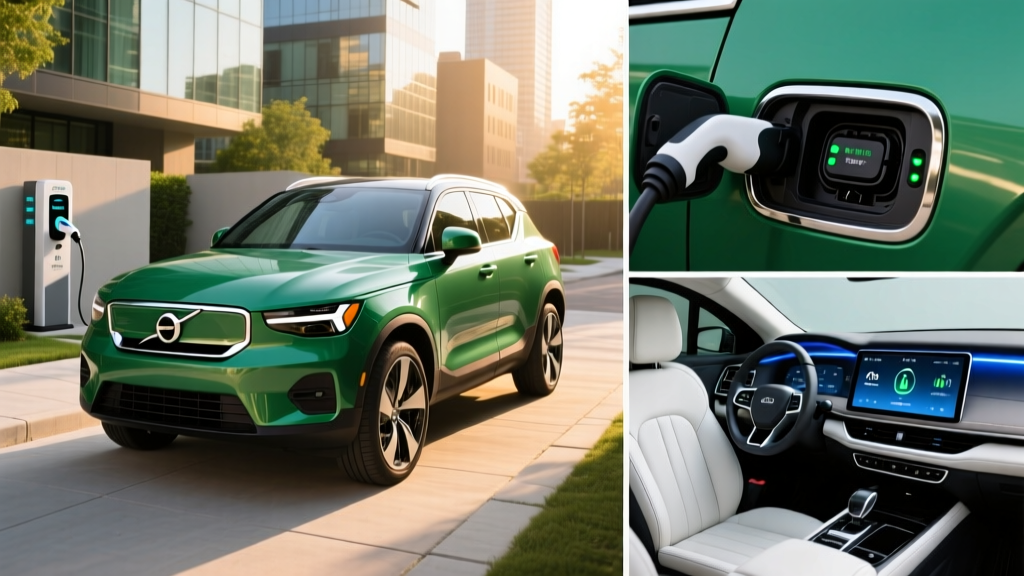
The 2021 Volvo XC40 Recharge was Volvo's first all-electric vehicle, launching the brand into the BEV arena with a compact luxury crossover that prioritized punchy performance and Scandinavian design over maximum range. Now several years into its lifecycle, the XC40 Recharge remains a compelling used-EV option for buyers who want dual-motor AWD, premium build quality, and a Google-powered infotainment system — but it demands honest scrutiny on efficiency and charging speed versus newer rivals.
This review covers the 2021 model year specifically, with real-world data, ownership economics, and how it stacks up in 2026's competitive compact electric SUV segment.
Specs at a Glance: 2021 Volvo XC40 Recharge
| Specification | Value |
|---|---|
| EPA Range | 223 miles |
| Battery (Usable) | 75 kWh (78 kWh gross), NMC lithium-ion |
| EPA Efficiency | 85 MPGe combined (43 kWh/100 mi) |
| Drivetrain | Dual-motor AWD |
| Horsepower | 408 hp |
| Torque | 486 lb-ft |
| 0–60 mph | 4.5 seconds |
| Max DC Fast Charge | 150 kW (CCS1) |
| 10–80% DC Charge Time | ~37 minutes |
| Level 2 Home Charging | 11 kW onboard charger (~33 mi/hr) |
| Cargo Volume (rear seats up) | 16.9 cu ft + 1.4 cu ft frunk |
| Cargo Volume (rear seats folded) | 49.8 cu ft |
| Base MSRP (2021) | $55,085 (including destination) |
| Battery/Powertrain Warranty | 8 years / 100,000 miles |
Real-World Range: What 223 EPA Miles Actually Means
Real-World Highway (70 mph, moderate temps): ~185–200 miles
Real-World City/Mixed: ~200–215 miles
Cold Weather (below 30°F, cabin heat): ~150–175 miles
The 2021 XC40 Recharge's 223-mile EPA rating was competitive at launch but now trails segment leaders like the Hyundai Ioniq 5 (303 mi) and Tesla Model Y Long Range (330 mi). The XC40 Recharge's relatively compact 75 kWh usable battery paired with a boxy, 4,700-lb curb weight explains the efficiency gap: at 43 kWh per 100 miles, it consumes more energy per mile than most rivals.
In real-world highway testing at sustained 70–75 mph speeds, owners consistently report 185–200 miles before reaching 10% state of charge. The XC40 Recharge lacks a heat pump on the 2021 model (Volvo added one for later model years), which means cold-weather range loss is significant — expect a 25–35% reduction in freezing temperatures when using cabin heating. Preconditioning the battery and cabin while plugged in mitigates some of this loss.
For daily commuting under 80 miles round-trip, the range is perfectly adequate. For road trips exceeding 200 miles, you'll need at least one DC fast-charge stop — something the 150 kW charge rate makes manageable but not class-leading.
Charging Speed: DC Fast Charge and Home Level 2
| Charging Level | Power / Rate | Time / Miles Added |
|---|---|---|
| Level 1 (120V household) | ~1.4 kW | ~4 mi/hr; full charge in 50+ hours |
| Level 2 (240V home) | 11 kW (48A) | ~33 mi/hr; 10–100% in ~8 hours |
| DC Fast Charge (CCS1) | Peak 150 kW | 10–80% in ~37 minutes |
The 2021 XC40 Recharge uses a CCS1 connector for DC fast charging. Its 150 kW peak rate was respectable at launch, but the charging curve is the real story. The SUV sustains approximately 120–140 kW between 10–40% state of charge, then tapers progressively. Above 60% SoC, speeds drop to roughly 80 kW, and above 80%, charging slows dramatically to protect the NMC cells — often below 40 kW.
This means the advertised 10–80% time of ~37 minutes is realistic under optimal conditions (preconditioned battery, moderate ambient temperature, a station capable of delivering 150 kW+). In practice at Electrify America or EVgo stations, expect 35–45 minutes for that 10–80% session. The XC40 Recharge does not support NACS natively; adapters are available for Tesla Supercharger access, though speeds may be limited by the adapter's rating.
At home, the 11 kW onboard charger is a genuine strength. A Level 2 wall connector on a 60-amp circuit (48A continuous) replenishes the battery at roughly 33 miles of range per hour — an overnight charge from 20% to full is easily achievable in 7–8 hours. This is faster than many competitors limited to 7.2 kW or 9.6 kW onboard chargers.
Performance and Driving Dynamics
The dual-motor AWD powertrain delivers 408 horsepower and 486 lb-ft of instant torque, making the XC40 Recharge genuinely quick. The 4.5-second 0–60 mph time outpaces most compact luxury crossovers, gas or electric. Power delivery is linear and relentless, with the typical EV advantage of no turbo lag or shift interruption.
Ride quality leans firm — the heavy battery pack sits low, giving the XC40 Recharge a planted feel through corners, but the suspension transmits sharper road imperfections more than some competitors. Steering is precise but light, and the one-pedal driving mode (with adjustable regenerative braking) works well for city driving. Volvo's torque-vectoring rear motor provides confident all-weather traction.
Towing capacity is rated at 2,000 pounds — adequate for a small trailer or bike rack, but not a class leader. If towing is a priority, the Ford Mustang Mach-E (up to 2,300 lb with the extended-range AWD) or the Rivian R2 (when it launches) may serve better.
Interior, Cargo, and Technology
The XC40 Recharge's cabin is where Volvo's reputation for Scandinavian luxury holds strong. Materials are premium — wool-blend upholstery is available as a leather alternative — and the minimalist design feels modern without being austere. Front seats are among the best in the segment for long-distance comfort.
Passenger space:
- Front headroom: 39.4 inches
- Front legroom: 40.9 inches
- Rear headroom: 39.1 inches
- Rear legroom: 36.1 inches
Rear legroom is adequate for adults but tighter than the Hyundai Ioniq 5 or VW ID.4. The 16.9 cubic feet of cargo space behind the rear seats is modest for the segment; folding the 60/40 split rear bench opens up 49.8 cu ft. The small front trunk (frunk) adds 1.4 cu ft — useful for charging cables but not much else.
The 2021 XC40 Recharge was one of the first vehicles to ship with Google built-in — Google Maps for navigation, Google Assistant for voice control, and Google Play Store for apps. This system is fast, familiar, and receives over-the-air updates. The 9-inch vertical touchscreen is responsive, though some owners find it small compared to competitors' 12–15-inch displays. A 12.3-inch digital driver display handles speed, range, and navigation directions.
Driver assistance: The XC40 Recharge comes standard with Volvo's Pilot Assist (SAE Level 2), which provides adaptive cruise control with lane-centering. It works well on highways but requires hands-on-wheel supervision. This is not a "self-driving" system — it's a driver-assist feature comparable to Toyota Safety Sense or Honda Sensing. The 360-degree camera, blind-spot monitoring with steering assist, and cross-traffic alert round out a strong safety suite.
Pricing, Trims, and Federal Tax Credit Eligibility
The 2021 XC40 Recharge launched in a single, well-equipped trim level:
| Item | Amount |
|---|---|
| 2021 XC40 Recharge (single trim) | $55,085 MSRP (incl. destination) |
| Premium Plus Package | Included (pilot assist, 360 camera, etc.) |
| Advanced Package (HUD, headlight cleaning) | ~$1,850 |
| Typical as-tested price | $55,000–$58,000 |
Federal tax credit (§30D) eligibility: As a used vehicle in 2026, the 2021 XC40 Recharge may qualify for the Used Clean Vehicle Credit (up to $4,000 or 30% of sale price, whichever is less) under IRS §25E rules, provided the following conditions are met:
- Sale price cap: The used vehicle must sell for $25,000 or less
- Buyer income limits: AGI ≤ $75,000 (single), $112,500 (head of household), $150,000 (joint)
- Dealer requirement: Must be purchased from a licensed dealer
- Vehicle age: Must be at least 2 model years old (2021 qualifies in 2026)
- One-time use: Buyer cannot have claimed the used-EV credit in the prior 3 years
For the original new-vehicle §30D credit (which applied at the time of the 2021 purchase), the XC40 Recharge qualified for the full $7,500 since Volvo's battery sourcing met pre-2023 rules. That credit is no longer available for new purchases of this model year. Always consult IRS.gov for current rules or speak with a tax professional.
As of early 2026, used 2021 XC40 Recharge listings typically range from $26,000 to $34,000 depending on mileage and condition. At or below $25,000, the used-EV credit can meaningfully reduce effective cost to around $21,000–$25,000 for eligible buyers.
Ownership Costs and Warranty
Volvo's battery and drive-unit warranty covers 8 years or 100,000 miles, whichever comes first, with a capacity retention threshold of 70%. This is industry-standard, matching Tesla, Hyundai, and most competitors. For a 2021 model, approximately 3 years and ~65,000 miles of battery warranty remain as of 2026 — adequate but worth verifying with a pre-purchase battery health check.
The limited vehicle warranty was 4 years / 50,000 miles, meaning most 2021 XC40 Recharge examples are now beyond bumper-to-bumper coverage. Volvo's complimentary maintenance program covered 3 years / 36,000 miles — also expired.
Efficiency and fuel cost comparison: At 43 kWh/100 miles and a national average electricity cost of $0.16/kWh, charging costs roughly $6.88 per 100 miles. A comparable gas-powered Volvo XC40 (28 MPG combined) at $3.40/gallon costs $12.14 per 100 miles — a savings of about $5.26 per 100 miles with the Recharge. Over 15,000 miles annually, that's roughly $789/year in fuel savings. Source: fueleconomy.gov.
Pros, Cons, and Who Should Buy
- 408 hp dual-motor AWD — genuinely quick (4.5s 0–60)
- Google built-in infotainment is fast and intuitive
- 11 kW onboard charger — faster home charging than most rivals
- Premium interior with standard leather-free wool option
- Strong safety suite with standard Pilot Assist
- Compact footprint ideal for urban parking
- 223-mi EPA range trails segment leaders by 80+ miles
- No heat pump (2021) — significant cold-weather range loss
- 150 kW peak DC charge — slower than 200+ kW rivals
- Modest cargo space (16.9 cu ft) for the segment
- Firm ride quality on rough pavement
- Tight rear legroom (36.1 in) vs. competitors
- You want a premium, compact AWD EV with strong performance for under $30,000 used
- Your daily commute is under 80 miles round-trip
- You have reliable home Level 2 charging and rarely road-trip beyond 200 miles
- You value Scandinavian design, Google infotainment, and Volvo safety credentials
- You need 300+ miles of range for frequent road trips
- You regularly drive in sub-freezing climates (no heat pump)
- You need maximum rear-seat space or cargo room for family duty
- Fastest DC charging speed is a priority for your route
How It Compares: Key Competitors
Against the Tesla Model Y Long Range (2021): The Model Y offers 326 miles of EPA range, access to the Supercharger network, and significantly more cargo space. The XC40 Recharge counters with a more premium interior, quieter cabin, and standard features Tesla charges extra for. Range and charging infrastructure heavily favor Tesla.
Against the Hyundai Ioniq 5 (2022+): The Ioniq 5's 800V architecture delivers 10–80% DC charging in ~18 minutes at 230+ kW — dramatically faster than the XC40's 37 minutes. The Ioniq 5 also offers up to 303 miles of range and a more spacious interior. The XC40 Recharge feels more traditionally luxurious inside.
Against the Ford Mustang Mach-E (2021): The Mach-E Extended Range AWD delivers 270 miles EPA and a sportier driving feel. The XC40 Recharge is more compact and easier to park but less practical for rear-seat passengers.
Frequently Asked Questions
What is the real-world range of the 2021 Volvo XC40 Recharge?
Expect 185–200 miles on the highway and 200–215 miles in mixed city driving. In cold weather below 30°F, range drops to approximately 150–175 miles due to the lack of a heat pump on the 2021 model. The EPA rates it at 223 miles under ideal conditions.
How fast does the XC40 Recharge charge?
On a DC fast charger, it peaks at 150 kW and reaches 10–80% in approximately 37 minutes under optimal conditions. At home on a Level 2 (240V) charger, the 11 kW onboard charger adds about 33 miles of range per hour, fully charging the battery in roughly 8 hours.
Does the 2021 XC40 Recharge qualify for a federal tax credit in 2026?
Not for new purchases — the original §30D new-vehicle credit is no longer available for this model year. However, as a used vehicle, it may qualify for the §25E Used Clean Vehicle Credit of up to $4,000 if the sale price is $25,000 or less and the buyer meets IRS income caps ($75K single / $150K joint). Check IRS.gov for eligibility details.
Is the 2021 XC40 Recharge worth buying used in 2026?
It's a strong value if you find one under $28,000 with low mileage and your driving needs align with its ~200-mile real-world range. The premium interior, quick AWD performance, and Google infotainment are genuine strengths. However, if range and charging speed are priorities, competitors like the Ioniq 5 or Model Y offer significantly more capability.
What is the battery warranty on a used 2021 XC40 Recharge?
Volvo covers the high-voltage battery and drive motors for 8 years or 100,000 miles (whichever comes first) against defects and capacity loss below 70%. As of 2026, a 2021 model has approximately 3 years of battery warranty remaining. Request a battery health diagnostic before purchasing.
Does the XC40 Recharge support Tesla Superchargers?
The 2021 XC40 Recharge has a native CCS1 port. You can access Tesla Superchargers using a CCS-to-NACS adapter (available from Tesla and third-party manufacturers), though charging speeds may be limited by the adapter. Volvo began switching to NACS ports on newer model years.
Sources: EPA fueleconomy.gov, IRS Used Clean Vehicle Credit, Volvo Cars USA press archives.