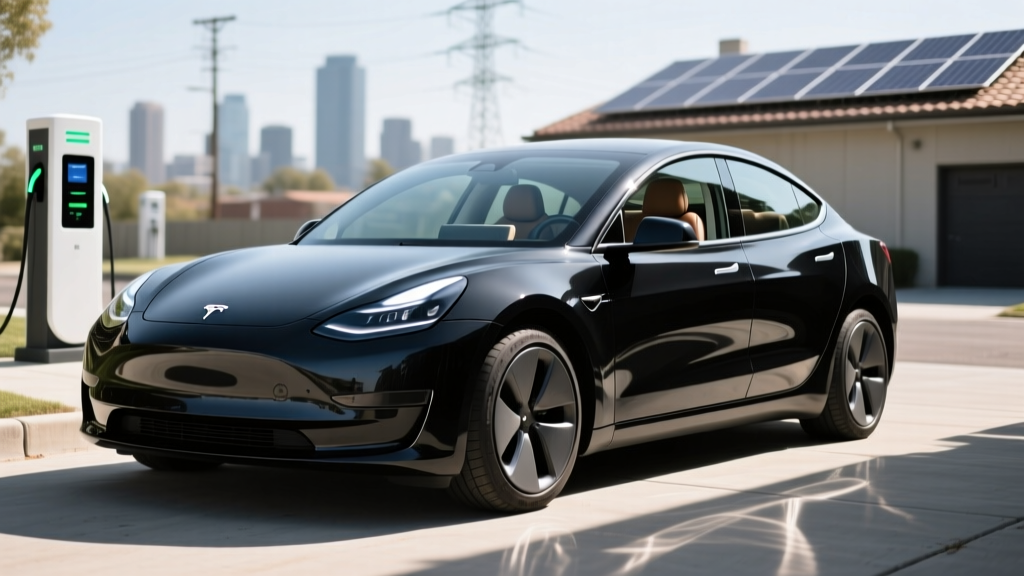
If you are shopping the used EV market in 2026, the 2021 Tesla Model 3 remains one of the most data-rich, well-supported options available. Tesla built over half a million Model 3s for the 2021 model year across Standard Range Plus, Long Range, and Performance trims, meaning parts availability, Supercharger compatibility, and third-party service knowledge are all strong. This review breaks down exactly what a 2021 Model 3 delivers in range, charging, and daily usability — and whether it still makes sense against newer competitors.
2021 Tesla Model 3 Trim Lineup and Key Specs
The 2021 model year offered three trims, each with distinct battery packs, drivetrains, and range figures. Tesla occasionally adjusted battery suppliers mid-year, so chemistry can vary even within the same trim.
| Spec | Standard Range Plus (SR+) | Long Range AWD | Performance |
|---|---|---|---|
| EPA Range | 263 mi | 353 mi | 315 mi |
| Battery (usable) | ~50 kWh (LFP) | ~75 kWh (NMC) | ~75 kWh (NMC) |
| Drivetrain | RWD, single motor | AWD, dual motor | AWD, dual motor |
| Horsepower | ~283 hp | ~346 hp | ~456 hp |
| 0-60 mph | 5.3 sec | 4.2 sec | 3.1 sec |
| MPGe (combined) | 142 MPGe | 134 MPGe | 123 MPGe |
| Original MSRP | $37,990 | $46,990 | $55,990 |
| Efficiency (kWh/100mi) | 24 kWh | 25 kWh | 28 kWh |
Sources: EPA Fuel Economy, Tesla 2021 press materials.
Real-World Range: What the EPA Sticker Doesn't Tell You
Long Range AWD: EPA 353 mi. Expect ~290–310 mi in mixed driving, ~260–280 mi sustained highway at 75 mph, and ~220–250 mi in sub-30°F winter conditions.
Performance: EPA 315 mi. Expect ~260–280 mi mixed, ~235–255 mi highway, and ~200–225 mi in cold weather.
Standard Range Plus: EPA 263 mi. Expect ~220–235 mi mixed, ~195–210 mi highway, and ~170–190 mi in cold weather.
The 2021 Model 3 Long Range's 353-mile EPA rating was class-leading at launch and still competitive in 2026. However, the EPA test cycle favors lower-speed mixed driving. On sustained 75 mph highway runs — the scenario that matters most for road trips — efficiency drops to roughly 28–30 kWh/100mi in the Long Range, translating to about 260–280 usable miles before you'd want to stop.
Cold weather compounds this. In temperatures below 30°F, the battery's internal resistance rises and cabin heating draws 2–5 kW continuously. Owners in northern climates consistently report 20–30% range reduction in winter. The 2021 Model 3 uses a resistive PTC heater rather than a heat pump (which Tesla introduced in the 2021 Model Y and later Model 3 refreshes), so cold-weather efficiency is noticeably worse than the 2022+ Highland refresh models.
The Standard Range Plus trim uses an LFP (lithium iron phosphate) battery, which tolerates regular 100% charging without degradation concerns — a real advantage for daily commuters who need every mile. The NMC packs in the Long Range and Performance trims benefit from daily charging limits of 80–90% to maximize longevity, reserving 100% for road trips.
Charging Speed: DC Fast Charging and Home Level 2
Charging infrastructure compatibility is one of the 2021 Model 3's strongest selling points in 2026. Tesla's Supercharger network remains the most reliable DC fast-charging network in North America, and the 2021 Model 3 uses the proprietary Tesla connector (now designated NACS). With adapters, it can also access CCS stations, though at reduced speeds due to adapter overhead.
| Charging Level | Standard Range Plus | Long Range / Performance | Miles Added per Hour |
|---|---|---|---|
| Level 1 (120V, 12A) | ~1.4 kW | ~1.4 kW | ~3–5 mi/hr |
| Level 2 (240V, 32A Mobile) | ~7.7 kW | ~7.7 kW | ~25–30 mi/hr |
| Level 2 (240V, 48A Wall Connector) | ~11.5 kW (limited by onboard charger) | ~11.5 kW | ~37–44 mi/hr |
| DC Fast Charge (peak) | ~150 kW | ~250 kW | Up to ~1,000 mi/hr at peak |
| DC 10–80% time | ~30 min | ~25–28 min | — |
The Long Range and Performance trims can peak at 250 kW on V3 Superchargers, but this peak is sustained only between roughly 10–30% state of charge. The charge curve tapers significantly: by 60% SoC, power drops to around 100 kW, and above 80%, it falls below 50 kW. This is why Tesla's navigation system recommends charging to 80% on road trips — the last 20% takes nearly as long as the first 60%.
The SR+ trim peaks at approximately 150 kW, making its charging curve flatter but slower overall. On a 200-mile road trip leg, the difference is modest (maybe 5–8 minutes extra), but it compounds on longer drives.
For home charging, the onboard charger in all 2021 Model 3 trims maxes out at 11.5 kW (48 amps). A Tesla Wall Connector on a 60-amp circuit delivers a full charge overnight in roughly 6–8 hours for the Long Range. Installation costs for a Level 2 home setup typically range from $800 to $2,500 depending on panel capacity and conduit runs — factor this into your used-EV budget.
Used Pricing and the $4,000 Federal Tax Credit
As of early 2026, used 2021 Tesla Model 3 pricing has settled into predictable ranges based on trim, mileage, and condition:
- Standard Range Plus: $16,000–$21,000 (30k–60k miles)
- Long Range AWD: $21,000–$27,000 (30k–60k miles)
- Performance: $24,000–$30,000 (25k–50k miles)
| Maximum credit | $4,000 or 30% of sale price (whichever is lower) |
| Vehicle price cap | $25,000 or less (sale price, not original MSRP) |
| Vehicle age requirement | At least 2 model years old (2021 qualifies in 2026) |
| Buyer income cap (AGI) | $75,000 single / $112,500 head of household / $150,000 joint |
| Prior credit history | Vehicle must not have been claimed for §25E since Aug 16, 2022 |
| Dealer requirement | Sale must be through a licensed dealer, reported to IRS |
| Transfer at sale | Yes — credit can reduce purchase price at point of sale |
Source: IRS §25E Used Clean Vehicle Credit. Consult a tax professional for personal eligibility.
The critical takeaway: the $25,000 price cap means the SR+ and lower-mileage Long Range models often qualify, while the Performance trim frequently exceeds the cap. If you find a Long Range listed at $24,500 from a dealer, the $4,000 credit brings your effective cost to $20,500 — exceptional value for a 353-mile EPA-range EV. The point-of-sale transfer means you don't need to wait until tax filing; the dealer applies the credit directly to your purchase price.
Note that the §25E used credit has different rules from the §30D new-vehicle credit. There are no battery-sourcing or critical-mineral requirements for used vehicles, but the price cap and income limits are strict. You can only claim the used credit once every three years.
Battery Health, Degradation, and Warranty Coverage
Five years into service, battery degradation is a legitimate concern for used buyers. Based on aggregated fleet data from sources like Recurrent Auto and TeslaFi community reports, 2021 Model 3 batteries typically show 5–10% degradation at 50,000–70,000 miles. The NMC packs in Long Range and Performance trims tend to lose capacity slightly faster in the first two years (the "knee" of the degradation curve), then stabilize. LFP packs in the SR+ show more linear, slower degradation.
Tesla's battery warranty for the 2021 Model 3 covers:
- SR+: 8 years / 100,000 miles, whichever comes first, with minimum 70% capacity retention
- Long Range & Performance: 8 years / 120,000 miles, minimum 70% capacity retention
This means a 2021 Model 3 purchased in 2026 still has roughly 3 years of battery warranty remaining. If the battery drops below 70% of its original capacity (measured by Tesla diagnostics), Tesla will repair or replace it at no cost. Out-of-warranty battery replacement costs range from $12,000 to $16,000 depending on the pack, though failures are statistically rare — most packs outlast the vehicle.
When inspecting a used 2021 Model 3, request a battery health screenshot from the vehicle's service menu or use third-party tools like Tessie or TeslaFi to pull State of Health (SoH) data. A pack showing 90%+ SoH at 50,000 miles is typical and healthy.
Interior, Cargo, Tech, and Driver Assistance
The 2021 Model 3 interior is minimalist by design — a 15-inch landscape touchscreen handles nearly all vehicle controls, climate, navigation, and media. There is no traditional instrument cluster; speed and navigation appear on the left side of the main screen. Build quality in 2021 models improved over 2018–2019 production, though panel gaps and trim alignment still vary unit to unit.
Passenger and cargo dimensions:
- Front headroom: 40.3 in | Legroom: 42.7 in
- Rear headroom: 37.8 in | Legroom: 35.2 in
- Trunk (rear): 23 cu ft | Frunk (front): 3.1 cu ft
- Total cargo: 26.1 cu ft (seats up)
Rear-seat space is adequate for adults on shorter trips but tighter than a Toyota Camry or Hyundai Ioniq 6. The frunk is small — useful for charging cables and a soft bag, not groceries.
Tech and driver assistance:
All 2021 Model 3s include Tesla's Basic Autopilot (SAE Level 2), which provides adaptive cruise control and lane-centering on highways. The optional Full Self-Driving (FSD) package ($10,000 at the time, now $8,000) adds automated lane changes, navigation-on-autopilot, traffic light/stop sign recognition, and the supervised city-streets capability. FSD remains a Level 2 system — the driver must remain engaged with hands on the wheel and eyes on the road at all times. It is not autonomous driving.
The infotainment system supports Bluetooth audio but lacks Apple CarPlay and Android Auto — a notable drawback for buyers accustomed to phone-mirroring. Navigation, Spotify, and a built-in web browser are native. Over-the-air updates continue in 2026, adding features incrementally.
- Class-leading efficiency (24–28 kWh/100mi)
- Supercharger network access — most reliable DC charging in the US
- Strong performance across all trims (5.3s to 3.1s 0-60)
- Over-the-air updates still active in 2026
- Eligible for $4,000 used EV tax credit on qualifying purchases
- LFP battery in SR+ allows daily 100% charging without degradation worry
- No Apple CarPlay or Android Auto
- No heat pump — cold-weather range loss worse than 2022+ models
- Rear seat space tight for taller passengers
- Minimalist controls frustrate some drivers (no physical volume knob, stalks for wipers)
- FSD purchase does not transfer reliably to new owners on used sales
- Insurance costs often 15–25% higher than comparable sedans
2021 Model 3 vs. 2026 Competitors: Is It Still Worth It?
The used 2021 Model 3 competes against both newer used EVs and current new models. Here's how it stacks up on the metrics that matter:
| Metric | 2021 Model 3 LR (Used ~$24K) | 2024 Hyundai Ioniq 6 SE (Used ~$28K) | 2025 Chevy Equinox EV (New ~$33K) |
|---|---|---|---|
| EPA Range | 353 mi | 361 mi | 319 mi |
| DC Fast Charge Peak | 250 kW | 235 kW | 150 kW |
| 10–80% DC Time | ~25–28 min | ~18 min | ~30 min |
| Charging Network | Tesla Supercharger (NACS) | CCS + NACS adapter | CCS + NACS adapter |
| 0–60 mph | 4.2 sec | 5.1 sec | 7.9 sec |
| Tax Credit Eligible | $4,000 (§25E used) | $4,000 (§25E used) | Up to $7,500 (§30D new) |
The 2021 Model 3 Long Range's advantage is the combination of range, Supercharger access, and performance at a sub-$25,000 effective price. The Ioniq 6 charges faster (its 800V architecture sustains higher power longer), but relies on the more fragmented CCS network unless you carry a NACS adapter. The Equinox EV is a practical crossover but can't match the Model 3's efficiency or acceleration.
Who Should Buy a Used 2021 Tesla Model 3?
Choose the 2021 Model 3 if:
- You want maximum range per dollar and can find a Long Range under $25K for the used credit
- You road-trip regularly and value Supercharger network reliability
- You commute 30–60 miles daily and can charge at home overnight
- You prioritize performance (even the base SR+ hits 60 mph in 5.3 seconds)
Look elsewhere if:
- You need Apple CarPlay or prefer physical controls
- You live in a cold climate and want a heat pump for winter efficiency (look at 2022+ Model 3 or Hyundai/Kia E-GMP vehicles)
- You regularly carry rear-seat passengers over 6 feet tall
- You want the latest ADAS features — newer models from BMW, Mercedes, and Hyundai offer more advanced highway assist systems
Frequently Asked Questions
What is the real-world range of the 2021 Tesla Model 3?
The Long Range AWD delivers approximately 290–310 miles in mixed driving, 260–280 miles on sustained highway runs, and 220–250 miles in freezing weather. The SR+ delivers roughly 220–235 mixed and 170–190 in cold conditions. These are based on owner-reported data aggregated across climates and driving styles.
How fast does the 2021 Model 3 charge at home and on DC fast chargers?
At home on a 48-amp Level 2 Wall Connector, all trims charge at up to 11.5 kW, adding roughly 37–44 miles of range per hour — a full overnight charge in 6–8 hours. On DC fast chargers, the Long Range and Performance peak at 250 kW (10–80% in ~25–28 minutes), while the SR+ peaks at ~150 kW (10–80% in ~30 minutes).
Does the 2021 Model 3 qualify for the federal EV tax credit?
It may qualify for the §25E Used Clean Vehicle Credit of up to $4,000, provided the sale price is $25,000 or less, the buyer's AGI is within limits ($75K single / $150K joint), the vehicle is sold through a licensed dealer, and it hasn't been claimed for this credit since August 2022. The new-vehicle §30D credit no longer applies to 2021 models.
Is the 2021 Model 3 worth buying vs. a newer EV?
For the price — often $20,000–$25,000 after the used credit — the 2021 Model 3 Long Range offers range and performance that still rival 2025–2026 new EVs costing $15,000+ more. The trade-offs are the lack of a heat pump, no CarPlay, and aging interior design. If those aren't dealbreakers, it remains one of the best value propositions in the used EV market.
What should I check before buying a used 2021 Model 3?
Pull battery State of Health data (via TeslaFi, Tessie, or a Tesla Service Center pre-purchase inspection), verify remaining warranty (8yr/100K–120K from original in-service date), check for open recalls on the suspension or 12V battery, and confirm whether FSD transfers with the vehicle (it often does not on private-party or third-party dealer sales).
How much does insurance cost for a 2021 Model 3?
Insurance premiums for the Model 3 run 15–25% higher than comparable gas sedans, averaging $1,800–$2,600 annually depending on state, driving record, and coverage level. Tesla's own insurance product (available in select states) uses real-time driving data and can be cheaper for safe drivers. Always get quotes before purchasing.