Quick Verdict: The Electric Sports Sedan That Still Punches Up
The 2021 Porsche Taycan arrived as the first 800-volt production EV, setting a benchmark for sustained fast-charging performance that many newer rivals still chase. Five years later, the used Taycan market has matured, and Porsche's electric sports sedan is now accessible at a fraction of its original MSRP. But does its real-world range hold up against modern competition? And what does ownership actually cost in 2026?
This review breaks down every number that matters — from EPA range to charging curves to total cost of ownership — so you can decide if a pre-owned 2021 Taycan earns a spot in your garage.
Range & Efficiency: EPA vs. The Real World
The 2021 Taycan was offered in several trims, each with different battery configurations and EPA range ratings. Porsche offered a standard 79.2 kWh (gross) battery pack and an optional Performance Battery Plus (93.4 kWh gross, approximately 83.7 kWh usable). Both packs use NMC (nickel manganese cobalt) lithium-ion chemistry with LG Energy Solution cells.
| Trim | Battery (Gross / Usable kWh) | Drivetrain | EPA Range (mi) | MPGe (Combined) | kWh/100 mi |
|---|---|---|---|---|---|
| Taycan (base RWD) | 79.2 / 71.0 | RWD | 200–225 | 79 | 43 |
| Taycan 4S | 79.2 / 71.0 | AWD | 199 | 68 | 49 |
| Taycan 4S (Perf. Battery Plus) | 93.4 / 83.7 | AWD | 227 | 69 | 48 |
| Taycan Turbo | 93.4 / 83.7 | AWD | 212 | 69 | 49 |
| Taycan Turbo S | 93.4 / 83.7 | AWD | 227 | 68 | 49 |
The Taycan's efficiency is middling by 2026 standards. At 43–49 kWh/100 mi, it trails the Tesla Model S Long Range (roughly 28 kWh/100 mi) and Lucid Air Grand Touring (roughly 26 kWh/100 mi). This is the trade-off for a performance-oriented powertrain with a two-speed rear transmission and heavy curb weight (4,700–5,100 lbs depending on trim).
Charging: Still a Benchmark for Sustained DC Speed
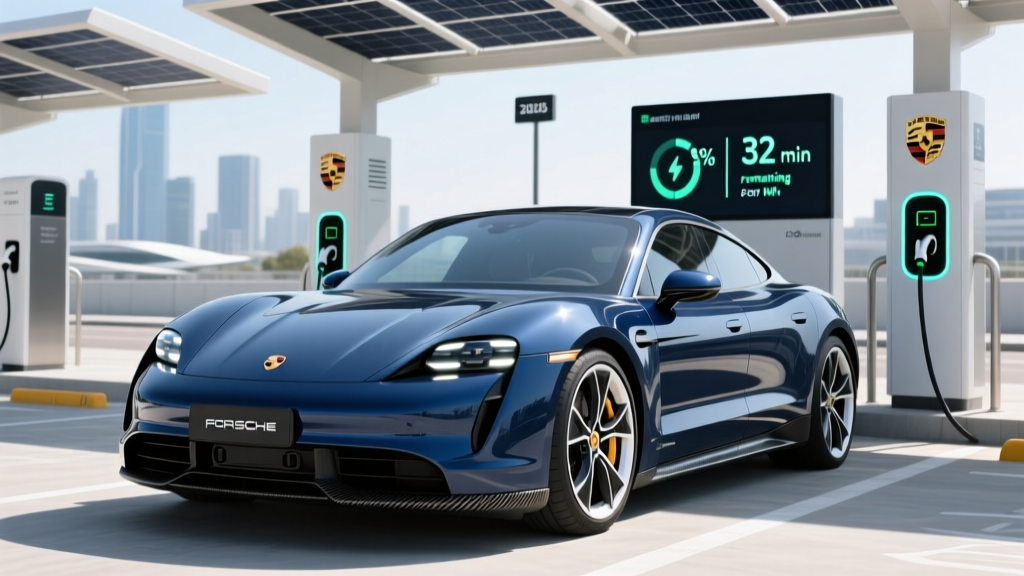
The Taycan's 800-volt architecture remains one of its strongest selling points. While peak DC fast-charge rates have been surpassed by newer platforms, the Taycan's charging curve — specifically its ability to sustain high power deep into the session — is exceptional.
| Charging Level | Power / Rate | Time / Speed | Notes |
|---|---|---|---|
| Level 1 (120V AC) | 1.2 kW | ~2–3 mi/hr | Emergency/trickle only |
| Level 2 (240V AC, 48A) | 11.5 kW (onboard charger) | ~28–32 mi/hr; 0–100% in ~9 hrs (93.4 kWh pack) | Standard J1772 connector; 9.6 kW with 40A circuit |
| DC Fast Charge (CCS1) | Up to 270 kW peak (93.4 kWh pack) / 225 kW (79.2 kWh pack) | 10–80% in ~22.5 min (Porsche-rated) | Sustains above 150 kW through ~55% SoC; tapers progressively above 80% |
Here's what the numbers mean in practice: on a 350 kW Electrify America or equivalent CCS1 station, the Performance Battery Plus model ramps quickly to roughly 250–270 kW, holds above 150 kW until approximately 55% State of Charge (SoC), then tapers through the 80% mark. The 10–80% time of approximately 22.5 minutes remains competitive with most 2025–2026 EVs. The smaller 79.2 kWh pack peaks at 225 kW and takes roughly 5 minutes longer to reach 80%.
Charging-curve insight: Porsche's curve is flatter than rivals like the Hyundai Ioniq 5 or Kia EV6, which hit higher peaks but drop off faster. On a 200-mile road trip with a single DC stop, the Taycan's sustained throughput means you're often back on the road faster despite a lower headline kW number. Always precondition the battery via the Porsche PCM navigation route planner before arriving at a DC station — this warms the pack and unlocks peak charge rates.
The Taycan uses the CCS1 connector. Porsche did not adopt NACS (Tesla's connector) for the 2021 model year. Adapters are available from third parties (such as the Lectron or A2Z CCS-to-NACS adapter) for accessing Tesla Superchargers, though charge rates through an adapter may be limited.
Performance & Drivetrain
The 2021 Taycan lineup delivers sports-car acceleration in a four-door package. Every trim features a permanently excited synchronous motor (PSM) on the rear axle; AWD models add an asynchronous motor (ASM) on the front axle. The two-speed transmission on the rear axle — a unique engineering choice — provides a short first gear for explosive launches and a tall second gear for efficient highway cruising.
| Trim | Horsepower (Overboost w/ Launch Control) | Torque (lb-ft) | 0–60 mph (sec) | Top Speed (mph) | Drivetrain |
|---|---|---|---|---|---|
| Taycan (base RWD) | 402 | 254 | 5.1 | 143 | RWD |
| Taycan 4S (Std. Battery) | 522 | 472 | 3.8 | 155 | AWD |
| Taycan 4S (Perf. Battery Plus) | 562 | 479 | 3.6 | 155 | AWD |
| Taycan Turbo | 670 | 626 | 3.0 | 161 | AWD |
| Taycan Turbo S | 750 | 774 | 2.6 | 162 | AWD |
The Turbo S's 2.6-second 0–60 time is verified and repeatable thanks to Porsche's launch control system and sophisticated thermal management. Even the base RWD Taycan at 5.1 seconds is quicker than most daily commuters will ever need. The regenerative braking system recovers up to 265 kW — among the highest regen rates in production — though Porsche does not offer true one-pedal driving. You will still use the brake pedal for complete stops.
Interior, Cargo & Technology
The 2021 Taycan's cabin is unmistakably Porsche: driver-focused, minimalist, and loaded with screens. The 16.8-inch curved digital instrument cluster, 10.9-inch central PCM (Porsche Communication Management) touchscreen, and an available 8.4-inch haptic climate control panel dominate the dash. An optional 10.9-inch passenger-side display was available.
| Dimension | Measurement |
|---|---|
| Front Headroom | 38.0 in |
| Rear Headroom | 36.5 in (35.7 in with glass roof) |
| Front Legroom | 41.2 in |
| Rear Legroom | 32.7 in |
| Trunk (rear cargo) | 12.9 cu ft |
| Frunk (front trunk) | 2.9 cu ft |
| Total Cargo | 15.8 cu ft |
The rear seat is the Taycan's most obvious compromise. With 32.7 inches of legroom, it trails the Tesla Model S (38.4 in rear legroom) and is tight for adults on longer trips. The rear cargo area at 12.9 cu ft is adequate for two carry-on suitcases and a few bags, but this is not a family hauler. The frunk is small at 2.9 cu ft — enough for a charging cable and a small bag.
Driver assistance: The 2021 Taycan includes Porsche InnoDrive with adaptive cruise control, lane-keeping assist, and traffic sign recognition. This is an SAE Level 2 driver-assist system — the driver must remain fully engaged with hands on the wheel at all times. It is not self-driving. Night vision assist and surround-view cameras were optional. Compared to Tesla's Autopilot or GM's Super Cruise, Porsche's system is competent but conservative, prioritizing smoothness over assertive lane changes.
Pricing, Tax Credits & Used Market in 2026
When new, the 2021 Taycan started at $79,900 (base RWD) and climbed to $185,000 for the Turbo S before options. Well-optioned 4S models commonly stickered above $120,000. In the 2026 used market, depreciation has brought these figures down substantially:
| Trim | Original MSRP | Est. 2026 Used Price (Good Condition) | Used-EV Tax Credit (§25E) | Effective Price After Credit |
|---|---|---|---|---|
| Taycan (base RWD) | $79,900 | $42,000–$48,000 | Up to $4,000 | $38,000–$44,000 |
| Taycan 4S | $103,800 | $50,000–$60,000 | Up to $4,000 | $46,000–$56,000 |
| Taycan Turbo | $150,900 | $62,000–$75,000 | Up to $4,000 | $58,000–$71,000 |
| Taycan Turbo S | $185,000 | $75,000–$92,000 | Up to $4,000 | $71,000–$88,000 |
Tax credit eligibility (critical details): Because the 2021 Taycan is now purchased as a used vehicle, it may qualify for the IRS §25E Used Clean Vehicle Credit — not the §30D new-vehicle credit. The §25E credit provides up to $4,000 (or 30% of the sale price, whichever is less). Key requirements include:
- Sale price cap: The used vehicle must be sold for $25,000 or less — this eliminates most used Taycan Turbo and Turbo S models from eligibility, and many 4S models as well. Only base RWD models in higher-mileage or fair condition may fall under the cap.
- Buyer income limits: Adjusted gross income must not exceed $75,000 (single), $112,500 (head of household), or $150,000 (joint filers).
- Dealer sale requirement: The vehicle must be purchased from a licensed dealer, not a private party.
- Model year requirement: The vehicle must be at least two model years old (the 2021 qualifies in 2026).
- First transfer: The credit applies only to the first qualified sale of the vehicle after August 16, 2022 — if a previous owner already claimed the credit on this specific VIN, it cannot be claimed again.
Given the $25,000 sale price cap, most 2021 Taycan buyers will not qualify for the used-EV credit. Consult a tax professional and verify current IRS rules before relying on this credit in your purchase decision.
Warranty & Battery Longevity
Porsche backed the 2021 Taycan with the following warranty coverage:
- New Vehicle Limited Warranty: 4 years / 50,000 miles
- Battery Warranty: 8 years / 100,000 miles, with a capacity retention threshold of 70%. If the battery's State of Health (SoH) drops below 70% within this period, Porsche will repair or replace it.
- Powertrain Warranty: 8 years / 100,000 miles (electric motors, power electronics, transmission)
By 2026, most 2021 Taycans have exited the bumper-to-bumper warranty window but remain under the 8-year battery and powertrain coverage (through model year 2029 or 100,000 miles). Porsche's NMC battery chemistry has shown modest degradation in real-world use — early owner reports and fleet data suggest approximately 5–8% capacity loss over the first 60,000–80,000 miles, well within the 70% warranty threshold. The 800V architecture's thermal management contributes to slower degradation by keeping cell temperatures stable during fast charging.
Who the 2021 Taycan Is For (And Who Should Look Elsewhere)
Pros
- Best-in-class sustained DC fast-charge curve (800V architecture)
- Repeatable, sports-car-level acceleration (Turbo S: 2.6 sec 0–60)
- Porsche build quality, chassis tuning, and steering feel
- Conservative EPA ratings often exceeded in real-world driving
- Strong thermal management reduces cold-weather and fast-charge degradation
- Significant used-market depreciation makes it more accessible in 2026
Cons
- Range (200–227 mi EPA) trails Tesla Model S, Lucid Air, and Mercedes EQS
- Efficiency (43–49 kWh/100 mi) is below average for a luxury EV sedan
- Cramped rear seat (32.7 in legroom) limits family use
- Small frunk (2.9 cu ft) and modest total cargo (15.8 cu ft)
- CCS1 connector requires adapter for Tesla Supercharger access
- Most used examples exceed the $25,000 cap for the §25E used-EV tax credit
- PCM infotainment can be laggy compared to Tesla or Lucid interfaces
Choose the 2021 Taycan If:
You prioritize driving dynamics, build quality, and fast-charge performance over maximum range. You charge at home most nights and take road trips within the 180–220 mile real-world envelope. You want a luxury sports sedan that drives like a Porsche first and an EV second.
Look Elsewhere If:
You need 300+ miles of range (consider a used Tesla Model S Long Range or Lucid Air), regularly carry rear-seat passengers, or require maximum cargo versatility. If maximizing tax-credit savings is a priority, the Taycan's used pricing typically exceeds the §25E cap.
Frequently Asked Questions
What is the real-world range of the 2021 Porsche Taycan?
Expect 200–220 miles in moderate temperatures at highway speeds with the Performance Battery Plus (93.4 kWh gross). The base 79.2 kWh pack delivers roughly 180–200 miles in similar conditions. Cold weather (below 30°F) can reduce range by 15–25%. Porsche's EPA ratings are conservative, and many owners report matching or slightly exceeding them in mixed city/highway driving.
How fast does the 2021 Taycan charge at home and on DC fast chargers?
At home on a Level 2 (240V, 48A) charger, the Taycan accepts up to 11.5 kW, adding approximately 28–32 miles per hour — a full overnight charge in roughly 9 hours for the larger pack. On a DC fast charger, it peaks at 270 kW (93.4 kWh pack) and charges from 10–80% in approximately 22.5 minutes, with a sustained curve that outperforms many newer EVs.
Does the 2021 Taycan qualify for a federal EV tax credit in 2026?
As a used vehicle, the 2021 Taycan may qualify for the IRS §25E Used Clean Vehicle Credit of up to $4,000. However, the vehicle must be sold for $25,000 or less to qualify — a threshold most used Taycans exceed. Buyer income limits also apply ($75K single / $150K joint). Verify eligibility on irs.gov and with a tax professional before purchasing.
Is the 2021 Taycan worth buying over a Tesla Model S or Audi e-tron GT?
The Taycan wins on steering feel, build quality, and sustained fast-charge performance. The Tesla Model S Long Range wins decisively on range (405 mi EPA), efficiency, cargo space, and Supercharger network access. The Audi e-tron GT shares the Taycan's 800V J1 platform and is mechanically similar but styled differently, with slightly less aggressive performance. Your choice depends on whether you value Porsche's driving dynamics (Taycan), range and tech (Model S), or design and value (e-tron GT).
What are the biggest ownership concerns with a used 2021 Taycan?
Insurance premiums are high — expect $2,500–$4,000 annually depending on your profile and state. Out-of-warranty repairs (post-50,000 miles) at Porsche dealerships are expensive. The 12V auxiliary battery is a known maintenance item. The CCS1 connector is being phased out industry-wide in favor of NACS, though adapters mitigate this concern. Battery health should be verified via a pre-purchase inspection at a Porsche dealer, who can pull the State of Health (SoH) report.
Does the 2021 Taycan have one-pedal driving?
No. Porsche's regenerative braking system recovers up to 265 kW — among the strongest in production — but the Taycan does not come to a complete stop using regen alone. You must use the brake pedal for full stops. This is a deliberate engineering choice by Porsche to preserve consistent brake-pedal feel.