Quick Verdict: The 2021 Taycan Still Sets the EV Performance Benchmark
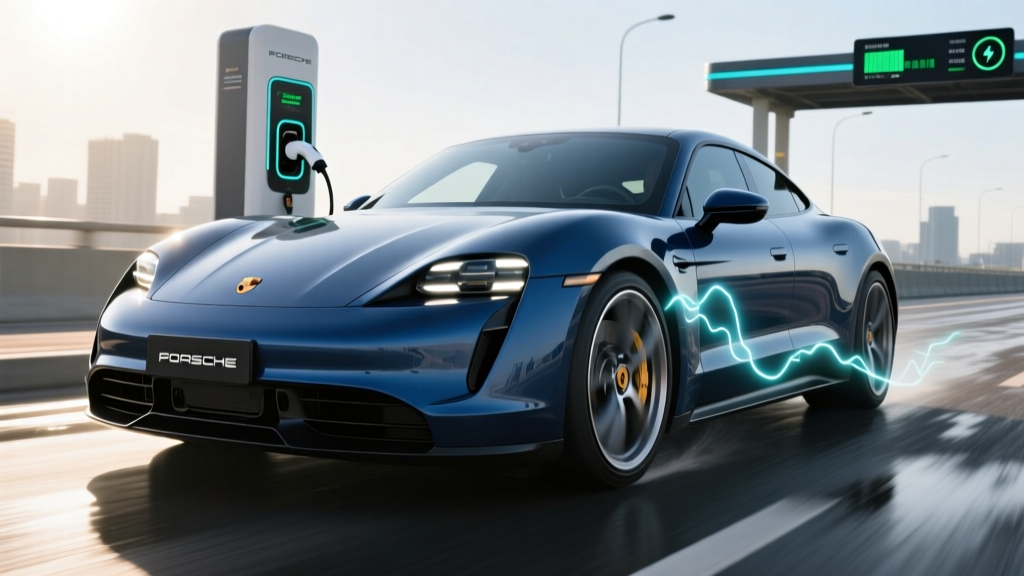
Five years after its debut, the 2021 Porsche Taycan remains the electric sports sedan that performance purists point to when debating whether EVs can deliver genuine driver engagement. The headline number — a 2.6-second 0-60 mph time for the Turbo S with Launch Control — was shocking in 2021 and still holds up against nearly every EV on sale in 2026. But the Taycan story is more than straight-line speed: its 800-volt architecture, repeatable performance, and chassis tuning set a template that competitors are still chasing.
This review breaks down every trim — base RWD, 4S, Turbo, and Turbo S — with exact EPA range figures, real-world efficiency data, DC fast-charge speeds, and the ownership economics that matter if you're shopping for one on the used market today.
2021 Porsche Taycan Spec Table: Every Trim at a Glance
| Spec | Taycan (Base RWD) | Taycan 4S | Taycan Turbo | Taycan Turbo S |
|---|---|---|---|---|
| Drivetrain | RWD (single motor) | AWD (dual motor) | AWD (dual motor) | AWD (dual motor) |
| Battery (usable / gross) | 71.0 / 79.2 kWh (Performance Battery) | 71.0 / 79.2 kWh std; 83.7 / 93.4 kWh opt (PB+) | 83.7 / 93.4 kWh (PB+) | 83.7 / 93.4 kWh (PB+) |
| Chemistry | NMC (nickel manganese cobalt) | NMC | NMC | NMC |
| Horsepower (Launch Control) | 402 hp | 522 hp (PB) / 562 hp (PB+) | 670 hp | 750 hp |
| 0-60 mph (Launch Control) | 5.1 sec | 3.8 sec (PB) / 3.6 sec (PB+) | 3.0 sec | 2.6 sec |
| EPA Range | 200 mi | 203 mi (PB) / 227 mi (PB+) | 212 mi | 199 mi |
| MPGe (combined) | 79 MPGe | 75–79 MPGe | 75 MPGe | 68 MPGe |
| Efficiency | 43 kWh/100mi | 42–45 kWh/100mi | 45 kWh/100mi | 49 kWh/100mi |
| Max DC Fast Charge | 225 kW | 225 kW (PB) / 270 kW (PB+) | 270 kW | 270 kW |
| 10–80% DC Charge Time | ~22.5 min | ~22.5 min (PB) / ~22.5 min (PB+) | ~22.5 min | ~22.5 min |
| Level 2 AC Charge Rate | 9.6 kW (~32 mi/hr) | 9.6 kW | 9.6 kW | 9.6 kW |
| Original Base MSRP | $81,250 | $105,150 | $152,350 | $186,350 |
Sources: EPA fueleconomy.gov, Porsche USA 2021 press specifications.
2021 Porsche Taycan 0-60: What Makes It So Fast — and Repeatable
The keyword that brings buyers to the Taycan is the 0-60 time, and the Turbo S delivers a staggering 2.6-second sprint when using Launch Control. That puts it in supercar territory, rivaling the Lamborghini Huracán and ahead of most anything wearing a Porsche badge short of the 918 Spyder.
But the Taycan's real engineering achievement isn't the peak number — it's repeatability. Thanks to the 800-volt electrical architecture (double the 400V standard in most EVs), the Taycan manages thermal loads far more effectively. Where some competitors lose a full second or more on back-to-back launches, the Taycan Turbo S can deliver near-identical 0-60 times repeatedly before thermal management intervenes. The two-speed transmission on the rear axle — a first for a production EV — gives a short first gear for explosive launches and a tall second gear for efficient highway cruising.
Even the base RWD model's 5.1-second 0-60 is competitive with sport sedans like the BMW M340i, while the 4S with the Performance Battery Plus (PB+) option hits 3.6 seconds — firmly in sports-car territory at a significantly lower price point than the Turbo variants.
Real-World Range vs. EPA Sticker
EPA Range: 199–227 miles depending on trim and battery pack.
Real-World Expectation: In mixed driving at moderate temperatures (65–75°F), expect roughly 85–90% of EPA — so around 170–205 miles. On sustained highway runs at 75+ mph, plan for 160–190 miles. In freezing weather (below 32°F), range drops 20–30%, meaning a Turbo S could deliver as little as 140–160 miles. The Taycan's heat pump (optional on 2021 models, standard from 2022) mitigates cold-weather losses significantly — prioritize used examples equipped with it.
Range and Efficiency: The Taycan's Honest Trade-Off
The 2021 Taycan's EPA range numbers — 199 to 227 miles — were its most criticized spec at launch, and they remain modest by 2026 standards. For context, the Tesla Model S Long Range achieved 405 miles EPA that same year, and the Lucid Air was rated at 520 miles.
However, the Taycan's real-world efficiency often exceeds its EPA sticker. Multiple independent tests, including those by Car and Driver, have shown the Taycan exceeding its EPA range on highway loops — a rarity among EVs. The 800V architecture contributes to lower resistive losses, and Porsche's conservative EPA testing methodology means the sticker number under-represents actual capability.
The efficiency numbers tell the story: the Taycan 4S with the larger battery achieves roughly 42 kWh/100 miles in mixed driving. That translates to about 2.4 miles per kWh. The Turbo S, with its wider tires and more aggressive calibration, consumes about 49 kWh/100 miles — roughly 2.0 miles per kWh.
If range is your primary concern, the 4S with the Performance Battery Plus is the sweet spot: 227 miles EPA with strong performance. The Turbo S sacrifices 28 miles of range for 188 additional horsepower.
Charging Speed: 800V Architecture Still Delivers in 2026
The Taycan's 800-volt platform was its most forward-looking feature in 2021, and it remains competitive five years later. Here's how charging breaks down across levels:
| Charging Level | Power | Speed | Notes |
|---|---|---|---|
| Level 1 (120V household) | ~1.4 kW | ~4–5 mi/hr | Emergency/trickle only; full charge takes 3+ days |
| Level 2 (240V home/public) | 9.6 kW | ~32 mi/hr | Full charge in ~9–10 hours; ideal for overnight |
| DC Fast Charge (Performance Battery) | 225 kW peak | 10–80% in ~22.5 min | CCS1 connector |
| DC Fast Charge (Performance Battery Plus) | 270 kW peak | 10–80% in ~22.5 min | CCS1 connector; sustained high power to ~55% SoC |
The 800V system's advantage isn't just peak kW — it's the charge curve. The Taycan holds near-peak power longer than most 400V competitors, which taper sharply after 50% State of Charge. On a 350 kW Electrify America or Ionity charger, the Taycan PB+ sustains above 200 kW from roughly 10% to 55% SoC before gradually tapering. That means the 10-80% time is genuinely around 22–23 minutes in real-world conditions, not just a lab figure.
One important note for 2026 buyers: the 2021 Taycan uses the CCS1 connector. Porsche has since adopted NACS (Tesla's connector) for new models, but the 2021 Taycan will require a CCS-to-NACS adapter for access to Tesla Supercharger stalls that support non-Tesla vehicles. Porsche provides a CCS adapter in some markets; confirm inclusion with the seller.
Pricing, Tax Credits, and Used-Market Value in 2026
The 2021 Taycan is no longer eligible for the federal §30D new-vehicle EV tax credit — that credit applied only to the original purchaser and only if the vehicle was new. However, used-market buyers may qualify for the Used Clean Vehicle Credit under IRS §25E:
- Credit amount: Up to $4,000 or 30% of the sale price (whichever is less)
- Vehicle price cap: Sale price must be $25,000 or less
- Income caps: $75,000 single / $112,500 head of household / $150,000 joint
- Vehicle age: Must be at least 2 model years old (2021 qualifies in 2026)
- Dealer requirement: Must purchase from a licensed dealer
Given that most 2021 Taycans sell for $55,000–$120,000+ on the used market depending on trim and mileage, the $25,000 sale price cap makes the used credit essentially inaccessible for this model. Budget accordingly — no federal credit will apply for most buyers.
As of early 2026, used-market pricing for the 2021 Taycan looks approximately like this:
| Trim | Original MSRP | 2026 Used Market (est.) | Federal Credit |
|---|---|---|---|
| Base RWD | $81,250 | $52,000–$62,000 | Not eligible (exceeds $25K cap) |
| 4S (PB) | $105,150 | $65,000–$78,000 | Not eligible |
| 4S (PB+) | ~$111,500 | $72,000–$85,000 | Not eligible |
| Turbo | $152,350 | $90,000–$110,000 | Not eligible |
| Turbo S | $186,350 | $110,000–$135,000 | Not eligible |
Used pricing varies significantly by mileage, condition, options, and region. Verify current listings on major platforms. Tax credit rules per IRS §25E.
Interior, Tech, and Daily Usability
The Taycan's cabin blends Porsche's traditional build quality with a thoroughly digital interface. Three screens dominate the dash: an 16.8-inch curved instrument cluster, a 10.9-inch central infotainment display, and an 8.4-inch haptic-touch climate/control panel below. A front-passenger display was optional.
Space and cargo: The Taycan is a four-seat sedan (4+1 optional rear middle seat, but it's tight). Rear legroom measures 32.7 inches — adequate for adults on shorter trips but snug compared to a Mercedes EQS or Tesla Model S. Cargo capacity is 14.3 cubic feet in the rear trunk plus 2.9 cubic feet in the front trunk (frunk), totaling 17.2 cu ft. That's enough for a weekend trip for two but won't swallow family road-trip luggage easily.
Driver assistance: The 2021 Taycan includes Porsche InnoDrive (adaptive cruise with predictive speed adjustment based on navigation data), lane-keep assist, and parking assist. This is an SAE Level 2 system — the driver must remain fully engaged with hands on the wheel. It's competent for highway cruising but not competitive with Tesla's Autopilot or GM's Super Cruise in terms of hands-free capability or route automation.
Notable drawbacks: The dual touchscreen climate controls draw criticism for requiring too many taps to adjust basic settings. Rear visibility is limited. The optional 21-inch wheels reduce range and ride comfort noticeably. And infotainment responsiveness, while good for 2021, feels a step behind current-generation systems.
Pros
- Class-leading driving dynamics and steering feel
- Repeatable launch performance without thermal fade
- 800V charging still competitive — sustained high-power DC curve
- Porsche build quality, materials, and fit/finish
- Real-world range often exceeds EPA estimates
- Strong depreciation stabilization in 2025–2026
Cons
- EPA range of 199–227 mi trails rivals significantly
- Rear seat space tight for a vehicle at this price point
- No federal tax credit available for used purchases
- CCS1 connector may need adapter for NACS Supercharger access
- Haptic climate controls distract from driving
- Optional equipment drives price very high quickly
Battery Longevity, Warranty, and Degradation
Porsche provides an 8-year / 100,000-mile battery warranty on the 2021 Taycan, guaranteeing that the battery will retain at least 70% of its original capacity during that period. The limited vehicle warranty covers 4 years / 50,000 miles.
The NMC (nickel manganese cobalt) chemistry in the Taycan's Performance Battery and Performance Battery Plus is well-proven. Real-world degradation data from high-mileage Taycan owners and fleet operators shows approximately 5–8% capacity loss over the first 100,000 miles — well within the warranty threshold. Porsche's conservative battery management system maintains a generous buffer at the top and bottom of the pack, which protects long-term health at the cost of some usable capacity.
Battery replacement cost, should it be needed out of warranty, is estimated at $25,000–$35,000 for the complete pack — a significant sum that buyers should factor into long-term ownership projections. Individual module replacement is possible and less expensive.
Care tips for used Taycan buyers:
- Request a battery State of Health (SoH) report from a Porsche dealer before purchase
- Verify whether the heat pump was included (optional in 2021) — it matters for cold-climate owners
- Prefer vehicles with the Performance Battery Plus for better range and faster peak charging
- Check for any outstanding recall campaigns on the NHTSA recalls database
2021 Taycan vs. Key Competitors: Is It Worth Buying in 2026?
The 2021 Taycan competes against several used-market EVs at similar price points. Here's how it stacks up:
| Attribute | 2021 Taycan 4S (PB+) | 2021 Tesla Model S LR | 2021 Audi e-tron GT | 2022 Lucid Air Pure |
|---|---|---|---|---|
| 0-60 mph | 3.6 sec | 3.1 sec | 3.9 sec | 3.8 sec |
| EPA Range | 227 mi | 405 mi | 238 mi | 410 mi |
| Max DC Charge | 270 kW | 250 kW | 270 kW | 210 kW |
| Rear Legroom | 32.7 in | 35.4 in | 33.1 in | 35.0 in |
| Used Price (est.) | $72K–$85K | $55K–$70K | $60K–$75K | $65K–$80K |
Who Should Buy the 2021 Taycan?
Choose the Taycan if: Driving dynamics, build quality, and repeatable performance matter more than maximum range. You want a sports sedan that happens to be electric — not an EV that happens to be quick. You have reliable home Level 2 charging and your daily driving fits within 180–200 miles.
Look elsewhere if: Range is your top priority (Model S or Lucid Air deliver nearly double). You need genuine rear-seat space for adults regularly. You want the latest hands-free driver-assist technology. You're counting on a federal tax credit to offset purchase price.
Frequently Asked Questions
What is the real-world range of the 2021 Porsche Taycan?
In mixed driving at moderate temperatures, expect 170–205 miles depending on trim. Highway driving at 75+ mph yields 160–190 miles. Cold weather (below 32°F) can reduce range by 20–30%. The Taycan frequently exceeds its EPA sticker on moderate-speed highway loops — a known quirk of Porsche's conservative EPA testing.
How fast does the 2021 Taycan charge at home and on DC fast chargers?
At home on a Level 2 (240V, 9.6 kW) charger, the Taycan adds roughly 32 miles of range per hour, with a full charge taking about 9–10 hours. On a 350 kW DC fast charger, the Performance Battery Plus models peak at 270 kW and charge from 10–80% in approximately 22.5 minutes, with a sustained high-power curve thanks to the 800V architecture.
Does the 2021 Porsche Taycan qualify for any federal EV tax credit in 2026?
Not for most buyers. The new-vehicle §30D credit is no longer available for used purchases. The used-vehicle credit (§25E) has a $25,000 sale price cap, and virtually all 2021 Taycans sell well above that threshold. Consult a tax professional and review IRS guidance on §25E for your specific situation.
Is the 2021 Taycan Turbo S 0-60 time still competitive in 2026?
Yes. The Turbo S's 2.6-second 0-60 mph with Launch Control remains among the fastest of any production EV available on the used market. Only the Tesla Model S Plaid (1.99 sec) and Lucid Air Sapphire (sub-2.0 sec) are meaningfully quicker, and both command higher used prices. The Taycan's advantage is repeatability — it can deliver near-identical launch times repeatedly without thermal degradation.
What should I look for when buying a used 2021 Taycan?
Prioritize: (1) the Performance Battery Plus for better range and charging, (2) the optional heat pump for cold climates, (3) a Porsche dealer battery State of Health report, (4) service records confirming software updates, and (5) verification of any open NHTSA recalls. Avoid examples with the base Performance Battery unless budget is the primary constraint — the range and charging penalties are noticeable.
How does the Taycan's 800V charging compare to newer EVs?
The Taycan's 800V architecture was pioneering in 2021 and remains competitive in 2026. Vehicles like the Hyundai Ioniq 5, Kia EV6, and Genesis GV60 also use 800V and achieve similar 10–80% charge times. Most competitors (Tesla, Ford, BMW, Mercedes) still use 400V systems that can match peak kW but taper more aggressively above 50% SoC. The Taycan's sustained charge curve remains an advantage on long road trips.