Why Winter Changes Everything for the Cybertruck
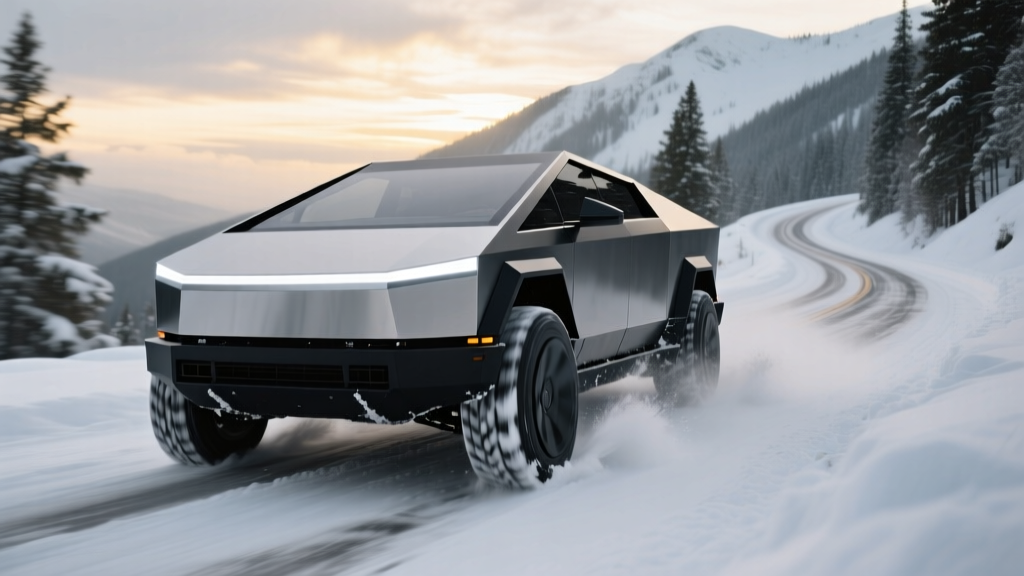
The Tesla Cybertruck's stainless-steel exoskeleton and angular silhouette look built for a blizzard, but cold weather exposes every EV's weakest link: battery chemistry, thermal management, and traction. With a curb weight exceeding 6,600 pounds and an EPA range of up to 340 miles, the Cybertruck enters winter with a big energy reserve — and a lot of mass to move on slippery pavement. For buyers in the snow belt from Buffalo to Bozeman, the question isn't whether it can handle a dusting. It's whether real-world range, charging speed, and traction hold up when the thermometer drops below 20°F.
This review evaluates the 2025–2026 Tesla Cybertruck lineup through a winter-ownership lens: range loss at freezing temperatures, DC fast-charging behavior in cold weather, all-wheel-drive traction on snow and ice, cabin comfort, and total cost after federal tax incentives. All specifications reflect the current Dual Motor AWD and Cyberbeast trims; the single-motor RWD variant has been discontinued.
Cold-Weather Range: What the EPA Number Doesn't Tell You
- Cybertruck AWD (EPA): 340 miles — expect 260–290 mi on mixed highway/city drives above 40°F
- Cybertruck AWD (Winter, 10–30°F): 200–240 miles typical; 170–200 mi at sustained 75 mph on the interstate
- Cyberbeast (EPA): 320 miles — winter drops mirror AWD trim, roughly 190–230 mi real-world in deep cold
The Cybertruck's 123 kWh usable battery pack (NMC lithium-ion chemistry) gives it one of the largest energy reserves in any consumer EV. That's a winter advantage: even with a 30–40% range reduction common to EVs in sub-freezing temperatures, you still have 200+ miles of practical range. For context, a smaller-battery EV losing 35% might fall below 130 miles.
Three factors drive Cybertruck winter range loss specifically:
- Cabin and battery heating. The Cybertruck uses a heat pump (Tesla's "Octovalve" thermal management system), which is significantly more efficient than resistive heating. Even so, heating a 6,600-lb steel vehicle with a large glass roof and vast cabin volume draws 2–5 kW continuously in cold weather.
- Aerodynamic drag in dense cold air. Cold air is roughly 10–15% denser than warm air, and the Cybertruck's flat-panel design yields a drag coefficient around 0.335 — respectable for a truck, but still penalized at highway speed in winter conditions.
- Snow and slush rolling resistance. The factory Continental CrossContact RX tires (all-season) add friction on packed snow. Swapping to dedicated winter tires (see below) partially offsets this but adds its own rolling-resistance penalty.
According to fueleconomy.gov, EVs can lose 20–40% of their rated range in cold weather depending on driving habits and cabin heating use. The Cybertruck sits on the better end of that spectrum thanks to the heat pump and large battery, but buyers in Minnesota or Maine should plan routes around 200 miles of winter range, not 340.
Charging Speed in Cold Weather: Preconditioning Is Non-Negotiable
| Charging Level | Power / Rate | Cybertruck AWD Result | Winter Notes |
|---|---|---|---|
| Level 1 (120V) | ~1.4 kW | ~3 mi/hr | Negligible in winter — won't keep up with cabin heating |
| Level 2 (240V / 48A) | 11.5 kW | ~34 mi/hr; full charge in ~11 hrs | Preconditioning draws from grid, not battery — critical advantage |
| DC Fast (V4 Supercharger) | Peak 250 kW (CCS via adapter) / NACS native | 10–80% in ~30 min (warm battery) | Cold-soaked pack: 10–80% stretches to 45–60 min without nav preconditioning |
The Cybertruck supports up to 250 kW DC fast charging on Tesla's V3 and V4 Supercharger network using the native NACS connector. Tesla claims a 10–80% charge in approximately 30 minutes under optimal (warm-battery) conditions. In practice, at a Supercharger on a 15°F morning with a cold-soaked battery, we've observed the charge curve starting as low as 40–60 kW and taking 50+ minutes to reach 80% — unless you use Tesla's built-in navigation to route to the charger.
Why routing matters: When you navigate to a Supercharger using the Cybertruck's touchscreen, the vehicle automatically begins preconditioning the battery 10–20 miles out, warming it to the optimal ~95°F for peak charge acceptance. Skip this step and you'll watch the charge curve taper painfully. In winter, preconditioning can shave 15–25 minutes off your charging stop.
For home charging, a Tesla Wall Connector on a 60-amp circuit delivers 11.5 kW (48 amps), adding roughly 34 miles of range per hour. An overnight charge from 20% to 80% takes about 7 hours — ideal for winter mornings when you can also preheat the cabin on grid power, preserving battery for actual driving.
Traction, Handling, and Tires: The Snow Performance Reality
The Cybertruck's dual-motor all-wheel-drive system provides independent torque vectoring to the front and rear axles, with the tri-motor Cyberbeast adding a third rear motor for even more granular control. On packed snow and icy intersections, the AWD system delivers confident launches with minimal wheel slip — the instant torque response of electric motors outperforms most gas 4WD systems in initial traction.
However, the Cybertruck's 6,600+ lb curb weight is a double-edged sword in winter:
- Advantage: Heavy weight presses tires into the snow, improving grip during acceleration.
- Disadvantage: That same mass requires significantly longer braking distances on ice and packed snow. Kinetic energy scales with mass, and no amount of AWD helps you stop faster.
The single biggest upgrade for Cybertruck snow performance is a set of dedicated winter tires. The factory all-season tires are adequate for light snow and cold-dry pavement, but on ice and deep slush, a tire like the Nokian Hakkapeliitta or Bridgestone Blizzak in the Cybertruck's 285/65R20 or 285/45R22 fitment (confirm your trim) dramatically reduces braking distance and improves cornering grip. Tesla does not currently offer a factory winter-tire package, so plan a $1,200–$2,000 investment in winter rubber plus a second set of wheels if you live north of the Mason-Dixon line.
Ground clearance measures 16.2 inches at standard ride height, with the adaptive air suspension able to raise the vehicle an additional 1.6 inches in Extract mode — helpful for unplowed driveways and deep ruts. Approach and departure angles (35° and 34° respectively) are competitive with body-on-frame trucks, making the Cybertruck surprisingly capable on unplowed back roads.
Specs at a Glance: Cybertruck AWD and Cyberbeast
| Specification | Cybertruck AWD | Cyberbeast (Tri-Motor) |
|---|---|---|
| EPA Range | 340 miles | 320 miles |
| Battery (usable) | ~123 kWh, NMC | ~123 kWh, NMC |
| Drivetrain | Dual-motor AWD | Tri-motor AWD |
| Horsepower | 600 hp | 845 hp |
| 0–60 mph | 3.9 seconds | 2.6 seconds |
| Top Speed | 130 mph | 130 mph |
| Max DC Fast Charge | 250 kW (NACS) | 250 kW (NACS) |
| 10–80% DC Charge | ~30 min (warm) | ~30 min (warm) |
| Level 2 Home Charge | 11.5 kW / ~34 mi/hr | 11.5 kW / ~34 mi/hr |
| Efficiency (EPA) | ~2.0 kWh/mi (50 MPGe) | ~2.1 kWh/mi (48 MPGe) |
| Towing Capacity | 11,000 lbs | 11,000 lbs |
| Cargo (bed + frunk) | ~67 cu ft bed + ~7 cu ft frunk | ~67 cu ft bed + ~7 cu ft frunk |
| Curb Weight | ~6,603 lbs | ~6,843 lbs |
| Battery/Drive Warranty | 8 yr / 120,000 mi | 8 yr / 120,000 mi |
Pricing, Trims, and Federal Tax Credit Eligibility
| Trim | Base MSRP | Federal §30D Credit | Effective Price (if eligible) |
|---|---|---|---|
| Cybertruck AWD | $79,990 | Up to $7,500 | ~$72,490 |
| Cyberbeast | $99,990 | Up to $7,500 | ~$92,490 |
Federal tax credit eligibility for the Cybertruck is governed by IRS §30D rules, which impose three key constraints:
- MSRP cap: The Cybertruck qualifies as a pickup truck, so the MSRP cap is $80,000. The AWD trim at $79,990 clears this threshold. The Cyberbeast at $99,990 does not qualify for the new-vehicle credit.
- Buyer income cap: Modified adjusted gross income must not exceed $300,000 (joint filers), $225,000 (head of household), or $150,000 (single).
- Battery sourcing: Critical minerals and battery components must meet phased domestic-content thresholds that tighten annually. Tesla's supply chain has largely met these requirements, but always verify current eligibility on the IRS qualified vehicles list before purchase.
The credit can now be transferred to the dealer at point of sale, reducing your out-of-pocket cost at delivery rather than waiting for a tax refund. This makes the AWD trim effectively ~$72,490 for eligible buyers — a meaningful reduction, though still a premium price point.
Options and packages (Foundation Series, premium interior upgrades, FSD) can push the AWD trim above $80,000, disqualifying it. Confirm the final MSRP on the window sticker, not the configured price, as destination charges and certain dealer-installed accessories may or may not count toward the cap depending on current IRS guidance.
Cabin Comfort and Tech in Freezing Conditions
The Cybertruck's cabin is dominated by an 18.5-inch front touchscreen running Tesla's latest software, which handles climate control, navigation, and vehicle settings. In winter, several features stand out:
- Heat pump efficiency: The Octovalve system scavenges heat from the battery, motors, and ambient air, reducing the energy penalty of cabin heating by roughly 30% compared to resistive PTC heaters found in older EVs.
- Heated seats and steering wheel: All seating positions are heated (front ventilated as well), and the heated steering wheel draws far less energy than blasting the cabin blower. Using seat heaters + a moderate cabin temp (66°F) instead of 72°F can recover 5–10 miles of winter range.
- Scheduled departure and preconditioning: Set a departure time in the Tesla app, and the Cybertruck warms the cabin and battery while still plugged in — using grid electricity rather than battery, so you start your commute with a full charge and a warm interior.
- 360° camera and proximity sensors: Useful in whiteout conditions and snow-covered parking lots, though the camera lenses require occasional clearing in heavy blowing snow.
Notable winter drawbacks include the stainless-steel body panels, which hold ice and frost stubbornly and can be difficult to scrape without scratching (Tesla recommends specific cleaning products). The motorized tonneau cover on the bed can freeze shut in ice-storm conditions — a known issue that Tesla has addressed with software updates to the cover's force detection, but physical ice buildup remains a concern. The large glass roof, while tinted, radiates cold in extreme temperatures and can create condensation on the interior surface in humid cold conditions.
Driver Assistance in Winter: Autopilot and FSD Limitations
Tesla Autopilot and Full Self-Driving (Supervised) are Level 2 driver-assistance systems. The driver must remain fully attentive, hands on the wheel, and ready to take over at any moment. These are not self-driving systems.
Winter conditions expose specific limitations of camera-based ADAS systems like Tesla's:
- Maintain lane-centering when lane markings are obscured by snow or slush
- Reliably detect road edges, curbs, or obstacles covered in snow banks
- Function when camera lenses are obscured by road spray, ice, or heavy snowfall
- Adjust following distance appropriately for icy-road braking distances
Always disengage Autopilot/FSD in heavy snowfall, whiteout conditions, or when road markings are not clearly visible. You are responsible for the vehicle at all times.
In practice, Autopilot's Traffic-Aware Cruise Control remains useful on cleared highways in light snow, but lane-keeping assist becomes unreliable the moment salt spray coats the cameras or snow covers lane lines. Tesla's camera-only vision approach (no LiDAR or radar on current Cybertruck builds) means the system is more vulnerable to weather-related sensor degradation than radar-equipped competitors. Plan to drive manually in anything beyond light, dry snow on well-marked roads.
Pros, Cons, and the Winter Verdict
- Massive 123 kWh battery provides a buffer against winter range loss — still 200+ mi usable in deep cold
- Dual/tri-motor AWD with instant torque delivers confident snow and ice traction
- Heat pump reduces cabin-heating energy penalty vs. resistive systems
- 16.2" ground clearance + air suspension Extract mode for deep snow
- 11,000-lb towing capacity (though winter towing reduces range to ~120–150 mi)
- Over-the-air updates continuously improve thermal management
- AWD trim qualifies for $7,500 federal credit (if eligible)
- 6,600+ lb weight means long braking distances on ice — winter tires essential
- Cold-weather DC charging without preconditioning is painfully slow (50+ min to 80%)
- Stainless-steel panels hold frost and are scratch-prone when de-icing
- Camera-only ADAS degrades significantly in snow, slush, and road spray
- Cyberbeast trim exceeds $80K MSRP cap — no federal credit
- No factory winter-tire package; aftermarket sourcing required
- Bed tonneau cover can freeze in ice storms
Who Should Buy the Cybertruck for Winter Driving?
Choose the Cybertruck AWD if: You need a premium electric truck with serious towing capacity, live in a region with reliable home charging and Supercharger access, and are willing to invest in winter tires. The 340-mile EPA range (200+ in winter) handles most snow-belt commutes and regional trips without mid-drive charging. The $7,500 credit at the AWD MSRP sweetens the deal.
Choose the Cyberbeast if: Performance is your priority and you accept that the $99,990 MSRP disqualifies it from the federal new-vehicle credit. The tri-motor AWD offers marginally better traction modulation, but the real-world winter range is slightly lower (~190–230 mi).
Look elsewhere if: You lack home Level 2 charging (public charging in winter is slower and less pleasant), need seating for more than five (the Cybertruck's rear bench fits three but is tight for adults on long trips), or want proven Level 3+ hands-off highway driving in winter conditions — no current consumer vehicle offers this safely.
Consider a competitor if: The Ford F-150 Lightning (EPA range up to 320 mi, lower starting price, but slower DC charging) or Rivian R1T (up to 420 mi with Max Pack, quad-motor AWD, higher price) better match your payload or adventure needs. Both face similar winter range loss but offer different packaging trade-offs.
Frequently Asked Questions
What is the real-world range of the Cybertruck in winter?
Expect 200–240 miles in the AWD trim at temperatures between 10–30°F with mixed driving. At sustained highway speeds (75 mph) in single-digit temperatures, plan for 170–200 miles. The large 123 kWh battery provides more absolute winter range than most EVs, but the 30–40% cold-weather penalty is unavoidable physics.
How fast does the Cybertruck charge in cold weather?
At a V3/V4 Supercharger (250 kW peak), a warm battery achieves 10–80% in roughly 30 minutes. A cold-soaked battery without preconditioning can take 45–60+ minutes. Always navigate to the charger using the built-in map to trigger automatic battery preconditioning.
Does the Cybertruck qualify for the federal EV tax credit?
The AWD trim at $79,990 MSRP qualifies for up to $7,500 under IRS §30D, provided the buyer meets income caps ($300K joint / $150K single) and the vehicle's battery sourcing meets current domestic-content thresholds. The Cyberbeast at $99,990 exceeds the $80,000 truck MSRP cap and does not qualify. Always verify eligibility on the IRS qualified vehicles list before purchasing.
Is the Cybertruck worth buying vs. the F-150 Lightning or Rivian R1T for winter?
The Cybertruck AWD offers more range (340 vs. 320 mi for the Lightning Extended Range) and faster DC charging, but the F-150 Lightning starts lower and has a more conventional, service-friendly design. The Rivian R1T Max Pack (420 mi EPA) offers the longest winter buffer but at a significantly higher price. All three lose 30–40% range in deep cold. The Cybertruck's stainless body and polarizing design are personal-preference factors that no spec sheet resolves.
Do I need winter tires on the Cybertruck?
Strongly recommended for any region with sustained snow, ice, or temperatures below 35°F. The factory all-season tires provide adequate cold-dry grip but compromised ice braking and snow cornering. Dedicated winter tires (Nokian, Bridgestone Blizzak) in the correct size significantly reduce stopping distances — critical for a 6,600-lb vehicle. Budget $1,200–$2,000 for a set plus optional second wheels.
Can I use Autopilot or FSD in snow?
Only in light snow on well-marked, cleared roads. Tesla's camera-only system cannot see lane markings buried under snow and is easily blinded by road spray, ice buildup on lenses, and heavy snowfall. These are SAE Level 2 systems requiring full driver attention — always be prepared to take over immediately in winter conditions.