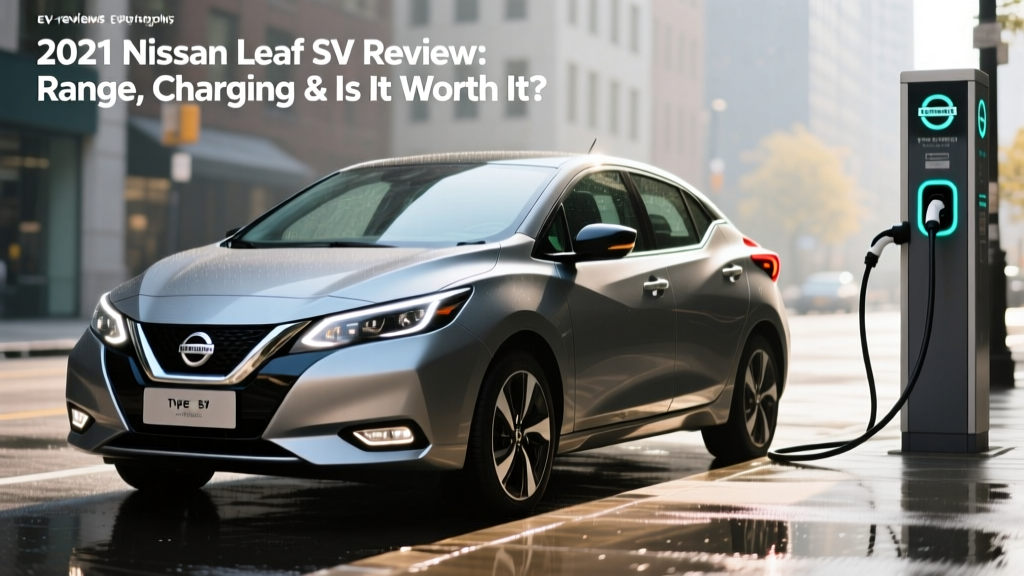
Quick Verdict: The 2021 Nissan Leaf SV at a Glance
The 2021 Nissan Leaf SV occupies a specific niche in the used EV market: an affordable, comfortable commuter hatchback with enough range for daily driving and moderate road trips, but held back by its CHAdeMO charging connector and passively cooled battery. If you're shopping the used EV market in 2026 and your commute is under 60 miles round-trip with reliable home charging, the Leaf SV remains a practical, well-equipped choice. If you need fast public charging for frequent highway travel, look to CCS/NACS-equipped competitors instead.
| Spec | 2021 Nissan Leaf SV |
|---|---|
| EPA Range | 149 miles |
| Battery (usable) | 40 kWh, NMC lithium-ion |
| Motor Output | 147 hp / 236 lb-ft torque |
| 0-60 mph | ~7.9 seconds |
| Drivetrain | FWD (front-wheel drive) |
| DC Fast Charge (peak) | ~46 kW (CHAdeMO) |
| 10-80% DC Charge | ~40-60 minutes |
| Level 2 Home Charge | 6.6 kW (~22 mi/hr) |
| Combined MPGe | 111 MPGe |
| Efficiency | 30 kWh/100 mi |
| Cargo (behind rear seats) | 23.6 cu ft |
| Cargo (seats folded) | 30.0 cu ft |
| Battery Warranty | 8 yr / 100,000 mi (capacity loss) |
| Original MSRP (SV) | $35,150 (before incentives) |
Range and Efficiency: What the EPA Number Doesn't Tell You
The 2021 Leaf SV pairs a 40 kWh usable battery pack (NMC chemistry) with a 110 kW electric motor driving the front wheels. The EPA rates the Leaf SV at 149 miles of combined range and 111 MPGe (30 kWh per 100 miles). That efficiency figure is competitive — it's in the same ballpark as a Chevrolet Bolt EV and better than many heavier crossover EVs.
EPA sticker: 149 miles. In practice, expect:
- City/suburban commuting (moderate climate): 140-155 miles — the Leaf excels in stop-and-go thanks to strong regenerative braking.
- Highway driving (70+ mph): 115-130 miles — the Leaf's aerodynamics and single-speed gearing hurt at sustained speed.
- Cold weather (below 32°F): 90-115 miles — the passively cooled battery and resistance heater (no heat pump on the SV trim) cause significant range loss. The Leaf SV Plus with its larger battery fares better here.
Plan for roughly 120 miles of usable range if your commute mixes highway and city driving in moderate conditions. If winters are harsh where you live, budget for 100 miles or less.
The Leaf SV does not include a heat pump — it uses a conventional PTC resistance heater for cabin warmth. This draws substantially more energy than a heat pump system in cold weather, compounding the range loss from the battery itself. Nissan's e-Pedal mode (aggressive regen enabling one-pedal driving) helps recover energy in city traffic, but it can't overcome the physics of a 40 kWh pack on a long highway run.
Charging: The CHAdeMO Problem in a CCS/NACS World
Charging is where the 2021 Leaf SV requires the most careful consideration from a 2026 buyer. The Leaf uses the CHAdeMO DC fast-charging connector — a standard that has been steadily losing ground in North America to CCS1 and, increasingly, the Tesla NACS connector.
| Charging Level | Connector | Power | Speed | Typical Use |
|---|---|---|---|---|
| Level 1 (120V) | J1772 | ~1.4 kW | ~5 mi/hr | Overnight trickle / emergency |
| Level 2 (240V) | J1772 | 6.6 kW | ~22 mi/hr | Home / workplace daily charging |
| DC Fast Charge | CHAdeMO | ~46 kW peak | ~90 mi/hr (peak) | Public fast charging / road trips |
Level 2 home charging is the Leaf SV's sweet spot. The onboard 6.6 kW charger fills the 40 kWh battery from empty to full in roughly 7 hours — easily enough for overnight replenishment. If you install a 240V/32A Level 2 home charger (typically $500-$1,200 for equipment plus $800-$2,500 for electrician installation), you'll wake up to a full battery every morning.
DC fast charging is the weak link. The Leaf SV peaks at approximately 46 kW on a CHAdeMO charger, which is slow by 2026 standards. A 10-80% charge takes roughly 40-60 minutes depending on battery temperature and starting state of charge. The Leaf's passively cooled battery means that after one fast-charge session, the battery warms up and subsequent sessions slow down further — a phenomenon called "rapidgate" that Nissan partially addressed in later models with firmware tweaks, but the physics remain.
The bigger structural issue: CHAdeMO infrastructure is shrinking. Electrify America, EVgo, and most new public networks have standardized on CCS1, and the industry is rapidly adopting NACS. As of 2026, finding a working CHAdeMO station on a road trip requires more planning than CCS or NACS alternatives. CHAdeMO adapters exist (to CCS or NACS), but they are expensive ($200-$400), bulky, and not all are certified for high-power use.
Performance and Driving Impressions
The Leaf SV's 147-horsepower AC synchronous motor produces 236 lb-ft of instant torque, delivering a 0-60 mph time of approximately 7.9 seconds. That's adequate for merging and passing, though it trails the Chevrolet Bolt EV (200 hp, ~6.5 seconds) and the Hyundai Kona Electric (201 hp, ~6.4 seconds).
Driving dynamics are comfortable rather than sporty. The ride quality is compliant, the steering is light and predictable, and cabin noise is well-managed at city speeds. Wind and tire noise become noticeable above 65 mph. The low center of gravity from the underfloor battery pack gives the Leaf confident cornering for a compact hatchback, though the eco-oriented tires prioritize efficiency over grip.
Nissan's ProPILOT Assist is standard on the SV trim — a Level 2 driver-assistance system combining adaptive cruise control with lane-centering. It works well on divided highways but requires hands-on-wheel supervision at all times. It is not a self-driving system. Forward collision warning, automatic emergency braking with pedestrian detection, blind-spot warning, and rear cross-traffic alert round out the Nissan Safety Shield 360 suite.
Interior, Cargo, and Technology
The 2021 Leaf SV interior is practical if dated. An 8-inch touchscreen infotainment system with Apple CarPlay, Android Auto, and navigation is standard. The SV adds a Bose 7-speaker audio system, heated front seats, a heated steering wheel, and a leather-wrapped shift knob over the base S trim. The digital instrument cluster provides clear readouts for range, energy flow, and charge status.
Passenger space is generous for a compact hatchback: 42.1 inches of front legroom and 33.5 inches in the rear. The rear seat fits two adults comfortably, three in a pinch. Cargo volume behind the rear seats is 23.6 cubic feet, expanding to 30.0 cubic feet with the 60/40 split rear seats folded. That's competitive with the Bolt EV (16.9 cu ft seats up) and significantly more practical for grocery runs and luggage.
Notable drawbacks: the cargo floor is somewhat high due to the battery beneath it, there is no front trunk (frunk), and the infotainment system, while functional, lacks the responsiveness and resolution of newer competitors. The CHAdeMO charge port is located on the vehicle's nose, which some owners find convenient and others find awkward depending on parking orientation at charging stations.
Pricing, Tax Credits, and Used Market Value
The 2021 Leaf SV originally carried an MSRP of $35,150 (including destination). The SV Plus, with its larger 62 kWh battery and 226-mile range, started at $43,900. On the used market in 2026, expect to find a 2021 Leaf SV with 30,000-50,000 miles priced between $14,000 and $19,000 depending on condition, mileage, and battery state of health.
Federal tax credit (used EV): Under the current IRS §25E used clean vehicle credit, you may qualify for up to $4,000 or 30% of the sale price (whichever is less) when purchasing from a dealer. Key requirements per IRS guidelines:
- Sale price must be $25,000 or less (most 2021 Leaf SVs qualify)
- Buyer AGI must not exceed $75,000 (single) / $112,500 (head of household) / $150,000 (joint)
- Vehicle must be purchased from a licensed dealer
- Vehicle must be at least 2 model years old (a 2021 model qualifies in 2026)
- Credit can be transferred to the dealer as a point-of-sale discount
This means a $17,000 Leaf SV could effectively cost $11,900 after the $4,000 credit (30% of $17,000 = $5,100, capped at $4,000). That is exceptional value for a well-equipped EV. Consult a tax professional to confirm your eligibility.
- Affordable used pricing, especially after §25E credit
- Comfortable ride and quiet cabin at city speeds
- Strong standard safety suite (ProPILOT Assist, Safety Shield 360)
- Generous cargo space for the segment (23.6 cu ft)
- Efficient in city driving (111 MPGe combined)
- Heated seats and steering wheel standard on SV
- CHAdeMO connector — shrinking public network
- Slow DC fast charging (~46 kW peak)
- Passive battery cooling — heat-related degradation and charge taper
- No heat pump — significant cold-weather range loss
- 149-mile range limits road-trip practicality
- Infotainment feels dated vs. 2026 competitors
Battery Health, Warranty, and Longevity
The 40 kWh NMC battery pack in the 2021 Leaf SV is passively cooled (no liquid thermal management). This was a deliberate cost-saving decision by Nissan, and it has real-world consequences: in hot climates, passive cooling accelerates battery degradation over time. Nissan's battery warranty covers capacity loss below 9 bars (out of 12) on the dashboard capacity gauge for 8 years or 100,000 miles.
For a 2026 buyer evaluating a used 2021 Leaf, checking the battery's state of health is critical. Use the Leaf Spy app with an OBD-II dongle to read the actual battery capacity and degradation percentage. A healthy 5-year-old Leaf should retain 85-92% of its original capacity. If the battery bars show 11 or 12 out of 12, degradation is within normal expectations. Below 10 bars warrants caution and potential negotiation leverage.
A full battery replacement, should it ever be needed, currently runs $6,500-$9,000 at a Nissan dealer — a significant expense relative to the vehicle's value. Most Leaf owners never need a replacement, but the risk is higher in hot climates (Arizona, Texas, Southern California) where passive cooling is least effective.
Who Should Buy the 2021 Nissan Leaf SV?
The 2021 Leaf SV is best suited for:
- Commuters with round-trip drives under 70 miles who can charge at home every night
- Second-car buyers who need an efficient runabout while keeping a gas or long-range vehicle for road trips
- Budget-conscious EV shoppers who want to minimize upfront cost and take advantage of the §25E used EV credit
- Mild-climate dwellers where extreme cold won't erode the already modest range
Look elsewhere if you need frequent highway road trips, live in a region with extreme heat or cold, or depend on public DC fast charging as your primary fueling method.
Frequently Asked Questions
What is the real-world range of the 2021 Nissan Leaf SV?
The EPA rates it at 149 miles combined. In real-world mixed driving, expect 120-140 miles in moderate weather, 115-130 on the highway, and as low as 90-115 in freezing temperatures. The lack of a heat pump significantly impacts cold-weather efficiency.
How fast does the 2021 Leaf SV charge?
On a Level 2 home charger (240V, 6.6 kW), a full charge takes about 7 hours, adding roughly 22 miles of range per hour. On a CHAdeMO DC fast charger, it peaks at approximately 46 kW, achieving a 10-80% charge in roughly 40-60 minutes. Charging speed tapers if the battery is warm from a previous session or from hot ambient temperatures.
Does the 2021 Nissan Leaf SV qualify for a federal tax credit?
As a new vehicle, the 2021 Leaf qualified for the full $7,500 §30D credit at the time of sale. For a used purchase in 2026, it may qualify for the §25E used clean vehicle credit — up to $4,000 or 30% of the sale price (whichever is less) — if the dealer sale price is $25,000 or less and your income falls within IRS limits. Verify current rules at irs.gov and consult a tax professional.
Is the 2021 Leaf SV worth buying vs. a Chevrolet Bolt EV or Hyundai Kona Electric?
The Bolt EV offers 259 miles of EPA range and CCS fast charging, making it more versatile for road trips — but it has less cargo space and a firmer ride. The Kona Electric delivers 258 miles and CCS charging with a more modern interior. If range and public charging access are priorities, both are stronger choices. If budget, comfort, and cargo space matter most for a commuter vehicle, the Leaf SV at $14,000-$19,000 (less with the §25E credit) is hard to beat on price alone.
Should I worry about the CHAdeMO connector in 2026?
Yes, if you plan to rely on public fast charging. CHAdeMO stations are becoming less common as networks standardize on CCS1 and NACS. If you charge at home 90%+ of the time and only occasionally need public charging, it's manageable with planning. If you take regular road trips, the shrinking CHAdeMO network is a genuine limitation. CHAdeMO-to-CCS adapters exist but add cost and bulk.
How do I check the battery health on a used 2021 Leaf?
Look at the battery capacity bars on the dashboard (12 bars is maximum, anything below 9 triggers the warranty). For a more precise reading, use the Leaf Spy Pro app with a compatible OBD-II adapter to read the actual state of health percentage. A reading above 85% on a 5-year-old Leaf is normal and healthy.