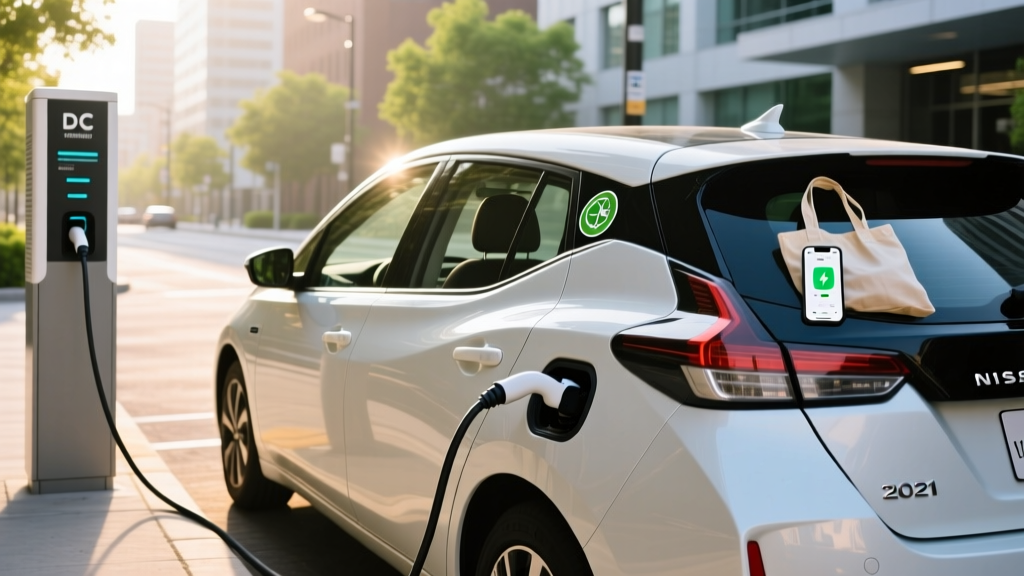
If you are shopping the used-EV market for an affordable daily commuter, the 2021 Nissan Leaf remains one of the most accessible entry points into electric ownership. With two battery options, a comfortable ride, and widely available inventory, it punches above its price in practicality. But the Leaf's aging CHAdeMO charging standard, passive battery thermal management, and modest fast-charge speeds mean it is not the right EV for every buyer. This guide gives you the exact numbers you need to decide whether a used 2021 Leaf fits your driving life in 2026.
2021 Nissan Leaf at a Glance: Core Specs
| Spec | Leaf S / SV (40 kWh) | Leaf SL Plus (62 kWh) |
|---|---|---|
| EPA Range | 149 miles | 226 miles |
| Battery (usable) | ~39 kWh, NMC | ~60 kWh, NMC |
| Motor Output | 147 hp / 236 lb-ft | 214 hp / 250 lb-ft |
| 0–60 mph | ~7.9 sec | ~6.8 sec |
| Drivetrain | FWD | FWD |
| EPA Efficiency | 111 MPGe (30 kWh/100 mi) | 104 MPGe (32 kWh/100 mi) |
| Max DC Fast Charge | ~50 kW (CHAdeMO) | ~100 kW (CHAdeMO) |
| Level 2 Charge Rate | 6.6 kW (~22 mi/hr) | 6.6 kW (~20 mi/hr) |
| Cargo Volume | 23.6 cu ft (rear seats up) | 23.6 cu ft (rear seats up) |
| Original Base MSRP | ~$32,620 | ~$44,820 |
Sources: fueleconomy.gov, Nissan USA archived spec sheets.
Real-World Range: What the EPA Sticker Doesn't Tell You
- Leaf S/SV (40 kWh): EPA 149 mi → expect ~120–135 mi highway, ~100–115 mi in freezing weather with cabin heat.
- Leaf SL Plus (62 kWh): EPA 226 mi → expect ~185–205 mi highway, ~155–175 mi in freezing weather with cabin heat.
The 2021 Leaf uses a passive air-cooled battery (no liquid thermal management). In sustained high temperatures or repeated fast-charge sessions, Nissan's battery management system throttles charge speed and may limit discharge power to protect cells — a phenomenon owners call "Rapidgate." Cold weather hits range harder here than on liquid-cooled rivals because the Leaf uses a resistive PTC heater rather than a heat pump.
For a 30-mile round-trip commute with home charging, the 40 kWh Leaf is perfectly adequate year-round in moderate climates. If your commute exceeds 60 miles one way or you face sub-freezing winters, the 62 kWh Plus is the safer pick. Per fueleconomy.gov, the combined efficiency of the Plus variant is 32 kWh per 100 miles — competitive with the Chevrolet Bolt EV but slightly behind the Hyundai Kona Electric's 28 kWh/100 mi.
Charging Speeds: CHAdeMO's Growing Problem
The 2021 Leaf charges through a CHAdeMO DC fast-charge port and a J1772 Level 2 port. This is the single biggest ownership consideration in 2026: the North American industry has standardized on NACS (Tesla's connector), and CHAdeMO infrastructure is shrinking relative to CCS and NACS networks.
| Charge Level | Leaf S/SV (40 kWh) | Leaf Plus (62 kWh) | Connector |
|---|---|---|---|
| Level 1 (120V, 12A) | ~1.4 kW / ~5 mi/hr | ~1.4 kW / ~4 mi/hr | J1772 |
| Level 2 (240V, 30A) | 6.6 kW / ~22 mi/hr | 6.6 kW / ~20 mi/hr | J1772 |
| DC Fast Charge | ~50 kW peak, 10–80% in ~60 min | ~100 kW peak, 10–80% in ~45 min | CHAdeMO |
The Plus variant's ~100 kW peak is respectable, but the Leaf's charge curve tapers aggressively above 80% State of Charge to protect its passively cooled cells. Plan for 45 minutes to reach 80% on a road trip — and do not expect to charge much beyond that without a long wait. On Electrify America or EVgo networks that still carry CHAdeMO connectors, you will find chargers, but availability is noticeably thinner than CCS or NACS. If your regular routes lack CHAdeMO-equipped stations, this is a dealbreaker.
Performance, Ride, and Daily Drivability
The standard Leaf's 147 hp and 236 lb-ft of instant torque make it peppy around town — 0–60 mph in roughly 7.9 seconds is adequate for merging and passing. The Plus model's 214 hp drops that to approximately 6.8 seconds, which feels genuinely quick in a compact hatch. Both variants are front-wheel drive with a single-speed reduction gear; there is no AWD option.
Ride quality is a Leaf strength. The suspension is tuned for comfort over sportiness, and the low center of gravity (battery pack under the floor) keeps body roll reasonable. Cabin noise is well-managed at city speeds, though wind and tire noise become noticeable above 70 mph. The e-Pedal feature enables one-pedal driving with aggressive regenerative braking — it takes a day to learn but dramatically reduces brake wear in stop-and-go traffic.
Interior, Cargo, and Tech Features
Inside, the 2021 Leaf shows its budget roots. The dash layout is functional but dated, with physical buttons for climate and an 8-inch touchscreen running NissanConnect. Apple CarPlay and Android Auto are standard on all trims (wired, not wireless). The SV and SL trims add navigation and a Bose audio upgrade.
ProPILOT Assist (available on SV and standard on SL/SL Plus) is Nissan's SAE Level 2 driver-assistance system combining adaptive cruise control with lane centering. It works well on marked highways but requires hands on the wheel at all times. This is not autonomous driving — you are the driver.
Cargo space is 23.6 cubic feet behind the rear seats and 30.0 cubic feet with the 60/40 split rear seats folded. Rear legroom is 33.5 inches — adequate for adults on shorter trips. There is no front trunk (frunk); the space under the hood houses conventional drivetrain components. Notably, the Leaf's battery pack intrudes slightly into the cargo floor, creating a small step when seats are folded.
Battery Health, Degradation, and Warranty
The 2021 Leaf uses NMC (nickel manganese cobalt) lithium-ion cells in a laminated pouch format. Nissan's battery warranty covers 8 years or 100,000 miles against capacity loss below 9 bars out of 12 on the dashboard capacity gauge (roughly 70–75% State of Health). For a 2021 model, that factory warranty extends through 2029.
Real-world degradation data from Leaf owner communities shows that passively cooled batteries in hot climates (Arizona, Texas, Southern California) lose capacity faster than liquid-cooled competitors. A 2021 Leaf in Phoenix might show 85–90% SoH after five years, while one in Oregon or Minnesota might retain 92–95%. If you are buying used, ask the seller to photograph the dashboard capacity bar display — each bar represents roughly 8–9% of original capacity.
Out-of-warranty battery replacement for a Leaf currently runs $6,500–$9,000 depending on whether you source a new or refurbished pack. Third-party refurbishers are an emerging option, but OEM replacement through a Nissan dealer is the most reliable path.
Pricing and the Used-EV Tax Credit in 2026
| Trim | Original MSRP | Typical 2026 Used Price | Max Used-EV Credit (§25E) |
|---|---|---|---|
| S (40 kWh) | $32,620 | $11,000–$14,000 | Up to $4,000 |
| SV (40 kWh) | $35,220 | $13,000–$16,000 | Up to $4,000 |
| SL Plus (62 kWh) | $44,820 | $17,000–$21,000 | Up to $4,000 |
Because the 2021 Leaf is now a used vehicle, the relevant federal incentive is the §25E Previously-Owned Clean Vehicle Credit — not the §30D new-vehicle credit. Per IRS guidelines, this credit equals 30% of the sale price, up to $4,000, and applies to vehicles sold for $25,000 or less through a licensed dealer. Buyer income caps apply: modified AGI must not exceed $75,000 (single), $112,500 (head of household), or $150,000 (joint). The vehicle must be at least two model years old (which a 2021 model satisfies in 2026) and you must not have claimed the used-EV credit in the prior three years. Always confirm eligibility with a tax professional before purchase.
2021 Nissan Leaf vs Key Competitors
On the used-EV market in 2026, the Leaf competes against the Chevrolet Bolt EV/EUV, Hyundai Kona Electric, and Kia Niro EV — all from similar model years. Here is how they stack up:
- Chevrolet Bolt EV (2021): 259 mi EPA range, 66 kWh battery, CCS fast charging (55 kW), liquid-cooled battery. Superior range and charging standard, but firmer ride and less cargo space.
- Hyundai Kona Electric (2021): 258 mi EPA range, 64 kWh battery, CCS (75 kW), liquid cooling. More efficient, better charging, but smaller interior.
- Kia Niro EV (2021): 239 mi EPA range, 64 kWh, CCS (77 kW). Practical crossover shape, strong value.
The Leaf's advantages are its lower entry price, comfortable ride, and strong ProPILOT Assist. Its disadvantages are the CHAdeMO connector (a shrinking network), passive battery cooling (faster degradation in heat), and lower range on the standard battery.
Who Should Buy the 2021 Nissan Leaf?
- Your daily driving is under 80 miles round trip and you can charge at home overnight.
- You live in a moderate climate where extreme heat or cold is rare.
- You want the lowest-cost entry into EV ownership with a proven, comfortable commuter.
- You have access to CHAdeMO chargers on any routes where you'd need DC fast charging.
- You take frequent road trips and need reliable, fast DC charging on the CCS or NACS networks.
- You live in a consistently hot climate and are concerned about long-term battery degradation.
- You need more than 226 miles of range or AWD capability.
Pros, Cons, and Final Verdict
- Affordable used pricing — as low as $11,000 before credits
- Comfortable, quiet ride quality
- e-Pedal one-pedal driving reduces brake wear
- ProPILOT Assist is a capable Level 2 highway aid
- Eligible for up to $4,000 used-EV federal credit
- Spacious hatchback cargo area (23.6 cu ft)
- CHAdeMO connector — shrinking public network
- Passive battery cooling — heat degradation risk
- Standard 40 kWh model limited to 149 mi EPA range
- DC fast charging is slow vs modern rivals (50–100 kW peak)
- No heat pump — cold-weather range loss is significant
- Dated interior infotainment and materials
The 2021 Nissan Leaf is a sensible, budget-friendly used EV for the right buyer — specifically, a home-charging commuter in a temperate climate who rarely needs DC fast charging. The CHAdeMO connector is a genuine long-term concern as the industry consolidates around NACS, and the passive battery cooling limits the Leaf's durability in hot climates. But at $11,000–$21,000 with a potential $4,000 federal credit, it delivers real electric miles for less than almost anything else on the market.
Frequently Asked Questions
What is the real-world range of the 2021 Nissan Leaf?
The 40 kWh Leaf S/SV is EPA-rated at 149 miles; expect 120–135 miles in real-world highway driving and 100–115 miles in freezing weather. The 62 kWh Plus is EPA-rated at 226 miles; expect 185–205 miles highway and 155–175 miles in cold conditions. Passive battery cooling and the lack of a heat pump make the Leaf more sensitive to temperature extremes than liquid-cooled rivals.
How fast does the 2021 Leaf charge at home and on DC fast chargers?
On a Level 2 home charger (240V, 6.6 kW), the Leaf adds roughly 20–22 miles of range per hour — a full overnight charge from empty takes 6–9 hours depending on battery size. DC fast charging peaks at ~50 kW (standard) or ~100 kW (Plus) via CHAdeMO, reaching 10–80% in approximately 45–60 minutes. Charge speed tapers sharply above 80% SoC.
Does the 2021 Nissan Leaf qualify for a federal tax credit?
As a used vehicle in 2026, the 2021 Leaf may qualify for the §25E Previously-Owned Clean Vehicle Credit: up to $4,000 (30% of sale price) when purchased through a licensed dealer for $25,000 or less. Buyer income caps apply ($75K single / $150K joint). Confirm eligibility with a tax professional and see IRS §25E guidelines.
Is the 2021 Leaf worth buying vs a used Chevy Bolt or Kona Electric?
The Leaf is typically cheaper than a comparable Bolt EV or Kona Electric on the used market, and it offers a more comfortable ride. However, the Bolt and Kona both use the CCS charging standard (wider network), have liquid-cooled batteries (better longevity in heat), and offer substantially more EPA range. If budget is the top priority and your commute is short, the Leaf wins. If you need range, fast charging, or hot-climate durability, the Bolt or Kona is the stronger choice.
What are the biggest drawbacks of the 2021 Nissan Leaf?
The three main concerns are: (1) the CHAdeMO connector, which is losing ground to CCS and NACS on public networks; (2) passive battery cooling, which accelerates degradation in hot climates and limits repeated fast-charge performance; and (3) the lack of a heat pump, which causes significant range loss in cold weather. The standard 40 kWh model's 149-mile EPA range is also limiting for anyone beyond short commutes.
How long will the 2021 Leaf battery last?
Nissan warrants the battery for 8 years / 100,000 miles against dropping below 9 of 12 capacity bars (~70–75% SoH). In moderate climates, Leaf batteries commonly retain 85–95% SoH at 5–7 years. In hot climates, degradation can be faster. Out-of-warranty replacement costs $6,500–$9,000. Always check the dashboard capacity bars before purchasing a used Leaf.