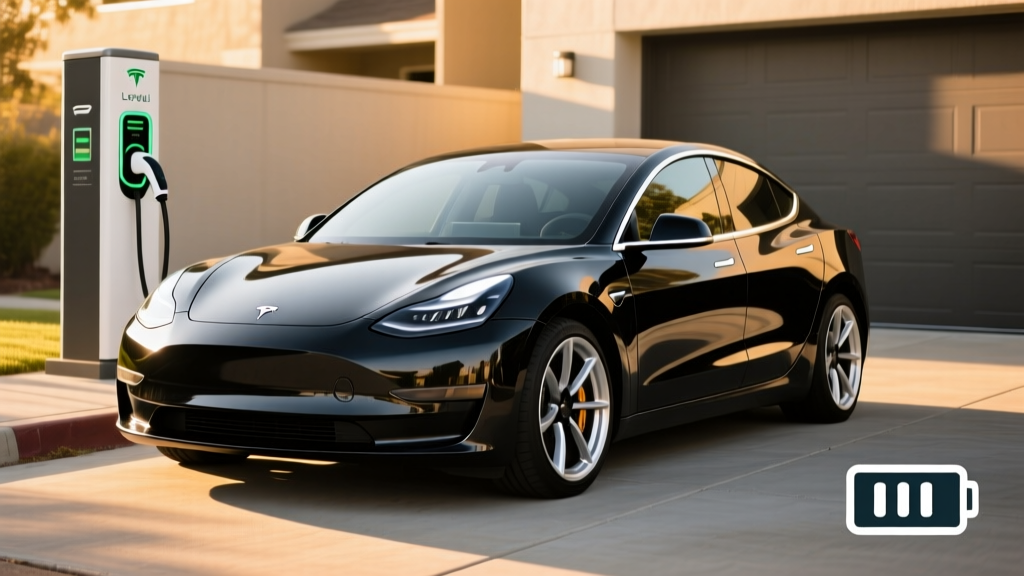
The 2021 Tesla Model 3 Performance remains one of the quickest sedans on the road — new or used — and in 2026 it sits in a sweet spot on the pre-owned market where depreciation has softened the blow but the hardware still punches well above its weight. If you've been searching for 2021 Model 3 Performance 0-60 data, ownership costs, and whether this five-year-old EV still holds up against newer rivals, this deep-dive profile covers the numbers that matter: real-world range, charging curves, battery health expectations, and the used-EV tax credit rules that could shave $4,000 off the price.
2021 Tesla Model 3 Performance: Core Specifications
| Specification | Value |
|---|---|
| EPA Range | 315 miles |
| Battery (Usable) | ~75 kWh, NMC (Nickel Manganese Cobalt) |
| Drivetrain | Dual-Motor AWD |
| Horsepower | ~456 hp (combined) |
| 0-60 mph (Tesla claim) | 3.1 seconds |
| 0-60 mph (independent tests avg.) | 3.2–3.4 seconds |
| Top Speed | 162 mph |
| MPGe (Combined) | 113 MPGe |
| Efficiency | 30 kWh/100 mi |
| Max DC Fast Charge | 250 kW (V3 Supercharger) |
| 10–80% DC Charge Time | ~27 minutes |
| Level 2 Home Charge Rate | 11.5 kW (~44 mi/hr) |
| Cargo Volume | 15 cu ft trunk + 3.1 cu ft frunk |
| Rear Legroom | 35.2 inches |
| Battery Warranty (Original) | 8 years / 120,000 miles (70% retention) |
| Original MSRP | $56,990 (before incentives) |
| Typical 2026 Used Price | $27,000–$34,000 |
0-60 mph and Performance: Does It Still Deliver?
Tesla officially rated the 2021 Model 3 Performance at 3.1 seconds to 60 mph with rollout subtracted. Independent testing by outlets like Car and Driver and Motor Trend consistently returned times in the 3.2 to 3.4 second range under real-world conditions — still blisteringly quick and enough to outrun nearly every internal-combustion sedan at any price point, let alone a five-year-old used EV priced in the low $30s.
The dual-motor all-wheel-drive powertrain delivers instant torque with zero lag, and Tesla's traction control software manages grip exceptionally well even on damp surfaces. Track Mode, which adjusts torque distribution, regen, and cooling for circuit use, was included on the 2021 Performance trim — a genuine differentiator versus competitors like the Polestar 2 or BMW i4 M50.
One ownership reality to note: battery State of Charge (SoC) directly affects acceleration. Below roughly 30% SoC, expect 0-60 times to stretch by 0.3–0.5 seconds. For peak performance, keep the battery above 50%.
Real-World Range vs. EPA 315 Miles
EPA Sticker: 315 miles
Real-World Highway (70–75 mph, moderate temps): ~255–275 miles
Real-World City/Mixed Driving: ~280–300 miles
Cold Weather (below 30°F, highway): ~210–240 miles
The 2021 Model 3 Performance uses an NMC (nickel manganese cobalt) battery pack with approximately 75 kWh of usable capacity. The EPA's 315-mile figure was measured under the agency's multi-cycle test protocol, which includes generous low-speed and city-driving segments that favor EVs with strong regenerative braking.
In practice, highway driving at sustained 70–75 mph speeds consumes energy faster — expect roughly 255 to 275 miles on a full charge in fair weather. The Model 3's efficiency is still class-leading at 30 kWh per 100 miles (per fueleconomy.gov), but physics is physics: higher speeds mean more aerodynamic drag.
Cold weather compounds the loss. NMC chemistry experiences increased internal resistance in freezing temperatures, and cabin heating draws additional power even with the Model 3's heat pump (standard on 2021 models). Plan for 210 to 240 miles of usable range on a cold winter highway trip. Preconditioning the battery while plugged in mitigates some of this loss and is essential for maintaining fast-charge speeds in winter.
Charging Speed: DC Fast Charge and Home Level 2
The 2021 Model 3 Performance supports Tesla's V3 Supercharger architecture at a peak rate of 250 kW. However, peak rate is not sustained rate — the charging curve tapers significantly as the battery fills.
| Charging Level | Max Power | Speed / Time |
|---|---|---|
| Level 1 (120V household) | ~1.4 kW | ~5 miles per hour |
| Level 2 (240V, 48A home charger) | 11.5 kW | ~44 miles per hour |
| DC Fast (V3 Supercharger) | 250 kW peak | 10–80% in ~27 min |
| DC Fast (CCS adapter, Electrify America) | ~150–175 kW typical | 10–80% in ~35–40 min |
At a V3 Supercharger, the Model 3 Performance pulls close to 250 kW between roughly 10% and 30% SoC, then progressively tapers. By 60% SoC, the rate drops to around 100–120 kW, and above 80% it falls below 50 kW. This is why Tesla and most EV experts recommend charging to 80% on road trips — the last 20% takes nearly as long as the first 60%.
For home charging, a Level 2 wall connector on a 60-amp circuit (48 amps continuous) delivers 11.5 kW, replenishing the full battery in roughly 7 hours. Most owners who charge overnight at home never need public charging for daily driving. If your home electrical panel can support a 60-amp dedicated circuit, installation typically runs $500–$1,500 beyond the $400–$500 cost of the Tesla Wall Connector itself.
CCS adapter note: The 2021 Model 3 shipped with Tesla's proprietary connector. Tesla sells a CCS adapter (~$175) that unlocks Electrify America and other CCS networks, though charge speeds via adapter may be slightly lower than native Supercharger rates. By 2026, the North American Charging Standard (NACS) has become the dominant connector, and Tesla's Supercharger network remains the most reliable DC fast-charging infrastructure in the U.S.
Interior, Tech, and Driver Assistance
The 2021 Model 3 interior follows Tesla's minimalist philosophy: a single 15-inch touchscreen handles infotainment, climate, navigation, and vehicle settings. There is no traditional instrument cluster — speed and range data appear on the left side of the main display. Build quality on the 2021 model year improved noticeably over the 2018–2019 Fremont-built cars, though panel gaps and trim alignment can still vary unit to unit.
Notable tech features:
- Over-the-air (OTA) software updates that have added features post-purchase, including UI refinements and efficiency tweaks
- Tesla Autopilot (standard): adaptive cruise control, lane-centering, automatic emergency braking — this is an SAE Level 2 driver-assist system requiring active driver supervision at all times
- Full Self-Driving (FSD) capability was an optional $10,000 add-on (or $199/month subscription); even with FSD, the system remains SAE Level 2 — not autonomous
- Sentry Mode dashcam recording, Dog Mode climate control, and phone-as-key entry
- Heat pump HVAC system (standard on 2021 models) — significantly more efficient in cold weather than resistive heating
Drawbacks to know:
- No physical buttons for climate or audio — everything requires touchscreen interaction
- Rear-seat headroom is tight for passengers over 6 feet (37.8 inches rear headroom)
- Turn-signal stalks were present on the 2021 model (removed on the 2024 Highland refresh), which many drivers prefer
- Sound insulation is adequate but not luxury-grade — road noise is noticeable above 65 mph on coarse pavement
Pricing, Used Market, and Federal Tax Credit (2026)
The 2021 Model 3 Performance originally carried an MSRP of $56,990 before any incentives. As of early 2026, used examples typically list between $27,000 and $34,000 depending on mileage, condition, and battery health.
| Scenario | Estimated Cost |
|---|---|
| Typical used price (good condition, ~45k mi) | $30,000 |
| Federal Used EV Credit (§25E, if eligible) | −$4,000 |
| Net cost after credit | ~$26,000 |
| Home Level 2 charger + installation | +$1,000–$2,000 |
| Effective drive-away cost | ~$27,000–$28,000 |
Federal tax credit rules for used EVs (IRS §25E): The Inflation Reduction Act created a credit for previously owned clean vehicles worth 30% of the sale price, up to $4,000. Key eligibility requirements per the IRS:
- The vehicle must be purchased from a licensed dealer (private-party sales do not qualify)
- Sale price must be $25,000 or less — this is a hard cap and many 2021 Model 3 Performance listings exceed it
- Buyer income caps: $75,000 single / $112,500 head of household / $150,000 joint (modified AGI)
- The vehicle must be at least two model years old (2021 qualifies in 2026)
- The credit can be transferred to the dealer at point of sale as an immediate price reduction
Practical reality: Because the §25E credit requires a sale price at or below $25,000, you'll need to negotiate aggressively or find a higher-mileage example to qualify. Some dealers may price just under the cap to facilitate the credit. If you find a 2021 Model 3 Performance at $24,900 from a dealer, the full $4,000 credit applies, bringing your net to roughly $20,900 — exceptional value for a 3.2-second, 315-mile EV.
Note: the new-vehicle §30D credit (up to $7,500) does not apply to used purchases. Consult a tax professional to confirm your personal eligibility.
Battery Health, Degradation, and Warranty Remaining
Tesla warranties the Model 3 Performance battery and drive units for 8 years or 120,000 miles, whichever comes first, with a minimum 70% capacity retention guarantee. For a 2021 model, that factory warranty extends through 2029 or until the odometer hits 120,000 miles — meaning most 2026 purchases still carry meaningful coverage.
NMC battery degradation data from Tesla's fleet and third-party trackers like owner-reported datasets shows typical capacity loss of approximately:
- Year 1–2: 3–5% loss (initial settling)
- Year 3–5: ~1–2% per year (gradual linear decline)
- Expected SoH at 5 years / 60,000 miles: ~90–93% of original capacity
A 2021 Model 3 Performance with 90% State of Health would deliver roughly 283 EPA-adjusted miles when new-equivalent — still highly competitive. To maximize longevity, avoid routinely charging to 100% for daily use (Tesla recommends 80–90% for NMC batteries) and minimize frequent DC fast-charging sessions when Level 2 is available.
Out-of-warranty battery replacement for the Model 3 currently ranges from $12,000 to $16,000 including labor at Tesla service centers, though third-party repair shops are increasingly offering module-level repairs for $3,000–$6,000.
2021 Model 3 Performance vs. Key Competitors
How does a used 2021 Model 3 Performance stack up against other sport EVs available in the same price range in 2026?
| Metric | 2021 Tesla Model 3 Perf. | 2022 Polestar 2 LRDM | 2022 BMW i4 M50 | 2022 Hyundai Ioniq 5 AWD |
|---|---|---|---|---|
| Used Price (2026 est.) | $27k–$34k | $25k–$31k | $38k–$45k | $28k–$34k |
| EPA Range | 315 mi | 249 mi | 227 mi | 256 mi |
| 0-60 mph | 3.2 sec | 4.5 sec | 3.7 sec | 5.0 sec |
| Max DC Charge | 250 kW | 150 kW | 200 kW | 235 kW |
| Charging Network | Supercharger (NACS) | CCS (limited) | CCS | CCS / NACS adapter |
| Efficiency (kWh/100mi) | 30 | 35 | 34 | 32 |
The Model 3 Performance wins decisively on range, acceleration, charging speed, and charging-network access. The Polestar 2 offers a more conventional interior and physical controls but gives up 66 miles of range and over a second to 60. The BMW i4 M50 is a more refined luxury experience but commands a significant price premium and falls short on range. The Ioniq 5 is a compelling all-rounder with excellent 800V charging architecture but can't match the Tesla's performance figures.
Choose the 2021 Model 3 Performance if: You prioritize acceleration, range, and access to the Supercharger network — and you're comfortable with a touchscreen-centric interface and minimalist cabin.
Look elsewhere if: You need generous rear-seat headroom, prefer physical controls, want a traditional luxury interior (consider BMW i4), or need a hatchback cargo opening (consider Ioniq 5 or Polestar 2).
Pros and Cons at a Glance
Pros
- 3.2-second 0-60 mph still elite in 2026
- 315-mile EPA range leads the used-EV segment
- 250 kW V3 Supercharger access — best-in-class road-trip charging
- OTA updates continue to add features and refinements
- Factory battery warranty valid through 2029
- Heat pump standard for cold-weather efficiency
- Potential $4,000 used-EV tax credit if priced ≤$25k
Cons
- Touchscreen-only controls frustrate some drivers
- Rear headroom tight for tall passengers
- Ride quality firm — especially with 20" Überturbine wheels
- Insurance costs above segment average (~$1,800–$2,400/yr)
- Used §25E credit requires ≤$25,000 sale price — hard to find on this trim
- No Apple CarPlay / Android Auto (Tesla-native infotainment only)
Frequently Asked Questions
What is the real 0-60 time of the 2021 Tesla Model 3 Performance?
Tesla claims 3.1 seconds with rollout subtracted. Independent tests typically measure 3.2–3.4 seconds under real-world conditions. Performance degrades slightly at low battery SoC (below 30%).
What is the real-world range of the 2021 Model 3 Performance?
The EPA rates it at 315 miles. Expect 255–275 miles on the highway in fair weather, 280–300 miles in mixed city driving, and 210–240 miles in cold-weather highway use. Five-year-old battery degradation may reduce these figures by 7–10% depending on the specific vehicle's State of Health.
How fast does the 2021 Model 3 Performance charge?
At a Tesla V3 Supercharger, it peaks at 250 kW and charges from 10–80% in approximately 27 minutes. On a home Level 2 charger (11.5 kW), a full charge takes about 7 hours, adding roughly 44 miles of range per hour.
Does a used 2021 Model 3 Performance qualify for the federal EV tax credit?
It may qualify for the IRS §25E used clean vehicle credit (up to $4,000), but only if the dealer sale price is $25,000 or less and the buyer meets income caps ($75k single / $150k joint). Many 2021 Performance examples list above this threshold, so negotiation is key.
Is the 2021 Model 3 Performance worth buying in 2026 vs. competitors?
For performance-per-dollar, yes — no used EV under $35,000 matches its combination of 3.2-second acceleration, 315-mile range, and 250 kW Supercharger access. If you need more rear-seat space, physical controls, or a hatchback, the Polestar 2 or Ioniq 5 are viable alternatives at the cost of range and speed.
How long will the battery last on a 2021 Model 3 Performance?
Tesla's NMC packs typically retain 90–93% capacity at five years / 60,000 miles. The factory battery warranty (8 years / 120,000 miles, 70% minimum retention) remains active through 2029. Out-of-warranty replacement runs $12,000–$16,000 at Tesla, with third-party options emerging at lower cost.
Is Autopilot on the 2021 Model 3 self-driving?
No. Tesla Autopilot and the optional Full Self-Driving (FSD) capability are SAE Level 2 driver-assist systems. The driver must remain fully engaged, hands on or near the wheel, and eyes on the road at all times. These systems assist with steering, acceleration, and braking but do not make the vehicle autonomous.