Quick Verdict: The 2021 Audi e-tron Sportback in 2026
The 2021 Audi e-tron Sportback occupies a specific niche in the used luxury EV market: it's a refined, beautifully built electric crossover that prioritizes comfort and build quality over range-per-dollar efficiency. With 218 miles of EPA-estimated range and a 95 kWh (86.5 kWh usable) NMC battery pack, it trades headline-grabbing numbers for a driving experience that feels unmistakably Audi. In 2026, with Q8 e-tron production having ended and the used-EV market maturing, the original e-tron Sportback presents an interesting value proposition for buyers who want premium materials and DC fast-charging capability at a depreciated price.
| Specification | 2021 Audi e-tron Sportback |
|---|---|
| EPA Range | 218 miles (Premium Plus), 225 miles (Prestige w/ 21" wheels varies) |
| Battery Capacity | 95 kWh gross / 86.5 kWh usable (NMC lithium-ion) |
| Max DC Fast Charge | 150 kW peak |
| 10–80% DC Charge Time | ~30 minutes |
| Level 2 Home Charging | 11 kW (onboard charger) |
| 0–60 mph | 5.5 seconds (Boost mode) |
| Horsepower | 355 hp standard / 402 hp Boost mode |
| Drivetrain | quattro AWD (dual-motor) |
| MPGe (Combined) | 76 MPGe |
| Efficiency | 44 kWh/100 mi |
| Cargo Volume | 27.3 cu ft (rear seats up) / 54.8 cu ft (folded) |
| Base MSRP (2021) | $79,095 (Premium Plus) / $86,795 (Prestige) |
| Battery Warranty | 8 years / 100,000 miles |
Range and Efficiency: Real-World Expectations
The EPA rates the 2021 e-tron Sportback at 218 miles on a full charge for the Premium Plus trim equipped with standard 20-inch wheels. The Prestige trim and optional 21-inch wheel packages can alter that figure slightly, with some configurations rated at 225 miles. But the EPA sticker is only a starting point for real-world planning.
EPA Estimated: 218 miles
Real-World Expectation: Plan for approximately 185–205 miles in mixed highway driving at 70–75 mph. In cold weather (below 32°F), expect a 15–25% reduction, dropping usable range to roughly 160–185 miles. City driving with regenerative braking recovers more energy and can approach or slightly exceed the EPA figure in mild conditions.
The e-tron Sportback's 44 kWh/100 mi efficiency rating (76 MPGe combined, per fueleconomy.gov) reflects its 5,700-pound curb weight and luxury-car insulation. Compared to a 2021 Tesla Model X Long Range (101 MPGe) or a Ford Mustang Mach-E Extended Range (101 MPGe), the Audi is notably less efficient. That inefficiency is the trade-off for the whisper-quiet cabin isolation and ride quality Audi engineered into the platform.
Audi uses a relatively large buffer (roughly 8.5 kWh locked above and below the usable window) to protect long-term battery health. This conservative approach helps explain the robust degradation data emerging from high-mileage e-tron owners, but it also means you're carrying battery weight you can't access.
Charging Speed: DC Fast and Home Level 2
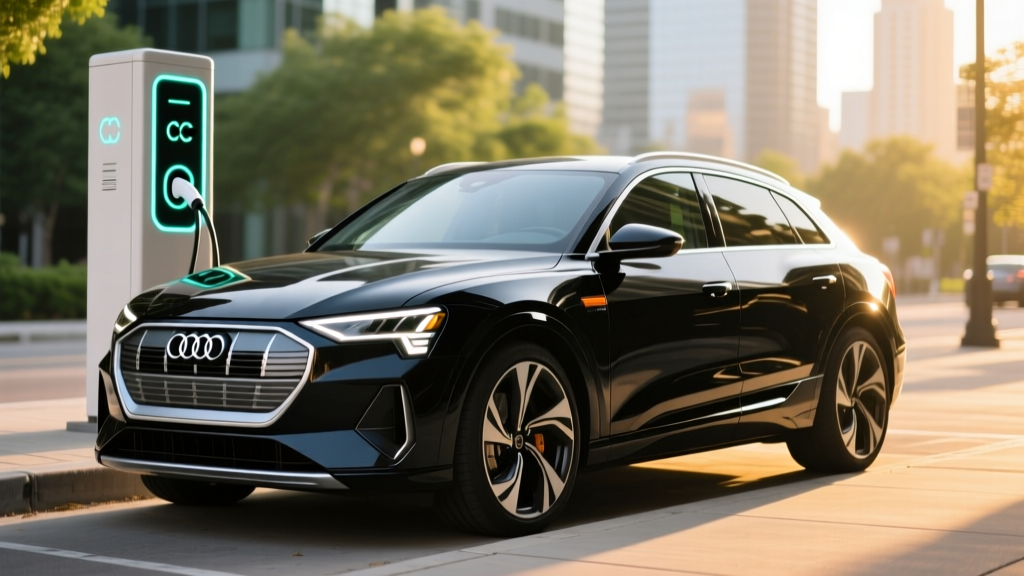
The 2021 e-tron Sportback's charging performance was one of its strongest selling points at launch and remains competitive in 2026. Audi equipped the vehicle with a 150 kW peak DC fast-charging capability via the CCS1 connector (the standard for non-Tesla EVs in North America at the time).
| Charging Level | Power / Rate | Time / Miles Added |
|---|---|---|
| Level 1 (120V household) | ~1.3 kW | ~3–4 miles per hour |
| Level 2 (240V, 48A home) | 11 kW (onboard max) | ~22 miles per hour; full charge ~9 hrs |
| DC Fast Charge (CCS1) | 150 kW peak | 10–80% in ~30 min; ~54 miles in 10 min |
What sets the e-tron apart from many contemporaries is its charge curve. Where competitors spike to peak kW then rapidly taper, the e-tron sustains close to 150 kW well past 70% state of charge before tapering. On a 350 kW Electrify America station, you'll see the full 150 kW from roughly 5% to 70% SoC, then a gradual ramp-down. This means real-world charging sessions are predictably quick: 10–80% in approximately 30 minutes under optimal battery temperature conditions.
The 11 kW onboard Level 2 charger is a strong point for home charging. A 48-amp Level 2 wallbox (such as a ChargePoint Home Flex or Wallbox Pulsar Plus) will replenish the battery at roughly 22 miles of range per hour, meaning an overnight charge from 20% to full takes about 8–9 hours. The vehicle supports J1772 for Level 2 AC charging and includes a CCS1 inlet for DC. For Tesla Supercharger access, you'll need the J1772-to-NACS adapter (not included, but widely available from third-party suppliers like Lectron or Tesla's own adapter).
Performance and Drivetrain
The dual-motor quattro all-wheel-drive system produces 355 horsepower in standard driving and 402 horsepower in Boost mode (activated via a second detent in the accelerator pedal or Sport driving mode). The 0–60 mph time of 5.5 seconds in Boost mode won't embarrass a Porsche Taycan, but it's not trying to. The e-tron Sportback's acceleration character is linear, composed, and effortless rather than violent.
Adaptive air suspension is standard on all trims, providing a ride quality that absorbs road imperfections with genuine sophistication. The Sportback's sloping roofline doesn't compromise the driving dynamics meaningfully — it's a comfort-oriented GT, not a track car. Towing capacity is rated at 4,000 pounds with the factory tow package, making it viable for light trailer or small boat duty.
Regenerative braking operates through steering-wheel paddles offering three levels of deceleration, plus an automatic mode that uses radar to modulate regen based on traffic ahead. Audi chose not to implement true one-pedal driving (full stop from regen alone), which some EV buyers expect but many luxury buyers actually prefer — the brake pedal feel remains consistent and natural.
Interior, Tech, and Cargo Practicality
The 2021 e-tron Sportback's cabin is a masterclass in Audi material quality. Standard equipment on the Premium Plus trim includes Valcona leather, a 12.3-inch Virtual Cockit digital instrument cluster, and a dual-touchscreen MMI infotainment system (10.1-inch upper, 8.6-inch lower). Wireless Apple CarPlay and Android Auto are standard. The Prestige trim adds a head-up display, Bang & Olusen 3D audio (16 speakers, 705 watts), and power soft-close doors.
The Sportback's coupe-like roofline reduces rear headroom compared to the standard e-tron SUV — rear passengers get 37.2 inches of headroom versus 38.6 in the SUV variant. Legroom remains generous at 39.1 inches front and 37.3 inches rear. Cargo capacity is 27.3 cubic feet behind the rear seats and 54.8 cubic feet with the 40/20/40 split rear seats folded. That's competitive with a BMW X6 but noticeably less than the standard e-tron SUV's 28.5/57.2 cu ft or a Tesla Model Y's 30.2/76.2 cu ft.
Driver assistance features include Audi pre sense basic and front (automatic emergency braking with pedestrian detection), lane departure warning, and adaptive cruise assist with stop-and-go. Note that Audi's adaptive cruise assist is an SAE Level 2 system — it requires continuous driver supervision and does not provide autonomous steering or hands-free operation. It's a competent highway companion, but it is not "self-driving."
Pricing, Used Market Value, and Tax Credits
When new, the 2021 e-tron Sportback started at $79,095 (Premium Plus) and $86,795 (Prestige), before a $1,095 destination charge. Options like the Towing Package ($750), 21-inch wheels ($1,200), and Night Vision Assistant ($2,500) pushed well-equipped examples past $90,000.
In the 2026 used-EV market, expect to find 2021 e-tron Sportback models priced between $32,000 and $45,000 depending on mileage, condition, and trim. Depreciation has been steep — a benefit for second owners, a sting for original buyers.
| Scenario | Estimated Cost |
|---|---|
| Used 2021 e-tron Sportback (avg. market) | $35,000–$42,000 |
| Federal Used EV Tax Credit (§25E) | Up to $4,000 (30% of sale price, max $4,000) |
| Price After Federal Credit | ~$31,000–$38,000 |
Tax credit details: The original §30D new-vehicle credit no longer applies to a 2021 model. However, the IRS §25E Used Clean Vehicle Credit offers up to $4,000 (30% of the sale price, capped at $4,000) for eligible used EV purchases from a licensed dealer. Key eligibility requirements for §25E:
- Vehicle must be at least two model years old (2021 qualifies in 2026)
- Sale price must be $25,000 or less to receive the full $4,000 (30% of $25k = $7,500, but capped at $4,000; vehicles above $25k receive 30% up to $4,000)
- Buyer income limits: $75,000 single / $112,500 head of household / $150,000 married filing jointly (modified AGI)
- Must purchase from a licensed dealer (private-party sales do not qualify)
- Credit is non-refundable — it can only offset tax liability (point-of-sale transfer available at participating dealers)
Many 2021 e-tron Sportback listings hover right around the $25,000 threshold. Buyers should confirm the final sale price with the dealer and verify personal income eligibility with a tax professional before counting on the full $4,000.
Battery Health, Warranty, and Longevity
Audi equips the 2021 e-tron Sportback with an NMC (nickel manganese cobalt) lithium-ion battery pack. The battery warranty covers 8 years or 100,000 miles against defects and capacity loss below 70% of original capacity — whichever comes first. Since 2021 models are now five years old in 2026, approximately three years or ~40,000+ miles of factory battery coverage typically remain, depending on the vehicle's in-service date and odometer.
Real-world degradation data from high-mileage e-tron owners (tracked on platforms like Geotab and Recurrent) suggests the e-tron's conservative buffer strategy pays dividends. Most 2021 e-trons with 60,000–80,000 miles show 90–94% state of health (SoH), well above the 70% warranty threshold. Audi's thermal management system — liquid cooling and heating — keeps the battery in its optimal temperature range, which is critical for longevity.
If a battery replacement were needed out of warranty, expect a cost between $15,000 and $22,000 at an Audi dealer, based on current parts and labor pricing. However, given the degradation data, this is a low-probability scenario for most buyers.
Pros and Cons
Pros
- Exceptional cabin quietness and ride quality — among the best in the luxury EV segment
- Sustained DC fast-charging curve (150 kW held to ~70% SoC) makes road trips practical
- Standard adaptive air suspension across all trims
- Strong build quality and premium materials throughout
- 4,000-lb towing capacity (with tow package)
- Steep depreciation = strong used value in 2026
Cons
- 218-mile EPA range trails competitors (Model X: 360 mi; Mach-E: 305 mi)
- Low efficiency (44 kWh/100 mi) means higher charging costs per mile
- Sportback roofline cuts cargo volume and rear headroom vs. standard e-tron
- No true one-pedal driving (regen doesn't bring car to full stop)
- Dual-touchscreen infotainment is slow and fingerprint-prone
- CCS1 connector requires adapter for Tesla Supercharger network access
Who Should Buy the 2021 e-tron Sportback?
This EV suits a buyer who prioritizes refinement over range-per-dollar. If your daily commute is under 80 miles round-trip and you have access to Level 2 home charging, the 218-mile range is more than adequate. The e-tron Sportback is ideal for:
- Comfort-focused commuters who value cabin isolation and ride quality above all else
- Luxury brand loyalists transitioning from an Audi Q5, Q7, or A6 who want familiar ergonomics
- Light towing households needing 4,000-lb capability with electric drivetrain benefits
- Used-EV value hunters who want $80,000 build quality at a $35,000 price point
It's less ideal for frequent long-distance road trippers (the 218-mile range means more stops), efficiency-obsessed buyers, or anyone who needs maximum cargo space. If you regularly drive 300+ miles between charges, a used Tesla Model X or even a Ford Mustang Mach-E Extended Range will serve you better.
Frequently Asked Questions
What is the real-world range of the 2021 Audi e-tron Sportback?
Expect 185–205 miles in mixed highway driving at moderate temperatures. In cold weather (below freezing), plan for 160–185 miles. City driving with regenerative braking can match or slightly exceed the 218-mile EPA estimate in mild conditions.
How fast does the 2021 e-tron Sportback charge?
On a DC fast charger, it peaks at 150 kW and charges from 10–80% in approximately 30 minutes, with the peak rate sustained to roughly 70% SoC. At home on a 48-amp Level 2 charger (240V), the 11 kW onboard charger adds about 22 miles per hour, filling the battery overnight in ~8–9 hours.
Does the 2021 Audi e-tron Sportback qualify for a federal tax credit in 2026?
Not the new-vehicle §30D credit — it's a used vehicle. However, it may qualify for the IRS §25E Used Clean Vehicle Credit: up to $4,000 (30% of sale price, capped at $4,000) if purchased from a licensed dealer, the sale price is at or below $25,000 for maximum benefit, and the buyer meets income limits ($75k single / $150k married filing jointly). Consult a tax professional to confirm eligibility.
Is the 2021 e-tron Sportback worth buying versus competitors?
It depends on your priorities. For ride quality, cabin materials, and sustained DC charging performance, the e-tron Sportback is outstanding. For range, efficiency, and cargo space, the Tesla Model X, Ford Mustang Mach-E, or Hyundai Ioniq 5 are stronger choices. The e-tron's steep depreciation makes it a compelling used luxury buy if range needs fit your lifestyle.
What is the battery warranty on the 2021 e-tron Sportback?
Audi covers the battery for 8 years or 100,000 miles against defects and capacity loss below 70% of original capacity. In 2026, most 2021 models still have approximately 3 years of factory battery coverage remaining, depending on the original in-service date.
Can the 2021 e-tron Sportback use Tesla Superchargers?
Not natively. The 2021 e-tron uses a CCS1 connector. You'll need a CCS-to-NACS adapter (available from Tesla and third-party manufacturers) to access the Supercharger network. Check adapter compatibility and station power limits before relying on this for road trips.
How efficient is the e-tron Sportback compared to other luxury EVs?
At 44 kWh/100 mi (76 MPGe combined), it is one of the less efficient luxury EVs. The BMW iX xDrive50 achieves 86 MPGe, and the Tesla Model X Long Range achieves 101 MPGe. Higher efficiency means lower per-mile charging costs — a factor worth considering if you drive high annual mileage.