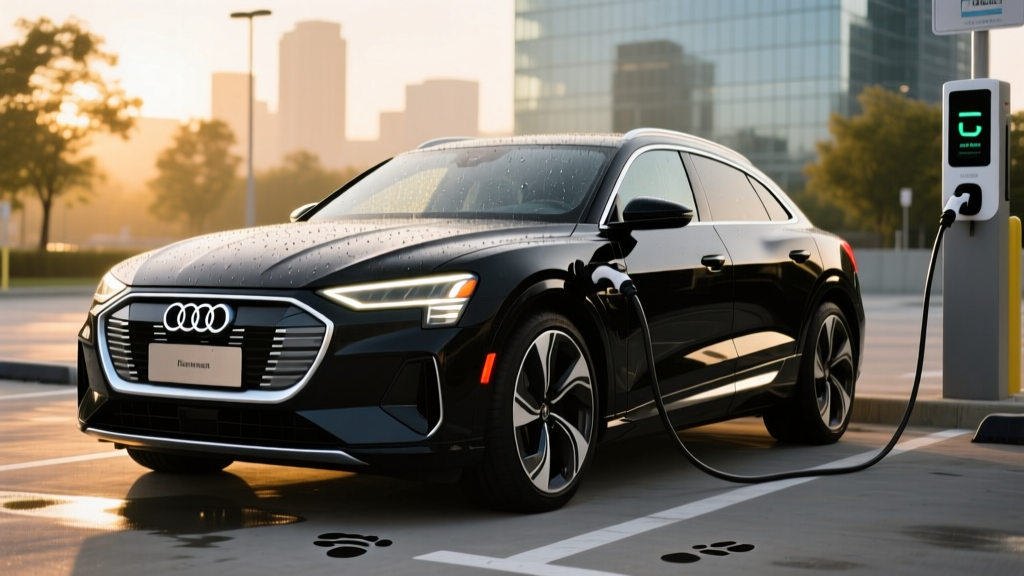
The 2021 Audi e-tron Premium occupies a specific niche in the used EV market: a luxury midsize electric SUV with refined driving dynamics, genuine fast-charging capability, and a price that has finally depreciated into territory where the federal used-EV tax credit can meaningfully offset the cost. Originally launching with an MSRP north of $65,000, these vehicles now trade on the used market in a range where savvy buyers can extract serious value — provided they understand the battery, the charging curve, and what "Premium" actually gets you versus higher trims.
This profile covers the 2021 Audi e-tron in its Premium trim — the base model — with the standard battery pack and quattro all-wheel drive. We will break down exact EPA figures, real-world range expectations in multiple conditions, DC fast-charging behavior including the sustained-charge advantage that sets the e-tron apart, home charging logistics, and the §25E used-EV tax credit rules that apply as of 2026.
2021 Audi e-tron Premium: Core Specifications
| Attribute | Value |
|---|---|
| EPA Range | 222 miles |
| Usable Battery Capacity | 86.5 kWh (95 kWh gross) |
| Battery Chemistry | NMC (Nickel Manganese Cobalt) |
| Drivetrain | Dual-motor AWD (quattro) |
| Horsepower | 355 hp (402 hp in Boost mode) |
| Torque | 414 lb-ft (490 lb-ft Boost) |
| 0–60 mph | 5.7 seconds (5.5 sec Boost mode) |
| Max DC Fast Charge Rate | 150 kW peak |
| 10–80% DC Fast Charge Time | ~30 minutes |
| Level 2 Charge Rate | 9.6 kW (~21 mi/hr) |
| MPGe (City / Hwy / Combined) | 74 / 73 / 74 MPGe |
| Efficiency | 46 kWh/100 mi |
| Cargo Volume (rear seats up / down) | 28.5 / 57.0 cu ft |
| Front Trunk (Frunk) | Not available |
| Original Base MSRP (2021) | $65,900 |
| Battery/Powertrain Warranty | 8 years / 100,000 miles |
| Vehicle Warranty | 4 years / 50,000 miles |
Source: EPA / fueleconomy.gov and Audi USA press archives.
Real-World Range: What to Actually Expect
Real-World Expectations:
- City / moderate climate: 210–230 miles — the e-tron's regen and thermal management are effective in stop-and-go driving.
- Highway (70–75 mph): 180–200 miles — aerodynamic drag on this 5,765-lb SUV reduces efficiency notably at sustained speed.
- Cold weather (below 32°F): 155–185 miles — expect 20–30% range loss due to cabin heating and battery chemistry. The e-tron's heat pump (standard on 2021 models) mitigates some loss compared to resistive-heating EVs.
- Towing (max 4,000 lbs): 100–130 miles — heavy trailer loads halve effective range.
The 2021 e-tron's 222-mile EPA rating was competitive at launch but now trails newer entrants like the BMW iX xDrive50 (324 miles EPA) and the Genesis GV60 (248 miles). However, the e-tron compensates with one of the most conservative battery buffers in the industry. Audi locks out roughly 8.5 kWh of the 95 kWh gross pack — this large buffer protects long-term battery health and means the usable 86.5 kWh you're driving on is genuinely usable without accelerated degradation concerns.
On a real-world road trip at 75 mph in 65°F weather, owners consistently report reaching approximately 190–200 miles before hitting 10% state of charge. That's a meaningful gap from the EPA sticker, and buyers accustomed to the e-tron's "range honesty" often plan around 185 miles as a safe highway number.
Charging Performance: Where the e-tron Excels
The 2021 Audi e-tron's charging behavior is one of its strongest engineering achievements. While the peak rate of 150 kW doesn't match the 250+ kW capability of a Tesla Model Y or Hyundai Ioniq 5, the e-tron sustains its peak rate far longer than most competitors — a characteristic that matters more in practice than peak numbers suggest.
| Charge Level | Power (kW) | Speed (miles of range per hour) | Notes |
|---|---|---|---|
| Level 1 (120V household) | ~1.4 kW | ~3 mi/hr | Emergency/trickle only; 72+ hours for full charge |
| Level 2 (240V home) | 9.6 kW | ~21 mi/hr | Full charge in ~9 hours; requires 40A or 48A circuit |
| DC Fast Charge (CCS) | 150 kW peak | ~320 mi/hr (at peak) | 10–80% in ~30 min; sustains 120+ kW up to ~70% SoC |
DC Fast-Charging Curve Detail: The e-tron reaches its 150 kW peak almost immediately upon plugging into a capable CCS station (preconditioned battery required). Unlike many EVs that peak and then taper sharply after 50%, the e-tron holds above 120 kW until approximately 70% state of charge before tapering to roughly 75 kW through 80%, and dropping further to 50 kW between 80–90%. This flat charge curve means a 10–80% session takes about 30 minutes — competitive with vehicles boasting higher peak numbers but less sustained delivery.
Preconditioning: The e-tron will precondition its battery for fast charging when a CCS charger is set as the navigation destination. This is critical in cold weather — arriving at a charger without preconditioning can cut peak charge rates by 40–50%. Always navigate to your charger via the onboard system.
Connector Note: The 2021 e-tron uses a CCS1 connector. As of 2026, the North American Charging Standard (NACS) has become dominant, but CCS1 chargers remain widely available on Electrify America, EVgo, and ChargePoint networks. Audi has not offered a factory NACS adapter for the 2021 model year, though third-party CCS-to-NACS adapters are available for Tesla Supercharger access (verify compatibility with your specific adapter before relying on it).
Performance and Driving Dynamics
The dual-motor quattro powertrain delivers 355 horsepower in standard driving and 402 hp when Boost mode is engaged (activated via a second kickdown of the accelerator or the shift lever in S mode). The 0–60 mph time of 5.7 seconds (5.5 in Boost) places the e-tron firmly in "quick but not sports-car" territory — comparable to a Porsche Macan S but trailing the Tesla Model X and BMW iX.
Where the e-tron genuinely stands out is refinement. Audi's NVH (noise, vibration, harshness) engineering is evident: the cabin is whisper-quiet at highway speed, the air suspension (standard on Premium Plus and Prestige, optional on Premium) absorbs road imperfections with composure, and the steering is precise if deliberately uncommunicative. The brake-by-wire regen system allows adjustable recuperation via steering-wheel paddles — from coasting (0 kW regen) to moderate one-pedal-style deceleration (~0.3g). Unlike some EVs, the e-tron does not offer true one-pedal driving to a full stop; you will need the friction brakes for the final few mph.
Towing: The 2021 e-tron is rated for 4,000 lbs with the factory tow package. This is competitive with the Ford Mustang Mach-E (1,500 lbs) and below the Rivian R1S (7,700 lbs), but sufficient for a small boat or light utility trailer.
Interior, Technology, and Cargo
The Premium trim — the base level — still delivers a well-appointed cabin. Standard equipment includes:
- 10.1-inch upper touchscreen (MMI navigation) and 8.6-inch lower climate/functions touchscreen
- 12.3-inch Audi Virtual Cockit digital instrument cluster
- Wireless Apple CarPlay, wired Android Auto
- Leather seating surfaces, heated 8-way power front seats
- Tri-zone automatic climate control
- Power liftgate
- Audi pre sense basic and city (forward collision warning, automatic emergency braking, lane departure warning)
Cargo space: 28.5 cubic feet behind the second row and 57.0 cubic feet with rear seats folded. This is competitive with a BMW X5 but notably less than the Tesla Model X (behind the second row: ~37 cu ft). The absence of a frunk is a missed opportunity — the space under the hood houses power electronics rather than storage.
Notable drawback: The dual-touchscreen MMI system requires precise finger input and draws eyes away from the road. The haptic feedback helps, but physical knobs for climate control would be preferable for daily use. Additionally, the 2021 model year lacks wireless Android Auto (added in later model years), which is a frustration for Android users.
Driver Assistance: The Premium trim includes Audi pre sense basic and city as standard. Adaptive cruise control with lane guidance (Audi adaptive cruise assist) is available as part of the Convenience package on Premium or standard on Premium Plus. This is an SAE Level 2 system — the driver must remain fully engaged with hands on the wheel and eyes on the road at all times. It is not self-driving.
Pricing, Tax Credits, and Ownership Economics
The 2021 Audi e-tron launched with a base MSRP of $65,900 for the Premium trim, $70,600 for Premium Plus, and $79,100 for Prestige (all before destination). As of early 2026, used-market pricing for a 2021 e-tron Premium with 30,000–50,000 miles typically falls between $28,000 and $36,000, depending on condition, mileage, and region.
| Item | Estimated Amount |
|---|---|
| Used Market Price (30K–50K miles) | $28,000 – $36,000 |
| Federal Used EV Tax Credit (§25E) | Up to $4,000 (30% of sale price, capped) |
| Estimated Price After Federal Credit | $24,000 – $32,000 |
| Estimated Home Level 2 Charger Install | $800 – $2,000 |
| Effective Drive-Off Cost | ~$25,000 – $34,000 |
§25E Used EV Tax Credit — Key Rules (2026):
- Credit amount: 30% of the sale price, capped at $4,000 maximum.
- Vehicle eligibility: Must be at least 2 model years old (2021 qualifies in 2026), sale price must be $25,000 or less to qualify for the full credit (vehicles above $25,000 may still qualify for a reduced credit — confirm with your dealer and tax professional).
- Buyer income caps: Adjusted gross income must not exceed $75,000 (single), $112,500 (head of household), or $150,000 (married filing jointly).
- Dealer requirement: Must be purchased from a licensed dealer (private-party sales do not qualify).
- Point-of-sale transfer: The credit can be transferred to the dealer at purchase, reducing your out-of-pocket cost immediately.
For the most current rules, consult IRS.gov §25E guidance and verify eligibility with a tax professional before purchase.
Important note on the §30D new-vehicle credit: The 2021 e-tron is no longer eligible for the $7,500 new clean vehicle credit (§30D), as that credit applies only to new vehicle purchases. The used-vehicle credit (§25E) is the applicable federal incentive.
Warranty and Battery Longevity
Audi provides an 8-year/100,000-mile warranty on the high-voltage battery and electric powertrain. The warranty covers defects and excessive capacity loss — Audi defines the threshold as the battery retaining less than 70% of its original usable capacity within the warranty period.
For a 2021 model, this warranty remains active through the 2029 model year or until 100,000 miles, whichever comes first. Given the e-tron's large 8.5 kWh buffer and conservative thermal management, real-world degradation data from high-mileage owners (80,000+ miles) shows capacity retention of approximately 92–95% — well within the warranty threshold. The NMC chemistry in the e-tron has proven durable, particularly because the large buffer means the cells rarely experience extreme high or low states of charge during normal use.
The standard vehicle warranty (4 years/50,000 miles) has expired for all 2021 models as of 2025. Buyers should budget for out-of-warranty maintenance on suspension components, electronics, and the 12V auxiliary battery (a common failure point in all modern vehicles, EVs included).
Pros and Cons
- Sustained DC fast-charging curve outperforms many EVs with higher peak kW ratings
- Exceptionally quiet, refined cabin — luxury-competitive NVH
- Large battery buffer protects long-term battery health (92–95% SoH at high mileage)
- quattro AWD provides confident all-weather traction
- Used pricing + §25E credit can bring effective cost below $28,000
- Standard heat pump reduces cold-weather range loss vs. resistive heating
- 4,000-lb towing capacity is practical for light trailers
- 222-mile EPA range is below 2026 competitors (iX: 324 mi, Model Y LR: 330 mi)
- CCS1 connector is losing ground to NACS; Supercharger access requires an adapter
- No frunk — missed storage opportunity
- Dual-touchscreen MMI is distracting and less intuitive than physical controls
- Heavy at 5,765 lbs — reduces efficiency at highway speeds
- 4-year/50,000-mile vehicle warranty has expired on all 2021 models
- Efficiency of 46 kWh/100 mi trails lighter competitors (Model Y: ~28 kWh/100 mi)
Who Should Buy the 2021 Audi e-tron Premium?
- You prioritize cabin refinement and ride comfort over maximum range
- Your daily driving is under 150 miles and you have home Level 2 charging
- You want a luxury badge at a depreciated price point with federal credit upside
- You value sustained fast-charging speed for occasional road trips over peak numbers
- You live in a region with reliable CCS charging infrastructure (Electrify America, EVgo)
- You need 300+ miles of range for frequent long-distance travel
- You want NACS-native Supercharger access without an adapter
- You prioritize cargo space (the Model X or Rivian R1S offer significantly more)
- You want the latest infotainment and driver-assist technology
- You need maximum efficiency (the e-tron's 46 kWh/100 mi is thirsty by 2026 standards)
Frequently Asked Questions
What is the real-world range of the 2021 Audi e-tron Premium?
The EPA rates the 2021 e-tron at 222 miles. In real-world use, expect approximately 190–200 miles on the highway at 70–75 mph in moderate temperatures, 210–230 miles in city driving, and 155–185 miles in cold weather (below 32°F). The large battery buffer means the range you see is genuinely usable without accelerated degradation.
How fast does the 2021 e-tron charge at home and on DC fast chargers?
On a Level 2 home charger (9.6 kW, 240V), the e-tron gains approximately 21 miles of range per hour, achieving a full charge in about 9 hours. On a 150 kW CCS DC fast charger, the 10–80% charge takes approximately 30 minutes, with the e-tron sustaining above 120 kW until roughly 70% state of charge — one of the flattest charge curves in the industry.
Does the 2021 Audi e-tron qualify for a federal tax credit in 2026?
As a used vehicle, the 2021 e-tron may qualify for the §25E Used Clean Vehicle Credit — up to $4,000 (30% of sale price). Eligibility requires a sale price of $25,000 or less, buyer income below IRS thresholds ($75K single / $150K married filing jointly), and purchase from a licensed dealer. The credit can be transferred at point of sale. Consult IRS.gov and a tax professional for your specific situation.
Is the 2021 e-tron worth buying versus a Tesla Model Y or BMW iX?
It depends on priorities. The e-tron wins on cabin quietness, ride refinement, and sustained charging performance. The Model Y wins on range (330 mi EPA), efficiency (28 kWh/100 mi), Supercharger network access, and cargo space. The BMW iX wins on range (324 mi EPA) and modern tech but costs significantly more on the used market. If luxury and comfort are your top criteria and 200 real-world highway miles is sufficient, the e-tron at $28K–$36K used is compelling value.
How long will the 2021 e-tron battery last?
The 8-year/100,000-mile battery warranty remains active through 2029. Real-world data from high-mileage e-tron owners shows 92–95% battery capacity retention at 80,000+ miles, well above the 70% warranty threshold. The large 8.5 kWh buffer and conservative NMC chemistry management contribute to strong longevity. Battery replacement, if ever needed outside warranty, is estimated at $15,000–$22,000 based on current parts pricing — though this is rarely required.
Can I charge the 2021 e-tron at Tesla Superchargers?
The 2021 e-tron has a CCS1 port. Accessing Tesla Superchargers requires a CCS-to-NACS adapter (third-party adapters are available, but verify compatibility and safety certifications before purchasing). Electrify America, EVgo, and ChargePoint CCS stations remain widely available and do not require an adapter.
What are the biggest drawbacks of the 2021 e-tron Premium?
The main compromises are range (222 mi EPA, ~190 mi highway), efficiency (46 kWh/100 mi is high), the CCS1 connector in an increasingly NACS-dominant market, lack of a frunk, and the distracting dual-touchscreen infotainment system. The expired 4-year vehicle warranty also means out-of-pocket costs for non-powertrain repairs.