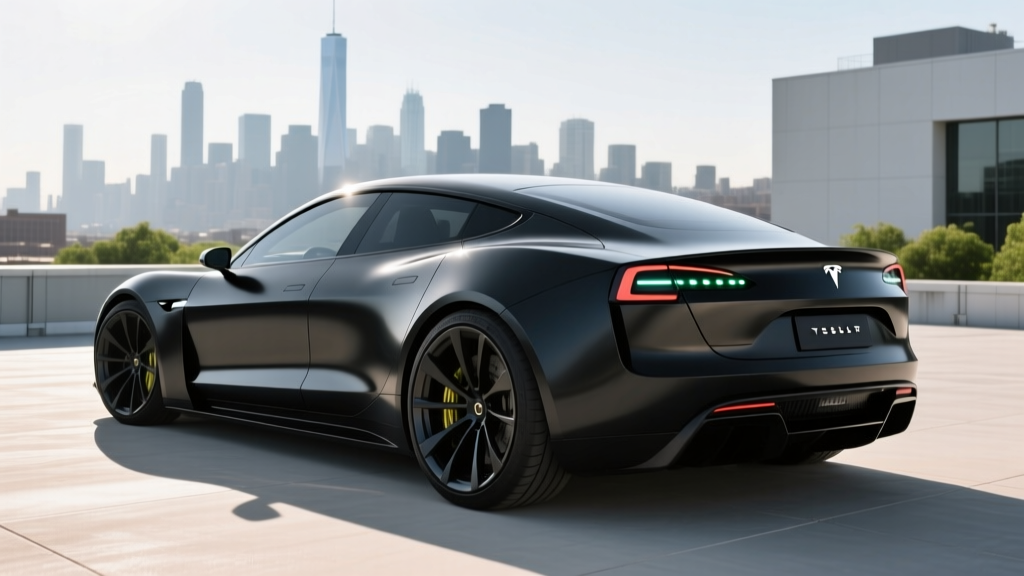
If you've been searching for information on the 2020 Tesla Roadster, you've likely encountered a maze of bold claims, shifting timelines, and unanswered questions. Originally unveiled in November 2017 with a planned 2020 production start, Tesla's second-generation Roadster has become one of the most talked-about—and most delayed—vehicles in automotive history. As of early 2026, the Roadster remains unreleased and unavailable for purchase. This profile examines every published specification, explains where the program stands today, and helps you decide whether to wait or look at alternatives that actually exist.
What Tesla Promised: The Headline Specifications
Tesla's 2017 reveal and subsequent updates painted an extraordinary picture. The company positioned the Roadster as a halo vehicle intended to demonstrate the performance ceiling of electric powertrains. Here is a consolidated look at every major spec Tesla has published.
| Attribute | Tesla's Claimed Figure |
|---|---|
| EPA Range (claimed) | 620 miles |
| Battery Capacity | 200 kWh (chemistry unconfirmed, likely NMC/NCA) |
| Drivetrain | Tri-motor AWD (1 front, 2 rear) |
| 0–60 mph | 1.9 seconds (base); 1.1 sec with SpaceX package |
| Top Speed | 250+ mph |
| Quarter Mile | 8.8 seconds (claimed) |
| Wheel Torque | 10,000 Nm (7,376 lb-ft) |
| Seating | 2+2 (4 seats) |
| Base Reservation Price | $200,000 (announced) |
| Founders Series | $250,000 (limited to first 1,000 units) |
| Warranty | Not published |
These numbers, if achieved in a production vehicle, would make the Roadster the longest-range and quickest-accelerating road-legal car ever sold. However, no independent testing body—EPA, IIHS, NHTSA, or automotive press—has verified any of them.
Range and Battery: The 620-Mile Claim Under Scrutiny
Tesla's claimed range: 620 miles
Real-world expectation (if produced): Likely 450–520 miles in mixed driving; 350–420 miles at sustained highway speeds of 75+ mph; potentially below 300 miles in sub-freezing temperatures.
Why the gap: EPA range testing uses a standardized city/highway cycle at moderate speeds. Sustained highway driving, cold weather, and accessory loads (HVAC, seat heaters) routinely reduce real-world range by 15–30% in existing EVs. A 200 kWh battery would be extraordinarily heavy—likely 1,200+ lbs for cells alone—which increases rolling resistance and energy consumption at speed.
The 200 kWh battery pack Tesla has referenced would be roughly double the capacity of the largest pack currently in any production passenger vehicle (the GMC Hummer EV's ~212 kWh pack weighs approximately 2,900 lbs). Packaging that much energy into a sports car chassis while maintaining the claimed performance figures represents an immense engineering challenge. Tesla has not confirmed the cell chemistry, though a nickel-based NMC or NCA formulation is virtually certain—LFP chemistry, used in some Tesla Model 3 Standard Range vehicles, is too heavy and low-density for this application.
Tesla's 4680 cell format, introduced in limited production starting in 2022, was expected to improve energy density and reduce cost. However, even with 4680 cells, fitting 200 kWh into a low-slung sports car while meeting crash-safety standards remains unproven. The EPA's fueleconomy.gov database contains no entry for the Roadster, meaning no official efficiency or range testing has occurred.
Charging Speed: What We Know (and Don't Know)
Tesla has published very little about the Roadster's charging architecture. Based on the claimed 200 kWh battery and Tesla's existing Supercharger network capabilities, here is a reasonable projection alongside known Tesla benchmarks.
| Charging Level | Power (kW) | Estimated Speed |
|---|---|---|
| Level 1 (120V household) | ~1.4 kW | ~3–4 mi/hr (over 150 hours for full charge) |
| Level 2 (240V home, 48A) | ~11.5 kW | ~30–35 mi/hr (~18–20 hours full) |
| DC Fast Charge (projected peak) | 250–350 kW (est.) | 10–80% in ~40–55 min (est.) |
A 200 kWh battery fundamentally changes the charging-time equation. Even at a sustained 250 kW—a peak rate that current V3 Superchargers can deliver but rarely sustain for an entire session—charging from 10% to 80% would require moving 140 kWh of energy, taking roughly 34 minutes at a perfect sustained rate. In practice, charge curves taper significantly above 50–60% state of charge to protect battery health, pushing realistic 10–80% times well above 40 minutes. If Tesla deploys V4 Supercharger hardware capable of higher sustained power, this could improve, but no Roadster-specific charging protocol has been announced.
For home charging, a Level 2 Tesla Wall Connector at 48 amps (11.5 kW) would add roughly 30–35 miles of range per hour. Fully replenishing a depleted 200 kWh pack would take approximately 18–20 hours—meaning overnight charging would restore about 60–70% of the battery. Owners would need a dedicated 60-amp circuit; many homes require a panel upgrade to support this, adding $1,500–$4,000 to installation costs.
Performance: 1.9 Seconds and the Physics Problem
Tesla's claim of a 1.9-second 0–60 mph time would place the base Roadster ahead of every production car ever independently tested. The Model S Plaid, with 1,020 horsepower and tri-motor AWD, achieves 0–60 in approximately 1.99 seconds in controlled testing by Motor Trend and Car and Driver. For the Roadster to beat that figure in a heavier vehicle (the 200 kWh pack alone adds enormous mass), Tesla would need to deliver exceptional traction management and possibly torque vectoring across all three motors.
The even more aggressive claim—a 1.1-second 0–60 with the optional "SpaceX package" using cold-gas thrusters—ventures into territory that no road-legal production vehicle has approached. Elon Musk has stated this package would use compressed-air thrusters positioned around the vehicle to improve acceleration, braking, and cornering. Whether this system can meet federal motor vehicle safety standards (FMVSS) is an open question. The National Highway Traffic Safety Administration (NHTSA) has not issued any guidance on thruster-equipped road vehicles.
Horsepower figures have not been officially published, but automotive engineers estimate the tri-motor setup would need to produce in the range of 1,000–1,500 hp to achieve the claimed acceleration targets in a vehicle likely weighing 4,500–5,000 lbs.
Pricing, Reservations, and Federal Tax Credit Eligibility
| Trim / Tier | Announced Price | Reservation Deposit |
|---|---|---|
| Base Roadster | $200,000 | $50,000 |
| Founders Series (first 1,000) | $250,000 | $250,000 (fully paid) |
Tesla accepted $50,000 reservation deposits for the base Roadster and $250,000 for the Founders Series. These are not purchases—they are refundable holds on a production slot for a vehicle that has not materialized. As of 2026, Tesla's website still lists the Roadster as a future product, but no firm production date has been communicated to reservation holders.
Under current IRS §30D rules, the Roadster faces multiple disqualifying barriers:
- MSRP Cap: The §30D credit caps eligibility at $55,000 for sedans and $80,000 for SUVs, vans, and pickup trucks. At $200,000+, the Roadster exceeds both thresholds by a wide margin.
- Income Cap: Buyers must have modified adjusted gross income (MAGI) below $150,000 (single), $225,000 (head of household), or $300,000 (joint). Many buyers in this price range exceed those limits.
- Battery Sourcing: Critical mineral and battery component sourcing requirements must be met, and Tesla has not disclosed the Roadster's supply chain.
Verdict: The Roadster will almost certainly not qualify for the $7,500 federal EV tax credit.
Interior, Cargo, and Daily Usability
Tesla showed a 2+2 seating configuration in the 2017 prototype, meaning two front seats and two small rear seats. In practice, the rear seats in vehicles of this type—comparable to a Porsche 911 or the original Tesla Roadster (2008–2012)—are suitable only for small children or cargo overflow. Tesla has not published interior dimensions, legroom measurements, or cargo volume in cubic feet.
The removable glass roof panel shown in the prototype adds an open-air element, but structural rigidity and noise insulation trade-offs are unknown. The prototype's interior featured a minimalist dashboard with a central touchscreen, consistent with Tesla's design language, though production interiors often differ substantially from show-car concepts.
As a daily driver, the Roadster's low ground clearance, wide body, and likely firm suspension would make it impractical for anything beyond smooth pavement. Ground clearance, approach/departure angles, and visibility figures have not been released.
Driver Assistance and Technology
Tesla has indicated the Roadster would include its full suite of driver-assistance features, including Autopilot and the option for Full Self-Driving (Supervised). It is critical to understand that these are SAE Level 2 systems—the driver must remain fully engaged, with hands on or near the wheel and eyes on the road at all times. They are not autonomous or self-driving.
Tesla Autopilot and FSD (Supervised) require continuous driver supervision. The vehicle can manage steering, acceleration, and braking under certain conditions, but the human driver is legally and operationally responsible at all times. Only Level 4 systems (e.g., Waymo's driverless robotaxi) operate without a human driver in defined service areas.
Beyond driver assists, Tesla's infotainment system offers over-the-air updates, streaming media, navigation with real-time traffic, and a mobile app for remote climate control and charging management. Whether the Roadster would receive the same hardware refreshes as the Model S/X (such as the current Ryzen-based infotainment processor) is unknown.
Where the Roadster Stands in 2026
Timeline of key Roadster milestones:
- November 2017: Unveiled at SpaceX headquarters. Production targeted for 2020.
- 2019: Production delayed to 2021.
- 2021: Delayed to 2022, then 2023.
- 2023: Elon Musk stated the design was "done" but that Tesla was prioritizing other products. No firm date given.
- 2024–2025: No meaningful production updates. Tesla focused on Cybertruck ramp, next-gen platform, and Optimus robot.
- Early 2026: Roadster remains listed on Tesla's website as a future product. No production timeline communicated.
The pattern of repeated delays—without a prototype undergoing EPA certification testing or crash testing—suggests the Roadster remains a low-priority skunkworks project rather than an imminent product. Tesla has never submitted the Roadster to the EPA for range or emissions certification, a mandatory step before any vehicle can be sold in the United States.
Should You Wait, or Look at Real Alternatives?
Wait for the Roadster if: You have $200,000+ earmarked for a halo electric sports car, you are comfortable with an indefinite timeline, and no current vehicle meets your performance expectations.
Look at alternatives now if: You want a vehicle you can actually drive, insure, and service today. Consider:
- Tesla Model S Plaid — 1,020 hp, 0–60 in ~2.0 sec, EPA 396 mi, ~$89,990. Available now.
- Rimac Nevera — 1,914 hp, 0–60 in 1.85 sec, EPA 287 mi, ~$2.2M. Limited production, available.
- Lotus Evija — 2,011 hp, 0–60 in <3.0 sec, WLTP ~250 mi, ~$2.3M. Entering limited deliveries.
- Porsche Taycan Turbo GT — 1,019 hp (launch control), 0–60 in 2.1 sec, EPA 269 mi, ~$230,000. Available now.
Frequently Asked Questions
Can I buy a 2020 Tesla Roadster today?
No. The second-generation Tesla Roadster has never entered production. You cannot purchase one new or used. Tesla accepted reservation deposits starting in 2017, but no customer deliveries have occurred, and no production date has been confirmed as of 2026.
What is the real-world range of the Tesla Roadster?
There is no real-world range data because no production vehicle exists for independent testing. Tesla claims 620 miles, but based on the physics of a heavy 200 kWh battery pack and the typical 15–30% real-world reduction from EPA figures seen in other EVs, a realistic expectation—if the car is ever built—would be approximately 450–520 miles in mixed driving, less at sustained highway speeds or in cold weather.
How fast does the Tesla Roadster charge?
Tesla has not published official charging specifications. With a projected 200 kWh battery, even at a peak rate of 250–350 kW DC fast charging, a 10–80% session would likely take 40–55 minutes due to charge-curve tapering. Home Level 2 charging at 11.5 kW would require roughly 18–20 hours for a full charge.
Does the Tesla Roadster qualify for the federal EV tax credit?
Almost certainly not. Under current IRS §30D rules, the credit is limited to vehicles with an MSRP of $55,000 or less (sedans) or $80,000 or less (SUVs/trucks/vans). At $200,000+, the Roadster far exceeds these caps. Buyer income limits and battery-sourcing requirements would further restrict eligibility. Always verify current rules at irs.gov.
Is the Tesla Roadster worth waiting for versus buying a Model S Plaid?
For nearly every buyer, the Model S Plaid is the rational choice. It delivers 1,020 hp, a 0–60 time of approximately 2.0 seconds, an EPA-rated 396 miles of range, access to the full Supercharger network, and a starting price around $89,990—all available today with a full warranty. The Roadster promises more on paper, but its indefinite timeline and likely $200,000+ price (with no tax credit) make it a speculative hold at best.
What happened to my Tesla Roadster reservation deposit?
Tesla's reservation terms have historically stated that deposits are refundable. If you hold a Roadster reservation, you can check your Tesla account for the deposit status. Some reservation holders have reported being able to request refunds, but processing times and policies may vary. Contact Tesla directly for the most current information on your specific reservation.