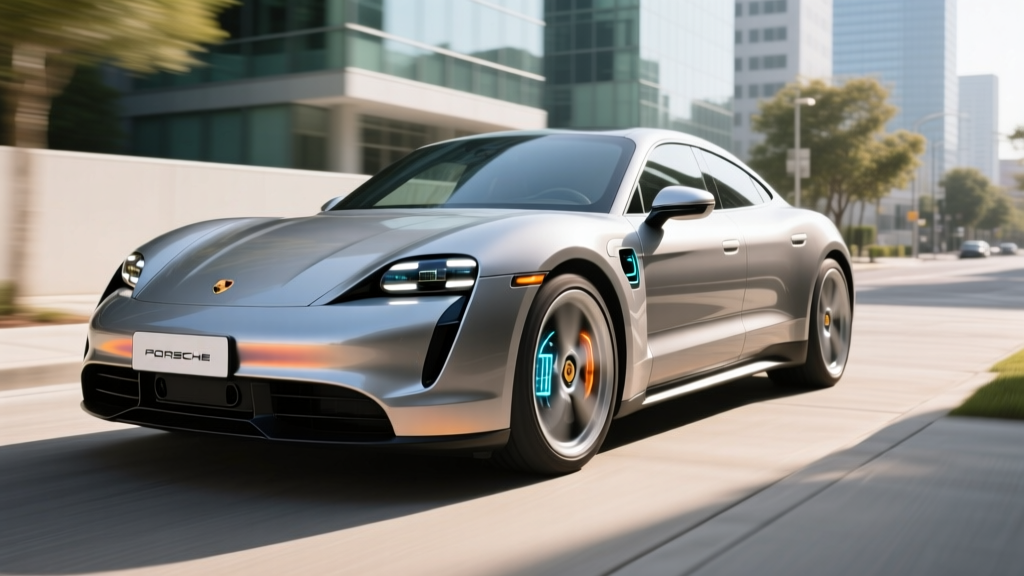
Quick Verdict: The Taycan Turbo's Performance Promise, Delivered
The 2020 Porsche Taycan Turbo arrived as the first EV to wear a Stuttgart crest, and it made no apologies for prioritizing driving dynamics over maximum range. With a 0-60 mph time of 3.0 seconds (and Car and Driver clocking it at 2.4 seconds with launch control), the Turbo variant established Porsche's electric performance benchmark. But for buyers evaluating this car in 2026 as a used EV purchase, the question isn't just straight-line speed — it's whether a 201-mile EPA range, an 800-volt architecture, and Porsche's build quality justify the price on the pre-owned market.
This review covers the Taycan Turbo's real-world range, charging behavior, battery longevity, and ownership economics with the precision you need before writing a check.
Range and Efficiency: EPA vs. Reality
Real-World Expectation: 170–190 miles on mixed highway driving; 140–160 miles at sustained 80+ mph or in sub-40°F temperatures. City driving with regen can push toward 210 miles.
The 2020 Taycan Turbo carries a 93.4 kWh gross battery pack (approximately 83.7 kWh usable), using NMC (nickel-manganese-cobalt) pouch cells supplied by LG Chem. Porsche's decision to limit the usable buffer protects long-term State of Health (SoH), but it also means fewer miles between charges than rivals with larger packs.
The EPA rated the Turbo at 68 MPGe combined, translating to roughly 49 kWh per 100 miles. In practice, the Taycan's thermal management system — which includes a heat pump as standard equipment — keeps efficiency relatively stable across temperatures. However, the car's weight (5,132 lbs curb) and wide, sticky Pirelli P Zero tires exact a toll at highway speeds. On a 75-mph cruise in 55°F weather, expect to see consumption climb to 52–55 kWh/100 mi, reducing effective range to the 170-mile mark.
Cold-weather note: In sustained 25°F driving, the Taycan's battery preconditioning and heat pump mitigate range loss better than many competitors, but you should still budget for a 15–20% reduction from the EPA sticker.
Charging: 800-Volt Architecture in Practice
| Charging Level | Power / Rate | Time / Miles Added |
|---|---|---|
| Level 1 (120V, 12A) | ~1.4 kW | ~3 miles per hour |
| Level 2 (240V, 48A) | 11.5 kW (onboard charger) | ~28 miles per hour; full charge in ~9 hours |
| DC Fast Charge (peak) | 270 kW (800V architecture) | 10–80% in ~22.5 minutes (ideal conditions) |
| DC Fast Charge (50 kW CCS) | 50 kW | 10–80% in ~90 minutes |
The Taycan Turbo was the first production EV with an 800-volt battery architecture, enabling DC fast-charge rates up to 270 kW at compatible CCS1 chargers. On a 350 kW Electrify America or Ionity station with battery preconditioning engaged, the charge curve holds above 200 kW from roughly 10% to 55% State of Charge, then tapers progressively. Expect a 10–80% session to take 22–25 minutes in warm conditions.
Preconditioning matters. Navigate to a DC fast charger using the built-in navigation, and the Taycan will warm the battery to the optimal temperature window before arrival. Skip this step on a cold morning, and your peak charge rate may be capped below 150 kW for the first several minutes.
For home Level 2 charging, the onboard 11.5 kW charger is competitive. A full overnight charge from 10% takes roughly 9 hours on a 48-amp circuit. Porsche also offered an optional 19.2 kW onboard charger for the 2020 model year, cutting Level 2 time to about 5.5 hours — worth seeking if you find a used example so equipped.
The 2020 Taycan uses the CCS1 connector for DC fast charging and a J1772 inlet for Level 2. An NACS adapter is not provided by Porsche for this model year, though third-party CCS-to-NACS adapters became available in 2025–2026 for Tesla Supercharger access.
Performance: The 0-60 Benchmark
| Specification | 2020 Taycan Turbo |
|---|---|
| 0–60 mph | 3.0 seconds (manufacturer); 2.4–2.6 sec (independent tests with launch control) |
| Horsepower | 670 hp (overboost with Launch Control) |
| Torque | 626 lb-ft |
| Drivetrain | Dual-motor AWD |
| Top Track Speed | 161 mph |
| Curb Weight | 5,132 lbs |
| Quarter Mile | ~10.8 seconds @ 130 mph |
Porsche's claimed 3.0-second 0-60 time is conservative. Multiple outlets, including Car and Driver, recorded 2.4-second runs with the car in Sport Plus mode and Launch Control engaged. The rear-mounted two-speed transmission — unique among EVs — gives the Taycan an extra gear for hard launches and relaxed highway cruising.
The dual permanent-magnet synchronous motors (one front, one rear) provide torque-vectoring all-wheel drive. In normal driving, the Taycan Turbo operates primarily in rear-wheel drive for efficiency, engaging the front motor under hard acceleration or when slip is detected. This strategy contributes to the car's natural, rear-biased handling feel.
Regenerative braking delivers up to 265 kW of recuperation — among the highest of any EV — meaning aggressive deceleration events rarely touch the friction brakes. Porsche estimates that most daily driving can be handled without the brake pedal, though the Taycan does not offer true one-pedal driving to a full stop.
Interior, Cargo, and Technology
The Taycan Turbo's cabin seats four adults (or five in a pinch with the optional rear middle seat). Rear legroom measures 32.7 inches — adequate for adults on short trips but tight for long-distance comfort. Front-seat occupants enjoy 41.3 inches of legroom and deeply bolstered 18-way adaptive sport seats.
Cargo space: The rear trunk provides 14.3 cubic feet, and the front trunk (frunk) adds 2.8 cubic feet — enough for a charging cable and a small bag. Total storage is limited compared to a Tesla Model S (26.3 cu ft rear) or a hatchback-style competitor.
The 2020 model year introduced Porsche's fully digital instrument cluster with a curved 16.8-inch display, a central 10.9-inch infotainment touchscreen, and an optional passenger-side 10.9-inch display. Physical climate controls were replaced by a touch-sensitive lower panel — a decision that drew criticism for requiring too much visual attention.
Driver-assistance tech: The 2020 Taycan offers adaptive cruise control, lane-keeping assist, and night vision with pedestrian detection. This is SAE Level 2 driver assistance — it requires continuous driver engagement and is not autonomous driving. Porsche's InnoDrive system (predictive adaptive cruise) was available as an option and uses map data and traffic-sign recognition to adjust speed proactively.
Pricing, Tax Credits, and Ownership Costs
| Item | Amount |
|---|---|
| Original Base MSRP (2020) | $150,900 |
| Typical As-Tested Price (2020) | $165,000–$185,000 |
| Used Market Range (2026) | $55,000–$80,000 depending on mileage/condition |
| Federal Used EV Tax Credit (§25E) | Up to $4,000 or 30% of sale price (whichever is lower), subject to income caps |
| New EV Tax Credit (§30D) | Not applicable — no longer in production |
The 2020 Taycan Turbo's original MSRP placed it firmly in the luxury performance segment. As of 2026, used examples have depreciated into the $55,000–$80,000 range, making them candidates for the IRS §25E Used Clean Vehicle Credit.
Key §25E requirements:
- The sale price must be $25,000 or less to qualify (most Taycan Turbos exceed this threshold, making credit eligibility unlikely at current used prices)
- Buyer income caps apply: $75,000 single / $112,500 head of household / $150,000 joint filers
- The vehicle must be purchased from a licensed dealer
- The credit is 30% of the sale price, capped at $4,000
In practice, the Taycan Turbo's used pricing typically exceeds the $25,000 sale-price cap, so most buyers will not qualify for the federal credit. Always verify current rules with a tax professional and the IRS.
Insurance: Expect annual premiums of $3,500–$5,500 depending on your profile — higher than average due to repair costs and performance classification.
Battery Warranty and Longevity
Porsche provided the 2020 Taycan Turbo with the following coverage:
- Battery warranty: 8 years / 100,000 miles (whichever comes first), covering capacity loss below 70% of original
- Powertrain warranty: 8 years / 100,000 miles
- Limited vehicle warranty: 4 years / 50,000 miles
The 83.7 kWh usable NMC pack has demonstrated strong longevity in early fleet data. Most 2020 Taycans with 60,000–80,000 miles show 90–94% State of Health, aided by the conservative usable buffer and active liquid thermal management. Porsche's battery replacement cost was estimated at $25,000–$30,000+ in 2024, though individual module replacement is possible and significantly cheaper.
For 2026 buyers evaluating a used example, request a battery health report from a Porsche dealer (available via the Porsche Diagnostic System). A State of Health above 90% at 50,000+ miles is typical and reassuring.
Pros and Cons
- 0–60 in 2.4–3.0 sec — elite performance that holds up in 2026
- 800V architecture enables 270 kW DC fast charging (10–80% in ~22 min)
- Exceptional build quality, fit and finish
- Natural, rear-biased handling with torque-vectoring AWD
- Strong battery SoH data at 5+ years of age
- Heat pump standard for cold-weather efficiency
- 201-mile EPA range is modest even by 2020 standards
- Small frunk (2.8 cu ft) and limited total cargo space
- Touch-sensitive lower console panel is distracting
- Rear seat legroom (32.7 in) is tight for adults on long trips
- No true one-pedal driving to a full stop
- Used pricing usually exceeds §25E tax credit cap
Who Should Buy the 2020 Taycan Turbo in 2026?
Choose the Taycan Turbo if: You want a luxury performance EV with sports-car handling, 800V fast-charging capability, and Porsche build quality — and your daily driving stays within ~170 real-world miles or you have reliable home/destination charging.
Look elsewhere if: You need maximum range (Lucid Air, Tesla Model S), frequent 300+ mile road trips without stops, generous rear-seat space, or eligibility for federal tax credits on your purchase.
The Taycan Turbo is best suited as a performance-oriented daily driver and weekend car for buyers who prioritize driving engagement over range maximization. It is not a road-trip EV in the same way a Model S Long Range or Lucid Air Pure is, but for the right use case — a commute-heavy owner with home charging and a taste for Porsche dynamics — it remains compelling at its 2026 used-market pricing.
Frequently Asked Questions
What is the real-world range of the 2020 Porsche Taycan Turbo?
The EPA rates it at 201 miles combined. In real-world mixed driving, expect 170–190 miles. Sustained highway driving at 80+ mph or cold weather below 40°F can reduce range to 140–160 miles.
How fast does the 2020 Taycan Turbo charge?
On a compatible 350 kW CCS1 DC fast charger with preconditioning, it peaks at 270 kW and charges from 10–80% in approximately 22–25 minutes. Home Level 2 charging at 11.5 kW adds about 28 miles per hour.
Does the 2020 Taycan Turbo qualify for a federal EV tax credit?
As a used vehicle, it could qualify for the IRS §25E Used Clean Vehicle Credit (up to $4,000), but only if the sale price is $25,000 or less. Most 2020 Taycan Turbos sell above this threshold, making credit eligibility unlikely. Verify with a tax professional and the IRS.
Is the 2020 Taycan Turbo worth buying over a Tesla Model S or Audi e-tron GT?
The Taycan Turbo excels in build quality, handling precision, and 800V charging speed. The Tesla Model S Long Range offers far more range (405 mi EPA) and Supercharger access. The Audi e-tron GT (which shares the Taycan's J1 platform) offers similar performance with a different design language and slightly lower used pricing. Your priority — range, handling, or value — determines the winner.
What battery chemistry does the 2020 Taycan Turbo use?
It uses NMC (nickel-manganese-cobalt) pouch cells with a 93.4 kWh gross / 83.7 kWh usable capacity. NMC offers high energy density and strong power delivery, though it is more sensitive to sustained high-State-of-Charge storage than LFP chemistry.
How has the Taycan Turbo's battery held up over time?
Early fleet data shows most 2020 examples at 60,000–80,000 miles retain 90–94% State of Health. Porsche's conservative usable buffer and active thermal management contribute to strong longevity. Request a dealer battery health report before purchasing.