Quick Verdict: The Used Performance EV Benchmark
The 2020 Porsche Taycan launched as the brand's first all-electric vehicle, and even in 2026, it remains one of the most dynamically accomplished EVs on the used market. Built on Porsche's 800-voltage J1 platform, the Taycan delivers sustained performance that most modern EVs still struggle to match. If you're shopping for a pre-owned luxury electric sports sedan, the 2020 Taycan 4S is the sweet spot — offering all-wheel drive, a usable EPA range, and class-leading DC fast charging that holds up against vehicles released years later.
But the 2020 Taycan isn't a range king, and its cargo space is modest. This is a driver's car that happens to be electric, not an efficiency-maximizing commuter. Here's everything you need to know before buying one today.
2020 Porsche Taycan Spec Table: Trims, Range, and Performance
| Spec | Taycan (Base) | Taycan 4S | Taycan Turbo | Taycan Turbo S |
|---|---|---|---|---|
| Drivetrain | RWD | AWD (Dual-Motor) | AWD (Dual-Motor) | AWD (Dual-Motor) |
| Battery (Gross / Usable) | 79.2 kWh / 71.0 kWh | 93.4 kWh / 83.7 kWh (Performance Battery Plus) | 93.4 kWh / 83.7 kWh | 93.4 kWh / 83.7 kWh |
| Battery Chemistry | NMC (LG Chem) | NMC (LG Chem) | NMC (LG Chem) | NMC (LG Chem) |
| Horsepower (Overboost w/ Launch Control) | 402 hp | 562 hp | 670 hp | 750 hp |
| 0-60 mph | 5.1 sec | 3.8 sec | 3.0 sec | 2.6 sec |
| EPA Range | 201 mi | 203 mi | 201 mi | 192 mi |
| EPA Efficiency (Combined) | 69 MPGe | 68 MPGe | 69 MPGe | 68 MPGe |
| Top Speed | 143 mph | 155 mph | 161 mph | 161 mph |
| Original Base MSRP | $81,350 | $103,800 | $150,900 | $185,000 |
Source: fueleconomy.gov — EPA estimates for the 2020 Taycan 4S with Performance Battery Plus.
Real-World Range: What the EPA Number Doesn't Tell You
EPA Estimated: 203 miles
Real-World Highway (70 mph, 72°F): ~185–195 miles
Real-World Highway (32°F, cold weather): ~150–165 miles
Real-World City/Mixed (moderate temps): ~200–215 miles
The 2020 Taycan's EPA range figures have always been conservative. Independent testing by Edmunds and other outlets consistently showed the Taycan 4S exceeding its EPA rating in mixed city driving, sometimes reaching 215+ miles. The J1 platform's two-speed rear transmission and sophisticated thermal management system contribute to strong real-world efficiency in stop-and-go conditions.
However, highway driving at sustained 70–80 mph speeds reduces range noticeably, and cold weather compounds this. Expect a 20–25% range reduction in sub-freezing temperatures on highway trips. If your commute involves long stretches of interstate in winter, plan for roughly 155 miles of usable range before needing a charge.
The Taycan's usable battery buffer is approximately 83.7 kWh on Performance Battery Plus models (93.4 kWh gross). Porsche reserves a generous top and bottom buffer to protect long-term battery health — which is good for longevity but means you won't see the full 93.4 kWh on a charger display.
Charging Speed: 800V Architecture That Still Competes in 2026
The Taycan's 800-volt electrical architecture was groundbreaking in 2020, and it remains a major advantage on the used market. Here's what charging looks like across all three levels:
| Charging Level | Power | Speed / Time | Connector |
|---|---|---|---|
| Level 1 (120V household) | ~1.4 kW | ~4 mi/hr added | J1772 adapter |
| Level 2 (240V home / public AC) | 9.6 kW (onboard charger) | ~28–30 mi/hr; full charge in ~10.5 hours | J1772 (CCS1 combo) |
| DC Fast Charge (Peak) | 270 kW (800V station) | 10–80% in ~22.5 minutes | CCS1 |
| DC Fast Charge (50 kW station) | 50 kW | 10–80% in ~90 minutes | CCS1 |
Charging curve reality: The Taycan 4S peaks at 270 kW only on DC fast chargers capable of delivering 800V at sufficient amperage (e.g., Electrify America 350 kW stalls). On a 350 kW-capable charger, the Taycan sustains above 200 kW from roughly 10% to 45% SoC, then tapers progressively. You'll see 10–80% in about 22–23 minutes under ideal conditions. On 150 kW chargers, expect 10–80% in roughly 35 minutes.
One critical note for 2026 buyers: the 2020 Taycan uses a CCS1 connector. With the industry's shift to NACS (Tesla's connector), you'll need a CCS-to-NACS adapter to use Tesla Supercharger V3/V4 stalls that don't have a CCS tethered cable. Porsche has not issued an official NACS retrofit for the 2020 model year, so plan for adapter use or rely on Electrify America, EVgo, and ChargePoint CCS networks.
For home Level 2 charging, the 9.6 kW onboard charger is solid. A full overnight charge from 10% takes about 10 hours — adequate for daily driving. Installation of a 48-amp Level 2 home charger (Hardwired, 60A circuit) typically costs $800–$2,500 depending on your electrical panel, per Qmerit industry estimates.
Performance and Driving Dynamics
The Taycan's performance credentials are undeniable, but they vary significantly by trim. All dual-motor AWD models (4S, Turbo, Turbo S) feature Porsche's two-speed transmission on the rear axle — first gear provides explosive launch acceleration, while second gear enables efficient high-speed cruising. The base RWD Taycan uses a single-speed rear transmission.
The Taycan 4S with Performance Battery Plus delivers 562 hp with Launch Control engaged, reaching 60 mph in 3.8 seconds. More impressive than the peak number is the repeatability: the Taycan can deliver multiple consecutive hard launches without thermal power reduction, something many competitors (including early Tesla Model S variants) cannot match.
The air suspension (standard on 4S and above) provides adjustable ride height and firmness. In Normal mode, the Taycan rides like a luxury sedan; in Sport Plus, it flattens corners with minimal body roll. Steering feel is communicative and weighted — a Porsche hallmark that carries over convincingly to the electric era.
Regenerative braking is present but notably not one-pedal driving capable. The Taycan does not come to a complete stop using regen alone; you must use the friction brake pedal to hold at a stoplight. Porsche's philosophy is that blending regen with friction braking provides more consistent pedal feel. This is a polarizing choice — some EV drivers accustomed to one-pedal operation find it annoying, while traditional performance car drivers tend to prefer it.
Interior, Cargo, and Technology
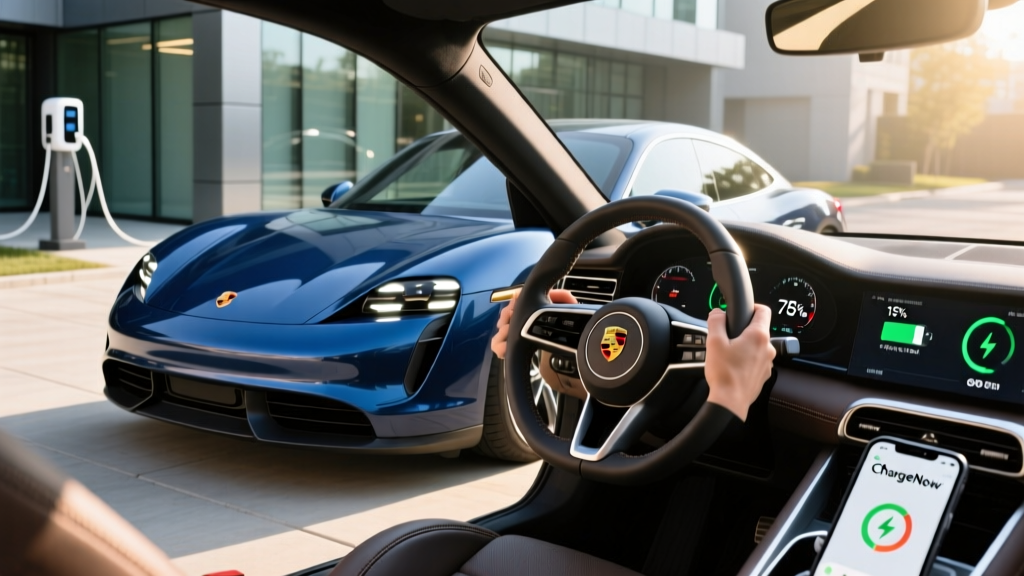
The 2020 Taycan interior is a showcase of screens and premium materials. The dashboard features a curved 16.8-inch digital instrument cluster, an 10.9-inch central infotainment touchscreen, and an 8.4-inch haptic-touch climate control panel on the center console. An optional passenger-side 10.9-inch display was available.
Passenger space is adequate but not generous:
- Front legroom: 41.2 inches
- Rear legroom: 32.7 inches (tight for tall adults)
- Front headroom: 39.3 inches
- Rear headroom: 36.8 inches
Cargo capacity:
- Rear trunk: 14.3 cu ft
- Front trunk (frunk): 2.8 cu ft (fits a small duffel or charging cables)
- Total: ~17.1 cu ft
The frunk is notably small due to the front-mounted power electronics and HVAC components. The rear trunk is practical for groceries and luggage for two, but this is not a road-trip hauler for a family of four with gear.
Infotainment: The Porsche Communication Management (PCM) system runs on a touchscreen with haptic feedback. Apple CarPlay is standard (wired); Android Auto was not available on the 2020 model year — it was added for 2022. If Android Auto is essential, this is a dealbreaker. Navigation includes EV-specific route planning with charging stop suggestions, though the native system is less sophisticated than what Tesla or newer Hyundai/Kia EVs offer.
Driver assistance: The 2020 Taycan offers Porsche InnoDrive (adaptive cruise + lane centering + traffic sign recognition), which is an SAE Level 2 system. The driver must remain fully engaged with hands on the wheel. It performs well on highways but does not offer hands-free operation like GM's Super Cruise or Ford's BlueCruise. Automatic emergency braking, lane-keeping assist, and parking sensors are standard.
Used Pricing and Federal Tax Credit Eligibility
As of early 2026, used 2020 Taycan pricing varies considerably by trim, mileage, and condition:
| Trim | Original MSRP | Typical Used Price (2026) | Used EV Tax Credit (§25E) |
|---|---|---|---|
| Taycan (Base RWD) | $81,350 | $42,000–$50,000 | Up to $4,000 (if sale price ≤ $25,000) |
| Taycan 4S | $103,800 | $48,000–$62,000 | Not eligible (price exceeds $25K cap) |
| Taycan Turbo | $150,900 | $60,000–$78,000 | Not eligible (price exceeds $25K cap) |
| Taycan Turbo S | $185,000 | $72,000–$95,000 | Not eligible (price exceeds $25K cap) |
Tax credit reality for used buyers: The IRS §25E Used Clean Vehicle Credit offers up to $4,000 or 30% of the sale price (whichever is less) for qualifying used EVs. However, the vehicle's sale price must not exceed $25,000 — a threshold that virtually no 2020 Taycan will meet in 2026. The base RWD model at high mileage may approach this range, but most listings remain well above.
For the §30D New Vehicle Credit, this is irrelevant for a 2020 model — that credit applied only at original purchase. The original 2020 Taycan did not qualify for the full $7,500 credit under the pre-2023 rules due to the phase-out timeline for certain manufacturers, and under current rules, battery sourcing and MSRP caps further limit eligibility. Do not factor a federal tax credit into your used Taycan purchase budget.
Battery Warranty, Degradation, and Longevity
Porsche provides an 8-year/100,000-mile battery warranty on the 2020 Taycan, guaranteeing that the battery will retain at least 70% of its original capacity. For a 2020 model, this factory coverage extends through the 2028 model year or 100,000 miles — whichever comes first.
The NMC (nickel-manganese-cobalt) battery cells are manufactured by LG Chem. Real-world degradation data from high-mileage Taycan owners and fleet operators suggests approximately 5–8% capacity loss over the first 100,000 miles under normal use. This is within the expected range for liquid-cooled NMC packs and well above the 70% warranty threshold.
Battery care tips for used Taycan buyers:
- Avoid routinely charging to 100% — the Taycan's battery management system already maintains a top buffer, but daily charging to 80–85% further reduces stress on NMC cells.
- Use DC fast charging when needed, but don't rely on it exclusively; frequent 270 kW sessions accelerate degradation marginally.
- Enable the Taycan's "Battery Care" charging profile (limits charge to 85% and reduces charging power for overnight sessions).
- Request a State of Health (SoH) diagnostic from a Porsche dealer before purchase — this reads the actual remaining capacity percentage.
Full battery replacement cost for the 93.4 kWh Performance Battery Plus pack is estimated at $20,000–$30,000 out of warranty, though individual module replacement is possible at lower cost for localized cell failures.
Pros and Cons
- Class-leading driving dynamics and steering feel
- 270 kW DC fast charging still competitive in 2026
- Repeatable launch performance without thermal throttling
- 800V architecture future-proofs charging infrastructure compatibility
- Premium build quality and materials
- Real-world range often exceeds EPA estimates in city driving
- Battery warranty coverage through 2028 or 100K miles
- EPA range of 192–203 mi trails competitors (Model S: 402 mi)
- No Android Auto on 2020 model year
- Small frunk (2.8 cu ft) limits cargo versatility
- Tight rear legroom (32.7 in) for tall passengers
- No one-pedal driving — requires brake pedal for full stop
- CCS1 connector requires adapter for NACS Supercharger access
- Used prices remain high; virtually no federal tax credit eligibility
- InnoDrive is capable but not hands-free like Super Cruise
Who Should Buy a Used 2020 Porsche Taycan?
Buy the 2020 Taycan 4S if:
- You prioritize driving dynamics over maximum range
- Your daily commute is under 150 miles round-trip
- You have access to home Level 2 charging
- You want a luxury performance sedan that still charges faster than most 2026 EVs
- You value Porsche build quality and brand cachet
- You need 300+ miles of range for frequent road trips (consider a used Tesla Model S or Lucid Air)
- You need seating for four adults comfortably (rear legroom is tight)
- Android Auto is essential to your workflow
- You want hands-free highway driving (consider GM Super Cruise vehicles)
- Your budget is under $45,000 — the Taycan's used market floor is higher
Frequently Asked Questions
What is the real-world range of the 2020 Porsche Taycan?
The 2020 Taycan 4S has an EPA-estimated range of 203 miles. In real-world mixed driving at moderate temperatures, owners report 200–215 miles. Highway driving at 70+ mph drops this to roughly 185–195 miles, and cold weather (below freezing) can reduce range to 150–165 miles on the highway.
How fast does the 2020 Taycan charge at home and on DC fast chargers?
On a Level 2 home charger (240V, 48A), the Taycan charges at 9.6 kW, adding roughly 28–30 miles of range per hour. A full charge from 10% takes about 10.5 hours. On a 350 kW-capable DC fast charger, the Taycan peaks at 270 kW and charges from 10–80% in approximately 22.5 minutes under ideal conditions.
Does the 2020 Porsche Taycan qualify for any federal tax credit in 2026?
As a used vehicle, the Taycan would need to meet the IRS §25E Used Clean Vehicle Credit requirements, including a sale price of $25,000 or less. Since nearly all 2020 Taycans sell well above that threshold in 2026, federal tax credit eligibility is extremely unlikely. The §30D new vehicle credit no longer applies to a 2020 model year.
Is the 2020 Taycan worth buying vs. a used Tesla Model S or Audi e-tron GT?
It depends on priorities. The Taycan outperforms the Audi e-tron GT (which shares the J1 platform but launched later with slightly higher range) in steering feel and build quality perception. Against a used Tesla Model S Long Range, the Taycan sacrifices roughly 200 miles of range but gains significantly in interior quality, ride refinement, and driving engagement. If range is paramount, the Model S wins. If driving dynamics and luxury are paramount, the Taycan is the stronger choice.
What are the biggest ownership costs to watch for?
Insurance premiums for the Taycan run 15–30% higher than comparable gas-powered Porsche Panameras, reflecting repair costs and EV-specific risk assessments. Tire wear is also a factor — the Taycan's weight (approximately 5,100 lbs for the 4S) and instant torque wear through rear tires faster than a comparable ICE sports sedan. Budget $400–$600 per tire for Porsche-spec N-rated rubber. Porsche recommends service intervals every 10,000 miles or annually, with typical costs of $300–$500 per visit for cabin air filter, brake fluid check, and multi-point inspection.
Can I use Tesla Superchargers with the 2020 Taycan?
The 2020 Taycan has a CCS1 charge port. To use Tesla Superchargers equipped with the Magic Dock (CCS adapter built in), you can charge directly. For NACS-only Supercharger stalls, you'll need a third-party CCS-to-NACS adapter. Tesla's official adapter is designed for Tesla vehicles with CCS capability, not for non-Tesla vehicles, so aftermarket adapters from brands like Lectron or A2Z are the practical solution. Always verify adapter compatibility and safety certifications before purchasing.