The 2019 Tesla Model S marked a pivotal year for the luxury electric sedan. It was the last model year before Tesla's major interior refresh and the introduction of the Plaid powertrain, meaning buyers in the used market today are looking at a car that bridges Tesla's "classic" era and its modern lineup. With the Model S Long Range offering an EPA-estimated 370 miles of range and the Performance variant delivering supercar-rivaling acceleration, the 2019 model year remains one of the most compelling used EVs on the market in 2026.
But buying a six-year-old luxury EV requires careful scrutiny of battery health, charging infrastructure compatibility, and real-world efficiency. This guide breaks down every number that matters.
2019 Tesla Model S Quick Specs
| Specification | Long Range | Performance (Raven) |
|---|---|---|
| EPA Range | 370 miles | 345 miles |
| Battery (usable) | ~95 kWh (100 kWh pack) | ~95 kWh (100 kWh pack) |
| Battery Chemistry | NMC (Nickel Manganese Cobalt) | NMC (Nickel Manganese Cobalt) |
| Drivetrain | Dual-Motor AWD | Dual-Motor AWD |
| Horsepower | ~469 hp | ~762 hp (Ludicrous Mode) |
| 0-60 mph | 4.2 seconds | 2.4 seconds (Ludicrous) |
| Top Speed | 155 mph | 163 mph |
| Peak DC Fast Charge | 200 kW (V3 Supercharger) | 200 kW (V3 Supercharger) |
| 10-80% DC Fast Charge | ~30 minutes | ~30 minutes |
| Level 2 Charge Rate | 11.5 kW (~34 mi/hr) | 11.5 kW (~34 mi/hr) |
| MPGe (combined) | 111 MPGe | 104 MPGe |
| kWh/100 mi | 30 kWh | 32 kWh |
| Cargo Volume | 26.3 cu ft (rear) + front trunk | 26.3 cu ft (rear) + front trunk |
| Battery Warranty (original) | 8 yr / 150,000 mi | 8 yr / 150,000 mi |
| Original Base MSRP | $79,990 | $99,990 |
Sources: EPA fueleconomy.gov, Tesla 2019 press materials.
Real-World Range: What the EPA Sticker Doesn't Tell You
Real-World Expectation: 290-330 miles highway; 340-365 miles mixed city/highway. In freezing temperatures (below 32°F), expect 240-290 miles depending on cabin heating usage and preconditioning habits.
The 2019 Model S Long Range's 370-mile EPA rating was class-leading at launch and remains competitive today. The car achieves this through its roughly 95 kWh usable battery capacity (from a 100 kWh gross pack) and the efficiency of the "Raven" powertrain introduced mid-2019, which replaced the front induction motor with a permanent-magnet reluctance motor from the Model 3.
On highway road trips at 70-75 mph, owners consistently report 290-330 miles of usable range before needing to charge. The Model S is a large, heavy sedan with a wide frontal area, and aerodynamic drag penalizes efficiency at sustained highway speeds. City driving with regenerative braking recovers more energy, pushing real-world figures closer to the EPA number.
Cold weather is the significant variable. NMC lithium-ion batteries experience increased internal resistance at low temperatures, and resistive cabin heating draws substantial power. Tesla's heat pump wasn't introduced on the Model S until the 2021 refresh, so the 2019 model relies on a PTC (positive temperature coefficient) heater that can pull 5-7 kW in extreme cold. Preconditioning the battery and cabin while plugged in is essential for preserving range in winter climates.
Charging Speed: DC Fast Charge and Home Level 2
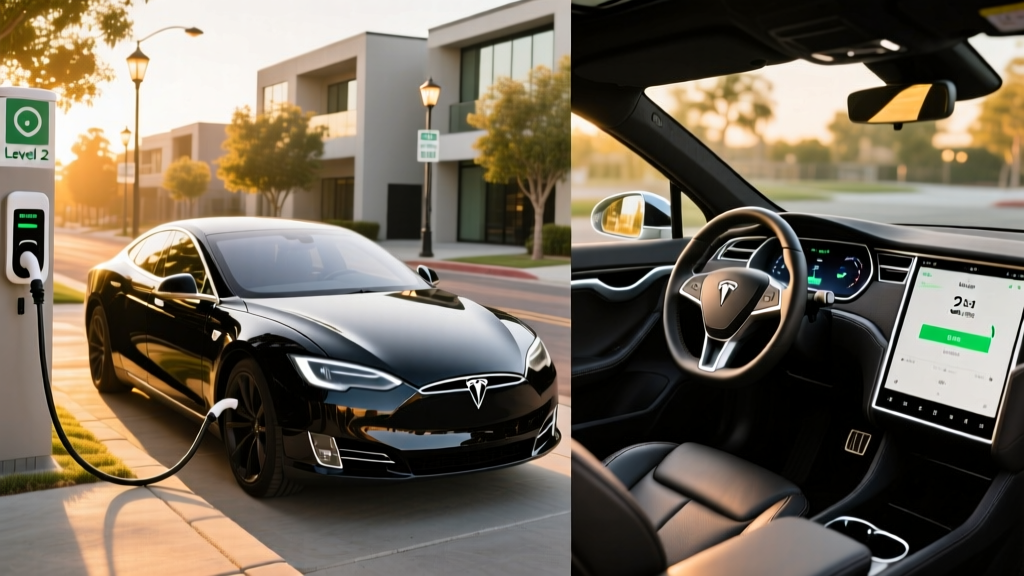
The 2019 Model S supports Tesla's proprietary connector and has full access to the Tesla Supercharger network — one of the strongest ownership advantages in 2026, even as the network opens to NACS-adapted non-Tesla EVs. Here's what charging looks like across all levels:
| Charging Level | Power (kW) | Speed (miles added/hr) | Notes |
|---|---|---|---|
| Level 1 (120V household) | ~1.4 kW | ~3-4 mi/hr | Emergency/trickle only |
| Level 2 (240V, 48A) | 11.5 kW | ~34 mi/hr | Full overnight charge in ~9-10 hrs |
| Level 2 (240V, 40A) | 9.6 kW | ~29 mi/hr | Common Wall Connector setting |
| DC Fast (V3 Supercharger) | Up to 200 kW peak | ~750 mi/hr (peak) | 10-80% in ~30 min |
| DC Fast (V2 Supercharger) | Up to 150 kW peak | ~560 mi/hr (peak) | 10-80% in ~40 min |
| DC Fast (CCS via adapter) | Up to 150 kW | Varies | Requires Tesla CCS adapter |
The 2019 Model S peaks at approximately 200 kW on V3 Superchargers, but — as with all EVs — that peak is not sustained. The charge curve tapers significantly above 50% state of charge (SoC). Expect roughly 200 kW from 10-30%, tapering to ~120 kW by 50%, and dropping to ~60 kW by 70%. This is why the 10-80% time of roughly 30 minutes is a more useful metric than peak kW alone.
For home charging, the onboard charger accepts up to 11.5 kW (48 amps) on a 60-amp circuit. A Tesla Wall Connector or equivalent Level 2 station on a dedicated 240V/60A circuit will fully recharge the battery overnight in roughly 9-10 hours. Most owners find that plugging in nightly and charging to 80-90% (to preserve NMC battery longevity) provides more than enough daily range without ever visiting a public charger during the week.
CCS adapter note: Tesla sells a CCS Combo 1 adapter that enables the 2019 Model S to charge on Electrify America, EVgo, and other CCS-equipped networks. This is valuable for road trips through areas with sparse Supercharger coverage, though Supercharger reliability remains superior in most regions.
Performance and Driving Dynamics
The 2019 Model S Performance with Ludicrous Mode remains one of the quickest production cars ever built. The 2.4-second 0-60 mph time is not a theoretical number — it's repeatable, launch-after-launch, thanks to the instant torque delivery of dual electric motors and Tesla's sophisticated traction control. Even without Ludicrous, the Performance model hits 60 mph in approximately 3.0 seconds.
The Long Range variant's 4.2-second 0-60 time is still firmly in sports-sedan territory, and for most buyers it represents the smarter value proposition. The dual-motor all-wheel-drive system provides confident traction in rain and light snow, and the air suspension (standard on all 2019 Model S trims) adjusts ride height for highway efficiency or rough-road comfort.
Driving dynamics are a mixed story. The Model S is a large, heavy car (approximately 4,900 lbs), and while the low center of gravity from the floor-mounted battery pack minimizes body roll, it doesn't feel as agile as a Porsche Taycan or even a BMW i5 through tight corners. Where the Model S excels is effortless highway cruising, passing power, and the one-pedal driving experience that strong regenerative braking enables.
Interior, Tech, and Cargo Space
The 2019 Model S interior is where the car's age shows most clearly compared to the 2021+ refresh. The 17-inch center touchscreen (vertically oriented in pre-refresh models) remains responsive, and Tesla's over-the-air updates have kept the infotainment software current through 2026. Navigation, streaming media, and the Tesla app integration all function well.
However, build quality on 2019 models is inconsistent. Panel gaps, creaking trim, and premature seat-bolster wear are common complaints in owner forums. The minimalist dashboard design appeals to some and frustrates others — there are virtually no physical buttons, and even the glovebox opens via the touchscreen.
Cargo dimensions:
- Rear cargo (behind second row): 26.3 cu ft
- Rear cargo (seats folded): 58.1 cu ft
- Front trunk (frunk): 5.3 cu ft
- Rear legroom: 35.4 inches
- Front legroom: 42.7 inches
The hatchback-style liftgate and flat load floor make the Model S remarkably practical for a sedan. The frunk adds useful space for charging cables or a small bag. Compared to the Porsche Taycan's more traditional trunk and smaller frunk, the Model S offers meaningfully more usable cargo volume.
Autopilot and Driver Assistance
The 2019 Model S came with basic Autopilot standard (Traffic-Aware Cruise Control and Autosteer). Enhanced Autopilot ($6,000 at the time) added Auto Lane Change, Navigate on Autopilot, Autopark, and Summon. Full Self-Driving capability was available as an $8,000 option (now higher) and has received continuous over-the-air updates since purchase.
In 2026, FSD Supervised on a 2019 Model S running current software is capable of handling most highway and many city driving scenarios, but it still makes errors at complex intersections, construction zones, and unusual road geometries. The 2019 hardware (Hardware 3 / HW3 computer, installed from approximately April 2019 onward) supports current FSD features, but earlier 2019 vehicles with Hardware 2.5 may have limitations. Verify the hardware version with Tesla before purchasing.
Safety ratings: The 2019 Model S received a 5-star overall rating from NHTSA and performed well in IIHS testing, though it predates some of the more rigorous updated IIHS test protocols.
Used Pricing and Federal Tax Credit Eligibility
As of early 2026, the 2019 Tesla Model S trades on the used market in the following approximate ranges:
| Trim | Mileage Range | Used Price (approx.) |
|---|---|---|
| Long Range | 50,000-80,000 mi | $32,000 - $40,000 |
| Performance | 40,000-70,000 mi | $38,000 - $48,000 |
| Performance (Ludicrous) | 30,000-60,000 mi | $42,000 - $55,000 |
Prices vary significantly based on mileage, battery state of health (SoH), Autopilot/FSD package inclusion, color, and service history. Vehicles with FSD purchased outright command a premium, though the value of FSD on a used Tesla is debated — it's tied to the car, not the owner, which is an advantage.
Does the 2019 Model S Qualify for the Federal Used EV Tax Credit?
Yes, potentially — under IRS §25E (the used clean vehicle credit), not §30D (which applies only to new vehicles). Here are the requirements:
- Credit amount: 30% of the sale price, up to a maximum of $4,000
- Vehicle price cap: The used vehicle must sell for $25,000 or less to qualify
- Buyer income limits: AGI must not exceed $75,000 (single), $112,500 (head of household), or $150,000 (joint)
- Vehicle age: Must be at least 2 model years old (2019 qualifies)
- Dealer requirement: Must be purchased from a licensed dealer (not private party)
- Battery capacity: Must have at least 7 kWh (Model S has ~100 kWh — qualifies)
The practical reality: Most 2019 Model S vehicles sell above the $25,000 price cap, meaning the used EV credit is unavailable for the majority of listings. If you find a higher-mileage Long Range example at or below $25,000 from a dealer, and your income qualifies, you could receive up to $4,000 as a point-of-sale reduction. Always verify current rules at IRS.gov and consult a tax professional before relying on credit eligibility.
Battery Health, Warranty, and Longevity
The 2019 Model S uses an NMC (nickel manganese cobalt) lithium-ion battery pack with approximately 100 kWh gross capacity (~95 kWh usable). NMC chemistry offers high energy density but is more sensitive to charging habits than LFP (lithium iron phosphate) packs found in some newer Tesla vehicles.
Original battery warranty: 8 years or 150,000 miles, whichever comes first, with a minimum 70% capacity retention threshold. For a 2019 model, this warranty expires in 2027 at the latest — meaning many examples still have active battery coverage in 2026.
Real-world degradation data: Based on aggregated owner reports and fleet data, 2019 Model S batteries with 80,000-120,000 miles typically show 8-14% degradation (86-92% state of health). Vehicles that were consistently charged to 100% and frequently Supercharged at high power tend to show more degradation. Those charged to 80-90% daily and preconditioned before fast charging retain capacity better.
Battery replacement cost: If the battery fails outside warranty, a replacement pack for the 2019 Model S costs approximately $15,000-$22,000 including labor at a Tesla service center. Third-party EV battery shops may offer refurbished packs for $10,000-$15,000. This is a significant financial risk on an out-of-warranty vehicle — always request a battery health report or third-party SoH assessment before purchase.
Pros and Cons
- Class-leading 370-mile EPA range (Long Range)
- Supercharger network access with CCS adapter flexibility
- Supercar-rivaling 2.4s 0-60 (Performance Ludicrous)
- Hatchback cargo practicality with 26.3 cu ft + frunk
- Continuous OTA software updates through 2026
- Air suspension standard on all trims
- Strong NHTSA 5-star safety rating
- Pre-refresh interior shows age; inconsistent build quality
- No heat pump — cold-weather range loss is significant
- NMC battery degrades faster than LFP if poorly maintained
- Most used examples exceed $25K used-EV credit cap
- Battery replacement cost ($15K-$22K) is a real financial risk
- High insurance premiums relative to used-market value
- HW2.5 vehicles may lack latest FSD capabilities
Who Should Buy the 2019 Tesla Model S?
Choose the 2019 Model S Long Range if: You want maximum range for highway commuting and road trips, value Supercharger access, and can accept the older interior. It's ideal for high-mileage commuters (30+ miles each way) who charge at home and need a comfortable, spacious sedan with real cargo versatility.
Choose the 2019 Model S Performance if: You want supercar acceleration in a practical daily driver and are willing to sacrifice ~25 miles of range for it. Best for enthusiasts who want Ludicrous Mode thrills without maintaining a second vehicle.
Look elsewhere if: You live in an extreme-cold climate (the lack of a heat pump is a genuine drawback), you need the latest interior quality (consider a 2021+ refresh Model S or a BMW i5), or you want the lowest total cost of ownership (a used Model 3 or Hyundai Ioniq 5 will cost significantly less to insure and maintain).
2019 Model S vs. Key Used EV Competitors
| Metric | 2019 Tesla Model S LR | 2020 Porsche Taycan 4S | 2020 Lucid Air (N/A) | 2021 BMW i5 eDrive40 |
|---|---|---|---|---|
| Used Price (approx.) | $32K-$40K | $45K-$58K | N/A (newer) | $40K-$50K |
| EPA Range | 370 mi | 203 mi | N/A | 295 mi |
| 0-60 mph | 4.2 sec | 3.8 sec | N/A | 5.5 sec |
| DC Fast Charge (peak) | 200 kW | 270 kW | N/A | 205 kW |
| Cargo (cu ft) | 26.3 + frunk | 14.3 + frunk | N/A | 17.3 |
| Heat Pump | No | Yes | N/A | Yes |
The Model S wins on range, cargo space, and value. The Taycan wins on build quality, driving dynamics, and 800V charging architecture. The BMW i5 offers a more modern interior with a heat pump but less range and no frunk. For pure range-per-dollar on the used market, the 2019 Model S Long Range is difficult to beat.
Frequently Asked Questions
What is the real-world range of the 2019 Tesla Model S?
Expect 290-330 miles on the highway and 340-365 miles in mixed driving for the Long Range trim. In freezing weather, range drops to 240-290 miles. The Performance variant loses roughly 25-40 miles from these figures.
How fast does the 2019 Model S charge?
On a V3 Supercharger, it peaks at 200 kW and charges from 10-80% in approximately 30 minutes. At home on a 240V/48A Level 2 charger, it adds about 34 miles per hour, fully charging overnight in 9-10 hours.
Does the 2019 Model S qualify for the federal EV tax credit?
Not the new-vehicle §30D credit. It may qualify for the §25E used clean vehicle credit (up to $4,000) if the sale price is $25,000 or less, purchased from a dealer, and the buyer meets income limits. Most 2019 Model S listings exceed the $25,000 price cap, making eligibility uncommon. Verify rules at IRS.gov.
Is the 2019 Model S worth buying in 2026 vs. competitors?
For range-per-dollar and Supercharger access, yes — it remains one of the best used EV values. For interior quality and driving dynamics, the Porsche Taycan is superior. For a more modern cabin with a heat pump, consider a 2021+ Model S refresh or a BMW i5.
How long will the 2019 Model S battery last?
NMC batteries in the 2019 Model S typically show 8-14% degradation at 80,000-120,000 miles. With proper charging habits (80-90% daily limit, preconditioning before fast charges), many packs retain 80%+ capacity beyond 150,000 miles. The original 8-year/150,000-mile warranty still covers many 2019 examples through 2027.
Does the 2019 Model S have Autopilot or Full Self-Driving?
Basic Autopilot (Traffic-Aware Cruise Control and Autosteer) is standard. Enhanced Autopilot and FSD were optional. FSD is SAE Level 2 driver assistance — the driver must remain fully engaged. Verify whether the car has HW3 (required for latest FSD features) before purchasing.