Quick Verdict: The Original EV Bargain Shows Its Age
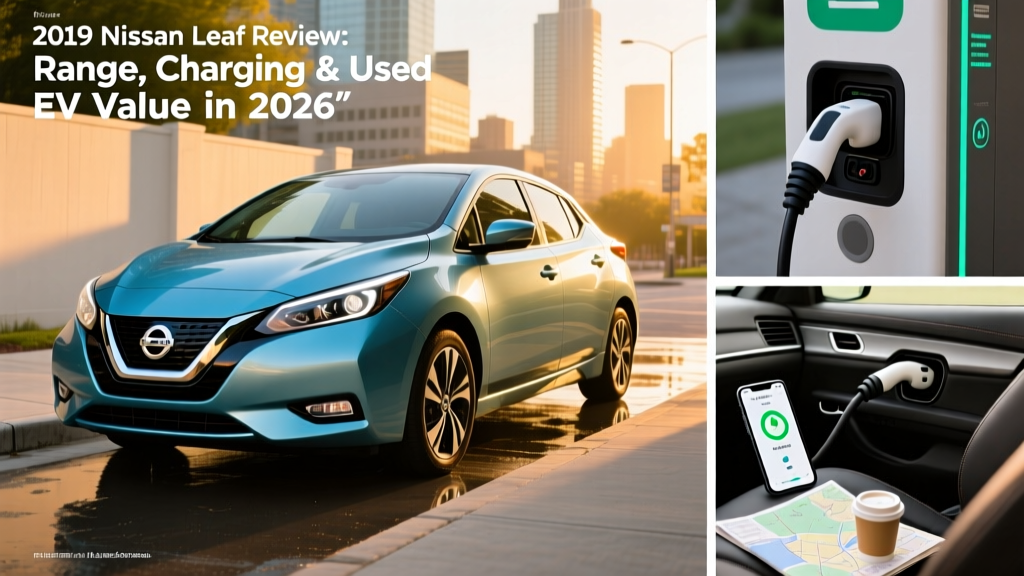
The 2019 Nissan Leaf occupies a strange space in 2026. As a new car, it was the best-selling EV in history for years — practical, affordable, and approachable. As a used purchase today, it remains one of the cheapest ways to get into a battery-electric vehicle, with examples trading between $8,000 and $16,000 depending on battery health, mileage, and trim. But the Leaf's passive air-cooled battery, CHAdeMO charging connector, and modest fast-charge speeds mean buyers need to go in with eyes wide open.
For a daily commuter covering under 100 miles round-trip with reliable home Level 2 charging, a well-maintained 2019 Leaf is still a compelling budget EV. For anyone planning frequent road trips or living in a hot climate where battery degradation accelerates, newer competitors offer substantially better long-term value. Here's every number that matters.
Range & Efficiency: Two Batteries, Two Very Different Experiences
The 2019 Leaf came in two distinct configurations — and the difference is critical for used buyers evaluating listings today.
| Spec | Leaf S / SV (Standard) | Leaf S Plus / SV Plus / SL Plus |
|---|---|---|
| Usable Battery Capacity | 40 kWh (NMC lithium-ion) | 62 kWh (NMC lithium-ion) |
| EPA Range | 151 miles | 226 miles |
| EPA Efficiency | 111 MPGe (30 kWh/100 mi) | 104 MPGe (33 kWh/100 mi) |
| Motor Output | 110 kW (147 hp) | 160 kW (214 hp) |
| Drivetrain | FWD (single motor) | FWD (single motor) |
| 0–60 mph | ~7.9 sec | ~6.5 sec |
The EPA numbers above assume moderate temperatures and mixed driving. In practice:
- Highway (70 mph, 75°F): Expect ~125–135 miles from the 40 kWh model, ~190–205 miles from the 62 kWh Plus.
- Cold weather (30°F, city/highway mix): Range drops 20–35% without a heat pump. The Leaf uses resistive cabin heating, which draws heavily from the pack — expect ~95–115 miles (40 kWh) or ~155–175 miles (62 kWh).
- 2026 battery degradation factor: A seven-year-old Leaf in a hot climate (Arizona, Texas) may have lost 15–25% of original capacity. A 40 kWh pack showing 10/12 bars on the dashboard health meter might deliver only ~115 real-world miles. Always check the battery bar indicator before purchasing.
The efficiency gap between the two trims is small — the heavier Plus pack and more powerful motor offset the larger battery. Both versions are competitive with contemporaries like the Chevrolet Bolt EV and Hyundai Kona Electric on a kWh-per-mile basis.
Charging: The CHAdeMO Challenge in a NACS World
This is where the 2019 Leaf requires the most honest assessment for a 2026 buyer. Nissan used the CHAdeMO DC fast-charging standard, and the industry has overwhelmingly shifted to CCS1 and now NACS (Tesla's connector, adopted by Ford, GM, Rivian, Hyundai, and others). CHAdeMO chargers are becoming scarce at public stations.
| Charging Level | 40 kWh Leaf | 62 kWh Leaf Plus |
|---|---|---|
| Level 1 (120V, 12A) | ~1.4 kW — 4 mi/hr | ~1.4 kW — 3.5 mi/hr |
| Level 2 (240V, 32A OEM EVSE) | 6.6 kW — ~22 mi/hr (full in ~7.5 hr) | 6.6 kW — ~22 mi/hr (full in ~11.5 hr) |
| DC Fast Charge (CHAdeMO) | 50 kW peak — 10–80% in ~40 min | 100 kW peak — 10–80% in ~45 min |
Charging curve reality: The 40 kWh model's 50 kW peak is a hard cap — you won't see faster charging regardless of the station. The 62 kWh Plus can accept up to 100 kW, but only in a narrow state-of-charge window (roughly 10–40%). Above 60% SoC, speeds taper sharply to under 40 kW, and above 80% they drop further. This means the advertised 10–80% time is achievable but the back half of the charge takes disproportionately long.
Thermal management warning: The Leaf uses passive air cooling for its battery pack — no liquid thermal management. In hot weather or during repeated DC fast-charge sessions (what owners call "Rapidgate"), the battery heats up and the car throttles charge speed to protect cells. On a summer road trip with two DC stops, your second session may peak at only 30–40 kW even on the Plus model.
Connector adapters: CHAdeMO-to-CCS adapters exist but are expensive ($250–$400) and not universally reliable. CHAdeMO-to-NACS adapters are less common. If your local public charging infrastructure is predominantly CCS or NACS, factor adapter cost and availability into your decision.
Performance & Driving Impressions
The standard 40 kWh Leaf's 147 hp and 236 lb-ft of torque provide adequate city acceleration but feel strained at highway merging speeds. The Plus model's 214 hp and 250 lb-ft transform the character — it's genuinely quick off the line and confident at speed.
Both versions are front-wheel drive with a single-speed reduction gear. Regenerative braking operates in two modes: standard "D" with mild regen and coasting, or "B" mode with stronger regen that approaches one-pedal driving but doesn't bring the car to a complete stop (you still need the friction brake). Nissan's e-Pedal mode enables true one-pedal driving to a full stop, which is among the smoothest implementations from this era.
Ride quality is comfortable and compliant — the Leaf prioritizes comfort over sportiness. Cabin noise is low at city speeds but wind and tire noise become noticeable above 65 mph. The turning radius is tight at 34.4 feet, making it excellent for urban parking.
Interior, Cargo & Technology
The 2019 Leaf's interior is functional rather than exciting. Soft-touch materials appear on the dashboard and door uppers, but hard plastics dominate the lower cabin. Seating is comfortable for four adults; the fifth rear seat is narrow.
| Dimension | Measurement |
|---|---|
| Front Headroom | 41.2 in |
| Front Legroom | 42.1 in |
| Rear Headroom | 37.3 in |
| Rear Legroom | 33.5 in |
| Cargo (rear seats up) | 23.6 cu ft |
| Cargo (rear seats folded) | 30.0 cu ft |
Infotainment: The SV and SL trims include an 8-inch touchscreen with Apple CarPlay and Android Auto (wired). The S trim uses a smaller 5-inch display. Navigation is available on SL. All trims include a rearview camera. The instrument cluster combines a digital speedometer with an analog power meter — clear and legible but dated compared to the full-digital clusters in the Bolt or Kona Electric.
ProPILOT Assist: Available on SV and standard on SL, Nissan's ProPILOT Assist is an SAE Level 2 driver-assistance system combining adaptive cruise control with lane-centering steering. It works well on divided highways but requires hands on the wheel at all times. It does not handle stoplights, stop signs, or highway exits. This is not autonomous driving — the driver remains fully responsible.
Notable drawbacks:
- No frunk (front trunk) — the space is occupied by power electronics
- Cargo floor is higher than competitors due to battery placement, reducing under-floor storage
- DC fast-charge port lacks a locking mechanism on early builds (check for the updated latch)
- No battery preconditioning feature — cold-weather DC charging is slow until the pack warms through use
Pricing, Tax Credits & Used Market Value
The 2019 Leaf's original MSRP ranged from $29,990 (S trim) to $43,550 (SL Plus with premium packages). Federal tax credits of up to $7,500 were available to original buyers, though Nissan had not yet hit the 200,000-vehicle manufacturer cap in 2019.
For 2026 used buyers, the relevant incentive is the §25E Previously Owned Clean Vehicle Credit, which provides up to $4,000 or 30% of the sale price (whichever is less) for qualifying used EVs.
| Factor | Details |
|---|---|
| 2019 Leaf Used Price Range (2026) | $8,000–$16,000 (depending on trim, mileage, battery bars) |
| Max §25E Used-EV Credit | $4,000 or 30% of sale price (whichever is less) |
| Buyer Income Cap (§25E) | $75,000 single / $112,500 head of household / $150,000 joint |
| Vehicle Price Cap (§25E) | Sale price must be $25,000 or less (Leaf qualifies) |
| Dealer Requirement | Must purchase from a licensed dealer (private sales excluded) |
| Point-of-Sale Transfer | Yes — credit can reduce purchase price at closing |
Example math: A 2019 Leaf SV (40 kWh) purchased from a dealer for $11,500 by a qualifying buyer could receive a $3,450 credit (30% of $11,500), bringing the effective price to ~$8,050. A Leaf SL Plus at $15,000 could net a $4,000 credit, dropping to ~$11,000. Always verify current IRS §25E eligibility rules before purchasing, as regulations may shift.
Battery health drives value: Nissan's dashboard displays battery capacity as 12 bars. A 2019 Leaf showing 12/12 bars commands a premium ($2,000–$4,000 more than a comparable 10-bar car). Request a LeafSpy OBD-II reading before purchasing — it provides precise state-of-health percentage, far more accurate than the dashboard bars alone.
Warranty & Battery Longevity
Nissan's original warranty coverage for the 2019 Leaf:
- Battery capacity warranty: 8 years / 100,000 miles — guarantees the pack retains at least 66.25% of original capacity (9 bars out of 12)
- Battery component warranty: 8 years / 100,000 miles (covers defects)
- Powertrain warranty: 5 years / 60,000 miles
- Bumper-to-bumper: 3 years / 36,000 miles
For a 2026 buyer, the 8-year battery warranty is nearing expiration on most 2019 Leafs (expiring between 2027–2028 depending on purchase date). If you buy a low-mileage example still within warranty, a battery that drops below 9 bars can be replaced by Nissan — though replacement batteries for the 40 kWh model are scarce and the 62 kWh pack reportedly costs $15,000–$20,000+ out of warranty.
Degradation data: The Leaf's passively cooled NMC battery degrades faster than liquid-cooled competitors, especially in hot climates. Data aggregated from Leaf owners shows typical capacity retention of 85–92% at 5 years in moderate climates, but 70–82% in consistently hot environments. This is the single biggest risk factor for used Leaf buyers.
Pros, Cons & Who Should Buy
Pros
- Among the cheapest used EVs available — effective price under $10K with tax credit
- Comfortable ride, easy to drive, tight turning radius for city use
- e-Pedal one-pedal driving is smooth and intuitive
- 62 kWh Plus model offers 226-mile EPA range — adequate for most commuters
- ProPILOT Assist is competent Level 2 highway assist
- Hatchback cargo flexibility with 23.6 cu ft behind rear seats
Cons
- CHAdeMO connector is a dying standard — public DC charging access is shrinking
- Passive air-cooled battery degrades faster than liquid-cooled rivals
- Rapidgate: repeated DC fast charging in heat causes severe speed throttling
- No battery preconditioning — cold-weather DC charging is painfully slow
- 40 kWh model's 151-mile EPA range is limiting even for a commuter
- No frunk; cargo floor is higher than competitors
- Dated interior materials and infotainment compared to 2022+ EVs
Best for: Budget-conscious commuters with reliable home Level 2 charging, driving under 80 miles round-trip daily, in moderate climates. The Plus model extends this to 120-mile commutes with margin.
Skip it if: You lack home charging and depend on public DC fast chargers (CHAdeMO availability is a real problem), you live in a hot climate (accelerated degradation), or you need road-trip capability (slow charging + shrinking CHAdeMO network makes long trips frustrating).
2019 Leaf vs. Key Used Competitors
In the $8,000–$16,000 used EV market, the 2019 Leaf competes against the Chevrolet Bolt EV (2017–2019), Hyundai Kona Electric (2019–2020), and the Tesla Model 3 (2018, higher-mileage examples). The Bolt's CCS connector, liquid-cooled battery, and 238-mile range make it a stronger all-around pick if you can find one in your budget. The Kona Electric offers 258 miles and CCS but tends to command higher used prices. The Model 3 offers the Supercharger network and over-the-air updates but starts above $18,000 for most 2018 examples.
The Leaf wins purely on entry price — it's the cheapest path to a modern-ish EV with over 150 miles of range. But the total ownership equation shifts when you factor in CHAdeMO charging limitations and faster battery degradation.
Frequently Asked Questions
What is the real-world range of the 2019 Nissan Leaf?
The 40 kWh model delivers roughly 125–135 miles on the highway in moderate weather, dropping to 95–115 miles in cold conditions. The 62 kWh Plus manages 190–205 highway miles in fair weather, 155–175 in cold. A seven-year-old battery with degradation will reduce these figures proportionally — check battery health bars before buying.
How fast does the 2019 Leaf charge?
On Level 2 (240V), both models accept 6.6 kW, adding about 22 miles of range per hour. On DC fast charge, the 40 kWh model peaks at 50 kW (10–80% in ~40 minutes), while the 62 kWh Plus peaks at 100 kW (10–80% in ~45 minutes). Both use the CHAdeMO connector, which is increasingly rare at public stations.
How much does a used 2019 Leaf cost after tax credits?
Used prices range from $8,000–$16,000 in 2026. The federal §25E used-EV credit provides up to $4,000 or 30% of the sale price (whichever is less), subject to buyer income caps ($75K single / $150K joint) and a $25,000 vehicle price cap. A $12,000 Leaf could drop to ~$8,400 after the credit when purchased from a licensed dealer.
Is the 2019 Nissan Leaf worth buying vs. competitors?
It depends on your priorities. If absolute lowest entry price is paramount and you have home charging in a moderate climate, the Leaf is hard to beat. If you need public DC charging, road-trip capability, or live in a hot climate, the Chevrolet Bolt EV (258 miles, CCS, liquid-cooled) is the stronger used buy at a slightly higher price.
Does the 2019 Leaf qualify for any federal EV tax credit?
Not the new-vehicle §30D credit (that applies only to new purchases). However, used buyers may qualify for the §25E Previously Owned Clean Vehicle Credit — up to $4,000 or 30% of sale price. Requirements include purchasing from a dealer, meeting income caps, and the vehicle sale price being under $25,000. Verify rules at IRS.gov before purchasing.
How long will the 2019 Leaf battery last?
Nissan's data and owner reports suggest the passively cooled NMC pack retains 70–92% capacity at 5–7 years depending on climate. In hot regions, expect faster degradation. The original 8-year/100,000-mile capacity warranty (minimum 66.25% retention) is expiring on most 2019 models between 2027–2028. Out-of-warranty battery replacement costs $15,000–$20,000+, making a healthy battery the single most important factor in a used purchase.