Quick Verdict: Still a Benchmark Used EV in 2026
The 2019 Tesla Model 3 Performance rewrote the rules for affordable electric sedans when it launched, and in 2026 it remains one of the sharpest used-EV buys on the market. A dual-motor AWD powertrain, 310 miles of EPA range, and a 3.2-second 0-60 mph time still embarrass sports sedans costing twice as much. For buyers targeting the keyword 2019 Model 3 Performance 0-60, the answer is simple: yes, it still hits that number on a prepared surface with warm tires, though real-world street runs typically clock 3.4-3.6 seconds once you factor in rollout and surface conditions.
As a used purchase, the 2019 Performance is compelling because it qualifies for the federal used-EV tax credit (up to $4,000 under IRC §25E) — not the new-vehicle §30D credit — and prices on the secondary market have settled into the $22,000-$28,000 range depending on mileage and battery State of Health (SoH). It's not flawless: the minimalist interior, firm ride, and panel-gap inconsistencies are well-documented. But for a driver who wants a fast, efficient, tech-forward daily with access to the Supercharger network, this is still a top-tier pick.
Range, Battery, and Efficiency
The 2019 Model 3 Performance ships with a ~75 kWh usable NMC (nickel-manganese-cobalt) battery pack — Tesla never published exact usable capacity, but teardowns and owner data consistently place it at 74-76 kWh depending on the specific cell batch (Panasonic 2170 cells). This is not an LFP pack; LFP chemistry arrived in Model 3 Standard Range variants later and uses a different charge-to-100% routine.
Real-World Expectation: 260-285 miles in mixed driving at 65-70 mph; 220-250 miles in sustained 80+ mph highway travel; 200-230 miles in sub-30°F cold weather without preconditioning. Cold-weather range loss of 25-35% is typical for NMC packs without consistent garage storage.
Efficiency on the EPA cycle is rated at 116 MPGe combined (29 kWh/100 mi), making the 2019 Performance one of the most efficient high-output EVs ever sold. On the real-world highway at 70 mph, expect closer to 250-270 Wh/mi (37-40 kWh/100 mi) without a tailwind — still exceptional for a 4,200-lb dual-motor AWD sedan.
| Spec | Value |
|---|---|
| EPA Range | 310 miles |
| Battery (usable) | ~75 kWh, NMC (Panasonic 2170) |
| EPA Efficiency | 116 MPGe / 29 kWh/100 mi |
| Drivetrain | Dual-motor AWD |
| Horsepower | ~450 hp (combined) |
| Torque | ~471 lb-ft |
| 0-60 mph | 3.2 sec (manufacturer, rollout-adjusted) |
| Top Speed | 162 mph |
| Cargo (trunk + frunk) | 15 cu ft trunk + 3.1 cu ft frunk |
| Curb Weight | 4,251 lb |
Charging Speed: DC Fast, Level 2, and Supercharger Access
The 2019 Model 3 Performance supports a peak DC fast-charge rate of approximately 250 kW on V3 Superchargers (introduced the same year). On a warm, preconditioned pack at a V3 stall, expect a 10-80% charge in roughly 25-28 minutes. On older V2 Superchargers capped at 150 kW, plan for 35-40 minutes for the same window.
| Level | Power | Speed (approx.) | Notes |
|---|---|---|---|
| Level 1 (120V) | ~1.4 kW | ~5 mi/hr | Emergency/trickle only |
| Level 2 (240V, 48A) | 11.5 kW | ~44 mi/hr | Home Wall Connector |
| DC Fast (V3 Supercharger) | 250 kW peak | 10-80% in ~27 min | Requires preconditioning |
| DC Fast (V2 Supercharger) | 150 kW peak | 10-80% in ~38 min | Older stalls |
| CCS (with adapter) | Up to 250 kW | Varies by network | Tesla now sells CCS adapter |
Level 2 home charging is handled via the Tesla Wall Connector (48A) or any J1772 station with a Tesla adapter. A full 0-100% Level 2 charge takes about 7-8 hours — ideal for overnight replenishment. One ownership reality: the charge curve tapers sharply above 80% SoC to protect the NMC pack, so DC fast charging past 80% is painfully slow. Plan your road-trip stops around the 10-80% window.
Tesla opened the Supercharger network to non-Tesla EVs in recent years, but Tesla owners still benefit from native NACS integration — no adapter needed at Superchargers — and automatic plug-and-charge billing. According to Tesla's Supercharger page, the network now exceeds 60,000 fast chargers globally, with dense U.S. coverage along interstate corridors.
Performance: The 0-60 Story and Driving Dynamics
The headline number — 3.2 seconds 0-60 mph — was measured by Tesla using a 1-foot rollout, the industry-standard drag-racing convention. Independent testers (Motor Trend, Car and Driver) consistently reproduced 3.2-3.4 second runs on prepped surfaces. On a typical public road with ambient asphalt, 3.5-3.8 seconds is more realistic, which still demolishes the BMW M340i and Audi S4 of the same era.
Dual-motor AWD delivers instant torque with no turbo lag, and the Performance trim adds Track Mode (added via OTA update in 2019), which allows adjustable torque distribution and aggressive regen settings for closed-course driving. The steering is quick and precise, though numb by enthusiast standards — classic Tesla. Ride quality is firm; the Performance trim sits on a lowered sport suspension with 20-inch wheels and low-profile rubber, so potholes and expansion joints communicate clearly to the cabin.
Interior, Tech, and Cargo
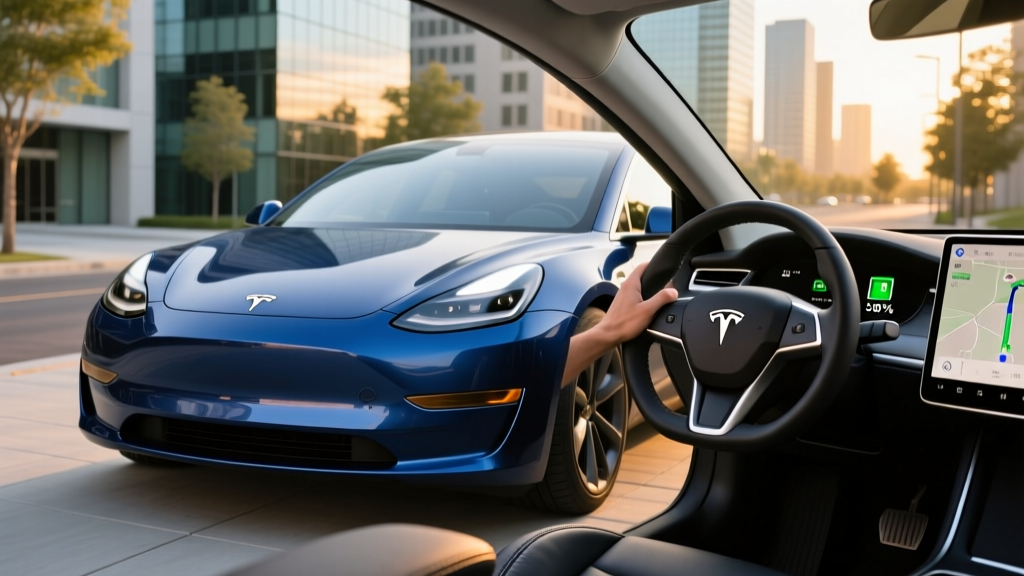
The 2019 Model 3 interior is famously minimalist: a single 15-inch center touchscreen handles infotainment, climate, navigation, and vehicle settings. There is no instrument cluster; speed and range appear in the upper-left corner of the main display. The navigation system is excellent and integrates live Supercharger availability with automatic battery preconditioning when a charger is selected as the destination.
Standard tech includes Autopilot basic functionality (Traffic-Aware Cruise Control and Autosteer — SAE Level 2, requiring driver supervision), over-the-air software updates, a premium 14-speaker audio system, heated front and rear seats, a panoramic glass roof, and phone-as-key via Bluetooth. Enhanced Autopilot and Full Self-Driving (Supervised) were optional — FSD capability was a $5,000-$7,000 add at the time, and its value on a used car depends heavily on whether the subscription or one-time purchase transferred with the vehicle.
Cargo space totals 15 cubic feet in the trunk (plus a shallow under-floor well) and 3.1 cubic feet in the frunk. Rear legroom is 35.2 inches — adequate for adults on shorter trips but tight for tall passengers on long hauls. The glass roof creates an airy feel but contributes to significant cabin heat gain in summer; a ceramic tint or aftermarket shade is a common owner upgrade.
Pricing, Used Market, and Tax Credit Eligibility
When new, the 2019 Model 3 Performance carried a base MSRP of $56,990 (before destination), rising to the low $60,000s with options like red paint, FSD, and 20-inch Performance wheels. In 2026's used market, expect to pay:
| Condition | Mileage | Price Range |
|---|---|---|
| Excellent (dealer CPO) | <40k mi | $27,000 - $30,000 |
| Good (private/CarmaX) | 40k-70k mi | $23,000 - $27,000 |
| Fair (high mileage) | 70k-100k mi | $19,000 - $23,000 |
The new-vehicle §30D federal tax credit does not apply to used purchases. However, the used clean vehicle credit under IRC §25E may provide up to $4,000 (30% of sale price, capped at $4,000) if the following conditions are met, per IRS guidance:
- Sale price is $25,000 or less (the $4,000 credit maxes out at this threshold)
- Buyer's modified AGI does not exceed $75,000 (single), $112,500 (head of household), or $150,000 (joint)
- Vehicle is purchased from a licensed dealer (private-party sales do not qualify)
- Vehicle is at least 2 model years old (easily met for a 2019)
- Buyer has not claimed another used clean vehicle credit in the prior 3 years
- Vehicle battery meets the 7 kWh minimum (75 kWh far exceeds this)
Point-of-sale transfer is available for the used credit as of 2024, meaning the dealer can apply the credit directly to the purchase price — a significant cash-flow advantage. Always confirm eligibility with a tax professional; rules are subject to legislative change.
Warranty and Long-Term Ownership
Tesla's original warranty on the 2019 Model 3 Performance includes:
- Basic Vehicle: 5 years / 60,000 miles
- Battery & Drive Unit: 8 years / 120,000 miles, whichever comes first, with minimum 70% capacity retention over the warranty period
In 2026, most 2019 examples are approaching or past the 5-year basic warranty but still within the 8-year/120,000-mile battery and drive-unit coverage — a critical advantage for used buyers. Verify the in-service date on any vehicle you consider; a late-2019 delivery could still have battery warranty through mid-2027.
Battery degradation data from large owner samples (TeslaFi, Recurrent Auto) shows the 75 kWh NMC pack typically retains 88-93% capacity at 60,000 miles and 84-90% at 100,000 miles. The biggest degradation occurs in the first 20,000 miles (roughly 3-5% loss), after which the curve flattens. Owners who routinely charged to 100% and stored at high SoC in hot climates see the lower end of that range.
Out-of-warranty battery replacement for a Model 3 Long Range/Performance pack currently runs $12,000-$16,000 at Tesla Service Centers, including labor. Third-party refurbishers offer remanufactured packs for $8,000-$11,000. Drive-unit failures are uncommon but not unheard of; a replacement is approximately $5,000-$7,000.
Pros, Cons, and Who This EV Suits
Pros
- 3.2-sec 0-60 still elite for the price
- 310-mi EPA range holds up in 2026
- Supercharger network access (native NACS)
- Strong OTA software update cadence
- Excellent efficiency (116 MPGe)
- Used-EV credit up to $4,000 available
- Battery warranty may still be active
Cons
- Firm ride on 20-inch Performance wheels
- No instrument cluster; screen-dependent controls
- Panel gaps and paint quality inconsistent
- No Apple CarPlay / Android Auto
- Rear seat tight for tall adults on long trips
- Insurance premiums 15-30% above class average
- Phantom braking incidents reported with Autopilot
Best for: Solo commuters and couples who want a fast, efficient daily with road-trip capability and don't need a back seat for full-size adults every day. The Supercharger network makes this one of the most practical used EVs for multi-state driving.
Not ideal for: Families needing easy child-seat access, buyers in regions with sparse Supercharger coverage who also lack home charging, or anyone who prefers tactile buttons over a touchscreen-centric interface.
How It Compares: Model 3 Performance vs. Rivals
Against the 2019-era competition, the Model 3 Performance still stacks up well. The Polestar 2 (2021+ launch) matches its range but trails on 0-60 (4.5 sec for the single-motor, 3.9 sec for the dual-motor Performance Pack). The BMW i4 M50 (2022+) is quicker (3.7 sec) and more refined inside but costs considerably more on the used market. The Hyundai Ioniq 6 (2023+) offers comparable range (342-361 mi EPA) but is newer and pricier used.
The Model 3's decisive advantages remain the Supercharger network, OTA update longevity (Tesla continues to push meaningful updates to 2019 hardware), and the lowest cost-per-mile of fast charging in the segment when using Superchargers or home Level 2. Its weaknesses — build-quality variance and screen-only controls — are matters of taste, not engineering.
Frequently Asked Questions
What is the real-world range of the 2019 Model 3 Performance?
Expect 260-285 miles in mixed driving, 220-250 miles at sustained highway speeds above 75 mph, and 200-230 miles in freezing weather without preconditioning. The EPA sticker is 310 miles, but real-world conditions rarely match the test cycle.
How fast does it charge at home and on the road?
At home on a Level 2 Wall Connector (11.5 kW), expect roughly 44 miles of range per hour of charging, or a full charge in 7-8 hours. On a V3 Supercharger (250 kW peak), a 10-80% charge takes approximately 25-28 minutes with a preconditioned battery.
Does the 2019 Model 3 Performance qualify for any federal tax credit?
Not the new-vehicle §30D credit — that applies only to new purchases. However, the used clean vehicle credit (IRC §25E) can provide up to $4,000 if you buy from a dealer for $25,000 or less and meet income caps ($75k single / $150k joint). Verify current rules at IRS.gov.
Is Autopilot or FSD on a 2019 Model 3 actually self-driving?
No. Autopilot and FSD (Supervised) are SAE Level 2 driver-assistance systems. The driver must remain fully engaged, hands on the wheel, and eyes on the road at all times. Tesla's naming has drawn NHTSA scrutiny for this reason.
Is the battery warranty still active in 2026?
Possibly. Tesla's battery and drive-unit warranty is 8 years / 120,000 miles. A 2019 model delivered in late 2019 could retain coverage through late 2027, provided mileage is under 120,000. Confirm the in-service date with Tesla or the selling dealer.
Should I buy a 2019 Model 3 Performance or wait for a newer used Model 3?
The 2021+ "Highland" refresh brought a quieter cabin, ventilated seats, ambient lighting, and a rear touchscreen. If refinement matters more than raw value, the 2021-2023 Long Range is worth the premium (~$5,000-$8,000 more used). If performance-per-dollar is the goal, the 2019 Performance is hard to beat.
Sources: EPA fueleconomy.gov (2019 Model 3 AWD Long Range/Performance data), IRS Used Clean Vehicle Credit, Tesla Model 3 Owner's Manual.