Quick Verdict: The 2019 Audi e-tron in 2026
The 2019 Audi e-tron was Audi's first mass-market battery electric vehicle, and it arrived with a philosophy that still defines the brand's EVs: prioritize refinement, build quality, and comfort over chasing the longest range or fastest charge time. Seven years later, the e-tron (now rebadged as the Q8 e-tron for newer model years) remains a compelling used-EV purchase — provided you understand exactly what you're getting and what you're giving up.
At 204 miles of EPA-estimated range, the 2019 e-tron falls short of rivals like the Tesla Model X or Jaguar I-PACE. But its 95 kWh battery pack, 150 kW DC fast-charging capability, and genuinely premium cabin make it one of the most comfortable entry points into luxury EV ownership on the used market. Pricing has dropped significantly, and qualifying buyers can still access the up-to-$4,000 used-EV federal tax credit under IRS §25E rules.
Range, Efficiency, and the Real-World Reality
The 2019 Audi e-tron carries an EPA-estimated range of 204 miles from its 95 kWh gross (83.6 kWh usable) lithium-ion battery pack. Audi uses NMC (nickel manganese cobalt) cell chemistry supplied primarily by LG Chem, favoring energy density and charge-rate consistency over the lower-cost LFP chemistry found in some newer competitors.
EPA estimate: 204 miles
Real-world highway (70-80 mph): ~170-185 miles
Cold weather (below 32°F): ~150-165 miles
City / moderate driving: ~195-210 miles
The e-tron's relatively conservative usable-battery buffer (~11.4 kWh held in reserve) protects long-term battery health but limits range. Highway speeds and cold temperatures compound the deficit — plan for 160-170 miles of comfortable range on winter road trips.
Efficiency checks in at 74 MPGe combined (city: 74 MPGe, highway: 73 MPGe) per fueleconomy.gov. That translates to roughly 46 kWh per 100 miles — thirsty by modern EV standards. A Tesla Model X from the same era achieves around 100 MPGe combined, and newer EVs like the BMW iX reach 86-89 MPGe. The e-tron's weight (5,765 lbs curb) and aerodynamic drag explain the efficiency gap.
| Spec | Value |
|---|---|
| EPA Range | 204 miles |
| Battery (Gross / Usable) | 95 kWh / 83.6 kWh |
| Battery Chemistry | NMC (LG Chem) |
| Max DC Fast Charge | 150 kW (CCS1) |
| 10-80% DC Fast Charge | ~30 minutes |
| Level 2 Charge Rate | 9.6 kW (~21 mi/hr) |
| MPGe (Combined) | 74 MPGe |
| 0-60 mph | 5.5 seconds (Boost mode) |
| Horsepower | 355 hp (402 hp Boost) |
| Drivetrain | Dual-motor AWD (quattro) |
| Curb Weight | 5,765 lbs |
| Cargo (rear seats up / folded) | 28.5 / 57.2 cu ft |
Charging Speed: DC Fast and Home Level 2
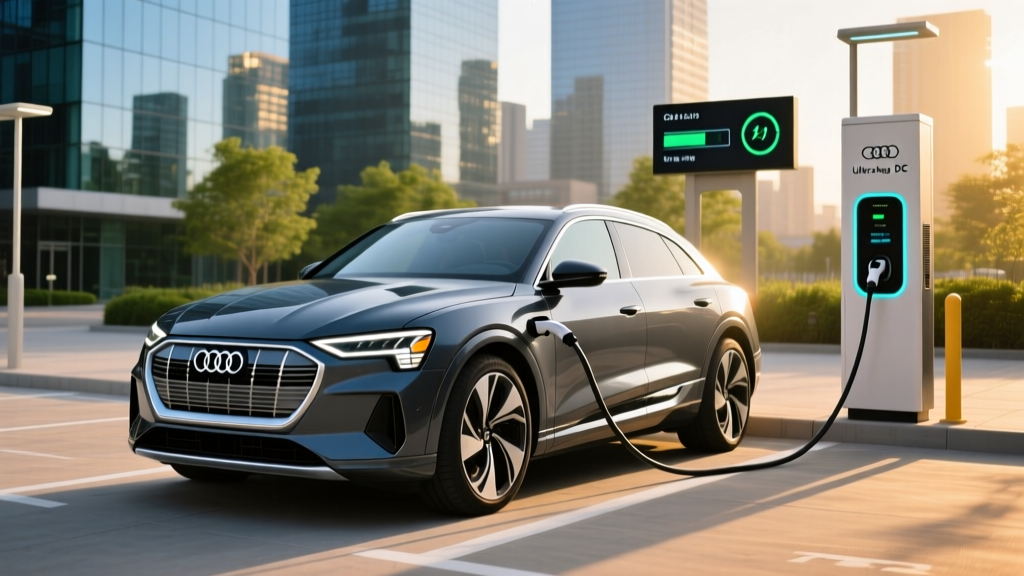
The e-tron's charging performance was one of its strongest selling points in 2019 and remains competitive today. The vehicle supports a peak DC fast-charge rate of 150 kW via its CCS1 connector, and Audi engineered an impressively flat charging curve that sustains high power well into the session.
| Level | Power / Rate | Speed (mi/hr) | Notes |
|---|---|---|---|
| Level 1 (120V) | ~1.2 kW | ~3 mi/hr | Emergency only; full charge ~70+ hrs |
| Level 2 (240V, 40A) | 9.6 kW | ~21 mi/hr | Overnight charge ~10 hrs (0-100%) |
| DC Fast (CCS1) | 150 kW peak | ~330 mi/hr (peak) | 10-80% in ~30 min; tapers sharply above 80% |
Charging curve reality: The e-tron sustains close to its 150 kW peak from roughly 5% to 70% state of charge — one of the flattest curves in its class. After 80%, power tapers significantly to protect the NMC cells, dropping below 50 kW. For road trips, plan stops around the 10-80% window to maximize time at peak speed. Above 80%, you're better off driving than waiting.
Home charging note: The onboard charger maxes at 9.6 kW (40 amps). A 48-amp Level 2 home charger will still only deliver 9.6 kW to the car. A standard 240V/40A NEMA 14-50 circuit or hardwired Level 2 unit handles this easily. Expect installation costs of $500-$1,800 depending on panel capacity and run length — consult a licensed electrician for your specific setup.
Performance and Driving Dynamics
The 2019 e-tron uses a dual-motor all-wheel-drive layout (Audi's electric quattro system) producing 355 horsepower in standard driving and 402 hp / 490 lb-ft of torque in Boost mode, which is accessible for short bursts via the kick-down switch or Sport mode.
The 0-60 mph sprint takes 5.5 seconds in Boost mode. That's respectable but not thrilling — the Tesla Model X Long Range of the same era does it in about 4.6 seconds, and the Jaguar I-PACE hits 4.5 seconds. The e-tron prioritizes smooth, linear acceleration over neck-snapping torque delivery.
Where the e-tron genuinely excels is ride quality. The standard adaptive air suspension absorbs road imperfections with a composure that neither the Model X nor I-PACE matches. Cabin noise isolation is exceptional, and the steering — while not sporty — is precise and confidence-inspiring. This is a grand-touring EV, not a track car, and it knows it.
Interior, Cargo, and Technology
The e-tron's cabin is where Audi's luxury pedigree shows most clearly. Materials, fit, and finish are a step above the Tesla Model X's minimalist interior, with soft-touch surfaces, real wood or aluminum trim, and supportive leather seats.
Cargo space: 28.5 cubic feet behind the second row, expanding to 57.2 cubic feet with the rear seats folded. There is no front trunk (frunk) — the space under the hood houses electronics and the HVAC system. For comparison, the Model X offers roughly 78 cu ft total with seats folded, and the Jaguar I-PACE delivers about 53 cu ft.
Infotainment: Audi's dual-screen MMI touch response system (10.1-inch upper, 8.6-inch lower) handles navigation, climate, and media. It looks sleek but draws criticism for requiring too many glances away from the road — physical knobs for volume and climate would be preferable. Apple CarPlay and Android Auto are standard (wired only on the 2019 model).
Driver assistance: The 2019 e-tron includes Audi pre sense basic and front (automatic emergency braking, forward collision warning), lane departure warning, and a rearview camera. Adaptive cruise control with stop-and-go and traffic jam assist were available as part of the Driver Assistance Package. This is an SAE Level 2 system — the driver must remain fully engaged and hands on the wheel at all times. It is not autonomous or self-driving.
Pricing, Tax Credits, and Ownership Costs
The 2019 Audi e-tron launched with a base MSRP of approximately $74,800 (Premium Plus trim) and $81,800 for the Prestige trim, before a $995 destination charge. As-tested examples with options frequently exceeded $85,000.
On the used market in 2026, expect to pay roughly $28,000-$38,000 depending on mileage, condition, and region — a steep depreciation curve that benefits second owners.
Qualifying buyers can claim 30% of the sale price, up to $4,000, on a used EV purchased from a dealer. Key requirements:
- Income caps: $75,000 (single), $112,500 (head of household), $150,000 (joint filers) — based on the lesser of current or prior year MAGI
- Vehicle price cap: Sale price must not exceed $25,000
- Vehicle age: Must be at least 2 model years old (2019 qualifies)
- Dealer sale required: Private-party sales do not qualify
- Battery capacity: At least 7 kWh (e-tron's 95 kWh easily clears this)
Battery and powertrain warranty: Audi covers the e-tron's high-voltage battery for 8 years or 100,000 miles (whichever comes first), with a capacity retention threshold of 70%. The powertrain carries the same 8-year/100,000-mile coverage. For a 2019 model, this means factory battery warranty expires in 2027 — a key consideration for used buyers. Verify remaining warranty with an Audi dealer using the VIN before purchase.
- Exceptional ride comfort and cabin quietness
- Flat DC charging curve sustains 150 kW to ~70% SoC
- Premium interior materials and build quality
- Strong adaptive air suspension (standard)
- Qualifies for up to $4,000 used-EV tax credit
- Competitive used pricing after steep depreciation
- 204-mile EPA range trails most competitors
- Low efficiency (74 MPGe) increases charging costs
- No frunk; cargo space is modest for the class
- Dual-screen infotainment is distracting while driving
- Heavy (5,765 lbs) — affects tire wear and braking
- Battery warranty nearing expiration on 2019 models
How It Compares: e-tron vs. Key Rivals
The 2019 e-tron competes in the used luxury EV SUV segment against the Tesla Model X, Jaguar I-PACE, and the later Mercedes-Benz EQC (which was limited in US availability). Here's how they stack up on the metrics that matter:
| Metric | Audi e-tron | Tesla Model X LR | Jaguar I-PACE |
|---|---|---|---|
| EPA Range | 204 mi | 325 mi | 234 mi |
| Battery (usable) | 83.6 kWh | ~98 kWh | 84.7 kWh |
| DC Fast Charge | 150 kW | ~145 kW (V2 SC) | 100 kW |
| 0-60 mph | 5.5 sec | 4.6 sec | 4.5 sec |
| MPGe (combined) | 74 | 100 | 76 |
| Cargo (seats folded) | 57.2 cu ft | ~78 cu ft | ~53 cu ft |
| Est. Used Price (2026) | $28-38K | $35-50K | $26-36K |
Choose the Audi e-tron if: Ride comfort, build quality, and a quiet cabin are your top priorities, and your daily driving stays within ~160 miles with access to home charging. The e-tron is the most refined cruiser in this group.
Choose the Tesla Model X if: Range, cargo space, Supercharger network access, and over-the-air updates matter most. You'll pay a premium on the used market, but the practicality advantage is substantial.
Choose the Jaguar I-PACE if: You want sportier handling and distinctive styling at a lower used price, but accept the slowest DC charging (100 kW peak) and similarly modest range.
Who the 2019 Audi e-tron Suits Best
The 2019 e-tron is ideal for commuters and daily drivers who travel under 150 miles round-trip, have reliable home Level 2 charging, and value a serene driving experience over maximum range or performance. It's a strong choice for luxury-car buyers transitioning to electric who want something that feels familiar and well-built rather than tech-forward and minimalist.
It is not ideal for frequent road-trippers — the 204-mile EPA range (and ~170-mile real-world highway range) means stops every 2-2.5 hours on longer drives. It's also not the best pick for families who regularly need maximum cargo volume; the Model X or a three-row EV like the Rivian R1S serves that role better.
Frequently Asked Questions
What is the real-world range of the 2019 Audi e-tron?
Expect approximately 170-185 miles on the highway at 70-80 mph, and around 150-165 miles in cold weather (below freezing). City and moderate-temperature driving can approach the 204-mile EPA estimate. The large battery buffer Audi engineers into the pack (~11.4 kWh unusable) protects longevity but reduces accessible range.
How fast does the 2019 e-tron charge at home and on DC fast chargers?
On a DC fast charger, the e-tron peaks at 150 kW and charges from 10-80% in approximately 30 minutes, with an unusually flat charge curve that sustains high power to ~70% SoC. At home on a 240V Level 2 charger (9.6 kW), a full charge takes roughly 10 hours — plan on overnight charging.
Does the 2019 Audi e-tron qualify for any federal tax credit?
The e-tron is no longer eligible for the new-vehicle §30D credit (which has MSRP, income, and battery-sourcing requirements and applies only to new purchases). However, it may qualify for the used-EV credit under IRS §25E: up to $4,000 (30% of sale price) if purchased from a dealer for $25,000 or less, and if your income falls under the caps ($75K single / $150K joint). Verify current rules at irs.gov and consult a tax professional.
Is the 2019 Audi e-tron worth buying in 2026 vs. competitors?
Yes — if comfort, quietness, and build quality are your priorities and the range works for your routine. The steep depreciation makes it a value pick in the luxury EV space. But if you need 300+ miles of range, maximum cargo room, or the fastest charging, look at the Tesla Model X or newer models like the Hyundai Ioniq 5 or BMW iX.
What happens when the battery warranty expires?
Audi's 8-year/100,000-mile battery warranty on the 2019 e-tron expires in 2027. If the battery degrades below 70% capacity within that window, Audi will repair or replace it. Post-warranty battery replacement costs are estimated at $15,000-$25,000+ depending on labor and parts availability — a significant financial risk for high-mileage examples. Request a battery health report (state of health / SoH) from an Audi dealer before purchasing.
Does the e-tron use NACS or CCS for charging?
The 2019 e-tron uses the CCS1 connector standard. It does not have a NACS (Tesla) port. You can use Tesla Superchargers with a CCS-to-NACS adapter at Supercharger locations that support non-Tesla vehicles — check the Tesla app for compatible stations. Audi has since moved newer models (2025+) to NACS, but the 2019 remains CCS1.