Quick Verdict: The 2018 Model X in 2026
If you're researching a 2018 Tesla Model X on the used market, you're looking at a vehicle that still offers genuine three-row electric SUV utility with access to Tesla's Supercharger network — but at a fraction of its original $80,000–$140,000+ sticker. In 2026, used 2018 Model X examples typically trade between $28,000 and $48,000 depending on trim, mileage, and battery condition. It remains one of the most capable used electric family haulers available, though falcon-wing doors, older MCU1 infotainment hardware, and potential out-of-warranty battery costs demand careful evaluation before purchase.
This review covers every 2018 Model X variant — the 75D, 100D, and P100D — with exact EPA range figures, real-world efficiency data, charging performance, and the ownership realities that only emerge after six or more years on the road.
Range, Battery, and Efficiency by Trim
The 2018 Model X was offered in three battery configurations. Tesla used NMC (nickel manganese cobalt) lithium-ion chemistry across all trims — this is important because NMC offers high energy density but is more sensitive to sustained high state-of-charge storage than LFP chemistry found in some newer Tesla models.
| Trim | Battery (usable kWh) | EPA Range (mi) | MPGe (combined) | kWh/100 mi | Drivetrain |
|---|---|---|---|---|---|
| 75D | ~72.5 kWh (75 kWh pack) | 237 | 93 MPGe | 36 | Dual-motor AWD |
| 100D | ~98 kWh (100 kWh pack) | 295 | 100 MPGe | 34 | Dual-motor AWD |
| P100D | ~98 kWh (100 kWh pack) | 289 | 89 MPGe | 38 | Dual-motor AWD (performance) |
Source: EPA / fueleconomy.gov
Real-World Range: What to Actually Expect
EPA sticker vs. reality: The 237-mile EPA rating on the 75D is achievable in mild-weather city driving with moderate regen use. Expect the following in practice:
- Highway (70–80 mph, mild weather): ~200–215 miles (75D), ~255–270 miles (100D)
- Cold weather (below 32°F, mixed driving): Subtract 25–35% — the 75D may deliver only 160–175 miles; the 100D around 195–220 miles
- With 6-year battery degradation (~8–12% typical for 2018 NMC packs): A 100D with 80,000 miles may show ~260 miles at 100% SoC, down from the original 295
The 100D is the sweet spot for road-trip usability. The 75D's real-world range makes it a commuter and school-run vehicle — not a comfortable cross-country cruiser without frequent stops.
Charging Speed: DC Fast Charge and Home Level 2
The 2018 Model X uses Tesla's proprietary connector (now being phased in favor of NACS standardization) and charges on the V2 Supercharger network at up to ~120 kW peak for 100D/P100D models, and ~100 kW for the 75D. These are not the 250 kW V3 speeds available on newer Tesla architectures — the 2018 Model X predates that hardware.
| Charging Method | 75D | 100D / P100D |
|---|---|---|
| Max DC Fast Charge (kW) | ~100 kW peak | ~120 kW peak (V2 Supercharger) |
| 10–80% DC Fast Charge Time | ~42 minutes | ~45 minutes |
| Level 2 Home (48A / 11.5 kW) | ~30 mi/hr added | ~34 mi/hr added |
| Level 2 Home (32A / 7.7 kW) | ~20 mi/hr added | ~23 mi/hr added |
| Level 1 (120V / 1.4 kW) | ~4 mi/hr added | ~4 mi/hr added |
Charging-curve reality: The 120 kW peak on a 100D only holds between roughly 10–30% SoC. Above 50%, the rate tapers significantly — expect ~60–70 kW by 60% SoC and ~25 kW by 85%. This is why 10–80% takes ~45 minutes rather than the ~25 minutes a sustained 120 kW would suggest. On road trips, plan your stops around this curve: shorter, more frequent stops from 10–60% are faster than waiting to charge past 80%.
Home charging note: The 2018 Model X comes with a Gen 2 Mobile Connector. For optimal home charging, install a NEMA 14-50 outlet (240V/50A) or a Tesla Wall Connector on a 60A circuit. A full overnight charge on a 48A Level 2 setup takes roughly 7–8 hours for the 100D and 5.5–6 hours for the 75D. Budget $500–$1,500 for a licensed electrician to install a 14-50 outlet, or $800–$2,200 for a hardwired Wall Connector installation depending on panel capacity and run length.
Performance: 0–60, Horsepower, and Drivetrain
Even by 2026 standards, the 2018 Model X delivers serious acceleration, particularly in P100D form with Ludicrous Mode.
| Trim | 0–60 mph | Horsepower (approx.) | Top Speed | Towing Capacity |
|---|---|---|---|---|
| 75D | 4.9 seconds | ~518 hp (combined) | 130 mph | 5,000 lbs |
| 100D | 4.7 seconds | ~518 hp (combined) | 155 mph | 5,000 lbs |
| P100D (Ludicrous) | 2.9 seconds | ~762 hp (combined) | 155 mph | 5,000 lbs |
All 2018 Model X trims feature dual-motor all-wheel drive with independent front and rear motors. The P100D's 2.9-second 0–60 time makes it one of the quickest SUVs ever built, gas or electric. Real-world towing at the 5,000-pound rated capacity will reduce range by approximately 40–50% — expect roughly 140–160 miles from a 100D while towing near max load.
Interior Space, Cargo, and Practicality
The 2018 Model X seats five, six, or seven depending on configuration (five-seat with a bench second row, six-seat with captain's chairs, or seven-seat with a small third row). Cargo volume is generous, aided by the front trunk (frunk).
- Cargo behind 3rd row: 21.8 cu ft (seven-seat config)
- Cargo behind 2nd row (3rd row folded): 54.0 cu ft
- Max cargo (all rear seats folded): 81.7 cu ft
- Frunk: 6.5 cu ft — useful for charging cables, groceries, or a small carry-on
- 2nd-row legroom: 38.4 inches (adequate for adults)
- 3rd-row legroom: 32.7 inches (best for children; tight for adults on long trips)
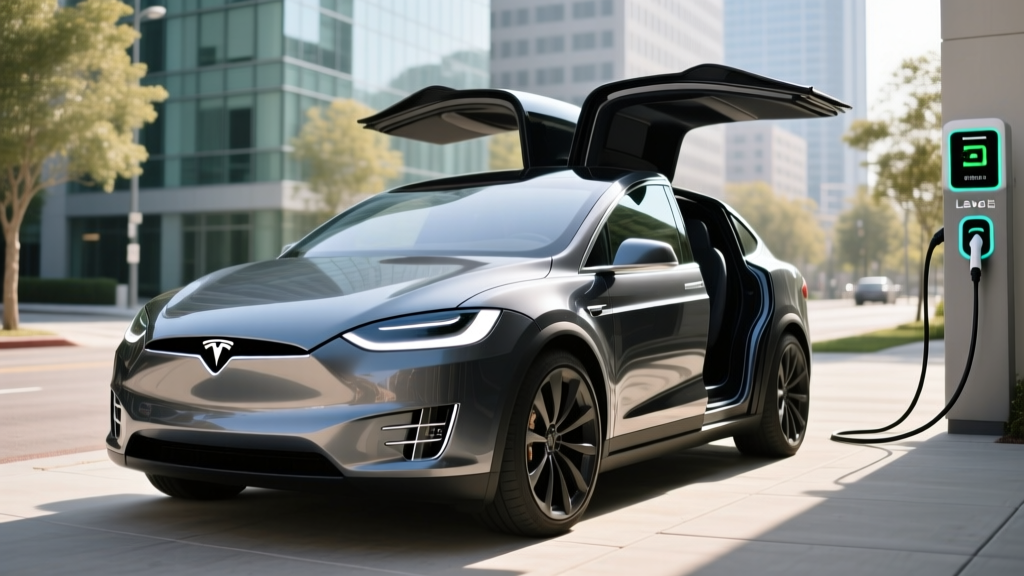
The falcon-wing rear doors are the Model X's signature feature. They open upward with articulated hinges, making child-seat loading and third-row access easier in tight parking spaces — but they are mechanically complex, can be slow in rain (water drips into the cabin when fully open), and are expensive to repair out of warranty. Sensor-equipped obstacle detection prevents them from hitting adjacent vehicles or low ceilings.
Pricing, Tax Credits, and Total Cost of Ownership
As of early 2026, used 2018 Tesla Model X pricing varies widely based on trim, mileage, battery health, and condition:
| Trim | Original MSRP | 2026 Used Range | Federal Used EV Credit (§25E) | Effective Price Range |
|---|---|---|---|---|
| 75D | ~$79,500 | $28,000–$36,000 | Up to $4,000* | $24,000–$32,000 |
| 100D | ~$96,000–$105,000 | $34,000–$44,000 | Up to $4,000* | $30,000–$40,000 |
| P100D | ~$135,000–$160,000+ | $40,000–$52,000 | Up to $4,000* | $36,000–$48,000 |
*Federal Used EV Tax Credit (§25E) eligibility: The 2018 Model X qualifies as a used EV under IRS §25E, which provides a credit of 30% of the sale price, up to $4,000. Requirements include: the vehicle must be sold by a licensed dealer, the sale price must be $25,000 or less to receive the full $4,000 (prices above this threshold receive 30% up to $4,000), buyer income must not exceed $75,000 (single), $112,500 (head of household), or $150,000 (joint), and the vehicle must be at least two model years old (satisfied). The credit can be transferred to the dealer at point of sale as a discount. Always verify current rules at IRS.gov and consult a tax professional.
Important note: The new-vehicle §30D credit ($7,500) does NOT apply to a 2018 Model X purchase in 2026. Only the used-vehicle §25E credit is available. The original §30D credit was largely unavailable on the Model X even in 2018 because Tesla had exceeded its 200,000-vehicle manufacturer cap by mid-2018.
5-Year Ownership Cost Estimate (Used 100D, 12,000 mi/yr)
- Electricity (home charging, $0.14/kWh avg): ~$3,400 over 5 years
- Insurance (national avg for Model X): ~$14,000–$18,000 over 5 years (Model X premiums are notably high due to repair costs)
- Maintenance (tires, cabin filter, brake fluid, wipers): ~$2,500–$4,000 over 5 years
- Potential out-of-warranty repairs: $0–$8,000+ (highly variable; see warranty section below)
Battery Health, Warranty, and Degradation
This is the single most important factor when evaluating a used 2018 Model X. The original battery and drive unit warranty was 8 years / 150,000 miles (for 100D and P100D) and 8 years / 120,000 miles (for 75D), whichever comes first, with a minimum 70% capacity retention guarantee.
In 2026, most 2018 Model X vehicles have expired or are expiring from their original battery warranty. This means a battery replacement — if needed — would be an out-of-pocket expense. Tesla battery replacement costs for a 100 kWh pack in the Model X typically range from $14,000 to $22,000 including labor at a Tesla Service Center. Third-party EV battery shops may offer refurbished pack swaps for $10,000–$15,000.
Typical degradation for a 2018 NMC pack at 6–8 years:
- 50,000 miles: ~5–8% capacity loss (range reduced by 15–24 miles on a 100D)
- 80,000 miles: ~8–12% capacity loss (range reduced by 24–35 miles on a 100D)
- 120,000+ miles: ~12–18% capacity loss, though some packs perform better
Before buying, check the battery's State of Health (SoH): Navigate to Settings → Software → Additional Vehicle Information on the touchscreen, or use third-party apps like TeslaFi or Tessie to pull detailed battery health data. A pre-purchase inspection at a Tesla Service Center ($200–$300) can verify pack health and flag any cell-imbalance issues.
Tech, Autopilot, and Notable Drawbacks
The 2018 Model X shipped with Tesla's MCU1 (Media Control Unit 1) — the older, slower infotainment processor based on NVIDIA Tegra 3. This means the touchscreen is noticeably laggy compared to MCU2 (Intel Atom) and the current MCU4/Ryzen units. Tesla offered an MCU upgrade program (MCU1 to MCU2 for ~$2,000, later to MCU4 for ~$1,500), and many used examples have had this upgrade performed. Always verify which MCU is installed — it significantly affects daily usability and access to features like Netflix/YouTube streaming, Tesla Arcade, and the latest navigation rendering.
Autopilot and Driver Assistance
The 2018 Model X includes Hardware 2.5 (HW2.5) for Autopilot. Basic Autopilot (traffic-aware cruise control and autosteer) is standard. Enhanced Autopilot (auto lane change, navigate on Autopilot, Smart Summon) and Full Self-Driving (FSD) were optional add-ons.
SAE Automation Level: Level 2. Regardless of the "Full Self-Driving" branding, Tesla's FSD (Supervised) is a Level 2 driver-assistance system. The driver must remain fully attentive, keep hands on the wheel, and be prepared to take over at any moment. This is not autonomous driving. Only Level 4 services like Waymo operate without a human driver in defined areas.
If the used Model X you're considering has an FSD purchase attached (a one-time $8,000–$10,000 add when new), verify that FSD transfers with the vehicle — Tesla's FSD transferability policy has changed multiple times. As of 2026, FSD purchased outright generally transfers with the car, but subscription-based FSD does not.
Notable Drawbacks
- Falcon-wing door complexity: Sensors, struts, and seals are expensive to replace out of warranty. Common issues include sensor errors, slow operation, and water leaks.
- Wind noise: Early Model X builds are known for more wind noise at highway speeds than competing luxury SUVs, partly due to the large panoramic windshield and door-seal design.
- Panel gaps and build quality: 2018 was mid-production for the Model X, and panel-gap inconsistency was common. Inspect door alignment, hatch fitment, and the front bumper-to-hood gap.
- Phantom braking: HW2.5-era Autopilot is more prone to phantom-braking events than current Tesla hardware. This is a documented NHTSA concern.
- No heat pump: The 2018 Model X uses resistive cabin heating, which draws significantly more energy in cold weather than the heat pump introduced in the 2021 refresh. This compounds cold-weather range loss.
Who Should Buy a Used 2018 Tesla Model X?
Choose the 2018 Model X if:
- You need three-row seating and genuine SUV cargo space in an electric vehicle on a sub-$45,000 budget
- You value access to the Tesla Supercharger network for road trips (over 6,000 stations in the U.S. as of 2026)
- You want dual-motor AWD with strong performance for mountain driving or inclement weather
- You can charge at home and your daily driving is under 150 miles
- You find a well-maintained 100D with verified battery SoH above 88%
Look elsewhere if:
- You need reliable 250+ mile real-world highway range in winter — consider a newer Model Y or a Rivian R1S
- You want the latest infotainment and driver-assist hardware — the MCU1/HW2.5 combo feels dated
- You can't absorb a potential $15,000–$22,000 battery replacement cost if the pack fails post-warranty
- You prioritize low insurance premiums — the Model X is among the most expensive EVs to insure
Pros and Cons at a Glance
Pros
- Spacious three-row cabin with 81.7 cu ft max cargo
- Supercharger network access for reliable road-trip charging
- P100D Ludicrous performance (2.9s 0–60) is extraordinary for an SUV
- Over-the-air software updates still add features years after purchase
- Federal used EV credit (§25E) up to $4,000 reduces effective cost
- Strong regenerative braking enables one-pedal driving in most conditions
- 5,000-lb towing capacity (with significant range trade-off)
Cons
- Battery warranty expired or expiring — major financial risk
- Falcon-wing doors are costly to repair and prone to sensor issues
- MCU1 infotainment is sluggish without an upgrade
- No heat pump — cold-weather efficiency suffers significantly
- Insurance costs are among the highest in the EV segment
- Build quality inconsistency (panel gaps, wind noise)
- DC fast charging limited to ~120 kW (45 min 10–80%)
2018 Model X vs. Key Used Competitors
At similar used price points ($30,000–$48,000 in 2026), the 2018 Model X competes with several alternatives:
| Vehicle | EPA Range | Seating | DC Fast Charge | Used Price (approx.) |
|---|---|---|---|---|
| 2018 Tesla Model X 100D | 295 mi | 5/6/7 | ~120 kW | $34,000–$44,000 |
| 2019 Jaguar I-PACE | 234 mi | 5 | ~100 kW | $26,000–$34,000 |
| 2020 Audi e-tron | 204 mi | 5 | ~150 kW | $30,000–$38,000 |
| 2018 Tesla Model Y (LR) | 316 mi* | 5/7 (tiny 3rd) | ~250 kW | $30,000–$38,000 |
*Model Y launched 2020; 2018 year shown for price comparison only — earliest Model Y examples are 2020.
The Model X wins on cargo volume, third-row availability, and Supercharger access. It loses on charging speed (the e-tron charges faster), build quality consistency, and insurance cost. If you only need five seats and prioritize newer hardware, a used 2020 Model Y Long Range is often the more pragmatic Tesla purchase.
Frequently Asked Questions
What is the real-world range of the 2018 Tesla Model X?
The 100D delivers approximately 255–270 miles on the highway in mild weather and 195–220 miles in cold weather, accounting for typical 6-year battery degradation of 8–12%. The 75D achieves roughly 200–215 highway miles in mild conditions and 160–175 in cold weather. City driving with regenerative braking can match or slightly exceed EPA estimates.
How fast does the 2018 Model X charge at home and on the road?
On a DC fast charger (V2 Supercharger), the 100D peaks at ~120 kW and charges from 10–80% in approximately 45 minutes. At home on a 48A Level 2 charger (11.5 kW), it adds about 34 miles of range per hour, fully recharging overnight in 7–8 hours. Level 1 (standard 120V outlet) adds only ~4 miles per hour — adequate only for emergency trickle charging.
Does the 2018 Tesla Model X qualify for any federal tax credit?
Not the new-vehicle §30D credit. However, it may qualify for the used clean vehicle credit (§25E) — up to $4,000 (30% of sale price, capped at $4,000) when purchased from a licensed dealer. Buyer income must not exceed $75,000 (single) / $150,000 (joint), and the sale price must be $25,000 or less to receive the full $4,000. Verify current eligibility at IRS.gov.
Is the 2018 Model X worth buying in 2026 vs. newer used EVs?
It depends on your priorities. If you need three rows, maximum cargo space, and Supercharger access under $45,000, the 100D is still compelling. If you only need five seats and want faster charging, newer hardware, and lower insurance, a used Model Y or a 2020+ Hyundai Ioniq 5 may serve you better. The expired battery warranty is the single biggest risk — factor a potential $15,000–$22,000 replacement into your total cost analysis.
What should I check before buying a used 2018 Model X?
Prioritize: (1) Battery State of Health via TeslaFi or a Tesla Service Center inspection — look for SoH above 88%. (2) MCU version — MCU2 or MCU4 is strongly preferred over the original MCU1. (3) Falcon-wing door operation — test open/close cycles and check for sensor errors. (4) Service history for drive unit replacements, battery work, and suspension repairs. (5) Autopilot hardware version (HW2.5) and whether FSD was purchased and transfers with the vehicle.
How much does insurance cost for a 2018 Model X?
The Model X is one of the most expensive EVs to insure. National averages range from $2,800 to $4,200 per year depending on driver profile, location, and coverage level. Tesla Insurance (available in select states) may offer competitive rates. Always get quotes before purchasing — insurance can add $300–$500/month to your ownership cost.
Sources: EPA / fueleconomy.gov, IRS Used Clean Vehicle Credit, Tesla owner's manual and service documentation.