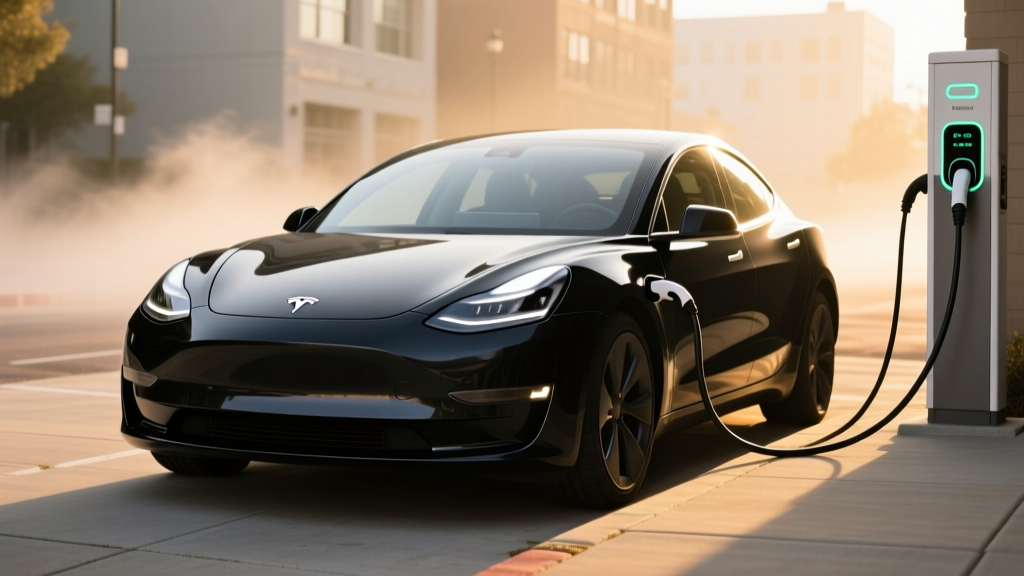
The 2018 Tesla Model 3 Performance was the first variant of the Model 3 to reach customers in volume, and it set a benchmark that competitors spent years chasing. Dual-motor all-wheel drive, a 3.3-second 0-60 mph time, and over 300 miles of EPA range in a sedan priced under $60,000 made it an industry inflection point. In 2026, it remains one of the most compelling used EVs on the market — but prospective buyers need to understand what seven-plus years of battery aging, evolving charging infrastructure, and current tax-credit rules mean for ownership today.
This review covers the 2018 Model 3 Performance with original specs, real-world range data, charging behavior, and what it costs to buy and run one now.
Spec Sheet: 2018 Tesla Model 3 Performance at a Glance
| Specification | Value |
|---|---|
| EPA Range (original) | 310 miles |
| Battery Capacity | ~75 kWh usable (NMC chemistry) |
| Drivetrain | Dual-motor AWD |
| Horsepower | ~450 hp (combined) |
| 0-60 mph | 3.3 seconds |
| Top Speed | 155 mph |
| Max DC Fast Charge | ~190 kW peak (V3 Supercharger) |
| 10-80% DC Charge Time | ~30 minutes |
| Level 2 Home Charge Rate | 11.5 kW (48A) — ~37 mi/hr |
| Efficiency (EPA) | 120 MPGe combined / 28 kWh/100 mi |
| Cargo Volume | 15 cu ft trunk + ~3 cu ft frunk |
| Seating | 5 passengers |
| Original MSRP | $54,500 (before options) |
| Battery Warranty (original) | 8 years / 120,000 miles (70% capacity retention) |
Real-World Range: What to Actually Expect
The EPA rated the 2018 Model 3 Performance at 310 miles of combined range when new. That number was measured on the standard EPA test cycle and represents a blend of city and highway driving at moderate temperatures. Real-world results diverge meaningfully depending on how and where you drive.
EPA sticker: 310 miles
Highway (70-80 mph, moderate temps): ~245-270 miles
City/mixed commuting: ~280-305 miles
Cold weather (below 32°F, highway): ~195-230 miles
Aged battery note: Most 2018 units show 8-15% degradation at ~80,000-120,000 miles, reducing effective range proportionally.
The Model 3 Performance's NMC (nickel manganese cobalt) battery pack is energy-dense but sensitive to temperature extremes. Tesla's thermal management system is among the best in the industry — active liquid cooling and heating keep the pack in its optimal window — but physics still wins in deep cold. Expect 25-35% range reduction in sub-freezing highway driving, consistent with independent testing by sources like fueleconomy.gov.
Battery degradation is a real factor for a 2018 vehicle in 2026. NMC cells typically lose 8-15% of original capacity over 100,000-150,000 miles depending on charging habits (frequent DC fast charging and consistently charging to 100% accelerate wear). A well-maintained 2018 Model 3 Performance with 80,000 miles might realistically deliver 260-275 miles of mixed-use range today. Always check the car's displayed range at 100% state of charge (SoC) before purchasing — the in-car display is a reasonable proxy for State of Health (SoH).
Charging Speed: DC Fast, Level 2, and Level 1
The 2018 Model 3 Performance uses Tesla's proprietary connector (now being rebranded as NACS) and can access the full Supercharger network, which in 2026 includes thousands of V3 (250 kW) and V4 stations across the US.
| Charging Level | Power (kW) | Speed (miles/hr) | Notes |
|---|---|---|---|
| Level 1 (120V outlet) | ~1.4 kW | ~4-5 mi/hr | Emergency/trickle only |
| Level 2 (240V, 48A Wall Connector) | 11.5 kW | ~37 mi/hr | Full charge in ~7 hours |
| Level 2 (240V, 32A mobile connector) | 7.7 kW | ~25 mi/hr | Common with NEMA 14-50 outlet |
| DC Fast (V3 Supercharger) | ~190 kW peak | Up to ~170 mi in 15 min | Tapers above 60% SoC |
| DC Fast (V2 Supercharger) | ~145 kW peak | ~130 mi in 15 min | Older stations, still common |
| CCS Adapter (non-Tesla DCFC) | ~150 kW peak | Varies | Requires Tesla CCS adapter (~$250) |
The 2018 Model 3 Performance peaks at roughly 190 kW on a V3 Supercharger when preconditioned and at a low state of charge (around 5-10%). However, the charge curve tapers significantly: by 50% SoC you're typically seeing 90-110 kW, and above 80% the rate drops to 30-50 kW. A realistic 10-80% charge takes about 30 minutes at a V3 station.
Preconditioning is essential. Navigate to a Supercharger using the car's built-in navigation, and the battery management system will warm the pack to optimal charging temperature en route. Skip this step — for example, by driving to a charger without routing through nav — and your peak charge rate may be cut by 30-50%, especially in cool weather.
For home charging, Tesla's Wall Connector at 48 amps delivers 11.5 kW, adding roughly 37 miles of range per hour. A full overnight charge from 10% to 90% takes about 6-7 hours. Installation costs for a 240V/60A circuit typically run $500-$2,000 depending on panel proximity and local permit requirements. If your electrical panel is maxed out, a panel upgrade can add $1,500-$3,000.
Performance and Driving Dynamics
The Performance variant's dual-motor setup — an induction motor up front and a permanent-magnet synchronous motor in the rear — delivers ~450 horsepower and a manufacturer-claimed 3.3-second 0-60 mph time. Independent testing by outlets like Motor Trend confirmed figures in the 3.1-3.5 second range depending on surface and conditions.
Acceleration remains explosive even with moderate battery degradation. The instant torque delivery characteristic of electric motors means the car feels quicker than its numbers suggest in everyday driving — merging onto highways and passing maneuvers are effortless.
The Performance trim included Tesla's Track Mode (introduced via over-the-air update), which adjusts stability control, cooling, and torque distribution for closed-course driving. The lowered sport suspension, larger brakes, and 20-inch Performance wheels give it sharper handling than the standard Long Range, though the ride is noticeably firmer over rough pavement.
One consideration for 2026 buyers: the suspension components on a 2018 vehicle with 80,000+ miles may be due for replacement. Control arm bushings, dampers, and ball joints wear with mileage regardless of powertrain, and Tesla's service centers or qualified independent shops can address these. Budget $1,500-$3,000 for a suspension refresh if the car hasn't had one.
Interior, Cargo, and Technology
The 2018 Model 3 interior follows Tesla's minimalist ethos: a single 15-inch center touchscreen handles virtually every function — climate, media, navigation, vehicle settings, and even the speedometer (there is no traditional instrument cluster). This design polarizes buyers. Some find it clean and distraction-free; others miss physical buttons for common adjustments like mirror positioning and vent direction.
Interior dimensions:
- Front legroom: 42.7 inches
- Rear legroom: 35.2 inches
- Trunk cargo: 15 cu ft (plus a rear-seat pass-through)
- Frunk (front trunk): ~3 cu ft — useful for charging cables or a small bag
Rear-seat space is adequate for adults on shorter trips but tighter than a Toyota Camry or Honda Accord. The glass roof creates an airy cabin but reduces headroom for taller passengers in back. The all-glass roof also lets in significant heat in summer — many owners add an aftermarket sunshade ($30-$60).
Tech features that still hold up in 2026:
- Over-the-air (OTA) software updates — Tesla continues to push updates to 2018 vehicles, adding features and refinements years after purchase
- Tesla mobile app — remote preconditioning, charge monitoring, location tracking, keyless entry via phone
- Sentry Mode — uses the car's cameras to record activity around the vehicle when parked (note: this feature causes ~1 mile of range loss per hour of use due to computer wakefulness)
- Dashcam and USB recording — built-in camera system records forward and (on later-updated cars) side/rear views
Driver assistance — Autopilot and FSD:
Tesla's Autopilot and Full Self-Driving (Supervised) are SAE Level 2 driver-assistance systems. The driver must keep hands on the wheel and eyes on the road at all times. These systems handle highway lane-keeping and adaptive cruise well, but they do not make the vehicle autonomous. Only Level 4 services like Waymo operate without a human driver, and those are limited to specific geofenced areas.
Basic Autopilot (traffic-aware cruise control and lane-keeping) comes standard. Full Self-Driving (FSD) was a $5,000-$8,000 option depending on when it was purchased. In 2026, FSD Supervised is capable of handling most highway and many city-driving scenarios but still requires active supervision and occasional intervention. If a used 2018 Model 3 has FSD, verify the license transfers with the vehicle — Tesla's policy on FSD transferability has varied over the years.
Pricing in 2026: Used Market and Tax Credits
The 2018 Model 3 Performance originally started at $54,500 before options. With common additions like FSD, premium paint, and 20-inch wheels, many left the showroom floor at $62,000-$70,000.
In the 2026 used-EV market, expect to pay:
| Condition / Mileage | Typical Price Range |
|---|---|
| 60,000-80,000 mi, excellent | $22,000-$27,000 |
| 80,000-110,000 mi, good | $18,000-$23,000 |
| 110,000+ mi, fair | $15,000-$19,000 |
Prices vary by region, color, FSD status, and battery health. Cars in states with strong EV adoption (California, Washington, Colorado) tend to have more inventory and slightly lower prices due to competition.
Does the 2018 Model 3 Performance Qualify for the Federal Tax Credit?
Yes — as a used EV, it may qualify for the §25E Used Clean Vehicle Credit, which provides up to $4,000 (or 30% of the sale price, whichever is lower). This is separate from the §30D new-vehicle credit and has its own rules.
- Credit amount: 30% of sale price, up to $4,000 maximum
- Vehicle price cap: Sale price must be $25,000 or less
- Buyer income cap: AGI must not exceed $75,000 (single) / $112,500 (head of household) / $150,000 (joint) — per IRS §25E rules
- Dealer requirement: Must be purchased from a licensed dealer (private-party sales do not qualify)
- Vehicle age: Must be at least 2 model years old (2018 qualifies in 2026)
- First use: You must be the first person to claim this credit on this specific vehicle sale
- Frequency limit: You can only claim the used-EV credit once every 3 years
If you find a 2018 Model 3 Performance priced at $22,000 from a qualifying dealer and your income falls under the cap, you could receive $4,000 at point of sale (as of 2024+, credits can be transferred to the dealer for an immediate price reduction). That brings effective cost to around $18,000 — extraordinary value for a 3.3-second AWD sedan.
Ownership Costs: Efficiency, Maintenance, and Warranty
The 2018 Model 3 Performance is rated at 120 MPGe combined by the EPA, which translates to roughly 28 kWh per 100 miles. At the US average residential electricity rate of ~$0.17/kWh (as of early 2026), that works out to about $0.048 per mile for home charging. Compare that to a 30-MPG gasoline car at $3.30/gallon: $0.11 per mile. Over 12,000 miles annually, the electricity savings are approximately $744 per year.
Maintenance costs are lower than a comparable gas sedan — no oil changes, spark plugs, or transmission fluid. Budget for:
- Tire rotation/replacement: EVs wear tires faster due to instant torque and heavier weight. Expect new tires every 25,000-35,000 miles ($800-$1,400 for a set of four)
- Cabin air filter: every 2 years (~$50-$100)
- Brake fluid check: every 2 years (regenerative braking means pads last 100,000+ miles in most cases)
- Windshield washer fluid and wiper blades: as needed
Warranty status in 2026: The original 8-year/120,000-mile battery and drive-unit warranty has expired or is expiring for most 2018 Model 3 Performance vehicles. Tesla warranted the battery to retain at least 70% of its original capacity during that period. If you're buying one today, you're likely purchasing out of warranty unless a previous owner purchased an extended service agreement.
Battery replacement costs, should the pack fail outside warranty, run $12,000-$16,000 for a refurbished or replacement unit through Tesla. Third-party EV battery repair shops are increasingly offering module-level repairs for $3,000-$6,000, replacing only the degraded cell modules rather than the entire pack.
Pros and Cons: Honest Assessment
- 310-mile EPA range still competitive with new EVs
- 3.3-sec 0-60 performance remains thrilling
- Access to Tesla Supercharger network (most reliable DC fast-charging infrastructure in the US)
- Continuous OTA updates keep the car feeling current
- Low running costs (~$0.05/mi on home electricity)
- Used-EV tax credit can bring effective price under $18,000
- Strong safety ratings (NHTSA 5-star, IIHS Top Safety Pick+)
- Minimalist interior with premium feel
- Battery and powertrain warranty likely expired
- Rear-seat space is tight for tall adults
- Touchscreen-only controls frustrate some drivers
- Firm ride quality on rough roads (Performance suspension)
- Panel gaps and early-production build quality issues (2018 was first year)
- No Apple CarPlay or Android Auto (Tesla's proprietary system only)
- Sentry Mode and cabin overheat protection cause phantom battery drain
- Insurance costs can be 20-40% higher than comparable gas sedans
Who Should Buy a 2018 Model 3 Performance?
This car is ideal for the performance-minded commuter who has access to home Level 2 charging and wants sports-sedan acceleration with daily-driver practicality. It works well for:
- Daily commuters with round trips under 200 miles (plenty of buffer even with degradation)
- Road trippers who value the Supercharger network's coverage and reliability
- Enthusiasts who want sub-4-second acceleration without six-figure pricing
- Tech-forward buyers who appreciate OTA updates and app integration
It's less ideal for:
- Families needing generous rear-seat space (consider a Model Y or Hyundai Ioniq 5 instead)
- Drivers without home charging access (public charging adds cost and time)
- Buyers uncomfortable with touchscreen-only vehicle controls
- Those who prioritize a plush, quiet ride over sporty handling
2018 Model 3 Performance vs. Key Competitors
| Attribute | 2018 Tesla Model 3 Perf. | 2019 BMW i3s (120 Ah) | 2020 Polestar 2 |
|---|---|---|---|
| EPA Range | 310 mi | 153 mi | 233 mi |
| 0-60 mph | 3.3 sec | 6.9 sec | 4.5 sec |
| Battery (kWh) | ~75 (NMC) | 42.2 (NMC) | 78 (NMC) |
| Max DC Charge | ~190 kW | 50 kW | 150 kW |
| Used Price (2026) | $18K-$27K | $18K-$24K | $20K-$27K |
| Charging Network | Tesla Supercharger | CCS (EA, etc.) | CCS (EA, etc.) |
The Model 3 Performance's combination of range, acceleration, and Supercharger access is difficult to match at this price point. The Polestar 2 is a strong alternative with more conventional styling and Google-based infotainment (including Android Auto), but it trails on range and charging speed. The BMW i3s offers a unique urban-EV experience but falls short on highway range.
Frequently Asked Questions
What is the real-world range of a 2018 Model 3 Performance today?
With typical battery degradation of 8-15% over 80,000-120,000 miles, expect 260-280 miles of mixed-use range. Highway driving at 75+ mph reduces this to 220-250 miles. In cold weather (below freezing), plan for 195-230 miles of usable range on the highway.
How fast does the 2018 Model 3 Performance charge?
On a V3 Supercharger, it peaks at ~190 kW and charges from 10-80% in roughly 30 minutes. At home on a 48A Level 2 Wall Connector (11.5 kW), a full charge takes about 7 hours, adding ~37 miles per hour. On a standard 120V outlet (Level 1), expect ~4-5 miles per hour — suitable only for overnight trickle charging.
Does it qualify for the federal EV tax credit?
Not the §30D new-vehicle credit, but it may qualify for the §25E Used Clean Vehicle Credit: up to $4,000 if the sale price is $25,000 or less, purchased from a licensed dealer, and the buyer meets income caps ($75K single / $150K joint). Consult a tax professional to confirm eligibility.
Is the battery likely to need replacement?
Tesla's NMC packs in the Model 3 have shown strong longevity. Data from fleet analyses suggest most retain 85-92% capacity at 100,000 miles. Complete pack failure is rare. The bigger risk is gradual degradation reducing your effective range over time rather than a catastrophic failure. Budget $12,000-$16,000 for a full replacement in the unlikely event it's needed, or $3,000-$6,000 for module-level repair.
Should I buy a 2018 Model 3 Performance or a newer used EV?
If your budget is $20,000-$25,000 and you want maximum range and performance per dollar, the 2018 Model 3 Performance is hard to beat. Newer used EVs (2022+ Hyundai Ioniq 5, Kia EV6) offer faster charging architectures (800V vs Tesla's ~400V) and more rear-seat space, but typically cost $10,000+ more on the used market. If Supercharger access and proven long-range efficiency matter most, the 2018 Model 3 Performance remains a top choice.
Can I charge a 2018 Model 3 at non-Tesla charging stations?
Yes. Tesla sells a CCS adapter (~$250) that allows the Model 3 to use Electrify America, EVgo, and other CCS-equipped networks. However, the Tesla Supercharger network remains the most reliable and widely available DC fast-charging option in the US, and you'll get the best charge rates on Tesla's own stations.