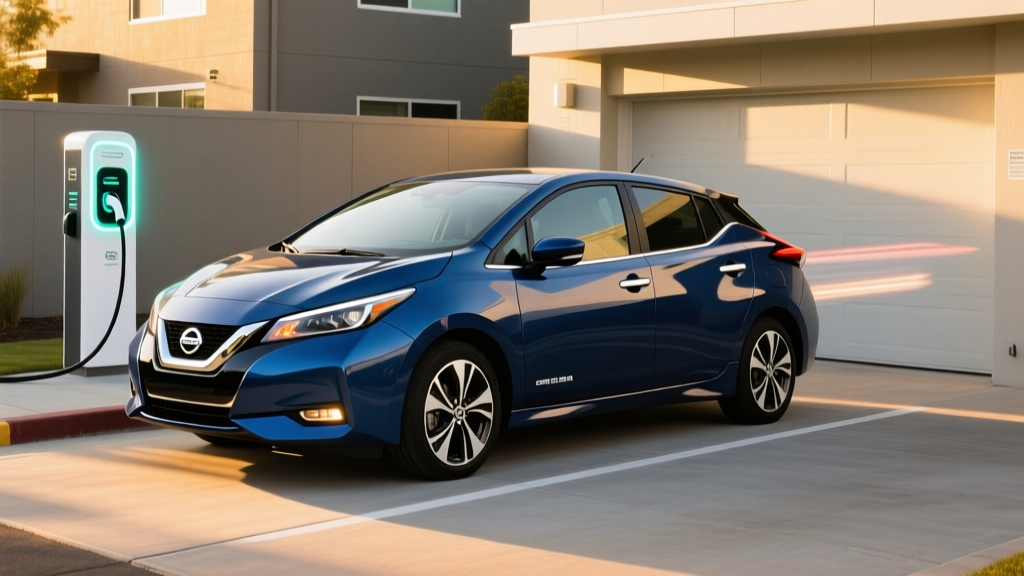
Quick Verdict: The 2018 Nissan Leaf SL in 2026
The 2018 Nissan Leaf SL was a landmark EV — the first generation to offer over 150 miles of EPA range in an affordable package. Nearly eight years later, it remains one of the most accessible entry points into electric vehicle ownership on the used market. With typical used prices hovering between $9,000 and $14,000 depending on mileage and battery health, the Leaf SL still serves as a practical commuter and city runabout. But its CHAdeMO charging standard, passive battery cooling, and modest fast-charge speed mean buyers need to go in with clear expectations about what this EV can and cannot do in 2026.
Real-World Range Reality Check
EPA Estimate: 151 miles (40 kWh battery)
Real-World Expectation: 120–140 miles in mixed driving; 100–115 miles at sustained 70+ mph highway speeds; as low as 85–100 miles in freezing temperatures with cabin heat. Battery degradation on a 2018 model may further reduce usable range by 10–20% depending on prior charging habits and climate exposure.
2018 Nissan Leaf SL: Key Specifications
| Specification | Value |
|---|---|
| EPA Range | 151 miles |
| Battery Capacity (Usable) | 40 kWh (NMC lithium-ion) |
| Efficiency | 112 MPGe combined / 30 kWh per 100 mi |
| Motor Output | 110 kW (147 hp), 236 lb-ft torque |
| Drivetrain | FWD (single motor, front-wheel drive) |
| 0–60 mph | ~7.9 seconds |
| DC Fast Charge (Max) | ~50 kW (CHAdeMO) |
| Level 2 Charge Rate | 6.6 kW onboard charger |
| Cargo Volume | 23.6 cu ft (rear seats up), 30.0 cu ft (seats folded) |
| Rear Legroom | 33.5 inches |
| Original MSRP (SL trim) | $36,200 (before incentives) |
| Typical Used Price (2026) | $9,000–$14,000 |
| Battery Warranty (Original) | 8 years / 100,000 miles (capacity loss below 9 bars on gauge) |
Battery, Chemistry, and Degradation
The 2018 Leaf uses a 40 kWh (gross) laminated lithium-ion battery pack with NMC (nickel manganese cobalt) chemistry. Unlike the Tesla Model 3 or later Hyundai Ioniq 5, the Leaf's pack relies on passive air cooling rather than an active liquid thermal management system. This design choice keeps weight and cost down, but it has real consequences for battery longevity and fast-charge performance.
Nissan's battery warranty covers capacity loss below 9 out of 12 bars on the dashboard capacity gauge for 8 years or 100,000 miles. For a 2018 model, that warranty window expired in 2026 for most original owners — meaning used buyers should treat battery State of Health (SoH) as a critical inspection item.
According to data aggregated by EV tracking communities and testing by sources like fueleconomy.gov, 2018 Leaf batteries typically show 85–92% SoH after six to seven years in moderate climates. Vehicles that spent extended time in hot regions (Arizona, Texas, Southern California) or that were frequently DC fast-charged without rest periods tend to cluster at the lower end of that range. Always request a LeafSpy Pro readout before purchasing — it provides granular cell-level health data the dashboard gauge simply cannot show.
Charging: CHAdeMO in a NACS World
The 2018 Leaf charges via CHAdeMO for DC fast charging and J1772 for Level 1 and Level 2 AC charging. This is the single biggest ownership consideration in 2026.
| Charging Level | Connector | Max Power | Speed / Time |
|---|---|---|---|
| Level 1 (120V household) | J1772 | ~1.4 kW | ~4–5 miles per hour |
| Level 2 (240V home/public) | J1772 | 6.6 kW | ~22 miles per hour; full charge ~7 hours |
| DC Fast Charge | CHAdeMO | ~50 kW peak | 10–80% in ~40–45 minutes |
The 50 kW CHAdeMO peak charge rate was competitive in 2018 but feels dated now. Most modern EVs on the NACS or CCS standard pull 150–250+ kW at DC fast chargers. More critically, the CHAdeMO network in North America has contracted significantly. Electrify America stations are CCS-only, and Tesla Superchargers (which now dominate public fast-charging infrastructure) require a NACS connector. CHAdeMO chargers still exist at select EVgo and independent locations, but availability is shrinking. Used Leaf buyers should verify CHAdeMO charger density along their regular routes before committing.
The Leaf's passive cooling also triggers what owners call "Rapidgate" — during repeated DC fast charges in warm weather, the car aggressively tapers charge speed to protect the battery, sometimes dropping to 20–30 kW after the first session. On a road trip with multiple fast-charge stops, this taper adds meaningful time.
Performance, Efficiency, and Daily Driving
The 110 kW (147 hp) AC synchronous motor delivers smooth, quiet acceleration that feels quicker than the 7.9-second 0–60 time suggests, thanks to 236 lb-ft of instant torque available from zero RPM. Around town, the Leaf SL is composed and easy to drive, with a tight 34.8-foot turning circle that makes parking effortless.
Efficiency is a genuine strength. The EPA rates the 2018 Leaf at 112 MPGe combined (30 kWh per 100 miles), and many owners report beating that figure in city driving with regenerative braking engaged. The e-Pedal feature — Nissan's implementation of strong one-pedal driving — lets you modulate speed almost entirely with the accelerator in stop-and-go traffic, maximizing regen energy recovery.
At highway speeds above 65 mph, efficiency drops noticeably. The Leaf's aerodynamics and lack of a heat pump (it uses resistive PTC heating) mean cold-weather highway driving is the worst-case scenario, with energy consumption sometimes reaching 38–42 kWh per 100 miles in sub-freezing conditions.
Interior, Tech, and the SL Trim Advantage
The SL was the top trim for the 2018 Leaf, and it packed considerable equipment for the price. Standard features on the SL include:
- Leather-appointed seats with heated front and rear seats
- Heated steering wheel
- Bose premium 7-speaker audio system
- LED headlights with auto on/off
- 360-degree Around View Monitor camera system
- NissanConnect EV with 7-inch touchscreen and navigation
- ProPILOT Assist (adaptive cruise control + lane centering — SAE Level 2)
- Automatic emergency braking with pedestrian detection
- Blind-spot warning and rear cross-traffic alert
ProPILOT Assist: Not Self-Driving
ProPILOT Assist is an SAE Level 2 driver-assistance system. It combines adaptive cruise control with lane-centering steering support on highways. The driver must keep hands on the wheel and eyes on the road at all times. This is not autonomous driving — it is a convenience feature that reduces fatigue on longer drives.
The infotainment system shows its age in 2026. The 7-inch screen is small by current standards, response times are sluggish, and Apple CarPlay/Android Auto were not standard on the 2018 model year (they arrived in the 2019 refresh). Bluetooth and USB connectivity work, but the interface feels like a generation behind. This is livable for most buyers at the used price point, but it's a tangible drawback versus newer EVs.
Pricing, Tax Credits, and Ownership Economics
Original MSRP for the 2018 Leaf SL was $36,200 (plus destination). In 2026, used examples typically trade between $9,000 and $14,000 depending on mileage, condition, and battery health.
| Cost Factor | Amount |
|---|---|
| Original MSRP (SL trim, 2018) | $36,200 |
| Typical Used Price (2026, avg. mileage) | $10,500–$13,500 |
| Federal Used EV Tax Credit (§25E) | Up to $4,000 (30% of sale price, max $4,000) |
| Effective Price After §25E Credit | ~$6,500–$10,500 |
| Estimated Annual Electricity Cost (12,000 mi) | ~$480–$650 (varies by utility rate) |
| Estimated Annual Insurance | ~$1,100–$1,500 |
Tax credit note: The §30D new-vehicle credit no longer applies to 2018 purchases. However, the §25E Previously Owned Clean Vehicle Credit — enacted under the Inflation Reduction Act — may provide up to $4,000 (30% of the sale price, capped at $4,000) for qualified used EV buyers. Per IRS guidelines, eligibility requires: the vehicle must be purchased from a licensed dealer (not private party), the buyer's adjusted gross income must not exceed $75,000 (single) / $112,500 (head of household) / $150,000 (joint), the vehicle must be at least two model years old, and the sale price must not exceed $25,000. The 2018 Leaf SL typically qualifies on price and age, but always confirm eligibility with a tax professional before relying on the credit.
Pros and Cons
Pros
- Extremely affordable used entry into EV ownership (sub-$10K after credit)
- Excellent city efficiency — easily beats 112 MPGe in stop-and-go driving
- Comfortable ride quality with good visibility
- SL trim is loaded: Bose audio, leather, ProPILOT Assist, 360° camera
- Low maintenance costs — no oil changes, minimal brake wear with regen
- Compact hatchback practicality with 23.6 cu ft cargo space
Cons
- CHAdeMO fast-charging standard is shrinking in North America
- Passive battery cooling causes Rapidgate on road trips and accelerates degradation in heat
- Real-world highway/cold range can drop to 85–110 miles
- Outdated infotainment with no Apple CarPlay/Android Auto (2018 model year)
- Battery warranty likely expired — replacement costs $6,500–$9,000+
- No heat pump — cabin heating is energy-intensive in winter
Who Should Buy the 2018 Leaf SL?
The 2018 Leaf SL makes the most sense for:
- City commuters with home Level 2 charging and a round trip under 80 miles
- Second-car households that need an efficient runabout for errands and school runs
- Budget-conscious buyers who want to go electric for under $10,000 after incentives
- Mild-climate residents where passive battery cooling is less of a degradation risk
It is not well suited for:
- Frequent road-trippers (CHAdeMO scarcity and 50 kW taper make highway travel frustrating)
- Extreme cold-climate drivers (resistive heating and range loss compound quickly)
- Buyers without reliable home charging access (public CHAdeMO options are limited)
Frequently Asked Questions
What is the real-world range of the 2018 Nissan Leaf SL?
The EPA rates it at 151 miles, but expect 120–140 miles in mixed driving, 100–115 miles on the highway at 70+ mph, and 85–100 miles in freezing temperatures. Battery degradation on a 2018 model may further reduce these figures by 10–20%. Always check State of Health via LeafSpy before purchasing.
How fast does the 2018 Leaf charge at home and on DC fast chargers?
On a 240V Level 2 home charger, the 6.6 kW onboard charger adds about 22 miles per hour, reaching a full charge in roughly 7 hours. On a CHAdeMO DC fast charger, it peaks at about 50 kW, taking 40–45 minutes from 10–80% SoC. Charge speed tapers significantly above 80% and during repeated fast-charge sessions in warm weather.
Does the 2018 Nissan Leaf qualify for the federal EV tax credit?
The §30D new-vehicle credit no longer applies. However, the §25E used EV credit may provide up to $4,000 if you buy from a licensed dealer, meet income limits ($75K single / $150K joint), and the sale price is $25,000 or less. Consult the IRS §25E page and a tax professional to confirm eligibility.
Is the 2018 Leaf SL worth buying versus a used Chevy Bolt EV or Hyundai Ioniq Electric?
The 2017–2022 Chevy Bolt EV offers 238–259 miles of range and CCS charging — substantially more range and a more future-proof charging standard, though at a higher used price ($13,000–$19,000). The 2017–2019 Hyundai Ioniq Electric delivers 124 miles of range but with exceptional efficiency (136 MPGe) and CCS charging. The Leaf SL wins on SL-trim equipment and low entry price but loses on charging standard longevity and highway range. If your budget allows, the Bolt EV is the stronger used-EV pick for most buyers.
What does a replacement battery cost for the 2018 Leaf?
A replacement 40 kWh battery pack from Nissan typically costs $6,500–$9,000+ including labor, though availability can be limited. Third-party refurbishment and used-pack swaps are emerging options but carry their own risks. Factor potential battery replacement into your total cost of ownership if the LeafSpy SoH reading is below 85%.
Does the 2018 Leaf have Apple CarPlay or Android Auto?
No. The 2018 model year predates Nissan's addition of Apple CarPlay and Android Auto to the Leaf, which arrived with the 2019 refresh. You're limited to Bluetooth, USB, and the native NissanConnect interface. Aftermarket head-unit replacements are possible but require custom integration.