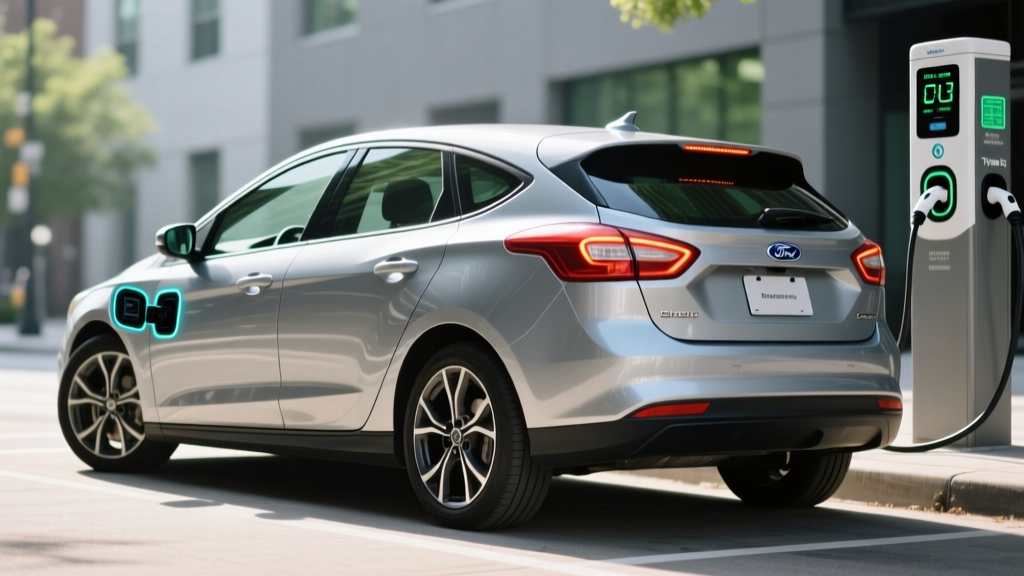
Quick Verdict on the 2018 Ford Focus Electric
The 2018 Ford Focus Electric delivers an EPA-rated 115 miles of range from its 33.5 kWh liquid-cooled lithium-ion battery. On the used market in 2026, expect to pay between $8,000 and $12,000 depending on mileage and condition. It remains a practical commuter car for drivers with home charging access and daily round trips under 80 miles. However, its DC fast charging maxes out at roughly 50 kW (CCS1), and real-world highway or cold-weather range drops to approximately 80–95 miles. No federal tax credit applies to private-party used purchases, though a $4,000 used-EV credit may apply through qualifying dealers.
Range and Battery: What You Actually Get
The 2018 Focus Electric uses a 33.5 kWh (total) / ~29.5 kWh usable liquid-cooled battery pack with NMC (nickel-manganese-cobalt) chemistry. Ford officially rated this car at 115 miles of combined EPA range with an efficiency of 107 MPGe combined (109 city / 105 highway), per fueleconomy.gov.
Real-World Range Expectations
| Condition | Expected Range |
|---|---|
| EPA Combined (sticker) | 115 miles |
| City/Suburban, mild weather | 105–120 miles |
| Highway (65–75 mph) | 85–95 miles |
| Cold weather (below 35°F) | 75–90 miles |
| Cold + highway combined | 65–80 miles |
The Focus Electric lacks a heat pump, relying on resistive cabin heating. In winter, expect 25–35% range loss compared to mild-weather driving. Preconditioning the cabin while plugged in mitigates some of this loss.
After eight years on the road, battery degradation is a real factor. Most 2018 Focus Electric examples show 8–15% degradation depending on climate history and charging habits. A car originally delivering 115 miles might now deliver 98–106 miles at full charge in ideal conditions. Ford's battery warranty was 8 years / 100,000 miles for defects and capacity loss below 60%, meaning most examples are now past warranty or very close to expiring.
Charging Speeds: Level 1, Level 2, and DC Fast
Understanding the distinction between kW (power — how fast energy flows) and kWh (energy — how much the battery holds) is essential here. The Focus Electric's 33.5 kWh battery is relatively small by 2026 standards, which means even modest charge rates fill it reasonably quickly.
| Charging Level | Power (kW) | Connector | Time (0–100% or 10–80%) | Miles Added per Hour |
|---|---|---|---|---|
| Level 1 (120V household) | ~1.2 kW | J1772 | ~28 hours (full) | ~4 mi/hr |
| Level 2 (240V, 32A) | 6.6 kW (onboard charger max) | J1772 | ~5.5 hours (full) | ~22 mi/hr |
| DC Fast Charge | Peak ~50 kW | CCS1 (Combo) | 10–80% in ~40–50 min | ~100 mi/hr (at peak) |
The 6.6 kW onboard AC charger was competitive in 2018 but is modest today — many newer EVs offer 11.5 kW or 19.2 kW Level 2 acceptance. A full Level 2 charge from empty takes roughly 5.5 hours, which works well for overnight home charging but means you cannot quickly top off during a midday stop unless you find a DC fast charger.
The 50 kW DC fast charge rate is the Focus Electric's most significant limitation for road trips. While modern EVs peak at 150–350 kW, the Focus Electric tops out around 50 kW and tapers significantly above 80% State of Charge. Plan on roughly 40–50 minutes for a 10–80% charge at a compatible CCS1 station. For context, a Hyundai Ioniq 5 on a 350 kW charger does the same in about 18 minutes.
EV vs Gas Comparison: The Focus Electric Against a Gas Focus
To put the ownership economics in perspective, here is how the 2018 Focus Electric stacks up against its gas-powered sibling, the 2018 Ford Focus SE (2.0L I4, automatic).
| Metric | 2018 Focus Electric | 2018 Focus SE (Gas) |
|---|---|---|
| EPA Combined Efficiency | 107 MPGe (32 kWh/100mi) | 30 MPG combined |
| Fuel/Energy Cost per Mile (national avg) | ~$0.04–$0.06 (home charging) | ~$0.11–$0.14 ($3.30/gal gas) |
| Annual Fuel Cost (12,000 mi) | ~$480–$720 | ~$1,320–$1,680 |
| Annual Maintenance (est.) | ~$300–$400 | ~$600–$900 |
| Oil Changes per Year | 0 | 2–3 |
| EPA Range / Tank Range | 115 miles | ~370 miles |
Source: EPA via fueleconomy.gov and AAA fuel cost averages. Home electricity rate assumed at $0.14/kWh; public DC fast charging raises per-mile cost to ~$0.08–$0.12.
The per-mile energy savings are substantial — roughly $600–$1,000 per year for a 12,000-mile driver charging primarily at home. Maintenance savings add another $200–$500 annually since there are no oil changes, spark plugs, or exhaust system components. Over five years of ownership, total savings versus the gas Focus can reach $4,000–$7,500 depending on local electricity and gas prices.
Total Cost of Ownership: What You Will Actually Spend
| Cost Category | 5-Year Estimate (Focus Electric) | Notes |
|---|---|---|
| Purchase Price (used, 2026 market) | $8,000–$12,000 | Varies by mileage, condition, region |
| Federal Used EV Tax Credit (§25E) | Up to $4,000 | Must buy from dealer, income caps apply, vehicle must be <$25,000. See IRS §25E |
| Home Level 2 Charger Install | $500–$2,000 | Equipment + electrician; panel upgrade adds $1,500–$3,000 if needed |
| Energy (5 yrs, 60,000 mi, home charging) | $2,400–$3,600 | At $0.14/kWh avg |
| Maintenance (5 yrs) | $1,500–$2,000 | Tires, cabin filter, brake fluid, wipers; brake pads rarely needed due to regen |
| Insurance (5 yrs) | $4,500–$6,500 | Varies widely by driver profile and state |
| Battery Replacement (if needed) | $6,000–$10,000 | Rare but possible out of warranty; refurbished packs may be cheaper |
The total five-year cost of ownership for a Focus Electric — assuming no major battery failure — typically falls between $17,000 and $26,000 including purchase price. That compares favorably to a used gas Focus when you factor in higher fuel and maintenance costs for the ICE vehicle, though the gas Focus has a lower risk of a catastrophic battery expense.
Common Misconceptions About the 2018 Focus Electric
| Myth | Fact |
|---|---|
| "115 miles of range is useless." | The average US commute is ~32 miles round trip. For a dedicated commuter or second car, 115 miles covers most daily needs with a wide margin — if you charge at home nightly. |
| "The battery will need replacing soon." | NMC batteries with liquid cooling degrade gradually. Most 2018 Focus Electric packs retain 85–92% capacity after 8 years. Full failure is uncommon; gradual range loss is the norm. |
| "I can road-trip it like any other car." | With 50 kW DC fast charging and 115-mile range, road trips require planning. Expect stops every 70–80 highway miles, with 40–50 minute charge sessions. It works for occasional trips but is not a seamless long-distance vehicle. |
| "I will get the $7,500 federal tax credit." | The §30D new-vehicle credit does not apply to used purchases. The §25E used-EV credit offers up to $4,000, but only through qualifying dealers, with income caps ($75K single / $150K joint) and a $25,000 sale-price cap. |
| "Any outlet works for charging." | Level 1 (120V) adds only ~4 miles per hour — a full charge takes over 24 hours. A Level 2 (240V) home charger is practically essential for daily use. |
Who Should Buy the 2018 Focus Electric (and Who Should Not)
Decision Framework
Buy it if:
- You have reliable Level 2 home charging (garage or driveway with 240V access)
- Your daily round-trip commute is under 80 miles
- You want an affordable entry into EV ownership under $12,000
- This will be a second car or dedicated commuter, not your sole vehicle for road trips
- You live in a mild-to-moderate climate (less cold-weather range loss)
- You value low running costs over range and fast-charging capability
Skip it if:
- You lack home charging access and must rely on public infrastructure
- Your daily driving regularly exceeds 90 miles
- You live in a cold climate (sub-20°F winters) and need reliable year-round range
- You need a single-vehicle solution that handles road trips without extensive planning
- You want modern ADAS features — the Focus Electric has basic cruise control and lane-keeping but nothing approaching Level 2 hands-free systems like BlueCruise or Super Cruise
- You need cargo space — the battery pack intrudes into the rear cargo area, reducing trunk volume to approximately 14.5 cu ft versus 23.3 cu ft in the gas Focus
What a First-Time EV Buyer Must Know
If the 2018 Focus Electric is your first EV, prepare for a few ownership realities that differ from gas vehicles:
Home charging is non-negotiable for this car. With only 115 miles of range, depending on public charging is expensive and impractical for daily use. Budget $500–$2,000 for a quality Level 2 home charger (such as a ChargePoint Home Flex or Emporia Vue) plus professional installation by a licensed electrician. If your electrical panel is older or already near capacity, a panel upgrade could add $1,500–$3,000.
Tires wear faster on EVs. The Focus Electric's instant torque and added weight (approximately 3,600 lbs versus ~2,900 lbs for the gas Focus) accelerate tire wear. Budget for replacement every 30,000–40,000 miles and choose tires rated for EV use when possible.
Brake pads last much longer. Regenerative braking handles most deceleration, so brake pads on the Focus Electric commonly last 80,000+ miles. You will still need periodic brake fluid flushes and rotor inspections.
Cold weather demands planning. Without a heat pump, the Focus Electric uses resistive heating that draws heavily from the battery. In sub-freezing temperatures, precondition the cabin while still plugged in to preserve range. Consider seat heaters (if equipped) as your primary warmth source on shorter trips.
Check battery State of Health before buying. Ask the seller for a recent State of Health (SoH) reading, available through OBD-II tools or Ford diagnostic software. A pack below 80% SoH on a 2018 model suggests heavy DC fast charging or extreme climate exposure and should lower the purchase price accordingly.
Frequently Asked Questions
Does the 2018 Ford Focus Electric qualify for any tax credit in 2026?
Not the $7,500 §30D new-vehicle credit — that applies only to new purchases. However, the §25E used clean vehicle credit may provide up to $4,000 (30% of the sale price, capped at $4,000) if you buy from a licensed dealer, the sale price is under $25,000, and your adjusted gross income falls below $75,000 (single) or $150,000 (joint). Verify current rules at IRS.gov.
What connector does the 2018 Focus Electric use?
It uses a J1772 connector for Level 1 and Level 2 AC charging, and a CCS1 (Combo) connector for DC fast charging. It does not have a NACS (Tesla) port. To use Tesla Superchargers, you would need a CCS-to-NACS adapter, but verify compatibility as not all adapters support older CCS1 vehicles reliably.
How long does the battery last?
Ford warranted the battery for 8 years / 100,000 miles against defects and capacity loss below 60%. In practice, liquid-cooled NMC packs like this one typically retain 80–90% capacity at 8–10 years with normal use. Complete battery failure is rare; gradual capacity fade is the expected pattern. A replacement pack, if needed, costs approximately $6,000–$10,000 including labor.
Can I take the 2018 Focus Electric on road trips?
Yes, but with significant planning. The 115-mile EPA range drops to roughly 85–95 miles at highway speeds, and the 50 kW DC fast charging means 40–50 minute stops every 70–80 miles. Use apps like PlugShare or A Better Routeplanner to map CCS1-compatible chargers along your route. For frequent long-distance drivers, a newer EV with 250+ miles of range and 150+ kW charging is a better fit.
Is the 2018 Focus Electric a good first EV?
It can be, if your budget is tight, you have home charging, and your daily driving stays under 80 miles. It offers low purchase cost, low running costs, and a familiar hatchback form factor. However, its limited range and slow fast-charging mean you may outgrow it quickly if your needs expand. Consider it a gateway EV — excellent for commuting, less ideal as a sole household vehicle.