The 2018 Bolt EV in 2026: Still a Smart Used-EV Bargain?
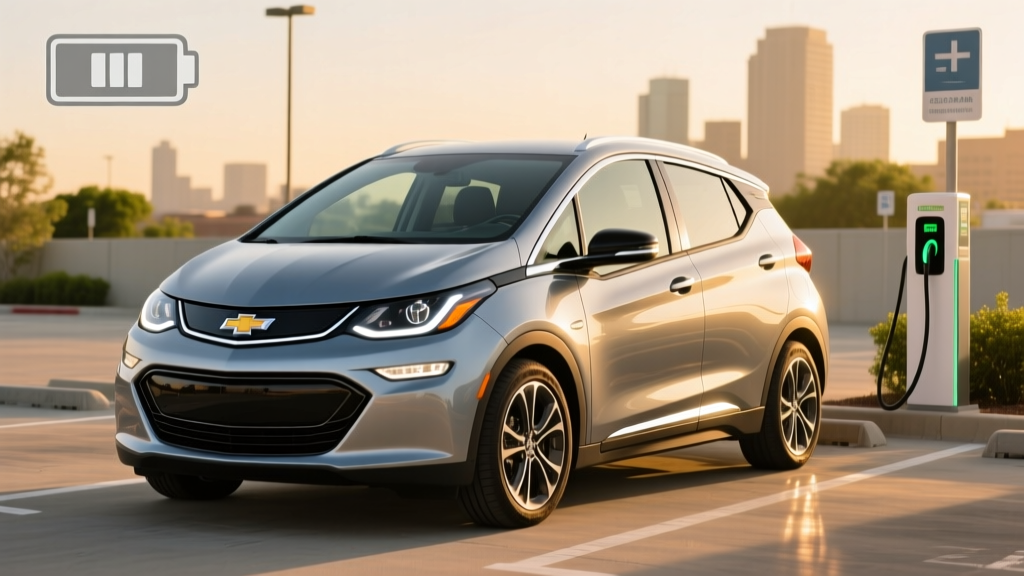
When the 2018 Chevrolet Bolt EV launched, it was one of the first affordable EVs to clear 200 miles of EPA range — a milestone that made mainstream electric commuting viable without a Tesla badge. In 2026, the Bolt EV is no longer in production (Chevrolet ended the original generation after 2023), but it remains one of the most compelling used EVs on the market. With typical resale values between $10,000 and $16,000, a proven 60 kWh NMC battery, and a roomy hatchback body, the 2018 Bolt EV is a strong candidate for budget-conscious buyers entering the electric space.
This review covers everything a used-EV shopper needs: real-world range expectations, charging realities, battery longevity data, ownership costs, and how it stacks up against competitors like the Nissan Leaf and Hyundai Kona Electric. Let's get into the numbers.
Core Specifications at a Glance
| Spec | 2018 Chevrolet Bolt EV |
|---|---|
| EPA Range | 238 miles |
| Battery Capacity (usable) | 57 kWh usable (60 kWh gross) |
| Battery Chemistry | NMC (Nickel Manganese Cobalt), LG Chem |
| Motor Output | 200 hp / 266 lb-ft torque |
| Drivetrain | Front-wheel drive (FWD) |
| 0–60 mph | 6.5 seconds |
| EPA Efficiency | 119 MPGe combined (28 kWh/100 mi) |
| Max DC Fast Charge | 55 kW (CCS1) |
| Level 2 Charge Rate | 7.2 kW onboard charger |
| Cargo Volume | 16.9 cu ft (rear seats up) / 56.6 cu ft (seats folded) |
| Rear Legroom | 36.5 inches |
| Battery Warranty (original) | 8 years / 100,000 miles (≥60% capacity retention) |
| Original MSRP | $36,620 (LT) / $43,520 (Premier) |
| Typical Used Price (2026) | $10,000–$16,000 |
Range: EPA Sticker vs. Real-World Reality
The Bolt EV's 238-mile EPA rating was genuinely impressive for its model year, and it still holds up well in 2026. The car achieves this through a combination of the 57 kWh usable battery and excellent efficiency — 28 kWh per 100 miles means it sips electrons rather than gulping them.
However, the EPA's fueleconomy.gov listing reflects laboratory testing. Real owners report that city driving with frequent regenerative braking can actually exceed the EPA number, sometimes touching 250+ miles in warm-weather urban commutes. Highway driving tells a different story: sustained 70–80 mph cruising pushes consumption closer to 32–34 kWh/100 mi, dropping practical range to roughly 180–200 miles.
Cold weather is the Bolt EV's Achilles' heel. Unlike many modern EVs, the 2018 model lacks a dedicated battery heat pump for cabin heating — it uses resistive heating, which draws heavily from the traction battery. In sub-freezing conditions, plan on a 20–35% range reduction. Preconditioning the cabin while still plugged in mitigates this, but the hit is unavoidable on longer cold-weather trips.
Charging Speeds: DC Fast, Level 2, and Level 1
Charging is where the 2018 Bolt EV shows its age most clearly. While it's perfectly adequate for daily home charging, its DC fast-charging capability falls well behind modern rivals.
| Charging Level | Power | Speed / Time | Connector |
|---|---|---|---|
| Level 1 (120V household) | ~1.2 kW | ~4 miles per hour | J1772 (included cordset) |
| Level 2 (240V home/public) | 7.2 kW | ~25 miles per hour; 0–100% in ~9 hours | J1772 |
| DC Fast Charge | 55 kW peak | 10–80% in ~50 minutes; adds ~90 mi in 30 min | CCS1 |
The 55 kW DC fast-charge cap is the Bolt EV's biggest limitation for road-trippers. At 55 kW peak — which it sustains reasonably well up to about 55% State of Charge (SoC) before tapering — a 10–80% session takes roughly 50 minutes. That's nearly double the time a modern Hyundai Ioniq 5 or Tesla Model 3 would need. The charge curve is relatively flat compared to newer EVs that spike to 200+ kW and taper aggressively, but the low ceiling means the Bolt EV simply can't ingest energy quickly.
For home charging, the 7.2 kW onboard charger is solid. A full overnight charge from empty takes about 9 hours on a Level 2 station, which is more than sufficient for daily top-ups. Most owners plug in each evening and start the next morning with a full battery. If your daily commute is under 60 miles, you'll rarely need to charge past 80%, which also helps preserve long-term battery health.
Connector note: The 2018 Bolt EV uses the CCS1 (Combo) connector for DC fast charging and J1772 for Level 1/2. With the industry shifting to NACS (Tesla's connector), CCS1 chargers remain widely available through networks like Electrify America, EVgo, and ChargePoint. If you need Tesla Supercharger access, a CCS-to-NACS adapter (approved by GM for use on legacy models) can open up that network — verify adapter compatibility with your specific VIN.
Performance, Efficiency, and Daily Drivability
The Bolt EV's single front-mounted motor produces 200 horsepower and 266 lb-ft of torque, delivered instantly as only an electric motor can. The 0–60 mph time of 6.5 seconds feels brisk in everyday driving, and the torque-rich acceleration makes highway merging and city stoplight starts genuinely satisfying. This is a quick hatchback, not a performance car — there's no dual-motor AWD option, and the FWD layout means torque steer is noticeable under hard acceleration on wet roads.
Efficiency is a highlight. At 119 MPGe combined (28 kWh/100 mi), the 2018 Bolt EV is one of the most efficient EVs of its era. For context, charging at the US average electricity rate of ~$0.16/kWh means fueling costs roughly $4.48 per 100 miles — compared to $12–$15 for a 30 MPG gas car at current fuel prices. Over a 12,000-mile year, that translates to roughly $540 in electricity versus $1,500+ in gasoline, saving $900+ annually in energy alone.
Regenerative braking is well-implemented with two modes: standard (coasting) and one-pedal driving via the "L" shifter position or the Regen on Demand paddle behind the steering wheel. The paddle is particularly useful — it lets you modulate regen intensity on the fly without committing to full one-pedal mode, a feature many owners prefer over the binary on/off approach in other EVs.
Battery Health, Degradation, and Warranty
The Bolt EV's 60 kWh (57 kWh usable) LG Chem NMC battery pack was engineered with a substantial buffer — the 3 kWh difference between gross and usable capacity protects against deep-discharge and overcharge degradation. This conservative buffer strategy has paid off: large-scale owner data shows most 2018 Bolt EVs retaining 90–95% of their original capacity after 60,000–80,000 miles, well above Chevrolet's warranty threshold.
Chevrolet's battery warranty guarantees at least 60% capacity retention for 8 years or 100,000 miles. For a 2018 model, that 8-year window closes in 2026 — meaning many of these vehicles are right at or just past the warranty expiration. When shopping used, check the battery's State of Health (SoH) via the vehicle's diagnostic menu or an OBD-II reader with EV-capable software like Torque Pro. A SoH reading above 90% on a 60,000–80,000-mile example is typical and healthy.
Important recall note: GM issued a recall for 2017–2019 Bolt EVs related to battery fire risk in certain cells manufactured at specific LG Chem plants. Affected vehicles received battery replacements or software remedies that limit charge to 90%. Before purchasing any used 2018 Bolt EV, verify with the VIN on NHTSA's recall lookup that all recall work has been completed. Vehicles that received full battery pack replacements under the recall effectively have a newer battery, which is a significant plus for used buyers.
Pricing, Tax Credits, and Total Cost of Ownership
The 2018 Bolt EV launched at $36,620 for the LT trim and $43,520 for the Premier. In 2026's used market, expect to pay between $10,000 and $16,000 depending on mileage, condition, and whether the battery recall remedy was applied.
With the used-EV credit, a $14,000 Bolt EV could effectively cost $10,000 after the $4,000 credit — extraordinary value for a 238-mile-range EV. Note that the new-vehicle §30D credit no longer applies since the Bolt EV is out of production, and the original §30D credit was fully phased out for GM vehicles back in 2019.
5-Year Ownership Cost Estimate (Used Buyer):
| Category | Estimated Cost |
|---|---|
| Purchase Price (after $4,000 credit) | ~$10,000–$12,000 |
| Electricity (12,000 mi/yr × 5 yrs @ $0.16/kWh) | ~$2,700 |
| Insurance (avg. $1,400/yr × 5) | ~$7,000 |
| Maintenance (tires, cabin filter, wipers, brake fluid) | ~$1,500 |
| Estimated Depreciation (5 yrs) | ~$3,000–$4,000 |
| Total 5-Year Cost | ~$24,200–$27,200 |
That total cost of ownership is remarkably competitive — lower than most used gas-powered compacts when you factor in fuel savings and minimal EV maintenance.
Interior, Tech, and Practical Space
The Bolt EV's cabin is practical rather than luxurious. The 8-inch touchscreen infotainment system supports Apple CarPlay and Android Auto (wired), which remains the most important tech feature for most buyers. The digital instrument cluster is clear and customizable, showing real-time energy flow, range, and efficiency data. Available features on the Premier trim include heated leather seats, a heated steering wheel, a Bose premium audio system, and a surround-view camera.
Driver assistance tech is basic by 2026 standards: the 2018 Bolt EV offers lane keep assist, forward collision alert, automatic emergency braking, and a following distance indicator. There is no adaptive cruise control on this model year, and no hands-free driving system — this is strictly a SAE Level 0–1 vehicle in terms of automation. You are the driver at all times.
Space is surprisingly generous for a compact hatchback. With 16.9 cubic feet behind the rear seats and 56.6 cubic feet with them folded, the Bolt EV swallows groceries, luggage, and moderate cargo with ease. Rear legroom of 36.5 inches is adequate for adults on shorter trips, though the rear seat cushion is somewhat low and flat. The tall roofline provides excellent headroom front and rear, and the elevated seating position gives a crossover-like view of the road despite the car's hatchback underpinnings.
Pros, Cons, and Who Should Buy
- 238-mile EPA range — still competitive in 2026
- Excellent efficiency (119 MPGe / 28 kWh/100 mi)
- Brisk 6.5-second 0–60 with instant torque
- Spacious hatchback with 56.6 cu ft cargo room
- Low used prices ($10K–$16K) + up to $4,000 used-EV credit
- Proven battery with strong long-term SoH data
- Regen on Demand paddle is a standout feature
- 55 kW DC fast charging — slow for road trips
- No battery heat pump — significant cold-weather range loss
- No adaptive cruise control or advanced ADAS
- Battery recall history — must verify remedy completion
- FWD only — no AWD option for snow-belt buyers
- Rear seat comfort is mediocre on long trips
- Original battery warranty expiring (8-yr window closes 2026)
Who this EV suits best: The 2018 Bolt EV is ideal for daily commuters, urban dwellers with home charging access, and budget-focused buyers who want maximum range per dollar. It excels as a primary car for commutes under 80 miles round-trip with overnight home charging. It is less suited for frequent long-distance road-trippers (the 55 kW charge rate adds too much downtime) or buyers in extreme cold climates who need every mile of range.
How It Compares: Bolt EV vs. Key Used-EV Rivals
| Spec | 2018 Chevy Bolt EV | 2018 Nissan Leaf (60 kWh) | 2019 Hyundai Kona Electric |
|---|---|---|---|
| EPA Range | 238 mi | 226 mi | 258 mi |
| Battery (usable) | 57 kWh (NMC) | 59 kWh (NMC) | 64 kWh (NMC) |
| DC Fast Charge | 55 kW | 50 kW (CHAdeMO) | 75 kW |
| 0–60 mph | 6.5 sec | 7.4 sec | 6.4 sec |
| Efficiency | 119 MPGe | 108 MPGe | 120 MPGe |
| Cargo (seats up) | 16.9 cu ft | 23.6 cu ft | 19.2 cu ft |
| Liquid Battery Cooling | Yes | No (passive air) | Yes |
| Typical Used Price (2026) | $10K–$16K | $9K–$14K | $13K–$18K |
The Bolt EV occupies a strong middle ground. It beats the Leaf on charging speed, battery thermal management, and performance. The Kona Electric offers more range and faster DC charging but typically costs more on the used market. The Leaf's lack of liquid battery cooling is a significant disadvantage for long-term battery health, making the Bolt EV the more reliable used-EV bet between those two.
Frequently Asked Questions
What is the real-world range of the 2018 Chevrolet Bolt EV?
In mixed driving at moderate temperatures, expect 200–225 miles. Highway-only driving at 75 mph drops this to roughly 180–200 miles. In freezing weather, plan for 150–180 miles. The 238-mile EPA figure is achievable in warm-weather city driving with regenerative braking.
How fast does the 2018 Bolt EV charge?
On DC fast charging, it peaks at 55 kW, taking approximately 50 minutes for a 10–80% session. On a 240V Level 2 home charger, it charges at 7.2 kW, adding about 25 miles of range per hour — a full charge takes roughly 9 hours. On a standard 120V outlet, expect about 4 miles per hour.
Does the 2018 Bolt EV qualify for any federal tax credit?
It does not qualify for the new-vehicle §30D credit (GM's credit was phased out in 2019, and the car is out of production). However, it may qualify for the IRS §25E used clean vehicle credit — up to $4,000 — if the sale price is ≤$25,000, buyer income is within limits ($75K single / $150K joint), and the vehicle is purchased from a licensed dealer. Consult a tax professional to confirm.
Is the 2018 Bolt EV worth buying in 2026?
Yes, for the right buyer. At $10,000–$16,000 with a possible $4,000 tax credit, it offers 238 miles of range, strong efficiency, and practical hatchback space for less than almost any other EV on the market. The main trade-offs are slow DC charging and cold-weather range loss. If your needs are primarily commuting and daily errands with home charging, the value proposition is excellent.
What should I check before buying a used 2018 Bolt EV?
Verify that the battery recall remedy has been completed (check the VIN on NHTSA.gov). Inspect the battery State of Health — 90%+ is normal and healthy for this age. Confirm the vehicle has liquid-cooled battery thermal management (all Bolt EVs do, but it's worth noting vs. competitors). Check maintenance records for tire rotations and cabin air filter replacements. Test the Regen on Demand paddle and one-pedal driving mode.
How long will the 2018 Bolt EV battery last?
Owner data and GM's engineering suggest the NMC pack should retain 80–90% of original capacity through 150,000+ miles under normal use. The original 8-year/100,000-mile battery warranty has expired or is expiring for 2018 models, so any future battery replacement would be an out-of-pocket cost. Full pack replacement, if ever needed, is estimated at $14,000–$16,000, though individual module repairs can cost significantly less. Most Bolt EV batteries are lasting well beyond the warranty period with minimal degradation.