If your search for a tesla suv 2017 brought you here, you're likely weighing a used Tesla Model X from that model year. The 2017 Model X was Tesla's first full production year after the 2015 launch kinks, and it remains one of the most distinctive electric SUVs on the used market — falcon-wing rear doors, a massive windshield, and access to the Supercharger network. But buying a nearly decade-old EV in 2026 requires a clear-eyed look at battery degradation, out-of-warranty repair exposure, and how its range and charging stack up against modern competition.
This review covers the 2017 Model X 75D, 90D, and 100D variants as they exist on the used market today, with real-world range expectations, charging realities, and total-ownership math. If you're cross-shopping, we also compare it against newer used alternatives like the 2020+ Model Y and Hyundai Ioniq 5.
Quick Verdict: Who Should Buy a 2017 Model X in 2026?
The 2017 Model X is best suited for buyers who need three rows of seating, want Supercharger access for road trips, and are comfortable with the repair-risk profile of an out-of-warranty luxury EV. It is not the right pick if you want modern efficiency, fast DC charging by 2026 standards, or low insurance premiums. Budget buyers should look at a used Model Y instead; the Model X is for those who specifically need its size and cargo volume.
2017 Tesla Model X Specs at a Glance
| Spec | 75D | 90D | 100D | P100D |
|---|---|---|---|---|
| Battery (gross / usable approx.) | 75 kWh / ~72.6 kWh | 90 kWh / ~83.5 kWh | 100 kWh / ~98 kWh | 100 kWh / ~98 kWh |
| Chemistry | NMC (nickel-manganese-cobalt) | NMC | NMC | NMC |
| EPA Range (new) | 237 mi | 257 mi | 295 mi | 289 mi |
| Drivetrain | Dual-motor AWD | Dual-motor AWD | Dual-motor AWD | Dual-motor AWD (Performance) |
| 0-60 mph | 6.0 sec | 4.8 sec | 4.7 sec | 2.9 sec (Ludicrous) |
| Horsepower (approx.) | 328 hp | 417 hp | 417 hp | 532 hp |
| Efficiency (EPA combined) | 92 MPGe / 36 kWh/100mi | 92 MPGe / 36 kWh/100mi | 97 MPGe / 35 kWh/100mi | 89 MPGe / 38 kWh/100mi |
| Max DC Fast Charge | ~120 kW (V2 Supercharger) | ~120 kW | ~120 kW | ~120 kW |
| Level 2 Home Charge Rate | 11.5 kW (48A) | 11.5 kW (48A) | 11.5 kW (48A) | 11.5 kW (48A) |
| Cargo (behind 3rd / 2nd / folded) | 25.7 / 56.4 / 88.1 cu ft | |||
| Battery Warranty (original) | 8 years / unlimited miles (retention-based) | |||
Battery Health: The Biggest Used-Model X Variable
The 2017 Model X uses NMC (nickel-manganese-cobalt) lithium-ion cells supplied by Panasonic. Unlike modern LFP (lithium iron phosphate) packs found in 2022+ standard-range Teslas, NMC offers higher energy density but is more sensitive to high-state-of-charge storage and extreme heat. Tesla's original battery warranty was 8 years with unlimited miles for the 75D/90D/100D, with a retention threshold of roughly 70% capacity. For most 2017 examples, that warranty has now expired as of 2025-2026.
According to data aggregated by Tesla owners and fueleconomy.gov, a 2017 Model X 100D with ~80,000 miles typically shows 8-13% degradation, leaving 85-90 kWh usable. Higher-mileage examples (120,000+ miles) or those frequently DC fast-charged in hot climates may show 15-20% loss. Before buying, request a battery health readout via the car's service menu or a third-party scan tool — State of Health (SoH) percentage is non-negotiable due diligence.
If the pack fails out of warranty, replacement cost from Tesla Service currently runs $18,000-$25,000 depending on pack size and labor. Third-party refurbishers offer rebuilt packs for $12,000-$16,000, but availability varies. This single risk factor should shape your purchase price negotiation.
Charging Speed: 2017 Hardware in a 2026 Network
The 2017 Model X charges via Tesla's proprietary connector (pre-NACS standardization) and is limited to the charge rates of its era:
| Charging Level | Power | Rate | Time / Notes |
|---|---|---|---|
| Level 1 (120V household) | ~1.4 kW | ~3-4 mi/hr | Emergency/trickle only |
| Level 2 (240V, 48A) | 11.5 kW | ~30-34 mi/hr | Full charge in ~8-9 hours (100D) |
| DC Fast (V2 Supercharger) | Peak ~120 kW | ~250-280 mi/hr (peak) | 10-80% in ~40-45 min |
| DC Fast (V3 Supercharger 250 kW) | Limited to ~120 kW by vehicle | Same as V2 | No speed benefit on 2017 hardware |
A critical point for 2026 buyers: the 2017 Model X cannot take advantage of Tesla's V3/V4 Superchargers at their full rate. Its battery management system and pack architecture cap DC charging at roughly 120 kW peak, and the charge curve tapers significantly above 60% SoC. Expect a 10-80% session to take 40-50 minutes — considerably longer than a modern Model Y (which does 10-80% in ~15-18 minutes at 250 kW).
Home Level 2 charging at 11.5 kW is still excellent by 2026 standards and will replenish the 100D from 20% to 100% overnight. You'll need a NEMA 14-50 outlet or a hardwired Wall Connector installed by a licensed electrician — budget $800-$2,000 for installation depending on your panel capacity and run distance.
For non-Tesla public charging, the 2017 Model X requires a J1772 adapter (included with the car) for Level 2, and a CCS adapter for non-Tesla DC fast chargers. Tesla began selling CCS adapters for older vehicles, but confirm compatibility with your specific VIN before relying on Electrify America or EVgo stations.
Performance and Driving Impressions
Even in 2026, the 2017 Model X feels quick. The dual-motor AWD system provides confident traction in rain and light snow, and the low center of gravity (battery pack under the floor) keeps body roll controlled for a three-row SUV. The P100D's 2.9-second 0-60 time remains supercar territory. The standard 100D at 4.7 seconds is more than adequate for highway merging and passing.
Ride quality is firm but compliant, though the air suspension on 2017 models is a known maintenance item — replacement front or rear air struts cost $1,500-$2,500 per corner if they leak. Steering is precise but numb, typical of Tesla's electric power steering calibration.
Regenerative braking is aggressive and enables one-pedal driving in most conditions. However, 2017 models lack the blended brake feel of newer EVs — the transition from regen to friction braking can feel abrupt.
Interior, Cargo, and Technology
The 2017 Model X offers three rows seating up to seven (2-3-2 configuration) or six with optional second-row captain's chairs. Interior materials are premium but not quite German-luxury grade — synthetic leather, open-pore wood, and aluminum trim. The 17-inch portrait touchscreen was class-leading in 2017 and still functions well, though the Intel Atom-based MCU1 computer in early 2017 builds is noticeably sluggish by 2026 standards. Tesla offered an MCU2 upgrade (Intel E3960) that significantly improves responsiveness — check whether the car you're evaluating has received it.
Cargo space: 25.7 cu ft behind the third row, 56.4 cu ft behind the second row, and 88.1 cu ft with both rear rows folded. The front trunk (frunk) adds 5.2 cu ft. These figures remain competitive with mid-size SUVs, though the Model Y (76.2 cu ft max) is more space-efficient relative to its footprint.
Notable tech: Autopilot (basic lane-keep and adaptive cruise) was standard; Enhanced Autopilot (auto lane-change, autosteer on highways) and Full Self-Driving capability were optional. Important: these are SAE Level 2 driver-assist systems, not autonomous driving. You must remain engaged, hands on or near the wheel, at all times. FSD on 2017 hardware runs Tesla's HW2.5 computer, which is less capable than HW3/HW4 found in newer vehicles — some newer FSD features may be limited or unavailable.
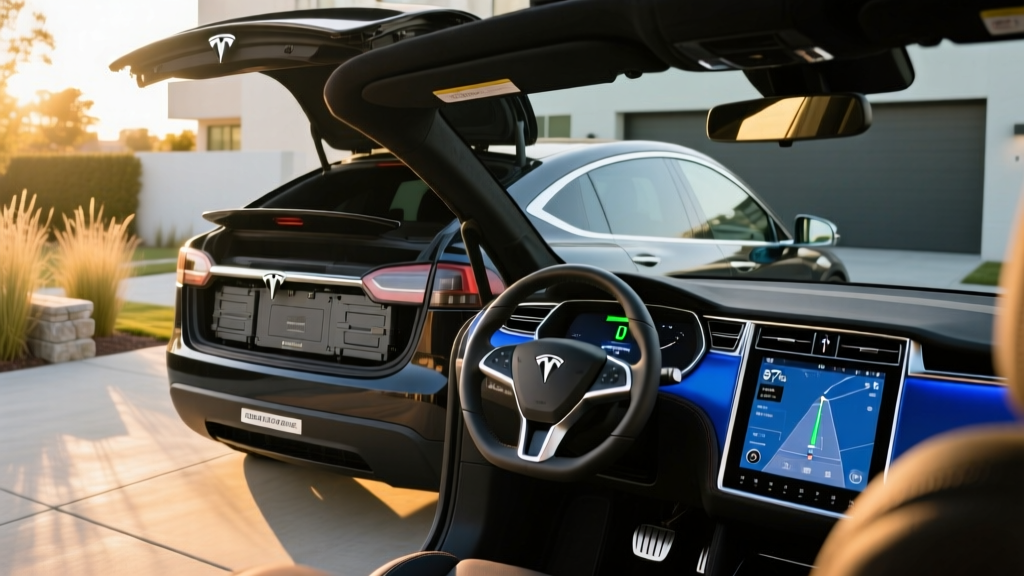
Falcon-wing doors are the Model X's signature feature. They open upward with dual hinges, allowing access in tight parking spots. However, they add weight, complexity, and potential water-ingress issues. Check door seals carefully and verify all proximity sensors function — the doors use ultrasonic sensors to avoid obstacles, and sensor failures are a known repair item.
Pricing, Tax Credits, and Ownership Costs
As of early 2026, used 2017 Tesla Model X prices vary widely by mileage, condition, and battery health:
| Trim | Mileage Range | Typical Asking Price |
|---|---|---|
| 75D | 60,000-90,000 | $22,000 - $28,000 |
| 90D | 60,000-90,000 | $25,000 - $32,000 |
| 100D | 50,000-80,000 | $30,000 - $38,000 |
| P100D | 40,000-70,000 | $35,000 - $45,000 |
Federal tax credit: Under current IRS §30D rules, the clean vehicle credit applies to new vehicles only (up to $7,500) or used vehicles under the separate §25E used clean vehicle credit (up to $4,000 or 30% of sale price, whichever is less). The 2017 Model X qualifies for the used EV credit (§25E) if:
- Sale price is $25,000 or less (this disqualifies most 100D and P100D examples)
- Buyer income is under $75,000 single / $150,000 married filing jointly / $112,500 head of household
- The vehicle is purchased from a licensed dealer (private-party sales do not qualify)
- The vehicle has not been previously claimed for the used credit after Aug 16, 2022 (verify with dealer)
Point-of-sale transfer is available for the used credit as of 2024, meaning the dealer can apply it at purchase. Consult a tax professional for your specific eligibility.
Insurance: The 2017 Model X carries higher-than-average insurance premiums due to repair costs (aluminum body, falcon-wing doors, air suspension). Expect $2,500-$4,000 annually depending on your profile and state — get quotes before purchasing.
Maintenance: EVs skip oil changes and have minimal brake wear (thanks to regen), but the Model X has known wear items: air suspension struts, falcon-wing door actuators, drive unit bearings, and the 12V auxiliary battery (replace every 3-4 years, ~$300-$500). Budget $1,500-$3,000 annually for out-of-warranty maintenance on a high-mileage example.
2017 Model X vs. Key Used Alternatives
| Attribute | 2017 Tesla Model X 100D | 2020 Tesla Model Y LR | 2022 Hyundai Ioniq 5 LR AWD |
|---|---|---|---|
| Used Price (typical) | $30,000-$38,000 | $28,000-$35,000 | $30,000-$36,000 |
| EPA Range (new) | 295 mi | 326 mi | 256 mi |
| Expected Range Today | ~240-265 mi | ~290-310 mi | ~240-250 mi |
| Rows / Seats | 3 rows / 6-7 | 2 rows / 5 | 2 rows / 5 |
| Max DC Charge | ~120 kW | ~250 kW | ~240 kW |
| 10-80% DC Time | ~40-45 min | ~15-18 min | ~18 min |
| Battery Warranty Remaining | Expired or near-expired | ~2 years remaining | ~6 years remaining |
| Supercharger Access | Yes (native) | Yes (native) | Yes (via NACS adapter, 2025+) |
- Three-row seating for 6-7 passengers
- 88.1 cu ft max cargo with frunk
- Tesla Supercharger network access
- Strong performance (4.7s 0-60 on 100D)
- Over-the-air software updates still supported
- Falcon-wing doors useful in tight spaces
- Battery warranty expired — $18K-$25K replacement risk
- Slow DC charging by 2026 standards (~120 kW peak)
- High insurance premiums ($2,500-$4,000/yr)
- Falcon-wing doors and air suspension are costly repair items
- MCU1 infotainment is slow without the MCU2 upgrade
- Efficiency lags modern EVs (35-38 kWh/100mi)
- No heat pump — cold-weather range loss is significant
Decision Framework: Is the 2017 Model X Right for You?
Choose the 2017 Model X if:
- You need three rows of seating and no current EV SUV fits your budget
- You can verify battery SoH above 85% via a pre-purchase inspection
- You have access to home Level 2 charging (essential for daily use)
- You accept the out-of-warranty repair risk and can budget $3,000-$5,000 for potential issues in year one
- You value Supercharger access for regular road trips
Look elsewhere if:
- You want fast DC charging for frequent long-distance travel (choose a 2021+ Model Y or Ioniq 5)
- You're on a tight budget and can't absorb a potential battery replacement
- You only need five seats — the Model Y offers better efficiency, faster charging, and lower running costs
- You live in a very cold climate — the lack of a heat pump means significant winter range loss
Frequently Asked Questions
What is the real-world range of a 2017 Tesla Model X today?
A 2017 Model X 100D with average mileage (60,000-80,000 miles) typically delivers 240-265 miles at full charge in mild conditions. Highway driving at 75+ mph reduces this to 210-230 miles. In freezing weather, expect 170-200 miles. The 75D delivers roughly 150-180 miles in mixed real-world use.
How fast does the 2017 Model X charge?
On DC fast chargers (including V3 Superchargers), the 2017 Model X is limited to approximately 120 kW peak, taking 40-50 minutes for a 10-80% charge. At home on a Level 2 charger (240V, 48A), it charges at 11.5 kW, adding roughly 30-34 miles per hour — a full overnight charge is standard.
Does a used 2017 Model X qualify for any federal tax credit?
It may qualify for the §25E used clean vehicle credit (up to $4,000) if the sale price is $25,000 or less, buyer income is under the IRS thresholds ($75K single / $150K married), and the purchase is through a licensed dealer. Most 100D and P100D examples exceed the $25,000 price cap. The §30D new-vehicle credit does not apply. Verify eligibility with your tax professional and reference IRS guidance on the used EV credit.
Is the 2017 Model X worth buying vs. a used Model Y?
Only if you need three rows of seating. The Model Y is more efficient, charges more than twice as fast on DC, has a more modern interior and infotainment system, and likely still has some battery warranty remaining. If five seats suffice, the Model Y is the stronger used buy in 2026.
What are the most expensive repairs on a 2017 Model X?
Battery pack replacement ($18,000-$25,000), air suspension struts ($1,500-$2,500 per corner), falcon-wing door actuators or hinges ($1,000-$2,000 per door), and drive unit replacement ($4,000-$7,000). A pre-purchase inspection by a Tesla-qualified technician is essential.
Can I use non-Tesla chargers with a 2017 Model X?
Yes, with adapters. A J1772 adapter (usually included) works for Level 2 public charging. For CCS DC fast chargers (Electrify America, EVgo), you'll need Tesla's CCS adapter, which Tesla has made available for older vehicles — confirm compatibility with your VIN. NACS-native chargers are simply Tesla Superchargers, which work natively.
Is Autopilot on a 2017 Model X safe to use?
Autopilot is an SAE Level 2 driver-assist system — it provides lane-centering and adaptive cruise control but requires continuous driver supervision. It is not self-driving. The 2017 Model X runs HW2.5, which has more limited sensor processing than current Tesla hardware. Use it as a fatigue-reduction aid on highways, not as a replacement for attentive driving.