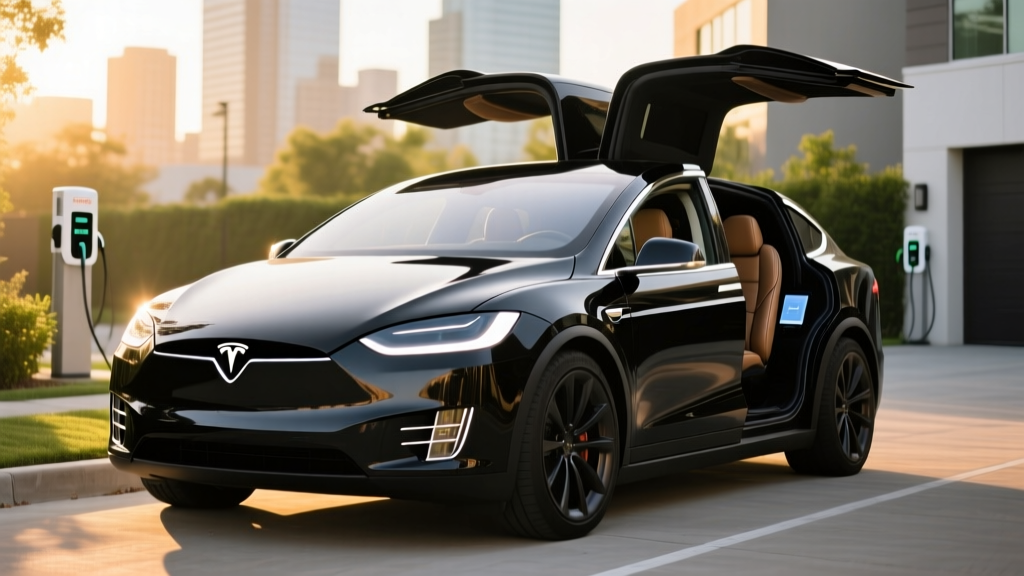
The 2017 Tesla Model X occupies a strange space in the used EV market. It is a falcon-wing-doored, three-row electric SUV that still turns heads, but it also carries a reputation for build-quality inconsistencies and expensive out-of-warranty repairs. For 2026 buyers shopping the used market, the 2017 Model X represents either a compelling value proposition or a potential money pit — and the difference often comes down to battery health, mileage, and which battery pack is under the floor.
This guide covers everything you need to evaluate a used 2017 Tesla Model X, from EPA range and real-world efficiency to DC fast-charging limitations, battery degradation data, and the total cost of ownership you should budget for in 2026.
2017 Tesla Model X: Quick Specs at a Glance
Three main battery configurations were available for the 2017 model year. Tesla's naming convention shifted mid-year, so you will see both the older (60D/75D/90D/P90D) and newer (75D/100D/P100D) badges. Here is what matters:
| Spec | 75D (75 kWh) | 100D (100 kWh) | P100D (100 kWh) |
|---|---|---|---|
| Battery (usable, approx.) | ~72.5 kWh (NMC) | ~98 kWh (NMC) | ~98 kWh (NMC) |
| EPA Range (new) | 237 miles | 295 miles | 289 miles |
| Drivetrain | Dual Motor AWD | Dual Motor AWD | Dual Motor AWD (Performance) |
| Horsepower | ~518 hp | ~518 hp | ~762 hp (Ludicrous) |
| 0–60 mph | 6.0 sec | 4.7 sec | 2.9 sec (Ludicrous Mode) |
| Efficiency (EPA combined) | 92 MPGe (36 kWh/100mi) | 92 MPGe (36 kWh/100mi) | 89 MPGe (38 kWh/100mi) |
| Max DC Fast Charge | ~120 kW (Supercharger V2) | ~120 kW (Supercharger V2) | ~120 kW (Supercharger V2) |
| Level 2 Home Charging | ~48 amps / 11.5 kW | ~48 amps / 11.5 kW | ~48 amps / 11.5 kW |
| Cargo (behind 3rd row) | 21.8 cu ft | 21.8 cu ft | 21.8 cu ft |
| Cargo (3rd row folded) | 56.4 cu ft | 56.4 cu ft | 56.4 cu ft |
| Cargo (max, all rows folded) | 81.7 cu ft | 81.7 cu ft | 81.7 cu ft |
| Seating | 5, 6, or 7 passengers | 5, 6, or 7 passengers | 5, 6, or 7 passengers |
| Battery Warranty (original) | 8 yr / 150,000 mi | 8 yr / unlimited mi | 8 yr / unlimited mi |
| Original MSRP (base, approx.) | ~$79,500 | ~$96,000 | ~$135,000 |
Sources: EPA / fueleconomy.gov, Tesla 2017 press materials.
Real-World Range: What to Expect in 2026
EPA rated range (new): 237 mi (75D) / 295 mi (100D) / 289 mi (P100D)
Expected real-world range in 2026: ~170–210 mi (75D) / ~220–265 mi (100D) / ~215–260 mi (P100D)
Highway-only (70–75 mph): Subtract 10–15% from above figures
Cold weather (below 32°F): Subtract 20–30% from above figures
The 2017 Model X uses NMC (nickel manganese cobalt) battery chemistry across all trims. NMC offers high energy density — critical for a heavy, aerodynamically challenged SUV — but it degrades faster than LFP (lithium iron phosphate) chemistry found in some newer Tesla vehicles.
After 8–9 years and typical mileage of 70,000–120,000 miles, expect battery degradation of roughly 10–18% depending on charging habits, climate exposure, and whether the previous owner routinely charged to 100%. A 100D that started at 295 EPA miles may now deliver 240–265 miles in mixed driving when new; in 2026, a realistic expectation is 220–250 miles in moderate temperatures with a healthy pack.
The Model X's boxy shape, large frontal area, and heavy curb weight (~5,100–5,400 lbs) make it particularly range-sensitive at highway speeds. At 75 mph on a flat interstate, efficiency drops to roughly 38–42 kWh/100mi for the 100D, compared to the EPA-rated 36 kWh/100mi combined. In cold weather, the resistive cabin heater (the 2017 model year did not have a heat pump — Tesla introduced those to the Model X in the 2021 refresh) compounds range loss significantly.
Pre-purchase tip: Ask the seller for a screenshot of the car's battery health or use a third-party tool like TeslaFi or Tessie to pull State of Health (SoH) data. A pack retaining below 80% of original capacity may qualify for warranty replacement if still within the 8-year/150,000-mile (75D) or 8-year/unlimited-mile (100D/P100D) window — but note that the 8-year clock started at the original in-service date, meaning most 2017 Model X vehicles will have exited battery warranty coverage by mid-to-late 2025.
Charging Speed: DC Fast Charging and Home Level 2
The 2017 Model X charges via Tesla's proprietary NACS connector (North American Charging Standard). This is an advantage in 2026, as Tesla's Supercharger network remains the most reliable public DC fast-charging infrastructure in the US. However, the 2017 Model X's charging architecture is limited to older Supercharger V2 hardware speeds.
| Charging Level | Power (kW) | Speed / Notes |
|---|---|---|
| Level 1 (120V household) | ~1.4 kW | ~3–4 miles per hour — impractical for daily use |
| Level 2 (240V home, 48A) | ~11.5 kW | ~30–34 miles per hour; full charge in ~8–10 hours |
| Level 2 (240V public, lower amperage) | ~7.2–9.6 kW | ~20–28 miles per hour |
| DC Fast (Supercharger V2) | Peak ~120 kW | 10–80% in ~40–50 minutes; tapers significantly above 60% |
| DC Fast (Supercharger V3/V4) | Capped at ~120 kW | V3/V4 stalls can deliver 250–350 kW, but the 2017 Model X hardware cannot accept more than ~120 kW |
| CHAdeMO (with adapter) | ~50 kW | Slow; legacy adapter required, mostly obsolete |
Charging curve reality: The 120 kW peak is only sustained between roughly 10–30% State of Charge. By 50% SoC, charge rate drops to ~80 kW; above 80%, it falls below 30 kW. A realistic 10–80% session on a V2 Supercharger takes 40–50 minutes. On a road trip, plan for 25–30 minute stops every 150–180 miles to stay in the fast-charging sweet spot.
For home charging, a Level 2 wall connector wired to a 60-amp circuit (48 amps continuous) will replenish roughly 30–34 miles of range per hour. That means a near-empty 100D battery can fully recharge overnight in about 8–10 hours. Most owners who charge nightly at home rarely need public charging except on road trips.
Performance, Ride Quality, and Daily Driving
Even the base 75D delivers 518 horsepower and a 6.0-second 0–60 mph time — numbers that embarrass most gas-powered SUVs from the same era. The P100D with Ludicrous Mode is genuinely supercar-quick at 2.9 seconds, though engaging it frequently accelerates battery degradation.
All 2017 Model X variants use dual-motor all-wheel drive with independent front and rear motors. The air suspension provides adjustable ride height — useful for clearing steep driveways or rough roads — and the regenerative braking system enables near-one-pedal driving in most conditions.
Driving dynamics caveats: The 2017 Model X is heavy, and you feel it in corners. Body roll is noticeable, and the steering lacks the precision of the Model S or Model 3. Ride quality on the standard 20-inch wheels is acceptable, but the optional 22-inch wheels transmit too much road harshness. Road noise at highway speeds is a common complaint, particularly from the large windshield and the falcon-wing door seals.
The panoramic windshield (one of the largest in any production vehicle) creates an airy cabin but contributes to solar heat gain in summer. Tesla included a manual sunshade, but it is fiddly to install.
Interior, Tech, and the Falcon Wing Doors
The 2017 Model X interior centers on a 17-inch portrait touchscreen that controls nearly every vehicle function — climate, media, navigation, vehicle settings, and even the glovebox. The instrument cluster is a smaller 12.3-inch digital display behind the steering wheel. There are virtually no physical buttons.
Infotainment and software: The 2017 Model X runs Tesla's software stack and continues to receive over-the-air updates, though some newer features (like the updated UI introduced with the 2021 refresh) are not available on the older hardware. Navigation, Supercharger routing, and the Tesla mobile app (remote climate control, charging status, vehicle location) all remain fully functional.
Driver assistance: Vehicles equipped with Enhanced Autopilot or Full Self-Driving Capability have hardware that was considered advanced in 2017 but is now classified as SAE Level 2 — meaning the driver must remain fully engaged with hands on the wheel and eyes on the road at all times. The 2017 Model X uses Hardware 2.5 (some late-build examples may have HW3). Tesla's FSD (Supervised) software is available on HW3-equipped vehicles, but it is not autonomous driving and requires constant supervision.
All Tesla Autopilot and FSD (Supervised) features are SAE Level 2 driver-assistance systems. The driver must remain alert, keep hands on the steering wheel, and be prepared to take over instantly. These systems do not make the vehicle self-driving. Only Level 4 services like Waymo operate without a driver.
The falcon-wing doors: They are the Model X's defining feature — and its most polarizing. The double-hinged rear doors open upward and outward, requiring less lateral clearance than conventional doors (Tesla claims just 12 inches on each side). They make loading child seats dramatically easier and provide dramatic curb appeal. However, they are mechanically complex, use ultrasonic sensors to avoid overhead obstacles, and have been a source of reliability complaints (seal leaks, sensor errors, actuator failures). Repair costs for falcon-wing mechanisms are substantial out of warranty.
Pricing, Tax Credits, and Total Cost of Ownership
As of early 2026, used 2017 Tesla Model X pricing varies widely based on mileage, battery health, trim, and condition:
| Trim | Mileage Range | Typical Used Price | Federal Tax Credit Eligibility |
|---|---|---|---|
| 75D | 80,000–120,000 mi | $22,000–$30,000 | Potentially eligible for $4,000 used-EV credit (§25E) |
| 100D | 60,000–100,000 mi | $28,000–$38,000 | Potentially eligible for $4,000 used-EV credit (§25E) |
| P100D | 50,000–90,000 mi | $35,000–$48,000 | Potentially eligible for $4,000 used-EV credit (§25E) |
Federal tax credit for used EVs (IRS §25E): The 2017 Model X is no longer eligible for the new-vehicle §30D credit. However, it may qualify for the used clean vehicle credit under §25E, which provides up to $4,000 (or 30% of the sale price, whichever is less) for qualified used EVs. Key requirements per IRS guidelines:
- Sale price must be $25,000 or less
- Buyer income caps: $75,000 single / $112,500 head of household / $150,000 joint
- Vehicle must be at least 2 model years old (2017 qualifies)
- Must be purchased from a licensed dealer (private-party sales do not qualify)
- Vehicle must have a battery capacity of at least 7 kWh (all Model X trims qualify)
- Credit can only be claimed once per VIN every 3 years
In practice, this means only 75D examples priced at or below $25,000 from a dealer are likely to qualify. Most 100D and P100D examples exceed the $25,000 sale price cap. Always verify eligibility with a tax professional before relying on the credit.
Estimated 5-Year Ownership Costs
| Category | Estimated Cost | Notes |
|---|---|---|
| Purchase price (avg.) | $33,000 | 100D, ~80k miles, private party |
| Electricity (home charging) | $3,500–$5,000 | At $0.14/kWh avg.; varies by region |
| Insurance | $12,000–$18,000 | Tesla insurance premiums are above average |
| Maintenance (tires, cabin filter, fluid) | $2,500–$4,000 | No oil changes; tires wear fast on heavy EVs |
| Out-of-warranty repairs (risk reserve) | $3,000–$8,000 | Drive unit, air suspension, falcon-wing actuators |
| Depreciation | $8,000–$12,000 | Estimated resale in 2031: $21,000–$25,000 |
| Total 5-year (estimated) | $62,000–$80,000 | Highly dependent on repair luck |
Compared to a used gas SUV like the 2017 BMW X5 or Audi Q7, the Model X saves significantly on fuel but carries higher insurance costs and a meaningful risk of expensive out-of-warranty repairs. The air suspension, drive units, MCU (media control unit), and falcon-wing door mechanisms are all known failure points that can each cost $2,000–$6,000+ to repair.
Pros and Cons: The Honest Assessment
- Class-leading Supercharger network access (NACS native)
- Genuine three-row seating with usable third row
- Strong performance even in base 75D trim
- Falcon-wing doors ease child-seat loading
- Large frunk + rear cargo area (81.7 cu ft max)
- Continued OTA software updates
- Low fuel cost vs. gas SUVs of similar size
- No battery warranty remaining on most examples
- DC fast charging capped at ~120 kW (slow vs. modern EVs)
- No heat pump — cold-weather range loss is severe
- Falcon-wing doors are expensive to repair
- Build quality inconsistencies (panel gaps, wind noise, interior rattles)
- Above-average insurance premiums
- Outdated Hardware 2.5 Autopilot on most examples
- High out-of-warranty repair risk (air suspension, drive units, MCU)
2017 Model X vs. Key Used Competitors
If you are cross-shopping a used three-row electric or plug-in SUV in the $25,000–$45,000 range, here is how the 2017 Model X stacks up:
| Attribute | 2017 Tesla Model X 100D | 2018 Jaguar I-PACE | 2019 Audi e-tron |
|---|---|---|---|
| EPA Range | 295 mi | 234 mi | 204 mi |
| 3rd-Row Seating | Yes (optional) | No | No |
| Max DC Charge | ~120 kW | ~100 kW | ~150 kW |
| Charging Standard | NACS (native Tesla) | CCS1 | CCS1 |
| Cargo (max) | 81.7 cu ft | 51.0 cu ft | 57.0 cu ft |
| 0–60 mph | 4.7 sec | 4.5 sec | 5.5 sec |
| Used Price Range | $28k–$38k | $22k–$30k | $25k–$35k |
The Model X is the only used EV in this price range offering optional third-row seating and access to the Supercharger network without an adapter. The I-PACE and e-tron offer better build quality and more refined interiors, but neither offers the range, cargo space, or charging infrastructure advantage of the Tesla.
Who Should Buy a 2017 Tesla Model X in 2026?
Buy it if:
- You need three rows of seating and want an EV
- You frequently road-trip and value Supercharger network access
- You find a 100D with under 80,000 miles and documented battery health above 85% SoH
- You can budget $5,000–$8,000 for potential out-of-warranty repairs over 3–5 years
- You want strong performance and cargo space in an electric SUV
- You live in a very cold climate and need reliable winter range (no heat pump)
- You cannot tolerate the risk of expensive falcon-wing or air suspension repairs
- You prioritize fast DC charging for frequent long-distance travel (120 kW is slow by 2026 standards)
- You want the latest driver-assist hardware (HW 2.5 is outdated)
- You need a vehicle with low insurance costs
Frequently Asked Questions
What is the real-world range of a 2017 Tesla Model X in 2026?
Expect roughly 170–210 miles for the 75D and 220–265 miles for the 100D in mixed driving at moderate temperatures. Highway driving at 75 mph reduces these figures by 10–15%, and cold weather below freezing can cut range by 20–30%. Battery degradation of 10–18% from new is typical at this age.
How fast does the 2017 Model X charge?
On a Tesla Supercharger V2, it peaks at approximately 120 kW, with a 10–80% session taking 40–50 minutes due to charge-curve tapering. On newer V3/V4 Superchargers, the 2017 Model X is hardware-limited to the same ~120 kW. At home on a 48-amp Level 2 charger, expect roughly 30–34 miles of range per hour, or a full overnight charge in 8–10 hours.
Does a 2017 Tesla Model X qualify for any federal tax credit?
It is not eligible for the new-vehicle §30D credit. However, if purchased from a licensed dealer for $25,000 or less, it may qualify for the used clean vehicle credit (IRS §25E) of up to $4,000, subject to buyer income caps ($75k single / $150k joint). Most 100D and P100D examples exceed the price cap. Consult a tax professional and review IRS §25E guidelines before purchasing.
Is the 2017 Model X battery warranty still valid?
Almost certainly not. The 8-year battery warranty on a 2017 model expired in 2025 at the latest. The 75D had a 150,000-mile limit; the 100D and P100D had unlimited miles but the 8-year time limit still applies. Unless the battery was replaced under warranty by Tesla (resetting the clock on the replacement pack), you are on your own for battery repairs. A full pack replacement from Tesla costs approximately $15,000–$22,000.
How does the 2017 Model X compare to newer used Tesla models?
A used 2021+ Model X (refreshed) offers a heat pump, Hardware 3/4 Autopilot, 250 kW charging, a horizontal touchscreen, and significantly improved build quality — but starts around $50,000–$65,000. A used Model Y (2020–2022) offers similar range, faster charging, and lower repair risk in the $28,000–$38,000 range, but has no third row and less cargo space.
What are the most common problems with the 2017 Model X?
Known issues include: falcon-wing door actuator and sensor failures, air suspension compressor and strut leaks, MCU (touchscreen) delamination or failure, drive unit whine or bearing wear, 12V battery drain, windshield cracking (large glass area), and water ingress around door seals. Budget for repairs and consider an extended third-party warranty if available.
Is it worth buying a 2017 Tesla Model X vs. competitors?
If you need three-row EV seating and road-trip charging infrastructure, the 2017 Model X has no direct rival at this price point. If you only need two rows, the Audi e-tron or Jaguar I-PACE offer better build quality and refinement. For budget-conscious buyers, a newer used Model Y provides a more reliable ownership experience with only modest space sacrifices.